
Mastering System Architecture with PlantUML and VPasCode
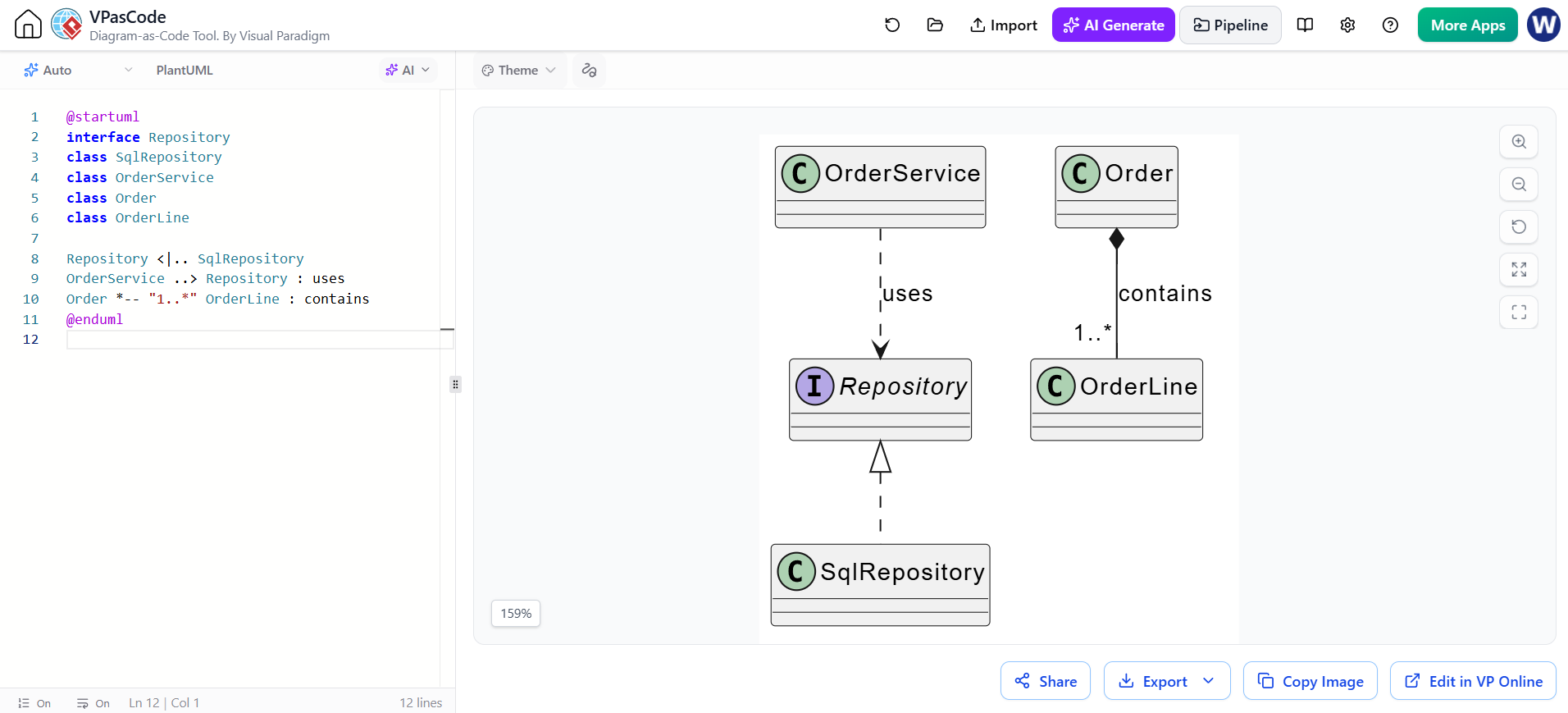
In the realm of software engineering, the gap between abstract design and concrete implementation is often bridged by modeling tools. Visual Paradigm’s VPasCode tool exemplifies this bridge, allowing developers to define complex system architectures using simple, text-based code. This tutorial explores how to leverage PlantUML within VPasCode to model class relationships, lifecycles, and dependencies effectively.
Understanding the Power of Diagram-as-Code
Traditional diagramming tools often rely on mouse clicks and drag-and-drop operations, which can be tedious and difficult to version control. VPasCode flips this paradigm by adopting a “Diagram-as-Code” approach. By writing text descriptions, you can generate precise UML diagrams instantly. This method is particularly powerful for defining relationships between system components.
The core of this approach lies in the syntax. The context provided by the tooling engine interprets specific symbols to denote how entities interact. For instance, in the example below, we define a simple order management system involving services, repositories, and data entities.
The PlantUML Syntax for Relationships
The arrow shape and the direction of the line are critical in conveying the type of relationship. The direction is typically chosen by the order of the names in the code, but labels are essential to clarify the semantic meaning.
- Inheritance / Generalization: Represented by
Parent <|-- Child. This indicates that the child class inherits from the parent interface or class. - Interface Realization: Represented by
Interface <.. Class. This shows that a class implements a specific interface. - Composition: Represented by
Whole -- Part. This is a strong form of association where the part’s lifecycle is owned by the whole. - Aggregation: Represented by
Whole o-- Part. This indicates a “has-a” relationship where parts can exist independently of the whole. - Dependency: Represented by
A ..> B. This signifies that A uses or depends on B, but does not necessarily own it.
Deconstructing the Example Architecture
Let’s break down the specific code snippet provided in the VPasCode interface to understand the architectural decisions being made.
@startuml
interface Repository
class SqlRepository
class OrderService
class Order
class OrderLine

Repository <|.. SqlRepository
OrderService ..> Repository : uses
Order *-- "1..*" OrderLine : contains
@enduml
1. Defining the Repository Layer
The code begins by defining an interface Repository and a class SqlRepository. The relationship Repository <|.. SqlRepository establishes that SqlRepository is a concrete implementation of the Repository interface. This promotes loose coupling, allowing the rest of the system to interact with the generic interface rather than the specific SQL implementation.
2. Service Dependencies
The line OrderService ..> Repository : uses demonstrates a dependency relationship. The OrderService relies on the Repository interface to perform data operations. The label "uses" explicitly states the nature of this dependency, ensuring clarity for future maintainers.
3. Object Composition and Cardinality
Perhaps the most critical modeling decision is found in the line: Order -- "1.." OrderLine : contains. Here, we use a solid diamond () to denote Composition. This implies that an Order object owns its OrderLine objects. If the Order is destroyed, the OrderLine instances typically cease to exist as well. The notation "1..*" defines the cardinality, indicating that one Order must contain at least one, and potentially many, OrderLines.
Choosing the Right Relationship: Composition vs. Aggregation
One of the most common pitfalls in system modeling is confusing Composition with Aggregation. While both look like associations, they carry different semantic weights regarding the lifecycle of the objects.
As noted in the tool's context, Composition is used when the part is meaningfully owned by the whole. The whole is responsible for the creation and destruction of the part. Conversely, Aggregation (o--) is used when the whole groups or refers to parts that can exist independently. For example, a Department aggregates Employees; if the Department is dissolved, the Employees still exist.
Therefore, if neither ownership interpretation fits your specific scenario, it is best to use a plain association line to avoid misrepresenting the system's logic.
Conclusion
Using VPasCode and PlantUML allows for a rigorous and maintainable approach to system architecture. By strictly adhering to relationship notations and understanding the lifecycle implications of composition versus aggregation, developers can create diagrams that are not just visual aids, but accurate blueprints for the codebase.