
Mastering Abstract Classes and Static Members in PlantUML with VPasCode
In the realm of software engineering, modeling the structure of an application is just as critical as writing the code itself. Visual Paradigm’s VPasCode tool allows developers to leverage the power of PlantUML to define class diagrams directly through text. This approach ensures that your documentation remains version-controlled, readable, and synchronized with your actual source code.
In this tutorial, we will dissect a classic object-oriented design pattern: the implementation of an Abstract Class containing both Abstract Methods and Static Members. We will explore how to represent the PaymentMethod hierarchy using VPasCode syntax and understand the underlying design principles.
Understanding the Design Pattern: The Payment Strategy
Before diving into the syntax, it is essential to understand the object-oriented concepts being modeled. The diagram illustrates a scenario where multiple types of payments (like Credit Cards, PayPal, etc.) can be used, but they all share a common interface.
The Role of Abstract Classes
An Abstract Class acts as a blueprint for other classes. It cannot be instantiated on its own. Instead, it defines a contract that its subclasses must fulfill. In our example, PaymentMethod is the abstract base class. It declares a method named authorize, but it does not provide the implementation logic for it. It says, “Any payment method will have an authorization process, but I don’t care how it happens.”
Static Members in Modeling
Notice the attribute supportedCurrencies. This is a Static Member. Unlike instance variables, which belong to a specific object, static members belong to the class itself. In the context of payment processing, the list of supported currencies (e.g., USD, EUR, GBP) is a property of the payment system as a whole, not a property of a single transaction instance.
Translating Concepts to VPasCode Syntax
VPasCode uses standard PlantUML syntax to render these concepts. The specific challenge here is telling the tool that a member is static or abstract. In standard UML, these are often denoted by underlining or specific fonts, but in code, we use explicit tags.
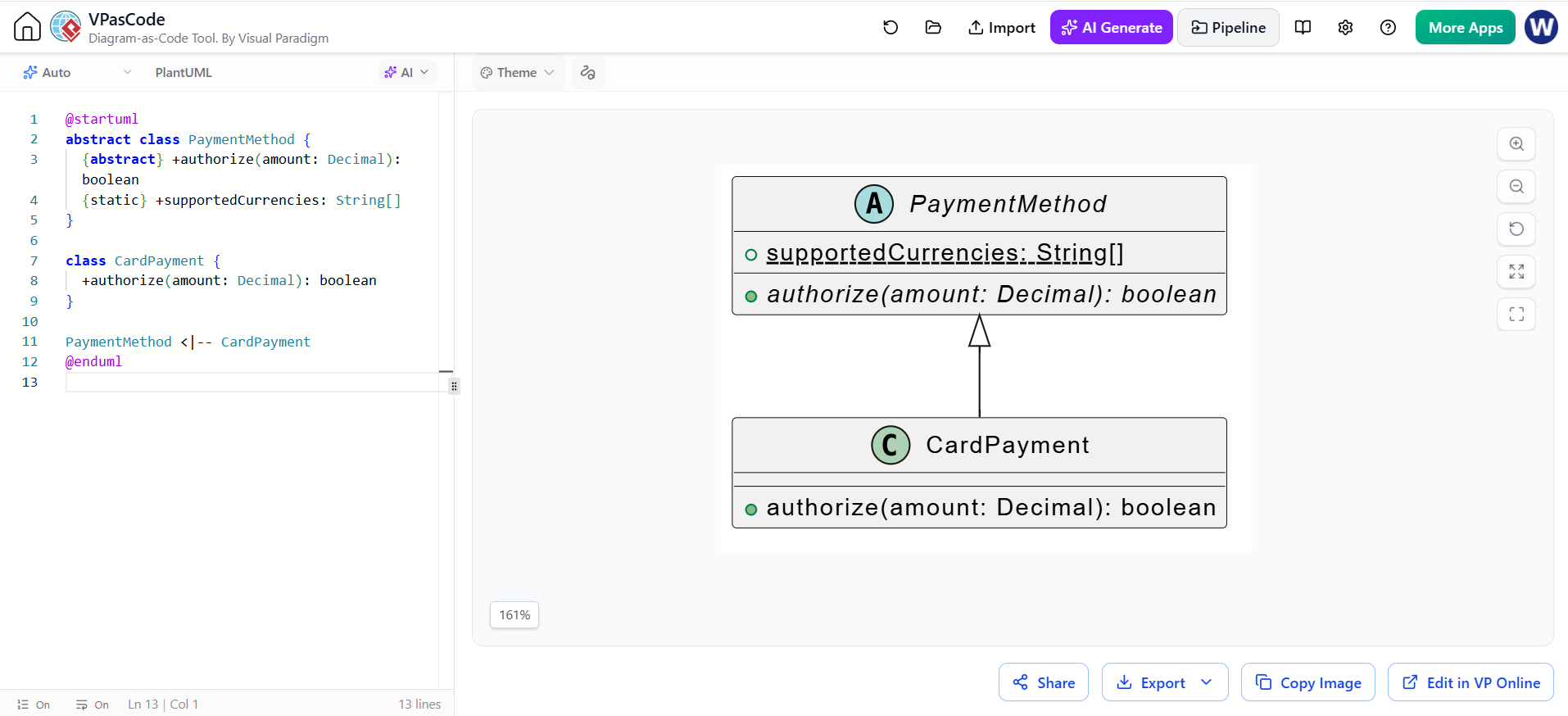
Here is the raw code snippet used to generate the diagram shown in the screenshot:
@startuml
abstract class PaymentMethod {
  {abstract} +authorize(amount: Decimal): boolean
  {static} +supportedCurrencies: String[]
}

class CardPayment {
  +authorize(amount: Decimal): boolean
}

PaymentMethod <|-- CardPayment
@enduml
Breaking Down the Syntax
Let's analyze the specific components that make this model work:
abstract class PaymentMethod: This keyword explicitly tells the diagram generator that this is an abstract class. In the visual output, this is often represented by an italicized class name or a specific icon (in VPasCode, the "A" icon).{abstract} +authorize...: To mark a method as abstract, we wrap the member declaration in curly braces with the keywordabstract. This ensures the method is drawn without a body in the class box, indicating it must be overridden.{static} +supportedCurrencies...: Similarly, to define a static attribute, we use the{static}tag. This is crucial for distinguishing between instance data and class-level data.PaymentMethod <|-- CardPayment: This line defines the inheritance relationship. The arrow points from the subclass (CardPayment) to the superclass (PaymentMethod), indicating thatCardPaymentextendsPaymentMethod.
Visualizing the Hierarchy
When VPasCode renders this code, it produces a clean Class Diagram. The top box, labeled PaymentMethod, contains the abstract signature. The bottom box, CardPayment, represents a concrete implementation.
In a real-world scenario, you would add more classes like PayPalPayment or CryptoPayment, all inheriting from PaymentMethod. This polymorphic design allows your system to handle different payment types uniformly by treating them all as PaymentMethod objects.
Why Use Diagrams-as-Code?
Using VPasCode to write this diagram offers significant advantages over drag-and-drop tools:
- Version Control Friendly: Text files (like PlantUML scripts) can be tracked in Git. You can see exactly which line changed when a new currency was added to
supportedCurrencies. - Consistency: It is easy to make global changes. If you decide to rename the
authorizemethod toprocessPayment, you only need to change it in the text file, and the diagram updates automatically. - Speed: For complex hierarchies, typing code is often faster than connecting lines with a mouse.
By mastering these syntax rules, you can effectively communicate complex system architectures to your team using the powerful VPasCode tool.