


Welcome to the team! As a new member of a small organization, you quickly realize that resources are precious, and every decision carries weight. In this environment, strategic clarity is not a luxury; it is a necessity. One of the most effective tools for gaining that clarity is the SWOT Analysis. This guide will walk you through exactly what it is, why your small team needs it, and how to execute it without the corporate jargon.
We are going to break down the process into manageable steps, ensuring you feel confident in leading or contributing to a strategic session. Whether you are mapping out a new product launch or reviewing annual performance, this method provides a structured way to look at your situation objectively.
🧩 What is SWOT Analysis?
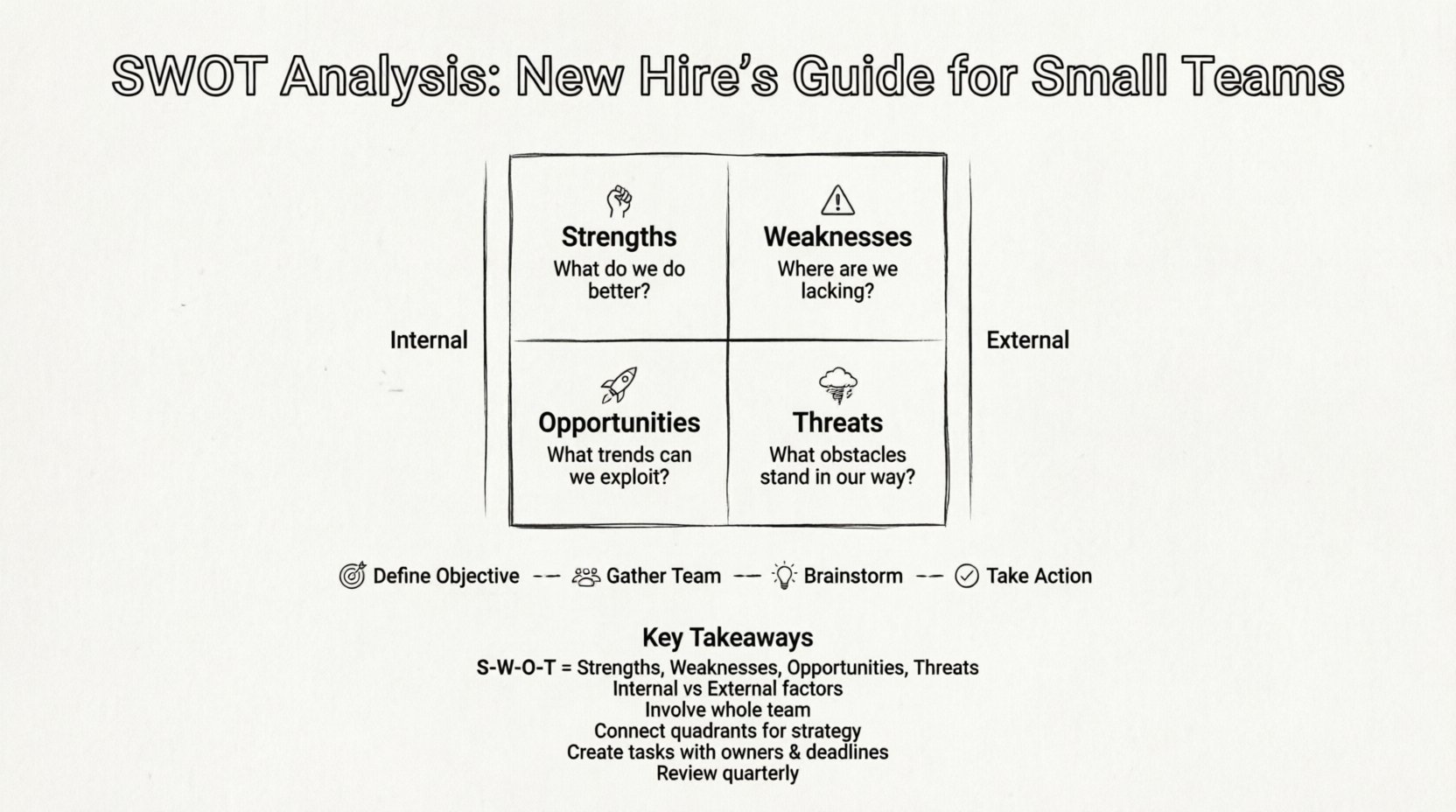
SWOT stands for Strengths, Weaknesses, Opportunities, and Threats. It is a strategic planning technique used to evaluate these four elements of a project or business enterprise. Unlike complex financial models that require extensive data, SWOT is designed for agility. It allows small teams to pivot quickly based on a clear understanding of their current standing.
The framework divides factors into two categories:
- Internal Factors: Things within your control (Strengths and Weaknesses).
- External Factors: Things outside your control that affect you (Opportunities and Threats).
By separating these factors, you prevent confusion between what you can fix and what you must adapt to. This distinction is vital for resource allocation.
🏗️ Why Small Teams Need This Tool
Large corporations often have dedicated strategy departments. Small teams often wear multiple hats. You might be handling sales, operations, and marketing simultaneously. This flexibility is a superpower, but it can lead to blind spots. A SWOT analysis forces a pause and a focused look at the landscape.
Here are specific reasons why this matters for your context:
- Resource Optimization: Small teams cannot waste effort. Identifying strengths helps you leverage what you already do well, reducing the need to build from scratch.
- Risk Mitigation: Identifying threats early allows you to create contingency plans before a crisis hits.
- Team Alignment: When everyone contributes, they feel ownership over the strategy. It unifies the team behind a common vision.
- Simple Implementation: It does not require expensive software or consultants. A whiteboard and sticky notes are often all you need.
🔍 The Four Quadrants Explained
To understand the framework, we must look closely at each component. You can visualize this as a 2×2 matrix, but the logic is what matters most.
| Category | Focus | Key Question |
|---|---|---|
| Strengths | Internal | What do we do better than anyone else? |
| Weaknesses | Internal | Where are we lacking or inefficient? |
| Opportunities | External | What market trends can we exploit? |
| Threats | External | What obstacles stand in our way? |
💪 Strengths (Internal)
Strengths are the assets you possess. These are positive attributes that give you an advantage. In a small team, these are often your people or your culture.
- Skilled Personnel: Do you have a developer who is an expert in a specific framework? That is a strength.
- Agility: Can you make decisions faster than competitors? Speed is a tangible asset.
- Customer Relationships: Do you have long-term clients who trust you? Loyalty is valuable.
- Cost Structure: Are your overhead costs lower than the industry average?
⚠️ Weaknesses (Internal)
Weaknesses are internal limitations. They do not mean failure; they mean areas for improvement. Acknowledging them is a sign of maturity, not weakness.
- Resource Gaps: Are you understaffed in specific departments like marketing or support?
- Technology: Are you using outdated tools that slow down production?
- Brand Awareness: Is your name unknown in the market compared to competitors?
- Processes: Do you have documentation gaps that cause confusion during onboarding?
🚀 Opportunities (External)
Opportunities are favorable conditions in the environment. They are not things you own, but chances you can seize.
- Market Trends: Is there a rising demand for sustainable products? If so, that is an opening.
- Regulatory Changes: Do new laws favor your business model over competitors?
- Competitor Moves: Did a rival drop a feature you can improve upon?
- Technology: Are there new tools available that can automate your manual work?
🌪️ Threats (External)
Threats are external challenges that could cause trouble for your business. You cannot stop them, but you can prepare.
- Economic Downturns: Will a recession reduce your clients’ budgets?
- New Competitors: Is a well-funded startup entering your niche?
- Supply Chain Issues: Are you dependent on a single vendor for critical components?
- Talent Shortage: Is it becoming harder to hire skilled workers in your region?
📋 Preparing for Your Session
Conducting a SWOT analysis is not a spontaneous activity. It requires preparation to ensure the data is accurate and the team is focused. Skipping this step often leads to vague answers like “we are good” or “the market is bad.”
1. Define the Objective
What are you analyzing? A SWOT for the entire company looks different than a SWOT for a specific marketing campaign. Be specific.
- Company Level: Strategic direction for the next year.
- Project Level: Feasibility of a new product launch.
- Department Level: Improving efficiency in the customer support team.
2. Gather the Right People
For a small team, you might include everyone. For larger organizations, select representatives from key areas. You need diverse perspectives to identify blind spots.
- Leadership: To provide strategic context.
- Frontline Staff: To provide ground-level reality.
- Cross-Functional Members: Someone from sales, someone from product, etc.
3. Collect Data
Before the meeting, gather any relevant information. This prevents the meeting from being just a guessing game.
- Customer Feedback: Reviews, surveys, and support tickets.
- Sales Data: What is selling and what is not?
- Competitor Intel: What are others doing?
- Internal Metrics: Productivity rates, churn rates, etc.
🛠️ Running the Workshop
Now that you are prepared, it is time to gather the team. The goal is to generate ideas without judgment initially, then analyze them.
Step 1: Set the Stage
Choose a quiet space where interruptions are minimized. If remote, ensure the video conference is stable. Set a timer to keep the session on track.
Step 2: Brainstorming
Go through each quadrant one by one. Ask the group to contribute ideas. Use sticky notes or a digital board to capture thoughts. Encourage participation from quiet members.
- Start with Strengths: It is easier to talk about wins than losses.
- Move to Weaknesses: Be honest but constructive. Focus on the process, not the person.
- Look Outward: Shift focus to the market for Opportunities and Threats.
Step 3: Voting and Prioritization
You will likely generate a long list of items. You cannot fix everything at once. Have each team member vote for the top three items in each category.
- Dot Voting: Give everyone three stickers or digital votes.
- Impact vs. Effort: Discuss which items offer the highest return for the least work.
🔗 Turning Insights into Action
A SWOT analysis is useless if it sits in a notebook. The real value comes from connecting the dots between the quadrants. This is where strategy is born.
Connecting the Quadrants
Look for relationships between the internal and external factors.
- S-O Strategies: How can you use your Strengths to take advantage of Opportunities? (e.g., Use your fast support team to capture customers who are frustrated with slow competitors.)
- W-O Strategies: How can you overcome Weaknesses by using Opportunities? (e.g., Use a new software trend to fix your outdated tech stack.)
- S-T Strategies: How can you use Strengths to minimize Threats? (e.g., Use your loyal customer base to weather an economic downturn.)
- W-T Strategies: How can you minimize Weaknesses to avoid Threats? (e.g., Diversify suppliers to avoid supply chain risks caused by your reliance on one vendor.)
Creating Action Plans
For every high-priority item identified, create a specific task. Vague goals lead to vague results.
- Assign Ownership: Who is responsible for this task?
- Set Deadlines: When must this be completed?
- Define Success: How do we measure if it worked?
- Allocate Resources: What budget or time is needed?
🚧 Common Pitfalls to Avoid
Even with the best intentions, teams can make mistakes during this process. Being aware of these common errors will save you time and frustration.
- Being Too Vague: “Good customer service” is not a strength. “24-hour response time with 95% satisfaction” is. Be specific.
- Confusing Internal and External: A new competitor is external. Their pricing strategy is external. Your ability to match their pricing is internal.
- Ignoring the Team: If leadership does the analysis alone, the team will not feel buy-in. Involve them.
- One-Time Event: Treat this as a living document. Market conditions change. Revisit the analysis quarterly.
- Focus Only on Negatives: Do not dwell on Weaknesses. They are just areas to improve. Balance them with Strengths.
❓ Frequently Asked Questions
How often should we do a SWOT analysis?
For small teams, an annual review is standard. However, if you are launching a new product or entering a new market, do it immediately before the project starts.
Can we do this remotely?
Absolutely. Many digital whiteboarding tools are designed for this. The key is ensuring everyone can see and edit the board simultaneously.
What if the team disagrees?
Disagreement is healthy. It means you are looking at the problem from different angles. Use data to settle debates. If data is unavailable, schedule a follow-up to gather it.
Does this work for non-profits?
Yes. The framework applies to any organization. For non-profits, Strengths might include community trust, while Threats might include funding cuts.
How do we measure success after the analysis?
Track the KPIs (Key Performance Indicators) you defined in your Action Plans. If you set a goal to reduce churn by 5%, track that number monthly.
📈 Final Thoughts
Strategic planning does not have to be intimidating. By using a SWOT analysis, small teams can gain a clear map of their situation. It transforms uncertainty into a list of actionable items. You have the data, you have the team, and now you have the framework.
Start small. Pick one project. Gather your team. Draw the four boxes. The clarity you gain will be worth the effort. As you implement these strategies, you will find your team becomes more resilient and focused. This is how sustainable growth happens in small organizations.
Remember, the goal is not perfection. The goal is progress. Keep the process simple, keep the team involved, and keep the focus on action. Good luck with your planning session.
📚 Key Takeaways
- SWOT stands for Strengths, Weaknesses, Opportunities, and Threats.
- Separate Internal factors (S, W) from External factors (O, T).
- Involve the whole team to get diverse perspectives.
- Connect the quadrants to create real strategies.
- Turn insights into specific tasks with owners and deadlines.
- Review and update the analysis regularly.
Related posts:
 Inside the CEO’s Brain: A Step-by-Step Guide to Conducting a Powerful SWOT Analysis
 From Idea to Pitch: How to Use a SWOT Analysis to Validate Your Startup Quickly
 The 5-Point Checklist to Ensure Your SWOT Analysis Actually Drives Strategy
 Stop Guessing Your Next Move: A Deep Dive into Mastering SWOT for MBA Case Studies