


Uncertainty is not a phase; it is a permanent condition of the modern business landscape. Market volatility, shifting consumer behaviors, and economic fluctuations require leaders to navigate with precision. In this environment, intuition alone is insufficient. You need a structured framework to assess your position clearly. The SWOT analysis remains one of the most robust tools for this purpose, yet its application during turbulent times requires a nuanced approach.
This guide details how to utilize the SWOT framework to make critical strategic decisions. Whether you are considering a radical pivot or doubling down on your current trajectory, this playbook provides the clarity needed to move forward with confidence. We will explore the mechanics of the analysis, the interpretation of data, and the specific signals that indicate a change in direction is necessary.
Understanding the SWOT Framework 🔍
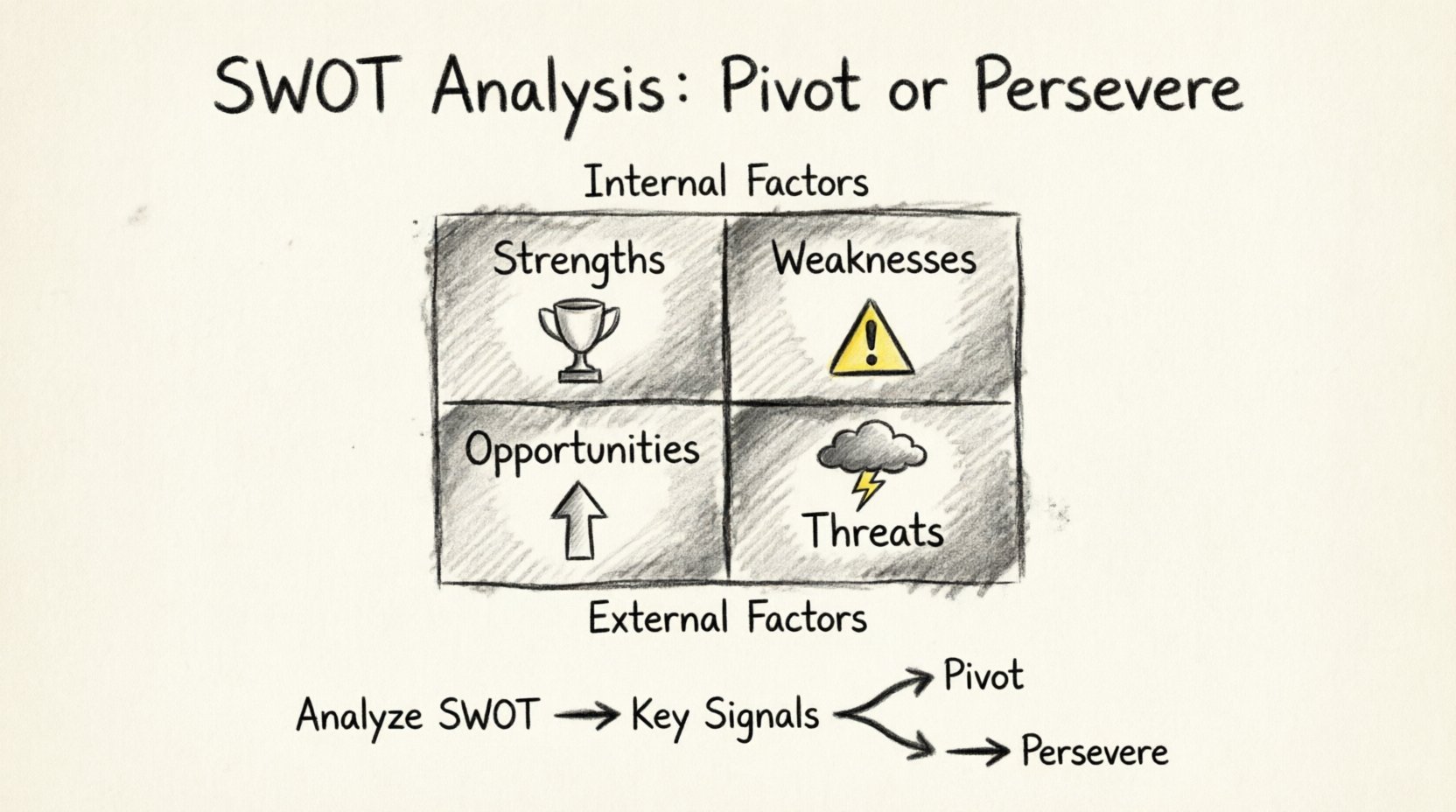
SWOT stands for Strengths, Weaknesses, Opportunities, and Threats. It is a strategic planning technique used to evaluate these four elements of a project or business enterprise. While often used for new ventures, its power lies in its ability to diagnose the current health of an organization facing external pressure.
- Strengths: Internal attributes that give you an advantage. These are resources, capabilities, or assets you control.
- Weaknesses: Internal attributes that place you at a disadvantage. These are areas where you lack resources or capabilities.
- Opportunities: External chances to improve performance. These are trends, market gaps, or changes you can leverage.
- Threats: External elements that could cause trouble. These are competitors, regulations, or economic shifts outside your control.
The distinction between internal and external factors is crucial. Strengths and Weaknesses are internal. Opportunities and Threats are external. Confusing these two categories leads to flawed strategy. For instance, a competitor launching a new product is a Threat (external), not a Weakness (internal), although it may expose a Weakness in your own product offering.
Why This Matters Now 🌪️
During stable times, businesses often operate on inertia. The SWOT analysis is typically a static snapshot. However, during uncertain times, the variables change rapidly. A strategy that worked six months ago may be obsolete today. A rigorous SWOT assessment helps you:
- Identify core rigidities that prevent adaptation.
- Spot early warning signs of market shifts.
- Validate whether your current resources align with new market demands.
- Create a fact-based basis for high-stakes decisions.
Without this structure, decision-making becomes reactive. You might chase trends that do not fit your model or ignore threats until it is too late. This analysis forces you to confront reality, separating emotional attachment from strategic necessity.
Conducting the Analysis: A Step-by-Step Guide 📝
Executing a SWOT analysis for strategic decision-making requires more than a brainstorming session. It demands data, honest feedback, and a structured process. Follow these steps to ensure accuracy.
Step 1: Assemble the Right Team 👥
Do not conduct this analysis in a vacuum. Include members from different departments. A sales leader sees different Opportunities than a product manager. A finance officer identifies different Weaknesses than an operations lead. Diversity in perspective prevents blind spots. Ensure participants feel safe to speak candidly without fear of retribution.
Step 2: Gather Quantitative and Qualitative Data 📈
Opinions are useful, but data is decisive. Before filling out the quadrants, collect evidence.
- Financial Reports: Look at cash flow, profit margins, and burn rates.
- Customer Feedback: Analyze support tickets, reviews, and churn data.
- Market Research: Review industry reports, competitor pricing, and macroeconomic trends.
- Internal Metrics: Look at employee retention, production efficiency, and technology uptime.
Step 3: Define the Scope Clearly 🎯
A SWOT analysis can become too broad. If you try to analyze the entire company, the results may be too vague to act upon. Narrow the scope. Focus on a specific product line, a specific market segment, or a specific operational challenge. This granularity yields actionable insights.
Step 4: Populate the Quadrants Honestly 🧠
Fill out each section based on the data gathered. Be ruthless. Do not list generic strengths like “good team.” List specific capabilities like “rapid deployment of software updates.” Do not hide Weaknesses. Admitting a flaw is the first step to fixing it.
| Quadrant | Key Question | Example (Tech Startup) |
|---|---|---|
| Strengths | What do we do better than anyone else? | Proprietary algorithm reduces latency by 40%. |
| Weaknesses | Where do we lose to competitors? | Customer support response time exceeds industry average. |
| Opportunities | What market trends can we exploit? | Competitors are raising prices due to supply costs. |
| Threats | What could stop us from succeeding? | New data privacy regulations increase compliance costs. |
Step 5: Cross-Reference and Prioritize 📋
Once the quadrants are filled, look for connections. How do your Strengths help you seize Opportunities? How do your Weaknesses expose you to Threats? This cross-referencing is where strategy is born. Prioritize the items that have the highest impact on your survival and growth.
Interpreting the Data: Pivot or Persevere? ⚖️
The ultimate goal of this exercise is decision-making. You must determine whether to Pivot (change direction significantly) or Persevere (continue the current strategy with adjustments). The SWOT results provide the signals for this choice.
Signals to Pivot 🔄
A pivot is a fundamental change in business model or product offering. It is high risk but necessary when the current path is blocked.
- Weaknesses outweigh Strengths: If your internal capabilities cannot support your current goals, you must change the goal or the vehicle.
- Threats are Existential: If external factors (regulations, technology shifts) make your current offering obsolete, staying the course is fatal.
- Opportunities are Elsewhere: If the market is moving to a segment where you have no Strengths, you may need to acquire or build them, or move entirely.
- Customer Churn is High: If data shows customers are leaving due to fundamental product flaws, the product itself may need to change.
Signals to Persevere 🏃
Perseverance does not mean ignoring problems. It means doubling down on what works while fixing specific bottlenecks.
- Strengths Align with Opportunities: If your unique value proposition matches a growing market demand, you should invest more heavily.
- Threats are Manageable: If external risks can be mitigated through operational changes, do not change the strategy.
- Weaknesses are Isolated: If the core engine is running well, but one department is lagging, fix that department rather than the whole business.
- Market Volatility is Temporary: If the uncertainty is cyclical rather than structural, maintain your position to capture the rebound.
Common Assessment Errors 🚫
Even with a solid framework, entrepreneurs often make mistakes that render the analysis useless. Avoid these pitfalls to ensure your strategy is sound.
- Confusing Internal and External: Listing “competitor pricing” as a Strength is an error. It is an external factor. Strengths must be internal.
- Being Vague: “Good marketing” is not a Strength. “High conversion rate from organic search” is. Specificity allows for measurement.
- Ignoring the Negative: It is tempting to focus only on Strengths and Opportunities. Weaknesses and Threats often hold the keys to survival.
- One-Time Exercise: A SWOT analysis is not a one-time document. It must be reviewed quarterly or whenever a major market shift occurs.
- Groupthink: If the whole team agrees too quickly, you may be missing dissenting viewpoints that highlight real risks.
Case Study: Retail Sector Adaptation 🏪
Consider a mid-sized retail chain facing a downturn. They conducted a SWOT analysis to decide on their future.
- Strength: Strong physical locations in high-traffic areas.
- Weakness: Outdated inventory management system.
- Opportunity: Growing demand for local, sustainable goods.
- Threat: Large e-commerce giants lowering prices.
Analysis revealed that their physical locations were becoming liabilities due to overhead costs (Weakness vs. Opportunity mismatch). However, the brand loyalty associated with those locations was a Strength. The decision was to Pivot the physical stores into experience hubs while moving inventory to a centralized warehouse.
This pivot was not a total abandonment of the physical model. It was a strategic shift based on the data. They leveraged the Strength (location) to mitigate the Threat (online competition) while fixing the Weakness (inventory).
Maintaining Strategic Agility 🔄
Once you have made your decision to Pivot or Persevere, the work continues. Uncertainty is dynamic. Your strategic plan must evolve with it.
- Set Checkpoints: Establish specific dates to re-evaluate the SWOT. If key assumptions change, the analysis becomes invalid.
- Monitor Leading Indicators: Don’t just look at lagging financial data. Watch for changes in customer inquiries, website traffic, and supplier stability.
- Empower Teams: Ensure those closest to the problem are empowered to report changes in the environment. Frontline employees often see Threats before executives do.
- Document the Decision: Write down the rationale for the Pivot or Persevere decision. This prevents future leaders from undoing the strategy based on memory or bias.
Integrating SWOT into Financial Planning 💰
Strategic analysis must be connected to financial reality. A decision to Pivot requires capital. A decision to Persevere requires cash flow management.
- Resource Allocation: Direct funds to areas that strengthen your identified Strengths. Cut funding to areas that highlight Weaknesses without a clear path to improvement.
- Risk Mitigation: If Threats are high, increase your cash reserve. Do not leverage debt to expand when the market is volatile.
- Scenario Planning: Use the SWOT to create financial scenarios. What if the Threat becomes a reality? What if the Opportunity is slower than expected?
Financial planning is the engine; SWOT is the navigation system. You need both to reach your destination safely. Without financial backing, a strategic pivot cannot be executed. Without strategic clarity, financial resources are wasted.
The Psychology of Assessment 🧠
Conducting this analysis requires emotional intelligence. Leaders often struggle with honesty. Admitting a Weakness feels like failure. Acknowledging a Threat feels like defeat. You must reframe this process.
- Reframe Weaknesses: View them as areas for investment, not character flaws.
- Reframe Threats: View them as risks to be managed, not inevitabilities to be feared.
- Reframe Failure: If a Pivot fails, it is data, not a disaster. It informs the next cycle of analysis.
Creating a culture of psychological safety allows the team to contribute to the SWOT without fear. This leads to more accurate data and better decisions. The goal is truth, not comfort.
Final Thoughts on Strategic Clarity 🧭
Uncertain times test the resilience of every organization. The difference between survival and failure often lies in the quality of the decision-making process. The SWOT analysis provides a structured way to cut through the noise. It forces you to look at your internal capabilities against external realities.
Whether you choose to Pivot or Persevere, the decision must be rooted in evidence. Use the insights gained to allocate resources wisely, manage risk, and align your team. This framework is not just a document; it is a mindset of continuous assessment and adaptation. By maintaining this discipline, you position your business to not only withstand uncertainty but to thrive within it.
Related posts:
 Inside the CEO’s Brain: A Step-by-Step Guide to Conducting a Powerful SWOT Analysis
 From Idea to Pitch: How to Use a SWOT Analysis to Validate Your Startup Quickly
 The 5-Point Checklist to Ensure Your SWOT Analysis Actually Drives Strategy
 Stop Guessing Your Next Move: A Deep Dive into Mastering SWOT for MBA Case Studies