


In the modern business landscape, static strategic planning is no longer sufficient. Markets shift, technologies evolve, and consumer behaviors transform at a pace that demands agility. A SWOT analysis—identifying Strengths, Weaknesses, Opportunities, and Threats—has long been a cornerstone of strategic planning. However, traditional applications often look backward, analyzing current capabilities rather than anticipating future shifts. To maintain relevance and competitiveness, organizations must evolve this framework to account for emerging trends. This guide provides a detailed approach to future-proofing your business by integrating dynamic external factors into your strategic assessment.
Why Traditional SWOT Analysis Falls Short 🛑
Many organizations treat SWOT as a one-time exercise. They complete the matrix, file the document, and move on to execution. This static approach assumes that the internal and external environments remain constant for the duration of the planning cycle. In reality, this assumption is rarely valid.
- Time Sensitivity: By the time a traditional analysis is published, market conditions may have changed.
- Lack of Context: Standard SWOT often ignores macro-level shifts such as regulatory changes or technological breakthroughs.
- Reactive vs. Proactive: Without trend integration, businesses react to threats after they emerge rather than preparing for them.
To build resilience, the analysis must become a living document. It requires continuous monitoring and the inclusion of variables that define the future trajectory of the industry.
Identifying Key Emerging Trends 🔍
Before modifying the framework, you must understand what trends warrant inclusion. These factors generally fall into four categories: technological, economic, social, and regulatory. Ignoring these can lead to significant blind spots.
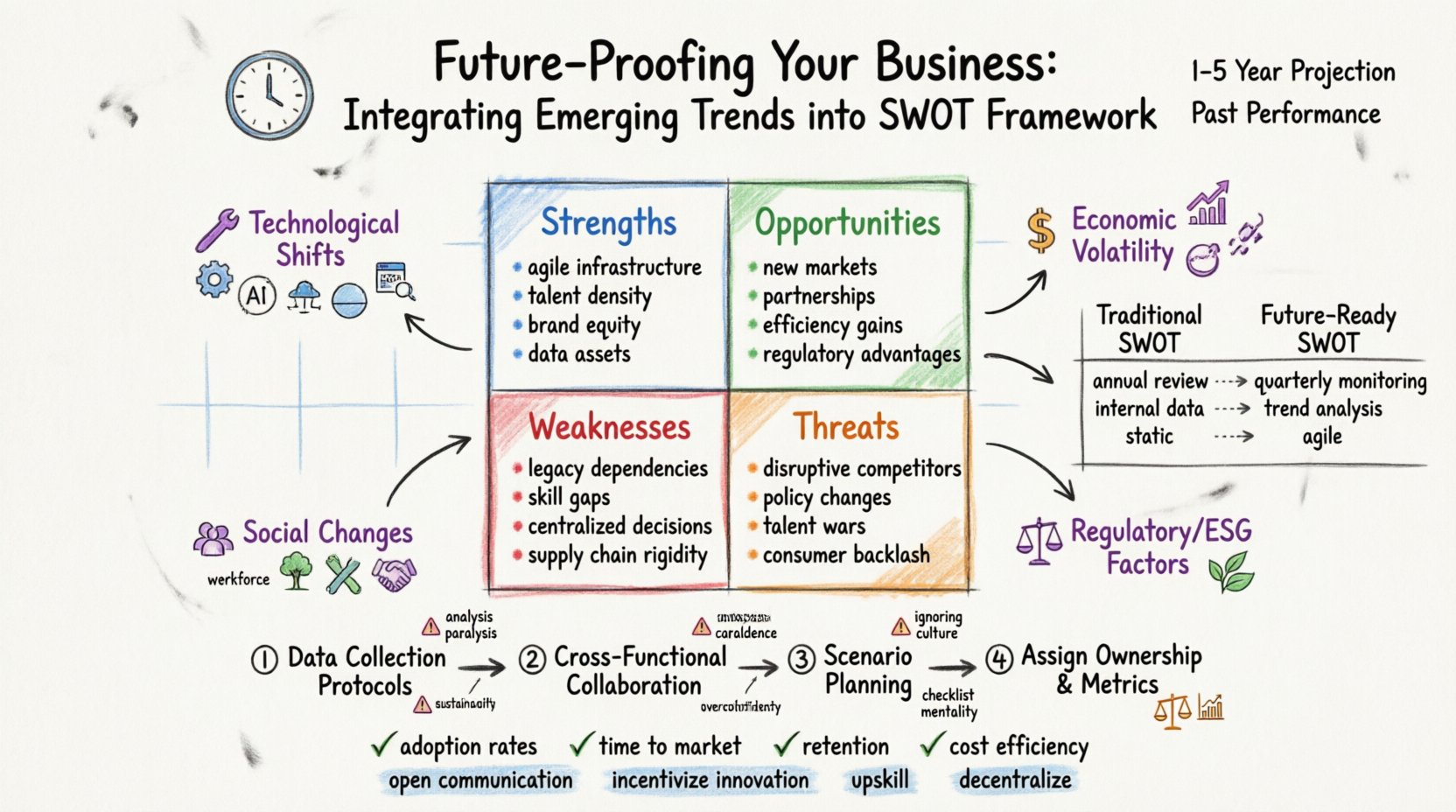
1. Technological Shifts
Automation, artificial intelligence, and data analytics are not just tools; they are structural forces. Consider how digital transformation impacts your operational efficiency. Does your infrastructure support remote collaboration? Are legacy systems slowing down innovation?
2. Economic Volatility
Inflation rates, supply chain disruptions, and currency fluctuations affect purchasing power and production costs. A robust analysis must account for economic fragility and potential market contractions.
3. Social and Cultural Changes
Consumer expectations around sustainability, diversity, and ethical sourcing are rising. Workforce demographics are shifting, bringing new perspectives and expectations regarding flexibility and purpose.
4. Regulatory and Environmental Factors
Compliance requirements are tightening globally. Environmental, Social, and Governance (ESG) criteria are becoming standard for investors and partners. Non-compliance poses a direct threat to operational continuity.
Integrating Trends into the SWOT Matrix 🔄
Integrating these trends requires a shift in how you categorize information. Instead of asking “What are our strengths?”, ask “How do our strengths position us against future challenges?”.
Strengths: Leveraging Core Competencies for the Future
Traditional strengths focus on current assets. Future-ready strengths evaluate adaptability. Look for:
- Agile Infrastructure: Systems that can be updated or scaled quickly without major downtime.
- Talent Density: Employees skilled in emerging technologies or adaptable to new workflows.
- Brand Equity: Reputation that allows for premium pricing or resilience during market downturns.
- Data Assets: Ownership of proprietary data that can inform predictive models.
Weaknesses: Identifying Structural Vulnerabilities
Weaknesses are often internal limitations. In a future-proof context, these are areas that hinder adaptation. Consider:
- Legacy Dependencies: Reliance on outdated hardware or software that limits integration.
- Skill Gaps: Absence of expertise in areas like cybersecurity or data science.
- Centralized Decision-Making: Hierarchies that slow response times to market changes.
- Supply Chain Rigidity: Inability to pivot suppliers or logistics routes during disruptions.
Opportunities: Capitalizing on External Shifts
Opportunities are external conditions you can exploit. Emerging trends create new avenues for growth. Look for:
- New Market Segments: Demographics created by societal shifts that require new product offerings.
- Partnership Potential: Collaborations with tech providers or complementary businesses.
- Efficiency Gains: Automation that reduces costs and frees up capital for investment.
- Regulatory Advantages: First-mover status in compliance with new environmental standards.
Threats: Anticipating External Disruptions
Threats are external risks. Future-proofing means identifying risks before they materialize. Key threats include:
- Disruptive Competitors: Startups using new technology to bypass traditional barriers.
- Policy Changes: New laws that increase compliance costs or restrict operations.
- Talent Wars: Competition for skilled workers in high-demand fields.
- Consumer Backlash: Public opinion shifts that damage brand reputation quickly.
Comparing Traditional vs. Dynamic SWOT Frameworks 📊
Understanding the difference between a static and dynamic approach is crucial for implementation. The table below outlines the distinctions.
| Feature | Traditional SWOT | Future-Ready SWOT |
|---|---|---|
| Time Horizon | Current state / Past performance | 1-5 Year Projection |
| Data Sources | Internal reports / Financials | Market research / Trend analysis / External data |
| Review Frequency | Annual or ad-hoc | Quarterly or real-time monitoring |
| Focus | Competitive position now | Adaptability and resilience |
| Outcome | Static strategy document | Agile action plan |
Step-by-Step Implementation Guide 🛠️
Transitioning to a trend-integrated SWOT requires a structured process. Follow these steps to ensure thoroughness and accuracy.
Step 1: Establish Data Collection Protocols
Reliable analysis depends on reliable data. Do not rely on anecdotal evidence. Implement systematic gathering methods.
- Market Intelligence: Subscribe to industry reports and news aggregators.
- Customer Feedback: Use surveys and support tickets to gauge shifting needs.
- Competitor Monitoring: Track their product launches, hiring patterns, and marketing shifts.
- Internal Metrics: Review operational efficiency and employee satisfaction scores.
Step 2: Cross-Functional Collaboration
Strategy cannot be siloed within the executive team. Input from various departments ensures a holistic view.
- IT Department: Assess technical debt and infrastructure readiness.
- Human Resources: Evaluate workforce skills and retention risks.
- Marketing: Provide insights into consumer sentiment and brand perception.
- Operations: Identify supply chain bottlenecks and capacity constraints.
Step 3: Scenario Planning
Once you have identified trends, map them against potential scenarios. This helps in understanding the impact of different futures.
- Best Case: Trends align positively, accelerating growth.
- Worst Case: Trends disrupt operations, causing significant loss.
- Most Likely: A moderate shift requiring adaptation.
Step 4: Assign Ownership and Metrics
Analysis without action is useless. Assign specific owners to each element of the SWOT.
- Strengths: Who is responsible for leveraging this asset?
- Weaknesses: Who is tasked with remediation or mitigation?
- Opportunities: Who will lead the initiative to capture this value?
- Threats: Who monitors the risk indicators?
Measuring Impact and Adjusting Strategy 📏
A dynamic framework requires a feedback loop. You must measure whether your strategic adjustments are yielding results. Define Key Performance Indicators (KPIs) that reflect trend adaptation.
- Adoption Rates: How quickly are new tools or processes being used?
- Time to Market: Has the speed of launching new products improved?
- Customer Retention: Are you maintaining loyalty despite market shifts?
- Cost Efficiency: Are operational costs decreasing due to automation or optimization?
Regularly review these metrics. If a trend that was initially an opportunity becomes a threat, update the matrix immediately. The document must reflect reality, not a wishful future.
Common Pitfalls to Avoid ⚠️
Even with a solid plan, execution errors can derail the process. Be aware of these common mistakes.
1. Analysis Paralysis
Collecting too much data without making decisions leads to stagnation. Focus on the most significant trends. Not every signal is a trend. Distinguish between noise and genuine shifts.
2. Overconfidence in Strengths
Just because you have a strong position today does not mean it will hold tomorrow. Complacency is a major risk. Regularly challenge your assumptions about what makes you successful.
3. Ignoring Internal Culture
Technology and markets change, but culture remains. If the organizational culture resists change, external strategies will fail. Foster a mindset of continuous improvement and learning.
4. Treating SWOT as a Checklist
Do not treat this as a box-ticking exercise. It requires deep thinking and honest self-reflection. If an item is listed, there must be a corresponding action plan attached.
Building a Culture of Adaptability 🧠
The SWOT framework is a tool, but the true asset is the organization’s ability to use it. Building a culture of adaptability ensures that the business can pivot when necessary.
- Encourage Open Communication: Employees at all levels should feel safe reporting risks or suggesting improvements.
- Incentivize Innovation: Reward teams that successfully pilot new ideas or improve processes.
- Invest in Learning: Provide resources for upskilling to keep pace with industry changes.
- Decentralize Decision-Making: Empower local leaders to respond quickly to regional market shifts.
Conclusion on Strategic Resilience 🏁
Integrating emerging trends into your SWOT framework is not a one-time project; it is a continuous discipline. It requires vigilance, data-driven decision-making, and a willingness to change course. By moving from a static view to a dynamic one, you position your organization to navigate uncertainty with confidence. The goal is not just to survive market shifts, but to use them as leverage for growth. Keep the analysis alive, keep the team informed, and keep the focus on future readiness.
Related posts:
 Inside the CEO’s Brain: A Step-by-Step Guide to Conducting a Powerful SWOT Analysis
 From Idea to Pitch: How to Use a SWOT Analysis to Validate Your Startup Quickly
 The 5-Point Checklist to Ensure Your SWOT Analysis Actually Drives Strategy
 Stop Guessing Your Next Move: A Deep Dive into Mastering SWOT for MBA Case Studies