


The Business Model Canvas (BMC) serves as a strategic management template for developing new business models or documenting existing ones. Among its nine building blocks, Revenue Streams is often the most critical indicator of viability. This block represents the cash a company generates from each customer segment. Optimizing this area is not merely about raising prices; it involves a deep structural alignment between value propositions, customer relationships, and pricing mechanisms. This guide details the strategic approach to refining revenue generation within the BMC framework.
🧐 Understanding the Revenue Block
Revenue streams are the outcomes of successful value delivery. In the context of the Business Model Canvas, this block is distinct from simple sales figures. It encompasses the various ways a business monetizes its value proposition. A robust revenue structure ensures sustainability, funds operations, and allows for reinvestment into innovation.
When analyzing the Revenue block, consider the following foundational questions:
- Who is willing to pay? Identify specific customer segments that perceive the highest value in your offering.
- What are they paying for? Is it access, convenience, ownership, or status?
- How do they pay? Are payments transactional, recurring, or leasing-based?
- How much do they pay? Does the price point align with the perceived value and the cost structure?
Optimization begins with a clear audit of current income sources. Many businesses rely on a single stream, creating vulnerability. Diversification stabilizes cash flow, while consolidation can increase margins. The goal is to find the equilibrium where revenue growth does not erode customer satisfaction.
💰 Identifying Revenue Types
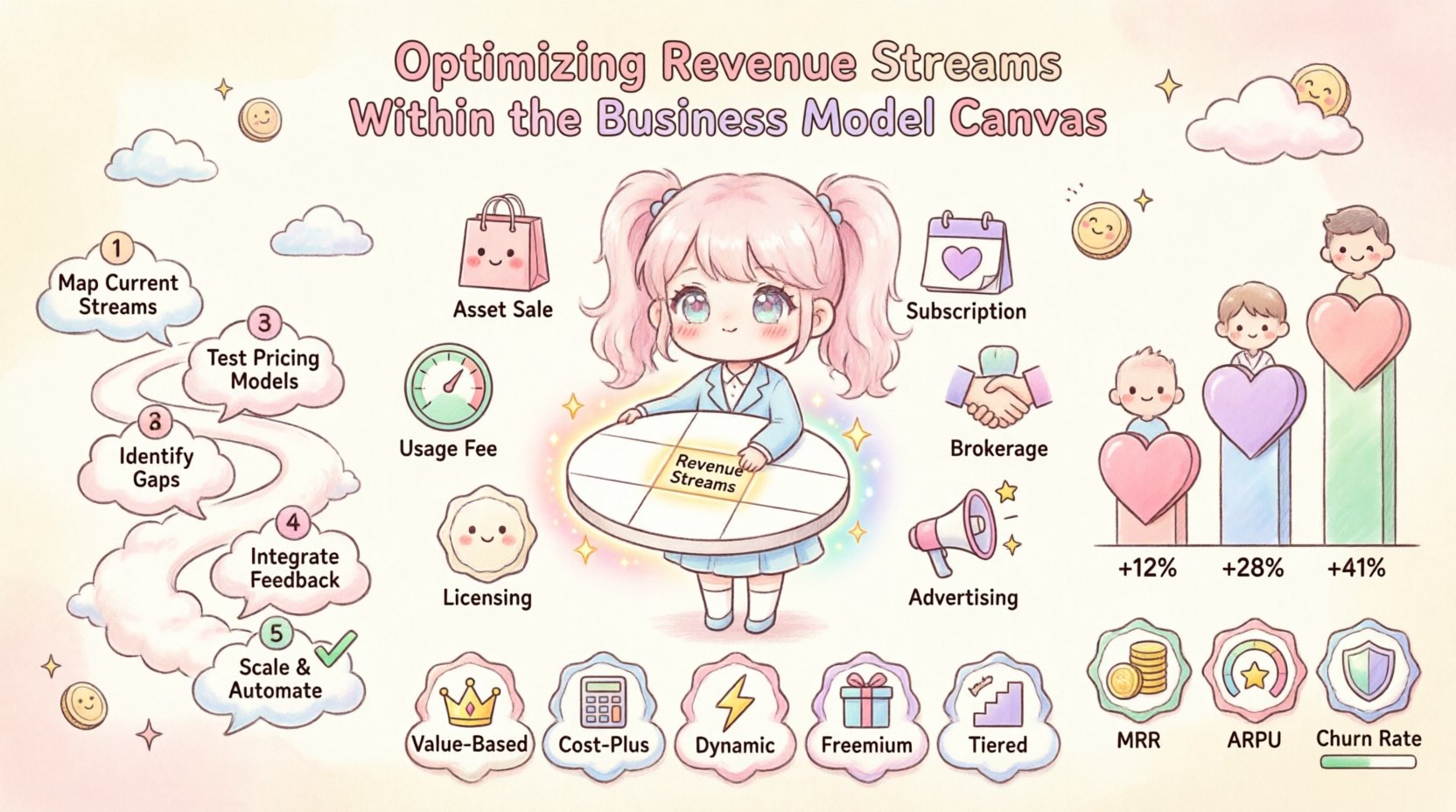
There are several distinct models for generating income. Understanding these categories allows for a tailored approach to optimization. Below is a breakdown of common revenue mechanisms found in the Business Model Canvas.
1. Asset Sale
This is the traditional model of selling physical goods. Optimization here focuses on volume, margin, and supply chain efficiency. For digital products, this translates to licensing or perpetual access fees.
2. Usage Fee
Customers are charged based on how much they use a service. This is common in telecommunications or cloud computing. Optimization involves monitoring usage patterns to encourage efficient consumption without discouraging necessary activity.
3. Subscription Fee
Recurring revenue is highly valued for predictability. Whether for content, software, or services, subscriptions build long-term relationships. The focus shifts to retention and reducing churn rather than one-time acquisition.
4. Licensing
Allowing others to use intellectual property in exchange for fees. This requires strong legal frameworks and protection of assets. Optimization involves expanding the reach of the IP to new markets or partners.
5. Brokerage Fees
Facilitating transactions between two parties and taking a cut. This model thrives on network effects. Optimization requires minimizing friction in the transaction process to encourage volume.
6. Advertising
Generating revenue by selling space to third parties. This often requires a free or subsidized product for the end-user. Optimization depends on audience size and engagement rates.
Table: Comparison of Revenue Models
| Revenue Type | Cash Flow | Customer Dependency | Optimization Focus |
|---|---|---|---|
| Asset Sale | One-time | Low | Volume & Margins |
| Subscription | Recurring | High | Retention & LTV |
| Usage Fee | Variable | Medium | Utilization Rates |
| Advertising | Variable | Low (End User) | Engagement & Reach |
📊 Pricing Strategies Alignment
Pricing is the only element of the Business Model Canvas that directly generates revenue; all others generate costs. Aligning price with value is the core of optimization. There are several strategic approaches to consider.
- Value-Based Pricing: Setting prices based on the perceived value to the customer rather than the cost of production. This often yields the highest margins but requires deep market insight.
- Cost-Plus Pricing: Adding a standard markup to the cost of the product. This ensures profitability but may leave money on the table if customers would pay more.
- Dynamic Pricing: Adjusting prices in real-time based on demand, time, or customer profile. This maximizes revenue during peak periods but requires sophisticated systems.
- Freemium Models: Offering a basic service for free while charging for premium features. This lowers the barrier to entry and converts users over time.
- Tiered Pricing: Offering multiple versions of a product at different price points. This captures value from different segments of the market.
When optimizing, test different price points. Small adjustments can have significant impacts on volume and total revenue. The elasticity of demand must be understood. If a price increase leads to a proportional drop in customers, the strategy may need revision.
🔄 Diversification Techniques
Relying on a single source of income is a risk. Diversification within the Business Model Canvas spreads this risk and opens new growth vectors. Here are effective ways to diversify revenue streams without diluting the brand.
- Add-on Sales: Offer complementary products or services that enhance the primary offering. For example, extending warranties or providing premium support.
- Cross-Selling: Introduce existing customers to related products they may need. This leverages existing trust and reduces acquisition costs.
- Geographic Expansion: Take the current revenue model to new regions. This requires adapting to local regulations and cultural preferences.
- B2B and B2C Hybrid: Serving both individual consumers and enterprise clients. Enterprise clients often provide larger contracts, while consumers provide volume.
- Data Monetization: If applicable, anonymized data insights can be sold to third parties. This adds a revenue layer without impacting the core service.
Ensure that new streams align with the Value Proposition. Selling something that contradicts the core promise can damage brand equity. For instance, a luxury brand should avoid discounting that cheapens the perception of the product.
💵 Customer Lifetime Value Focus
Optimizing revenue is not just about acquisition; it is about maximizing the total value extracted from a customer over their entire relationship with the business. This concept is known as Customer Lifetime Value (CLV).
To increase CLV:
- Improve Retention: It is generally less expensive to keep an existing customer than to acquire a new one. Invest in customer success and support.
- Reduce Churn: Analyze why customers leave. Addressing these pain points directly stabilizes recurring revenue.
- Encourage Upselling: Move customers to higher-tier packages as their needs grow. This naturally increases revenue per user.
- Extend the Relationship: Offer loyalty programs or long-term contracts that lock in revenue for extended periods.
Tracking the ratio of CLV to Customer Acquisition Cost (CAC) is essential. A healthy ratio indicates that the revenue model is sustainable. If acquisition costs rise faster than lifetime value, the business model requires adjustment.
📈 Key Performance Indicators
To measure the effectiveness of revenue optimization efforts, specific metrics must be tracked. These indicators provide visibility into the health of the Business Model Canvas.
- Monthly Recurring Revenue (MRR): Crucial for subscription models. It predicts future revenue based on current subscriptions.
- Average Revenue Per User (ARPU): Measures the average income generated from each customer. Increasing ARPU is a direct path to optimization.
- Gross Margin: Indicates how much profit remains after the direct costs of delivering the service. High margins provide flexibility for reinvestment.
- Churn Rate: The percentage of customers who stop using the service over a given period. Low churn is vital for long-term stability.
- Conversion Rate: The percentage of leads that become paying customers. Optimizing the sales funnel improves this metric.
Regularly reviewing these KPIs allows for agile adjustments. If MRR grows but churn increases, the quality of new revenue may be declining. If ARPU is high but volume is low, the market penetration may be too narrow.
⚠️ Common Challenges and Pitfalls
Even with a solid strategy, businesses face obstacles when optimizing revenue. Awareness of these pitfalls helps in avoiding common traps.
- Price Wars: Competing solely on price erodes margins and devalues the brand. Focus on differentiation instead.
- Complexity: Too many pricing tiers or revenue models can confuse customers. Keep the structure simple and transparent.
- Over-optimization: Focusing too heavily on short-term revenue can damage long-term trust. For example, aggressive upselling can annoy users.
- Ignoring Cost Structure: Revenue is meaningless without considering costs. A high-revenue stream that consumes disproportionate resources may be a liability.
- Regulatory Compliance: Changing pricing models can sometimes trigger legal or tax implications. Ensure all changes adhere to local laws.
🛠️ Implementation Steps
Putting these strategies into practice requires a systematic approach. Follow these steps to optimize the Revenue Streams block effectively.
- Audit Current Streams: List all existing income sources and calculate their contribution to total revenue.
- Analyze Profitability: Determine the cost associated with each stream. Identify which are profitable and which are draining resources.
- Customer Feedback: Survey users about their willingness to pay for different features or services.
- Competitor Analysis: Review how competitors price similar offerings. Identify gaps in the market.
- Prototype Changes: Test new pricing or models on a small segment before a full rollout.
- Monitor Results: Track the KPIs defined earlier to measure the impact of changes.
- Iterate: Use the data to refine the model further. Optimization is a continuous process, not a one-time event.
🔗 Connecting Revenue to Value Proposition
Revenue cannot exist in isolation. It must be directly linked to the Value Proposition. If the value proposition shifts, the revenue model must shift accordingly. For example, if a company moves from selling a product to providing a service, the revenue model should transition from asset sales to usage fees or subscriptions.
Maintain this alignment by asking:
- Does the price reflect the solution provided?
- Does the payment frequency match the consumption pattern?
- Are we monetizing the right outcomes?
When these elements align, the business creates a sustainable cycle where value drives revenue, and revenue fuels value creation. This synergy is the hallmark of a mature and optimized Business Model Canvas.
🌟 Final Thoughts
Optimizing revenue streams within the Business Model Canvas is a multifaceted endeavor. It requires a balance between pricing strategy, customer psychology, cost management, and strategic diversification. By focusing on long-term value rather than short-term gains, businesses can build resilient income structures.
Remember that the canvas is dynamic. As markets change, customer needs evolve, and technology advances, the revenue model must adapt. Continuous monitoring and willingness to pivot are essential. The goal is not just to generate income, but to build a sustainable engine for growth that supports the broader organizational vision.
Start by reviewing your current streams against the criteria outlined above. Identify one area for improvement and begin the testing process. Optimization is a journey of incremental gains that compound over time.
Related posts:
 Business Model Canvas: How to Validate Business Model Assumptions Before Pitching Investors
 Pivoting Your Business Model Canvas Based on Real Market Data
 Business Model Canvas: Identifying Critical Weaknesses in Early Stage Business Models
 Business Model Canvas: Designing Scalable Business Models for Hypergrowth Startups