

Systems engineering has evolved significantly over the last decade. The industry is shifting away from document-heavy processes toward Model-Based Systems Engineering (MBSE). Within this shift, Systems Modeling Language (SysML) has become the standard notation for capturing system architecture, behavior, and requirements. For professionals seeking roles in this field, demonstrating proficiency in SysML is no longer optional; it is a critical differentiator. This guide details the specific competencies that hiring managers look for, helping you align your expertise with current industry demands.
Employers are not just looking for someone who can draw diagrams. They need individuals who understand the underlying logic of system design, the ability to trace requirements, and the capacity to model complex interactions without ambiguity. This comprehensive overview breaks down the essential skills required to succeed in a modern systems engineering role.
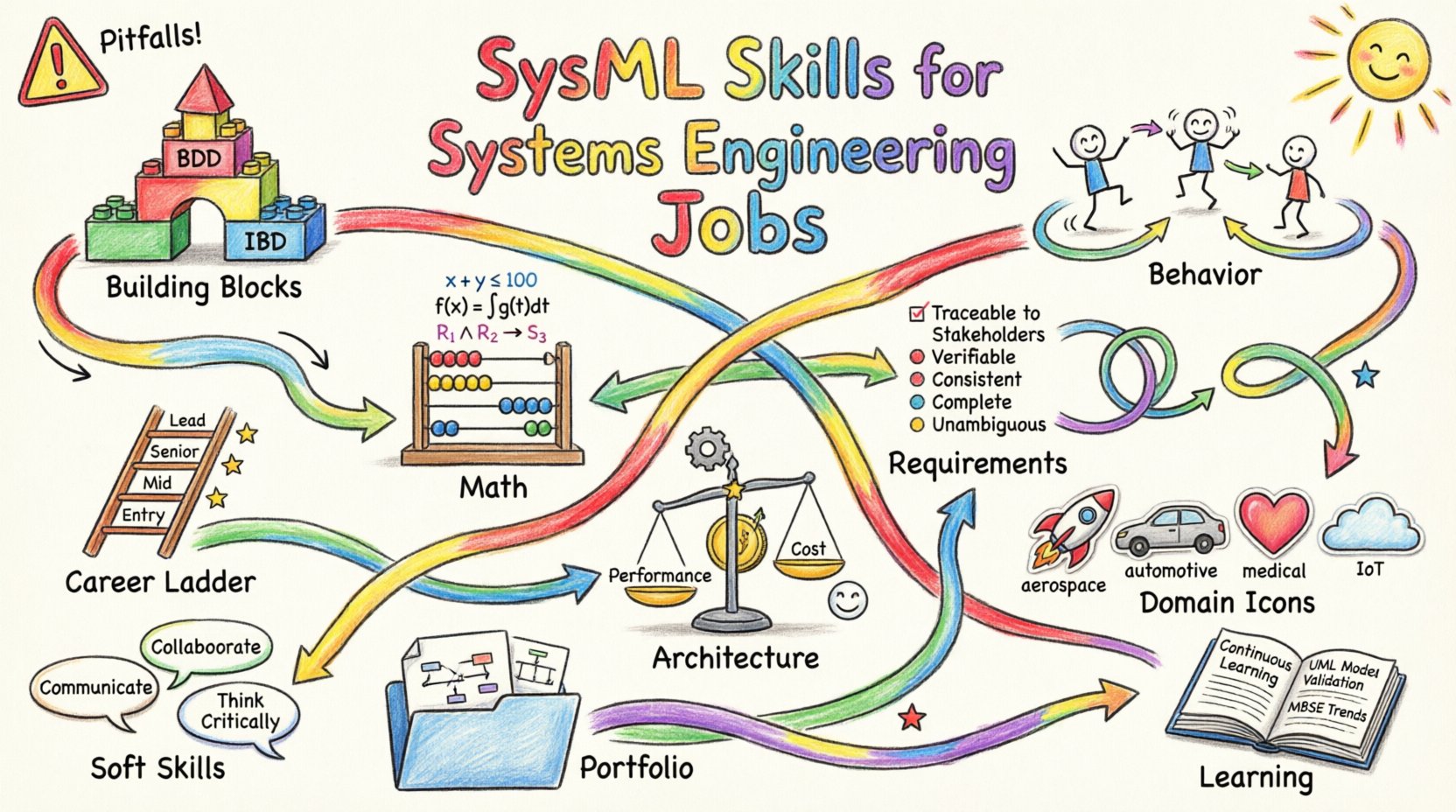
1. Foundational Structural Modeling 🏗️
Before diving into complex behaviors, a candidate must demonstrate mastery of structural modeling. This forms the backbone of any SysML model. Hiring managers expect you to understand how to define the physical and logical composition of a system.
Block Definition Diagrams (BDD): You should be proficient in creating BDDs to define system blocks, their properties, and the relationships between them. This includes distinguishing between composition, aggregation, and generalization.
Internal Block Diagrams (IBD): These diagrams detail the internal structure of a block. You must know how to define parts, ports, and connectors. Understanding the difference between flow ports and standard ports is essential for accurate data flow modeling.
Part Properties: Properly naming and typing parts ensures clarity. A model with ambiguous part names creates technical debt that hinders collaboration.
Relationships: Mastery of association, dependency, and usage relationships is required. You must understand when to use each relationship type based on the strength of the dependency between system elements.
When describing your experience, focus on how you used these diagrams to clarify system boundaries. For example, you might explain how you used IBDs to resolve interface conflicts between subsystems during the design phase.
2. Behavioral Modeling Capabilities 🔄
Static structures are only part of the story. A functioning system must behave correctly under various conditions. Demonstrating competence in behavioral modeling shows you can simulate dynamic scenarios.
State Machine Diagrams: These are vital for modeling systems with distinct modes of operation. You should be able to define states, transitions, events, and actions. Understanding the difference between entry, exit, and do activities is a common interview topic.
Activity Diagrams: Use these for modeling workflows, data flow, and algorithmic processes. Focus on how you modeled control flow versus object flow. This is particularly relevant for software-heavy systems or data processing pipelines.
Sequence Diagrams: These clarify temporal interactions between objects. You should be able to create sequence diagrams that show message passing, activation bars, and lifelines. This skill is crucial for verifying communication protocols between components.
Use Case Diagrams: While simpler, they define the scope of system functionality from a user perspective. You must be able to link use cases to other diagrams to ensure functional coverage.
In interviews, discuss how behavioral models helped identify edge cases. Did a state machine reveal a deadlock scenario? Did a sequence diagram show a missing error handling path? These examples prove you use the language for validation, not just documentation.
3. Parametric and Quantitative Analysis ⚙️
This is often the skill that separates junior modelers from senior engineers. Parametric modeling allows you to link system properties to performance constraints mathematically.
Constraint Blocks: You must know how to define mathematical relationships between variables. This includes defining equations that govern performance limits.
Parametric Diagrams: These diagrams link constraint blocks to system properties. You should understand how to solve these constraints to verify if a design meets its performance goals.
Variables and Units: Properly defining units is critical. A model that mixes units without conversion is prone to errors. Demonstrate your ability to set up unit systems that align with industry standards.
Simulation: While specific tools vary, the concept of solving parametric constraints is universal. You should understand the workflow of setting up a simulation, running it, and interpreting the results to iterate on the design.
When applying for roles involving performance-critical systems, emphasize your experience with parametric analysis. Mention how you used it to optimize trade-offs between weight, power, and cost. This demonstrates a quantitative approach to engineering.
4. Requirements Engineering Integration 📋
One of the primary benefits of MBSE is the ability to trace requirements throughout the system lifecycle. Employers value candidates who can link high-level needs to detailed design elements.
Requirement Diagrams: You should be comfortable organizing requirements hierarchically. This includes parent-child relationships and satisfaction relationships.
Traceability: This is the core skill. You must be able to link a requirement to a block, a state, or a constraint. If a requirement changes, you should understand how to assess the impact on the model.
Verification: Show how you use the model to verify requirements. Did you create test cases linked to specific requirements? Did you use the model to generate verification plans?
Refinement: Demonstrate your ability to decompose high-level requirements into lower-level subsystem requirements. This shows you understand the decomposition process inherent in systems engineering.
Discuss your experience with bidirectional traceability. This ensures that every requirement is implemented and every implementation satisfies a requirement. It is a key metric for quality assurance in regulated industries.
5. Architecture and Trade Studies 🏛️
Systems engineering is fundamentally about making decisions. Your ability to model alternatives is a high-value skill.
Alternative Configurations: You should be able to model different architectural options within the same framework. This allows for direct comparison of structural variations.
Trade-off Analysis: Combine parametric analysis with structural variations to evaluate trade-offs. For instance, compare a centralized architecture versus a distributed one based on latency and redundancy metrics.
Scenarios: Use scenarios to validate architectures. Show how a specific operational scenario stresses the system differently depending on the architecture chosen.
Documentation: Your models should serve as the source of truth for architecture documentation. You should be able to extract views from the model that cater to different stakeholders, such as hardware engineers or software developers.
6. Interoperability and Data Exchange 🔄
Systems rarely exist in isolation. They interface with other systems, software, and hardware. Understanding how to exchange data is crucial.
Standardized Exports: You should be familiar with exchanging model data using standard formats. This ensures that your models can be viewed by team members using different environments.
Interface Definitions: Clearly defining interfaces is key to interoperability. You must ensure that interface definitions are consistent across subsystems to prevent integration issues.
Version Control: Models grow complex. You need to understand version control strategies for model files. This includes managing changes, merging branches, and tracking history.
Collaboration: Discuss your experience working in teams where multiple engineers contribute to the same model. Understanding the protocols for checking out and checking in elements is vital.
7. Domain-Specific Knowledge 🚀
General modeling skills are good, but domain expertise is better. Tailoring your skills to specific industries makes your profile more attractive.
Aerospace and Defense: Focus on safety-critical systems, reliability, and certification standards. Mention experience with rigorous traceability and validation.
Automotive: Emphasize real-time constraints, embedded software interfaces, and functional safety (ISO 26262).
Medical Devices: Highlight risk management, regulatory compliance, and human-machine interface modeling.
Industrial IoT: Focus on connectivity, data streams, and edge computing architectures.
When listing your skills, identify the specific domain standards you are familiar with. This shows you understand the regulatory and operational context of the systems you are designing.
8. Soft Skills for Modelers 🗣️
Technical proficiency must be paired with communication skills. A model is useless if no one understands it.
Abstraction: You must know when to simplify a model for a stakeholder and when to provide granular detail. This requires knowing your audience.
Translation: You often act as a translator between business requirements and technical implementation. You need to explain technical constraints in business terms.
Conflict Resolution: Disagreements on system interfaces are common. You should demonstrate experience mediating these discussions using the model as the neutral ground.
Documentation: Your models should be annotated. Comments, notes, and legends are essential for maintaining model clarity over time.
9. Skill Levels vs. Job Expectations 📊
Understanding where you fit in the hierarchy of skills helps you target the right opportunities. The table below outlines typical expectations for different seniority levels.
Seniority Level | Modeling Proficiency | Responsibility Scope | Key Expectation |
|---|---|---|---|
Entry-Level | Basic diagrams (BDD, IBD) | Component design | Accuracy and adherence to standards |
Mid-Level | Behavioral & Parametric | Subsystem integration | Traceability and validation |
Senior-Level | Architecture & Trade-offs | System synthesis | Strategic alignment and optimization |
Lead/Architect | Enterprise Standards | Organization-wide MBSE | Process definition and mentoring |
When preparing your resume, align your listed skills with the level you are targeting. A senior role requires evidence of architectural decision-making, not just diagramming capability.
10. Building a Portfolio 📂
A resume lists skills; a portfolio proves them. Since you cannot share proprietary models, create sanitized examples that demonstrate your workflow.
Synthetic Projects: Create a model for a hypothetical system, such as a satellite power system or an autonomous vehicle controller.
Structure: Include the BDD to show structure, the IBD to show interfaces, and the Sequence Diagram to show behavior.
Traceability: Show a snapshot of the requirements traceability matrix. This proves you understand the link between need and design.
Analysis: Include a screenshot of a parametric solution showing performance metrics. This demonstrates quantitative analysis skills.
Annotations: Ensure your portfolio models are well-commented. This shows you value maintainability and clarity.
Be prepared to walk a hiring manager through your portfolio. Explain your design choices. Why did you choose a state machine over an activity diagram for that specific function? This conversation reveals your engineering judgment.
11. Continuous Professional Development 📚
The field of systems engineering is not static. Standards and best practices evolve. Staying current is a requirement for long-term success.
Standards: Keep up to date with ISO/IEC 15288 and IEEE 1540. These documents define the lifecycle processes and modeling guidelines.
Community: Engage with professional organizations like INCOSE. They provide resources, networking, and certification opportunities.
Certification: Consider certifications related to systems engineering. While not a replacement for experience, they validate your theoretical knowledge.
Methodology: Familiarize yourself with methodologies like OSEM or ARIS. Different organizations apply SysML differently, and adaptability is key.
12. Common Pitfalls to Avoid ⚠️
Even experienced engineers can fall into traps that reduce the value of their models. Awareness of these pitfalls helps you stand out as a competent practitioner.
Over-modeling: Creating models that are too detailed for the current design phase. This creates maintenance overhead. Know when a model is sufficient.
Inconsistency: Ensuring the model is consistent is difficult. If the behavior diagram contradicts the structural diagram, the model is unreliable. Regular reviews are necessary.
Lack of Context: A diagram without context is confusing. Always provide a legend or a system context diagram to orient the reader.
Ignoring Constraints: Focusing only on structure and ignoring performance constraints leads to designs that look good but do not work. Always validate against constraints.
Final Thoughts on Career Growth 💼
Systems engineering roles are increasingly demanding a blend of traditional engineering rigor and modern digital fluency. By focusing on these core SysML competencies, you position yourself as a valuable asset to any engineering team. The ability to model complex systems, trace requirements, and validate performance is what drives project success.
Remember that tools change, but the underlying principles of systems thinking remain constant. Your goal is to communicate system intent clearly and unambiguously. Whether you are working in aerospace, automotive, or software, the ability to create a robust, traceable model is a universal skill.
Focus on building a portfolio that demonstrates these capabilities. Practice your explanations of technical decisions. Stay updated on industry standards. With these steps, you will be well-prepared to navigate the competitive landscape of systems engineering recruitment.