

Modern engineering projects are becoming increasingly complex. Systems span hardware, software, and human interaction across multiple disciplines. Managing this complexity requires a structured approach to information flow. Model-Based Systems Engineering (MBSE) provides the framework for this. Within this framework, the Systems Modeling Language (SysML) stands out as a critical standard. It allows engineers to represent system structures, behaviors, and requirements in a unified manner. One of the most significant capabilities of this language is traceability. Traceability ensures that every requirement is linked to the design elements that satisfy it, and ultimately to the tests that verify it.
This guide explores the mechanics of establishing end-to-end traceability using SysML. We will examine how relationships function, how diagrams support data linkage, and how this practice impacts verification and validation. The goal is to provide a clear understanding of maintaining integrity throughout the system lifecycle.
🧵 Understanding End-to-End Traceability
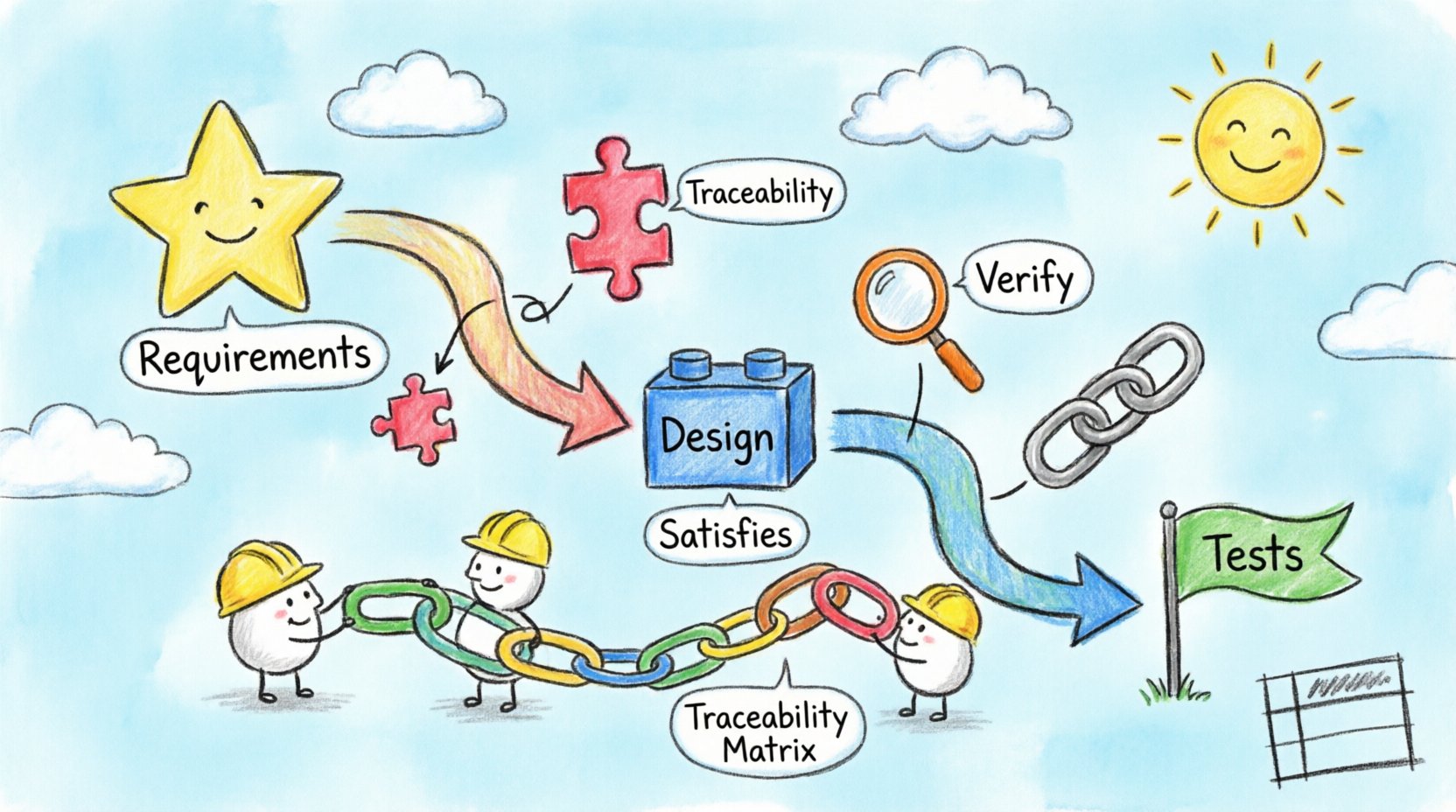
Traceability in engineering is often described as the ability to track the history, location, or application of an item or set of items. In the context of SysML, it refers to the explicit links between different model elements. These links create a chain of evidence. If a requirement changes, the engineer can identify every component affected by that change.
Without traceability, engineering data exists in silos. Requirements might be documented in one spreadsheet, designs in a CAD tool, and tests in another management system. Disconnections lead to errors. Features may be built that do not meet the original need, or tests may verify aspects that are no longer relevant.
Key Characteristics of Effective Traceability
- Bi-directional: Links work both ways. You can go from a requirement to the design, and from the design back to the requirement.
- Complete: Every requirement must have a corresponding design element.
- Consistent: Links must remain valid throughout the project lifecycle.
- Verifiable: The links must be checkable to ensure data integrity.
🏗️ The SysML Foundation for Linking Requirements
SysML provides specific diagram types and relationship types designed to maintain these links. Unlike text-based documents, the model enforces structure. This structure makes it difficult to create orphaned requirements or disconnected design blocks.
Core Relationship Types
The language defines standard relationships that represent the flow of information. Understanding these is essential for building a robust traceability network.
- Satisfies: This relationship connects a lower-level element to a higher-level one. Typically, a component satisfies a requirement. If a component is deleted, the requirement becomes unsatisfied.
- DeriveReqs: This indicates that a requirement is derived from another requirement. It often happens when a system requirement is broken down into subsystem requirements.
- Refines: Used when a requirement is elaborated upon. It adds detail to a parent requirement without changing its intent.
- Verify: This links a requirement to a test case or verification activity. It confirms that the requirement has been tested.
🗺️ Mapping Diagrams to Traceability Needs
Different diagrams serve different purposes in the traceability chain. While the relationships exist within the model, the diagrams provide the visual context. Engineers use these views to understand how the system is structured and how information flows.
Requirement Diagram
The Requirement Diagram is the central hub for traceability. It visualizes the relationships between requirements and other model elements. It allows for the definition of constraints and the linking of requirements to blocks.
- Visualizing Hierarchy: Engineers can see parent-child relationships clearly.
- Linking to Blocks: Direct connections show which parts of the system are responsible for specific needs.
- Linking to Tests: Verification requirements are often placed here to show the testing status.
Block Definition Diagram (BDD)
The Block Definition Diagram defines the structure of the system. It shows the parts and their connections. Traceability is maintained here by associating requirements with specific blocks.
- Structural Integrity: Ensures the physical structure supports the logical needs.
- Interface Definition: Links requirements to the interfaces between components.
- Part Classification: Helps organize requirements by subsystem or hardware component.
Internal Block Diagram (IBD)
The Internal Block Diagram details the connections between parts. It shows how data and energy flow through the system. This is critical for functional traceability.
- Flow Connections: Links functional requirements to specific data paths.
- Port Mapping: Ensures that interface requirements are met by the actual ports defined in the design.
- Exposure: Shows how internal components interact with external actors.
📊 The Traceability Matrix Concept
A Traceability Matrix is a document or view that maps requirements to other elements. In a SysML model, this is often generated automatically from the relationships defined in the diagrams. It provides a tabular view of the links.
| Requirement ID | Requirement Text | Design Element | Verification Method | Status |
|---|---|---|---|---|
| REQ-001 | System must operate in temperatures between -10°C and 50°C. | Block: Thermal_Unit | Test: Thermal_Cycle_Test | Verified |
| REQ-002 | Data throughput must exceed 100 Mbps. | Block: Network_Interface | Test: Bandwidth_Test | In Progress |
| REQ-003 | User must be able to calibrate the device. | Block: UI_Module | Test: Usability_Test | Pending |
This table format allows project managers to see the coverage at a glance. It highlights gaps where a requirement lacks a design element or a test case. It also helps in auditing compliance with safety standards.
🚀 Advantages of SysML Traceability
Implementing this level of detail offers tangible benefits for engineering teams. It reduces risk and improves efficiency over the long term.
- Impact Analysis: When a change occurs, the model shows exactly what is affected. This prevents unintended consequences.
- Compliance: Industries like aerospace and medical devices require strict proof of traceability. SysML provides the evidence needed for certification.
- Communication: Stakeholders can view the same model. Developers, testers, and managers share a single source of truth.
- Reusability: Standardized elements can be reused in future projects. Traceability ensures that legacy components are understood and integrated correctly.
- Cost Reduction: Finding errors early in the design phase is cheaper than fixing them in production. Traceability helps catch these errors before manufacturing begins.
🛑 Common Challenges in Implementation
While the benefits are clear, maintaining a traceable model is not without difficulty. Teams often face hurdles during the adoption process.
- Granularity: Deciding how detailed the links should be is difficult. Too coarse, and the model is useless. Too fine, and the maintenance burden becomes too high.
- Tool Integration: Connecting the modeling environment with external management systems requires effort. Data must flow seamlessly between tools.
- Human Error: Engineers might forget to update a link when a change occurs. Automation helps, but human oversight is still required.
- Model Bloat: Excessive relationships can make the model slow and difficult to navigate. Regular cleanup is necessary.
- Training: Teams need to understand the semantics of the language. Misusing relationships leads to broken traces.
✅ Best Practices for Maintaining Integrity
To ensure the traceability chain remains strong, teams should adopt specific practices. These habits help maintain the quality of the model over time.
1. Define Standards Early
Establish a naming convention and relationship standard at the start of the project. This ensures consistency. Define what satisfies means versus what derives means for your specific project context.
2. Automate Where Possible
Use features within the modeling environment to check for orphaned elements. Scripts or built-in validators can alert engineers if a requirement has no associated design block.
3. Regular Audits
Schedule regular reviews of the traceability matrix. Check for broken links and ensure that verification results are up to date. This keeps the model aligned with the actual project status.
4. Version Control
Store the model in a version control system. This allows the team to track changes to relationships over time. If a link is removed, the history shows why.
5. Integrate with Verification
Do not treat verification as a separate phase. Link test cases directly to requirements in the model. This ensures that the test results are automatically associated with the requirement status.
🔍 Integration with Verification and Validation
Traceability is most powerful when it connects to the verification process. Verification answers the question, “Did we build the product right?” Validation answers, “Did we build the right product?”
Verification Integration
In SysML, verification is often modeled using Verification Cases. These cases define the method used to test a requirement. The relationship between a Requirement and a Verification Case is explicit.
- Pass/Fail Status: The model can record the outcome of the test.
- Trace to Evidence: Test reports can be linked to the model element.
- Gap Analysis: Identify requirements that have not been tested.
Validation Integration
Validation ensures the system meets the user’s needs. This often involves higher-level use cases or user scenarios. SysML Use Case Diagrams are useful here.
- Actor Alignment: Ensure the system interacts with the correct actors.
- Scenario Coverage: Verify that all user scenarios are covered by the requirements.
- Feedback Loop: Validation results feed back into requirements, potentially triggering changes.
🔄 Managing Change in a Traceable Model
Engineering projects rarely go exactly according to plan. Requirements change. Designs evolve. The traceability model must accommodate these shifts without losing its integrity.
Change Propagation
When a requirement is modified, the model helps identify the ripple effect. The engineer can see which blocks are linked to this requirement. They can then assess if the design needs to change.
Versioning Requirements
Requirements should be versioned. If a requirement is updated, the old version is archived. The new version links to the updated design. This preserves the history of the decision.
Baseline Management
Create baselines at key milestones. A baseline captures the state of the model at a specific point in time. This allows the team to revert if necessary or to compare progress against a specific target.
📝 Summary of Key Takeaways
Building a traceable system model requires discipline and a clear understanding of the language standards. The relationships defined in SysML are the backbone of this process. They provide the structure needed to link needs to solutions.
- Standardize: Use consistent relationship types.
- Visualize: Use diagrams to understand the connections.
- Validate: Link tests directly to requirements.
- Monitor: Regularly check for gaps and errors.
- Integrate: Connect with external management tools.
By following these principles, engineering teams can manage complexity effectively. The model becomes a living document that reflects the current state of the system. It supports decision-making and reduces the risk of failure. This approach is essential for modern systems engineering.
🔗 Final Thoughts on Model Integrity
The effort invested in establishing traceability pays off during the testing and deployment phases. Issues are identified earlier, and the root cause is easier to find. The model serves as a reliable record of the engineering decisions made.
As systems continue to grow in complexity, the need for robust traceability will only increase. Adopting these practices now prepares teams for future challenges. It ensures that the system remains maintainable and understandable throughout its lifecycle.