

In the landscape of scalable software architecture, the concept of multi-tenancy is fundamental. A single application instance serves multiple customers, known as tenants, while maintaining logical separation of data. Designing the underlying data structure requires precision. Entity Relationship Diagrams (ERDs) serve as the blueprint for this architecture. They visualize the relationships between tables, keys, and constraints that enforce data integrity across tenants. 📐
When constructing an ERD for a multi-tenant environment, the primary challenge is balancing isolation, performance, and cost. There is no single solution that fits every scenario. Instead, architects must select a pattern that aligns with the security requirements and operational budget. This article explores the core strategies for modeling these schemas, providing a deep dive into technical implementation details without relying on specific vendor tools. 🛠️
Understanding the Core Patterns 🔍
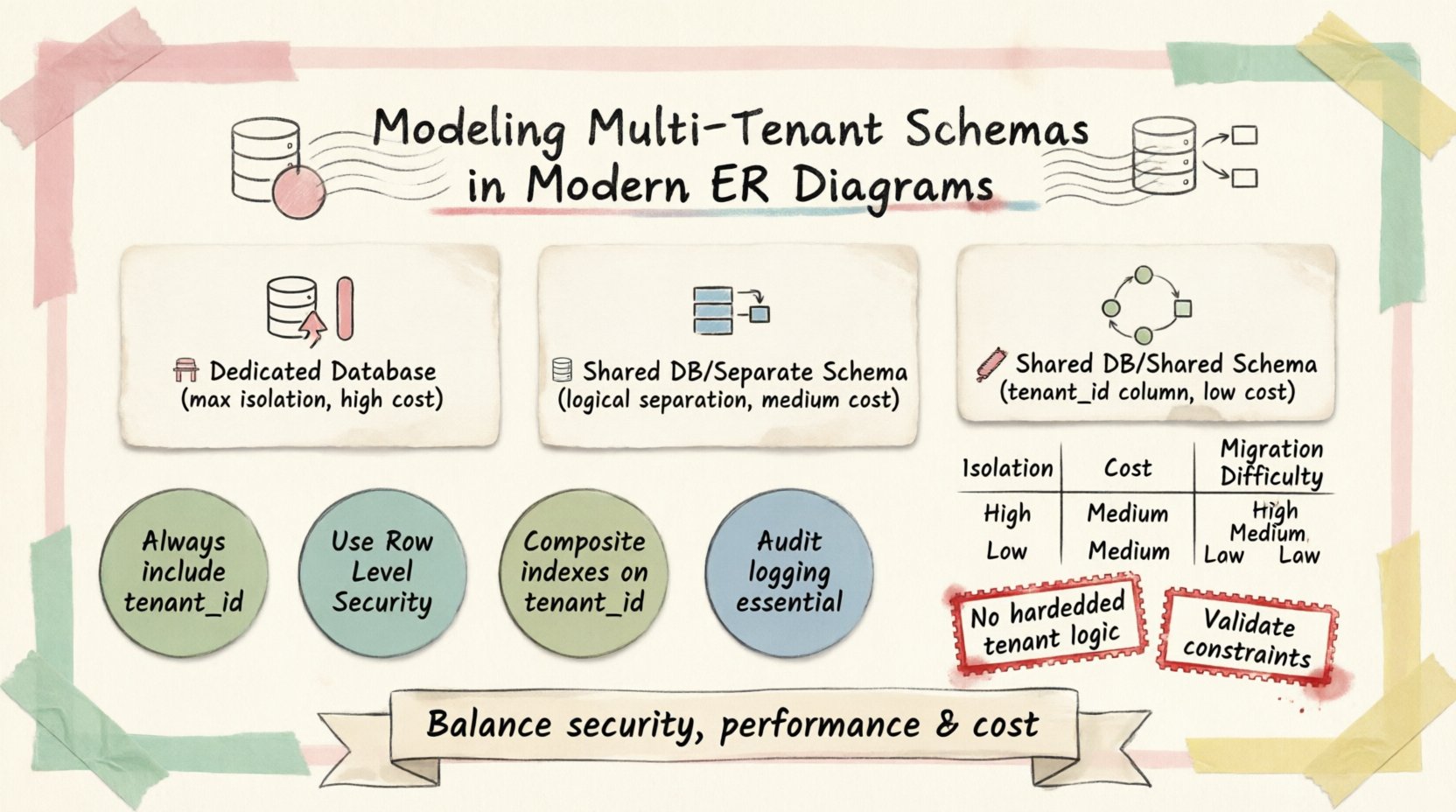
The foundation of multi-tenancy modeling lies in how tenant data is physically stored and logically separated. Three distinct patterns dominate the industry. Each presents unique trade-offs regarding data isolation and maintenance complexity.
1. Dedicated Database per Tenant 🏢
In this approach, every customer receives their own isolated database instance. The ERD structure remains identical across all instances, but the physical boundaries are strict.
- Isolation Level: Maximum. A failure in one database does not impact others.
- Security: High. Physical separation prevents accidental data leakage.
- Cost: Higher due to resource overhead per instance.
- Migration: Complex. Schema changes require running scripts across every instance.
From an ERD perspective, this pattern looks like a standard single-tenant diagram. However, the deployment pipeline must manage multiple connections. This is often used for enterprise clients with strict compliance requirements.
2. Shared Database, Separate Schema 📂
Here, all tenants reside within a single database system, but each tenant has their own distinct schema (namespace). Tables are duplicated per schema.
- Isolation Level: High. Logical separation within the database engine.
- Security: Strong. Access control lists (ACLs) can restrict schema visibility.
- Cost: Moderate. Shares the database engine overhead.
- Maintenance: Easier than dedicated DBs, but schema updates must propagate to all schemas.
In the ERD, this is represented by grouping tables under specific namespace labels. The relationships remain consistent, but the scope of the diagram expands to show multiple schema containers.
3. Shared Database, Shared Schema 🔗
This is the most common pattern for general SaaS applications. All data resides in the same set of tables, distinguished by a specific column.
- Isolation Level: Logical. All rows exist in the same table.
- Security: Dependent on application logic and Row Level Security (RLS).
- Cost: Lowest. Maximizes resource utilization.
- Maintenance: Simple. Schema changes apply to all tenants instantly.
The ERD for this pattern introduces a critical column: tenant_id. This foreign key links every record to a specific customer. It is the cornerstone of data segregation in this model.
Visualizing Tenant Data in ERDs 📊
Creating an effective ERD for multi-tenancy requires specific notations to communicate the partitioning strategy clearly. Stakeholders need to understand how data flows and where boundaries exist.
The Tenant ID Column
In a shared schema, the tenant_id must appear on every table that stores user-specific data. This is not optional. Omitting this column from a transactional table can lead to severe data leakage.
- Primary Key: Often, the combination of
tenant_idand a local ID forms a composite primary key. - Indexing: Crucial for performance. Queries filtering by
tenant_idmust be fast. - Constraints: Foreign keys often reference a central
tenantsmaster table.
Master Tenant Table
A dedicated table usually exists to store metadata about each tenant. This table holds configuration details, subscription status, and billing information.
- Key Attributes: Tenant ID, Name, Plan Tier, Created Date.
- Relationships: One-to-Many with all other data tables.
Comparing Schema Strategies 📋
To make an informed decision, compare the operational impact of each strategy using the table below.
| Feature | Dedicated DB | Shared Schema | Shared Table |
|---|---|---|---|
| Data Isolation | Physical | Logical | Logical |
| Query Complexity | Simple | Complex | Complex |
| Resource Cost | High | Medium | Low |
| Schema Migration | Hard | Medium | Easy |
| Backup Strategy | Granular | Granular | Full Dump |
Security and Data Partitioning 🔒
Modeling the schema is only half the battle. The data access layer must enforce the boundaries defined in the diagram. Logical isolation is the goal when using shared tables.
Row Level Security (RLS)
Modern database engines support RLS, which enforces access policies at the row level. This allows the database itself to filter results based on the current user context.
- Policy Definition: A rule states that a row is visible only if
tenant_idmatches the session. - Implementation: The ERD should reflect the capability to store session context.
- Benefit: Reduces the risk of application-level bugs leaking data.
Auditing and Logging
Every change to tenant-specific data should be logged. An audit table is essential in the ERD to track who modified what and when. This is critical for compliance and debugging.
- Fields Required: Tenant ID, User ID, Action, Timestamp, Old Value, New Value.
- Retention: Policies must define how long logs are kept.
Performance Considerations ⚡
Shared tables introduce complexity to query execution plans. As the volume of data grows, the database engine must efficiently separate tenant data without scanning the entire table.
Indexing Strategies
Standard indexing is insufficient. You need composite indexes that prioritize the tenant identifier.
- Primary Index: Should start with
tenant_idfollowed by the natural key. - Query Optimization: Ensure all queries include the tenant filter in the
WHEREclause. - Partitioning: Some systems allow physical partitioning of tables by
tenant_idrange or hash.
Query Complexity
When joining tables across multiple schemas or tenants, the join condition must include the tenant ID. Failing to do so can result in a Cartesian product of data from different customers.
- Join Logic: Always join on
tenant_idAND the relationship key. - Application Layer: Middleware should inject the tenant filter automatically.
Maintenance and Migration 🔄
Schemas are not static. They evolve as requirements change. Multi-tenancy adds a layer of difficulty to these changes.
Schema Evolution
Adding a column is straightforward in a shared table. Dropping a column affects all tenants. In a dedicated database model, you must script the change for every instance.
- Versioning: Track schema versions to manage backward compatibility.
- Rollbacks: Have a plan to revert changes if a migration fails on a subset of tenants.
Backups and Recovery
Recovery strategies differ by pattern. A dedicated database allows you to restore a single tenant without affecting others. A shared database requires restoring the entire instance.
- Granularity: Shared tables make point-in-time recovery for a single tenant difficult.
- Testing: Regularly test restoration procedures in a staging environment.
Common Pitfalls to Avoid ⚠️
Even with a well-designed ERD, implementation errors can compromise the system. Be vigilant about these common issues.
- Hardcoded Tenant Logic: Never hardcode tenant IDs in the application code. Use configuration or session context.
- Global Variables: Avoid storing tenant context in global variables that might persist across requests.
- Missing Constraints: If the database does not enforce
tenant_iduniqueness, the application must validate it strictly. - Ignoring Analytics: Aggregating data across tenants for reporting requires careful handling to avoid mixing sensitive information.
Best Practices for Naming Conventions 🏷️
Consistency in naming helps developers understand the data structure immediately. Use prefixes or suffixes to denote tenant-specific tables if they exist in a shared schema.
- Table Naming:
tenant_name_ordersororders_tenant_id. - Column Naming: Always include
tenant_idexplicitly in every record table. - Indexes: Name indexes clearly, e.g.,
idx_orders_tenant_id.
Conclusion on Architecture Choices 🎯
Selecting the right multi-tenant schema pattern requires a balance of technical feasibility and business needs. The ERD is the tool that communicates this choice to the entire team. Whether choosing physical isolation for security or shared tables for efficiency, the diagram must clearly show the boundaries.
By adhering to strict modeling standards, implementing robust indexing, and maintaining clear separation logic, you can build a system that scales securely. The complexity of tenancy is manageable when the foundation is solid. Focus on data integrity and performance from the first line of the diagram. 🚀