
VP OpenDocs: Designing a Unified Knowledge Architecture with Mermaid
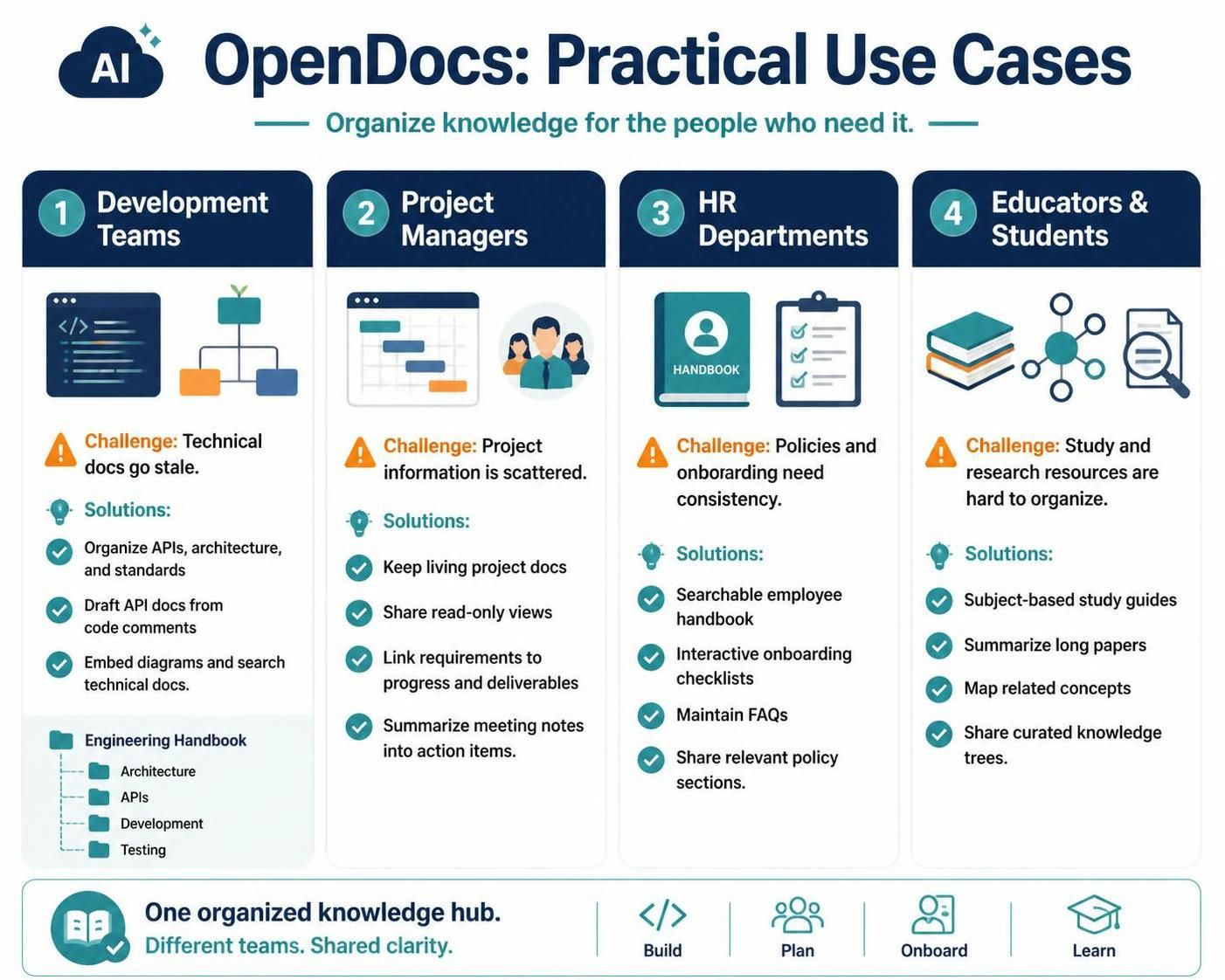
In modern software development and organizational management, information often becomes trapped in silos. Developers write code but neglect documentation, project managers struggle to keep stakeholders aligned, and HR departments find it difficult to scale onboarding. The OpenDocs framework addresses this fragmentation by proposing a unified architecture where knowledge is organized, searchable, and AI-enhanced. This tutorial explores the system architecture behind this solution, modeling the hierarchical structure and data flows using standard diagramming techniques.
Understanding the Core Architecture
The OpenDocs system is built on a hierarchical “Knowledge Tree” model. Unlike a flat file system, this structure allows for the nesting of complex information, ensuring that documentation evolves alongside the product or organization. The architecture is designed to support four distinct user personas: Development Teams, Project Managers, HR Departments, and Educators.
At the heart of this architecture is the concept of a Living Documentation System. Instead of static PDFs, the system utilizes dynamic content generation. For example, the Development module integrates with source code to automatically generate API documentation, while the Project Management module links requirements directly to progress reports.
The Engineering Handbook Structure
The most critical component of the system is the Engineering Handbook. This is not merely a collection of documents but a structured directory that serves as the central repository for technical truth. The hierarchy is typically divided into four primary domains:
- Architecture: System overviews, technology stacks, and Decision Records (ADRs).
- APIs: REST endpoints, GraphQL schemas, and authentication flows.
- Development: Setup guides, coding standards, and deployment processes.
- Testing: Unit testing protocols, integration tests, and performance benchmarks.
To visualize this structural model, we can use Mermaid.js to create a hierarchical graph. This diagram illustrates how the root node branches out into the primary functional areas and their respective sub-modules.
graph TD
    Root[OpenDocs Knowledge Hub] --> Dev[Development Teams]
    Root --> PM[Project Managers]
    Root --> HR[HR Departments]
    Root --> Edu[Educators & Students]

    subgraph Dev_Structure
    Dev --> Arch[Architecture]
    Arch --> ADR[Decision Records]
    Dev --> API[APIs]
    API --> REST[REST Endpoints]
    API --> GraphQL[GraphQL Schema]
    Dev --> Coding[Coding Standards]
    end

    subgraph PM_Structure
    PM --> LivingDocs[Living Project Docs]
    PM --> Stakeholder[Stakeholder Views]
    PM --> AI_Notes[Meeting Summaries]
    end

    subgraph HR_Structure
    HR --> Handbook[Employee Handbook]
    HR --> Onboarding[Interactive Onboarding]
    HR --> FAQ[AI-Updated FAQs]
    end

    subgraph Edu_Structure
    Edu --> StudyGuides[Study Guides]
    Edu --> Research[Research Materials]
    Edu --> MindMap[Visual Concept Maps]
    end
Modeling the Data Flow and AI Integration
The power of the OpenDocs architecture lies in its ability to integrate Artificial Intelligence (AI) into the documentation workflow. The system is not just a passive storage unit; it actively processes data to reduce the cognitive load on users.
1. Automated API Documentation Generation
For development teams, a common pain point is “stale” documentation. The OpenDocs solution employs an automated pipeline where the AI parses source code comments and annotations. This data is then mapped to the APIs section of the hierarchy. The diagram below represents the data flow from the source code to the final rendered documentation.
graph LR
    Code[Source Code & Comments] --> Parser[AI Parser]
    Parser --> Schema[API Schema Generation]
    Schema --> Docs[Interactive Docs]
    Docs --> Search[Searchable Index]

    style Code fill:#f9f,stroke:#333,stroke-width:2px
    style Parser fill:#bbf,stroke:#333,stroke-width:2px
    style Docs fill:#bfb,stroke:#333,stroke-width:2px
2. Dynamic Meeting Summarization
For Project Managers, the challenge is keeping information centralized. The system captures unstructured meeting notes and uses Natural Language Processing (NLP) to extract action items, which are then linked to specific project requirements. This ensures that the “Living Project Docs” are always up to date without manual entry.
- Ingest: Raw text from meeting transcripts is uploaded.
- Analyze: AI identifies key entities (tasks, deadlines, owners).
- Link: Items are linked to the relevant project deliverable nodes.
- Notify: Stakeholders receive read-only views of the updated status.
Implementing the Solution
To successfully deploy an OpenDocs-like system, organizations must adopt a “structure-first” philosophy. Before populating content, the directory tree must be defined. This allows the AI to understand the context of the information it is processing. For example, a policy document placed under HR > Onboarding has a different access level and semantic meaning than one placed under Development > Security.
Additionally, the system supports role-based access control (RBAC) by default. While the Engineering Handbook might be public to all engineers, specific Architecture Decision Records might be restricted to senior leadership, ensuring that sensitive strategic information is protected while maintaining transparency in other areas.
Conclusion
The OpenDocs architecture demonstrates how a structured, hierarchical approach combined with AI automation can solve the pervasive problem of information silos. Whether it is a developer looking for an API reference, a project manager tracking deliverables, or a student organizing research, the system provides a unified knowledge hub. By modeling these structures using tools like Mermaid, teams can visualize their information architecture before implementation, ensuring a scalable and maintainable documentation ecosystem.