
BPMN 2.0: The Ultimate Bridge Between Business Strategy and IT Execution
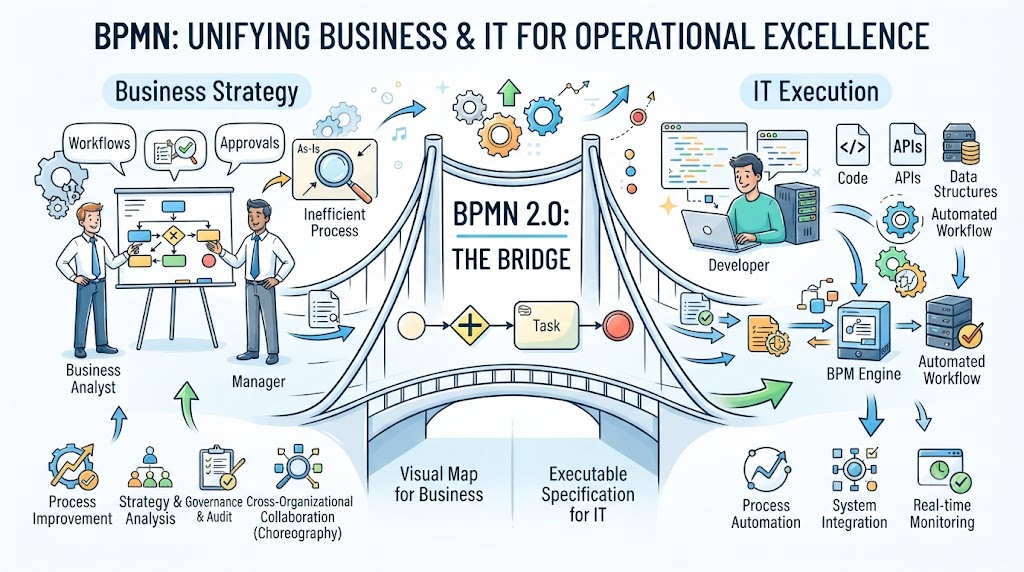
In the modern enterprise, a dangerous chasm often separates the people who design business strategy from the teams responsible for executing it. On one side sit the Business Analysts and Managers, focused on workflows, approvals, and operational efficiency. On the other are the Developers, deep in the weeds of code, APIs, and data structures. For decades, this communication gap has resulted in misaligned projects and fragile processes.
The solution lies in a universal language: Business Process Model and Notation (BPMN). As illustrated in the diagram above, BPMN acts as “The Bridge,” transforming a visual map understood by business stakeholders into an executable specification for IT systems.
The Architecture of the Bridge
The visual representation of this architecture is striking. It depicts two distinct worlds being unified by a central structure. To understand how BPMN facilitates this, we must look at the flow of information across the bridge.
1. The Business Strategy Side (The Input)
On the left side of the bridge, we find the business domain. This is where the “As-Is” analysis happens. Business analysts and managers identify inefficiencies and define the desired operational flows. They think in terms of:
- Workflows: The sequence of activities required to complete a task.
- Approvals: Decision points requiring human intervention.
- Exceptions: What happens when things go wrong?
Without a standardized notation, these concepts are often documented in vague text documents or simplistic flowcharts that developers struggle to interpret accurately. The goal here is Process Improvement and Strategy & Governance.
2. The IT Execution Side (The Output)
On the right side of the bridge, the focus shifts to technical implementation. The developer takes the business requirements and translates them into technical assets. This side deals with:
- Code & APIs: The underlying logic that powers the application.
- Data Structures: How information is stored and retrieved.
- Automation Engines: The BPMN engine that actually runs the workflow.
The result of this execution is Process Automation, System Integration, and Real-time Monitoring. The bridge ensures that the code built matches the business intent exactly.
The Core Mechanism: Visual Map to Executable Specification
The center of the diagram highlights the unique power of BPMN. It is not just a drawing tool; it is a modeling language. The bridge represents the transition from a Visual Map for Business to an Executable Specification for IT.
Consider the specific elements shown in the center of the bridge. You will see a diamond shape (an exclusive gateway) and a rounded rectangle (a task). In BPMN 2.0, these symbols are not merely graphical representations. They are semantic definitions:
- The Task: This represents a specific unit of work. In the diagram, it connects the business logic to the BPM Engine.
- The Gateway (Diamond): This represents a decision point. It dictates the path the process takes based on data (e.g., “Is the amount over $500?”).
- The Connector: The arrows define the control flow, ensuring that the sequence of events is preserved from the whiteboard to the server.
When a business analyst draws this diagram, they are creating a high-fidelity blueprint. When a developer uses a tool like Visual Paradigm to model this, they can often export this model directly into a format the BPM Engine understands, drastically reducing the “interpretation” phase of software development.
Benefits of a Unified Approach
The diagram illustrates the profound benefits of this unified architecture. By bridging the gap between the business and IT, organizations achieve:
- Cross-Organizational Collaboration (Choreography): Complex interactions between different departments or external partners can be mapped out clearly.
- Agility: When business rules change, the “Visual Map” can be updated, and the changes can be propagated to the “Executable Specification” faster.
- Auditability: The standardized notation ensures that every process is documented in a way that is universally understood, making governance and auditing much easier.
Ultimately, the bridge of BPMN 2.0 ensures that the strategy defined by the business leaders is not lost in translation but is faithfully executed as operational reality by the technical teams.