


Every entrepreneur dreams of building the next unicorn. 🦄 Yet, the graveyard of startups is filled with brilliant ideas that never made it past the launch phase. Often, the difference between a pivot and a shutdown lies not in the product itself, but in the strategic clarity behind it. One of the most enduring frameworks for business strategy is the SWOT analysis. While many founders know the acronym, very few execute it with the precision required to drive real decisions. 🧠
This guide dissects a fictional but realistic scenario involving a tech startup named “NexStream.” We will explore how poor execution of a SWOT analysis contributed to its downfall and how a rigorous, data-driven approach could have altered the trajectory. We will avoid fluff and focus on actionable insights, structural integrity, and the mechanics of strategic planning. 🛠️
🏢 The Scenario: NexStream
NexStream was a B2B SaaS platform designed to automate supply chain logistics for small-to-medium enterprises (SMEs). The founders had a strong technical background and secured initial seed funding based on a compelling prototype. The product was functional, and the user interface was clean. However, within eighteen months, the company ran out of cash and dissolved. 📉
Post-mortem interviews with the leadership team revealed a common thread: they were reactive rather than proactive. They spent their time building features requested by early adopters without understanding the broader market landscape. They never sat down to objectively assess their internal capabilities against external pressures. 🧐
❌ The Failure: Why the SWOT Was Ignored
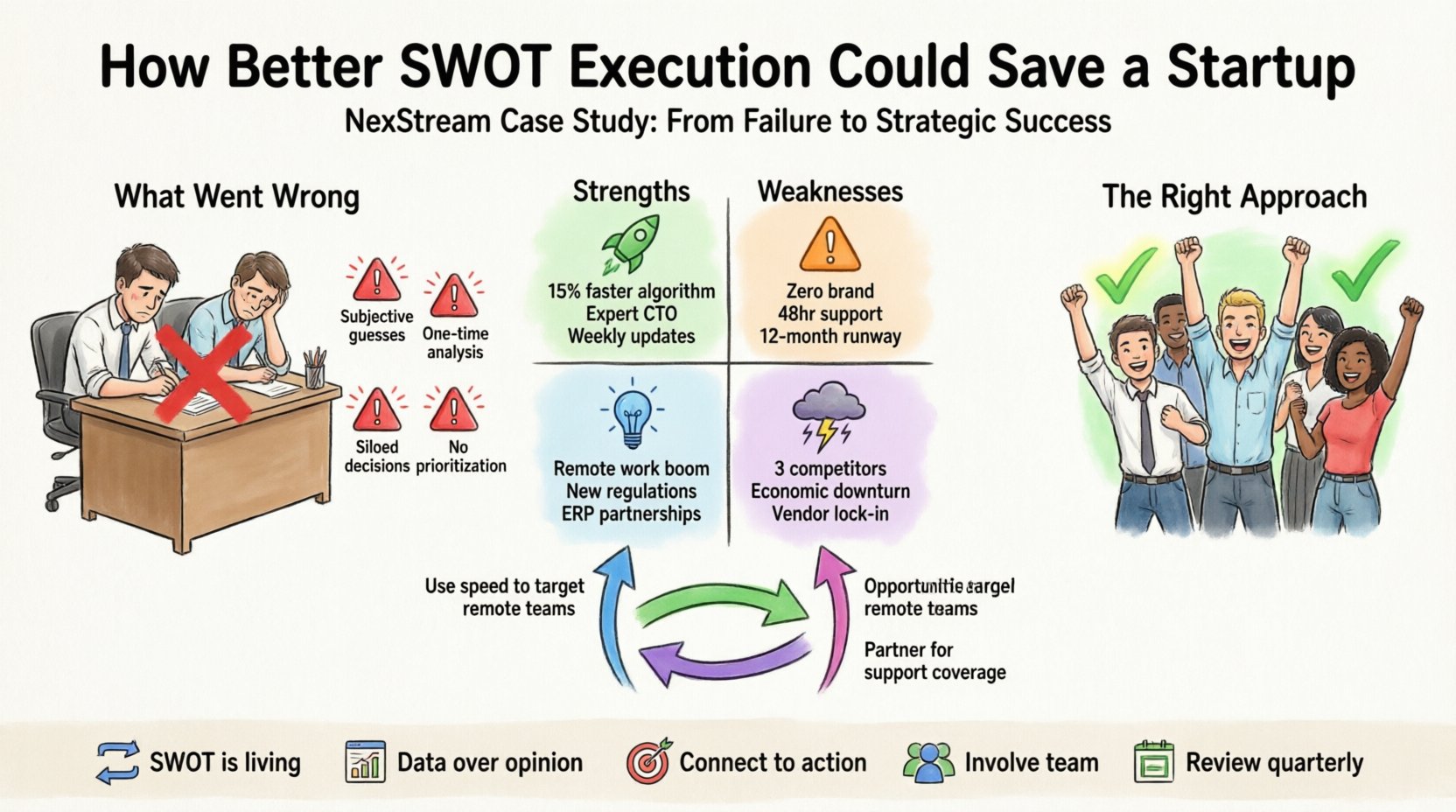
In the early days, the team conducted a SWOT analysis. However, it was treated as a checkbox exercise for the board meeting rather than a living strategic document. The results were generic, vague, and disconnected from daily operations. Here is what went wrong:
- Subjectivity: Strengths were listed based on gut feeling rather than metrics. 🎯
- Static Data: The analysis was done once at launch and never revisited. Markets change monthly. 🔄
- Isolation: The SWOT was kept in a closed room by the founders. The engineering and sales teams were unaware of the strategic context. 🚫
- Lack of Prioritization: All items were treated as equal importance. Not all threats are existential, and not all strengths are scalable. ⚖️
Because the framework was ignored, the company missed critical signals. They focused on “Strengths” that did not translate to revenue and underestimated “Threats” that eventually killed their growth. Let us break down how a proper execution would have looked.
✅ The Correct Approach: A Hypothetical SWOT Breakdown
To understand the gap, we must reconstruct what a high-fidelity SWOT analysis for NexStream could have looked like. This requires moving beyond buzzwords and into specific, verifiable business realities. 📊
1. Strengths (Internal)
Strengths are the internal attributes that give the organization an advantage over others. In the case of NexStream, these should have been quantifiable.
- Proprietary Algorithm: Their routing logic was 15% faster than competitors, verified by third-party testing. 🚀
- Team Expertise: The CTO had 10 years of experience in logistics software, reducing development bugs. 🛡️
- Agile Deployment: The ability to deploy updates weekly without downtime. ⚡
2. Weaknesses (Internal)
Weaknesses are attributes that place the organization at a disadvantage relative to others. These are often the most uncomfortable truths to admit.
- Brand Recognition: Zero presence in the market compared to legacy providers. 🏷️
- Customer Support: Limited to email only, causing a 48-hour response time. ⏳
- Capital Reserves: Only 12 months of runway after the seed round. 💸
3. Opportunities (External)
Opportunities are external chances to make a greater profit or increase market share. These are trends the company can exploit.
- Remote Work Trends: SMEs needed better digital tools for distributed teams. 🌍
- Regulatory Changes: New data privacy laws favored modern, compliant platforms. 📜
- Partnerships: Potential integration with major ERP systems used by larger firms. 🔗
4. Threats (External)
Threats are external elements in the environment that could cause trouble for the business or project. These require mitigation strategies.
- Market Saturation: Three major competitors launched similar features. 🦍
- Economic Downturn: SMEs cut budgets on software during recessions. 📉
- Vendor Lock-in: Customers found it too costly to switch from legacy systems. 🔒
📊 Visualizing the Strategic Gap
Seeing the data side-by-side highlights the disconnect between the product reality and the market reality. The table below contrasts the “Initial Assumption” vs. the “Strategic Reality”.
| Dimension | Initial Assumption | Strategic Reality |
|---|---|---|
| Core Value | Speed of routing | Cost reduction & reliability |
| Target Audience | All SMEs | High-growth tech-enabled logistics firms |
| Competitive Edge | Better code | Better integration ecosystem |
| Risk Factor | Technical failure | Market adoption and churn |
This table reveals a critical misalignment. NexStream optimized for speed, but the market valued cost and reliability. A proper SWOT would have forced a pivot in the value proposition before significant capital was burned. 🔍
🔍 Deep Dive: Connecting SWOT to Action
Knowing the SWOT is not enough. The magic happens in the TOWS matrix, which cross-references these elements to generate strategies. This is where execution lives. 🔨
1. S-O Strategies (Maxi-Maxi)
Use Strengths to maximize Opportunities. How can NexStream use its speed to capture the remote work trend?
- Market the algorithm as a “Cost-Saver” for remote teams who need efficiency without added headcount. 🏠
- Leverage the agile deployment to integrate with new compliance tools faster than competitors. 📈
2. W-O Strategies (Mini-Maxi)
Overcome Weaknesses by taking advantage of Opportunities. How can they fix support issues using the regulatory trend?
- Partner with a third-party support agency to handle the 48-hour response gap. 🤝
- Hire sales reps with experience in the compliance sector to navigate the regulatory changes. 🧑💼
3. S-T Strategies (Maxi-Mini)
Use Strengths to avoid Threats. How can speed protect against market saturation?
- Use the 15% speed advantage as a hard differentiator in sales pitches against legacy providers. 🛑
- Focus on niche markets where the legacy competitors are too slow to respond. 🎯
4. W-T Strategies (Mini-Mini)
Minimize Weaknesses and avoid Threats. This is the defensive posture. How to survive the economic downturn?
- Implement a freemium tier to reduce churn during budget cuts. 📉
- Secure a line of credit to extend runway beyond 12 months. 💳
⚠️ Common Pitfalls in SWOT Execution
Even with a template, many organizations fail to extract value. Understanding these pitfalls prevents repetition. 🚧
- Confusing Internal with External: A common error is listing a competitor’s action as a Strength. Competitors are external; your reaction to them is internal. 🔄
- Listing Symptoms, Not Causes: “Low revenue” is a symptom. “Poor market fit” is the cause. Always dig deeper. 🏥
- Ignoring the Data: Subjective opinions like “we have a great culture” mean nothing without retention metrics. 📝
- One-and-Done: A SWOT is a snapshot. It needs to be updated quarterly or when major pivots occur. ⏱️
🛠️ The Implementation Framework
How do you move from analysis to action? The following steps ensure the SWOT remains relevant. 📋
Step 1: Data Gathering
Do not rely on memory. Gather sales reports, customer feedback, churn data, and market research. 📂
Step 2: Cross-Functional Workshop
Bring in engineering, sales, and support. Different departments see different threats. 🗣️
Step 3: Prioritization Matrix
Not every item is actionable. Rank items by Impact and Urgency. ⏳
Step 4: Assign Owners
Every strategic initiative must have an owner. If no one is accountable, it remains a wish. 👤
Step 5: Review Cycle
Schedule a quarterly review to update the SWOT and adjust the roadmap. 📅
🧩 The Role of Culture in Strategy
Tools are useless without the right culture. A culture of honesty allows a team to admit weaknesses without fear. A culture of execution ensures that strengths are leveraged. 🤝
For NexStream, the culture was built on “hustle” rather than “strategy.” This led to working hard on the wrong things. A strategic culture encourages pause, reflection, and adjustment. 🧘
📈 Measuring Success Post-Analysis
How do you know the SWOT worked? Look for these metrics over time. 📊
- Customer Acquisition Cost (CAC): Should stabilize as targeting improves. 💰
- Churn Rate: Should decrease as product-market fit strengthens. 📉
- Feature Adoption: Should align with identified opportunities, not just hype. 📈
- Runway Extension: Should increase as resources are allocated efficiently. ⏳
🚀 Final Thoughts on Strategic Clarity
Success in business is rarely accidental. It is the result of deliberate choices made under uncertainty. The SWOT analysis is a tool to reduce that uncertainty. It forces leaders to confront reality. 🌍
When a startup fails, it is rarely due to a lack of effort. It is usually due to a lack of direction. By rigorously applying this framework, founders can align their internal capabilities with external realities. This alignment is the bedrock of sustainable growth. 🏗️
The difference between NexStream’s fate and a hypothetical success lies in the discipline to execute the framework. It requires humility to admit weaknesses and the courage to pivot based on data. These are the traits that define resilient organizations. 💪
Strategic planning is not a destination. It is a continuous process of adaptation. Keep your SWOT alive, keep your data fresh, and keep your team aligned. This is the path forward. 🚶♂️
📝 Key Takeaways
- SWOT is not static: Treat it as a living document that evolves with the business. 🔄
- Data over opinion: Base every point on verifiable metrics and research. 📊
- Connect to action: Every item in the analysis must lead to a specific strategic initiative. 🎯
- Involve the team: Strategy is a collective effort, not a founder-only task. 👥
- Review regularly: Set a calendar reminder to revisit the analysis quarterly. 📅
By adhering to these principles, you transform a simple checklist into a powerful engine for growth. The market rewards those who understand their position and act accordingly. 🏆
Related posts:
 Inside the CEO’s Brain: A Step-by-Step Guide to Conducting a Powerful SWOT Analysis
 From Idea to Pitch: How to Use a SWOT Analysis to Validate Your Startup Quickly
 The 5-Point Checklist to Ensure Your SWOT Analysis Actually Drives Strategy
 Stop Guessing Your Next Move: A Deep Dive into Mastering SWOT for MBA Case Studies