


Strategic planning requires clarity. Leaders often face a choice when analyzing business environments. Do they look inward? Do they scan the macro-environment? Or do they focus on industry competition? Choosing the right framework determines the quality of decisions made. SWOT, PESTLE, and Porter’s Five Forces are the three most common models used in corporate strategy. Each offers a unique lens. Understanding their differences is crucial for effective planning.
This guide breaks down each framework. It explains their mechanics, strengths, and limitations. It provides a clear comparison to help you decide which tool fits your specific situation. Whether you are assessing a startup or restructuring an established enterprise, the right approach leads to actionable insights.
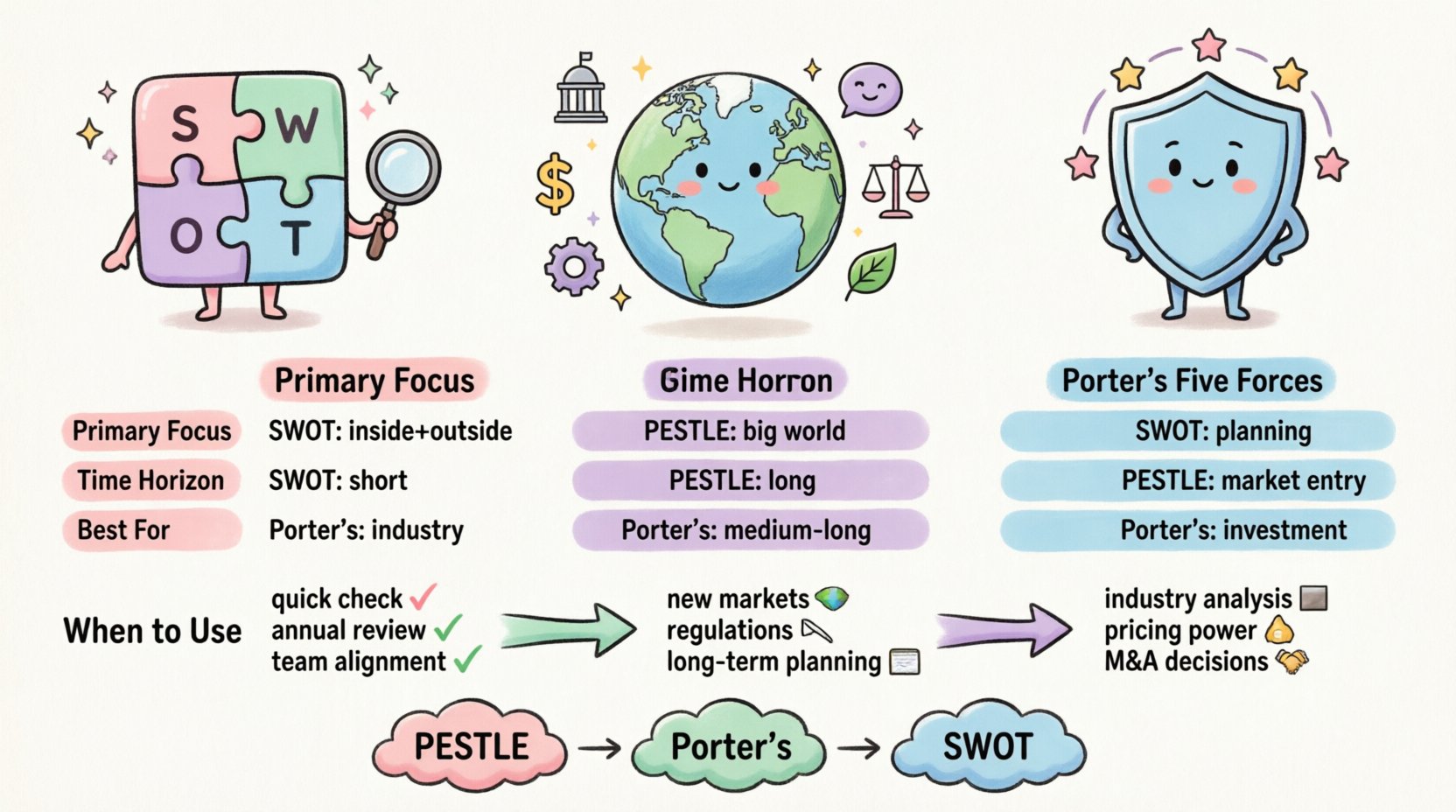
🔍 Understanding SWOT Analysis
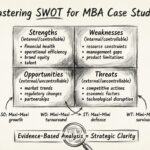
SWOT stands for Strengths, Weaknesses, Opportunities, and Threats. It is a foundational tool used to evaluate the internal and external factors affecting an organization. The matrix divides analysis into two dimensions: internal capabilities and external conditions.
Internal Factors
- Strengths: Attributes that give the company an advantage. Examples include proprietary technology, strong brand reputation, or efficient supply chains.
- Weaknesses: Areas where the company lacks competitive edge. Examples include outdated infrastructure, high debt ratios, or skill gaps within the workforce.
External Factors
- Opportunities: Favorable conditions outside the organization. Examples include emerging markets, regulatory changes favoring the sector, or competitor failures.
- Threats: Obstacles that could cause trouble. Examples include new regulations, economic downturns, or aggressive competitor entry.
SWOT is popular because of its simplicity. It requires no complex calculations. Teams can map these factors on a whiteboard during a workshop. However, it has limitations regarding depth. It often lists items without establishing causal relationships between them. A strength does not automatically lead to an opportunity unless a strategy connects them.
🌍 Deep Dive into PESTLE Analysis
PESTLE expands the view beyond the immediate industry. It focuses on macro-environmental factors that influence an organization over the long term. The acronym stands for Political, Economic, Social, Technological, Legal, and Environmental.
The Six Pillars of PESTLE
- Political: Government policies, trade restrictions, tax laws, and political stability. How does a change in administration affect operations?
- Economic: Growth rates, interest rates, exchange rates, and inflation. Does the current economic climate allow for expansion?
- Social: Demographics, cultural trends, and lifestyle changes. Is consumer behavior shifting toward sustainability?
- Technological: Innovation rates, automation, and R&D activity. Will new tech render current products obsolete?
- Legal: Employment laws, health and safety regulations, and consumer protection. Are compliance costs rising?
- Environmental: Climate change, carbon footprint, and waste management. How does sustainability impact brand perception?
PESTLE is essential for long-term strategic planning. It forces leaders to look outward at forces they cannot control but must adapt to. It is particularly useful for market entry decisions or multi-year investment horizons. However, it can be broad. Without focus, the analysis might list too many factors without prioritizing the ones that matter most.
🏭 Analyzing Competition with Porter’s Five Forces
Developed by Michael Porter, this framework analyzes the competitive intensity of an industry. It determines profitability and attractiveness of a market. The model looks at five distinct forces that shape industry competition.
1. Threat of New Entrants
How easy is it for new competitors to enter the market? High barriers to entry (capital requirements, patents) protect existing players. Low barriers increase competition and reduce margins.
2. Bargaining Power of Suppliers
How much control do suppliers have over prices? If there are few suppliers, they can dictate terms. This squeezes profitability. If many suppliers exist, the buyer has more leverage.
3. Bargaining Power of Buyers
How much control do customers have? If buyers can easily switch to competitors, they drive prices down. High loyalty or switching costs reduce this power.
4. Threat of Substitute Products
Are there alternative solutions to the product? If a substitute exists that is cheaper or better, it limits pricing power. This is often overlooked in traditional product categories.
5. Rivalry Among Existing Competitors
How intense is the competition? Price wars, advertising battles, and innovation races increase rivalry. High rivalry often leads to lower industry profits.
Porter’s Five Forces is the gold standard for industry analysis. It provides a structural view of profitability. It helps answer whether an industry is worth entering or investing in. It is less effective for analyzing internal organizational health.
📊 Head-to-Head Comparison
Understanding the differences helps in selection. The following table outlines the core distinctions between these three frameworks.
| Feature | SWOT Analysis | PESTLE Analysis | Porter’s Five Forces |
|---|---|---|---|
| Primary Focus | Internal & External | Macro-External | Industry Structure |
| Time Horizon | Short to Medium | Long Term | Medium to Long Term |
| Key Output | Strategic Alignment | Environmental Scanning | Competitive Advantage |
| Best Used For | General Planning | Market Entry | Investment Decisions |
| Data Type | Qualitative | Qualitative & Quantitative | Qualitative |
🛠️ When to Use Which Framework?
Selecting the right tool depends on the strategic question at hand. Using the wrong lens can lead to blind spots. Here are specific scenarios for each.
Use SWOT When…
- You need a quick snapshot of the current situation.
- You are conducting an annual review.
- You want to align internal capabilities with external possibilities.
- Stakeholders need a simple, visual representation of the strategy.
Use PESTLE When…
- You are entering a new geographic market.
- Regulatory changes are expected in your sector.
- You are planning for a 5 to 10-year horizon.
- Macroeconomic trends are driving your risk profile.
Use Porter’s Five Forces When…
- You are evaluating the attractiveness of an industry.
- You need to understand pricing power dynamics.
- Competitive threats are emerging from substitutes.
- You are deciding on mergers and acquisitions.
🧩 Integrating the Frameworks
While distinct, these tools are not mutually exclusive. The most robust strategies often combine them. A layered approach provides a 360-degree view.
Example Workflow
- Start with PESTLE: Identify macro-trends. (e.g., A new data privacy law is coming).
- Apply Porter’s: Assess how this affects industry competition. (e.g., Compliance costs favor larger players, increasing rivalry).
- Conclude with SWOT: Map the findings to internal status. (e.g., Our Weakness is compliance tech; our Strength is agile legal team).
This integration ensures that external factors are translated into internal action items. It prevents the common pitfall of knowing the problem but not knowing how to fix it within the organization.
⚠️ Common Pitfalls to Avoid
Even the best framework fails if executed poorly. Leaders must be aware of common errors that reduce the value of these analyses.
- Listing without Prioritizing: Writing down every possible factor dilutes focus. Rank items by impact and probability.
- Ignoring Data: Relying solely on opinion leads to bias. Support claims with market research or internal metrics.
- Static Analysis: These tools are not one-time exercises. Markets change. Update the analysis regularly.
- Confusing Means with Ends: A SWOT is not a strategy. It is an input to strategy. Do not mistake the list for the plan.
- Overlooking Interconnections: A weakness in one area might exacerbate a threat in another. Map the relationships.
🚀 Implementation Steps
Executing a strategic analysis requires a structured process. Follow these steps to ensure rigor and consistency.
1. Define the Objective
Clarify the decision you are trying to support. Is it a launch? A pivot? A budget allocation? The objective dictates the depth of the analysis.
2. Gather the Right Team
Include diverse perspectives. Marketing, operations, finance, and sales should all contribute. Different departments see different threats and opportunities.
3. Collect Data
Use internal reports, customer feedback, and industry research. Avoid assumptions. Validate every point with evidence.
4. Facilitate the Workshop
Run a session dedicated to the framework. Use a whiteboard or digital tool to map findings. Encourage debate. Challenge initial assumptions.
5. Synthesize and Action
Move from analysis to action. Assign owners to specific items. Set deadlines. Ensure the insights lead to concrete changes in the business plan.
📈 Measuring Success
How do you know the analysis was effective? Success is measured by the quality of subsequent decisions. Did the strategy address the identified threats? Did it leverage the identified strengths? Track key performance indicators related to the strategic goals set after the analysis.
🔎 Final Considerations
Strategic planning is not about predicting the future with certainty. It is about preparing for multiple possibilities. SWOT, PESTLE, and Porter’s Five Forces offer structured ways to prepare. None is superior in all contexts. The choice depends on the specific challenge.
For internal health checks, SWOT remains the standard. For long-term horizon scanning, PESTLE is indispensable. For industry viability, Porter’s Five Forces provides the clearest picture. Combining them creates a comprehensive strategy. This approach minimizes risk and maximizes the potential for sustainable growth.
Leaders who master the selection of these tools gain a distinct advantage. They see risks before they become crises. They spot opportunities before competitors do. The goal is not just to analyze, but to act with confidence based on that analysis.
Related posts:
 Inside the CEO’s Brain: A Step-by-Step Guide to Conducting a Powerful SWOT Analysis
 From Idea to Pitch: How to Use a SWOT Analysis to Validate Your Startup Quickly
 The 5-Point Checklist to Ensure Your SWOT Analysis Actually Drives Strategy
 Stop Guessing Your Next Move: A Deep Dive into Mastering SWOT for MBA Case Studies