

Strategic management is a core component of many business and management curricula. Among the various frameworks used to assess organizational position, few are as ubiquitous or as foundational as the SWOT analysis. This tool is designed to identify the internal and external factors that can impact an organization’s success. For students preparing for a certification exam or an academic assessment, understanding the nuances of this framework is critical. It is not merely about memorizing four letters; it is about understanding the interplay between capabilities and environmental conditions.
This guide provides a comprehensive breakdown of the SWOT analysis. It covers definitions, structural components, strategic applications, and specific considerations for examination settings. By the end of this reading, you will have a clear understanding of how to construct, interpret, and apply this framework effectively without relying on generic summaries.
What is SWOT Analysis? 🤔
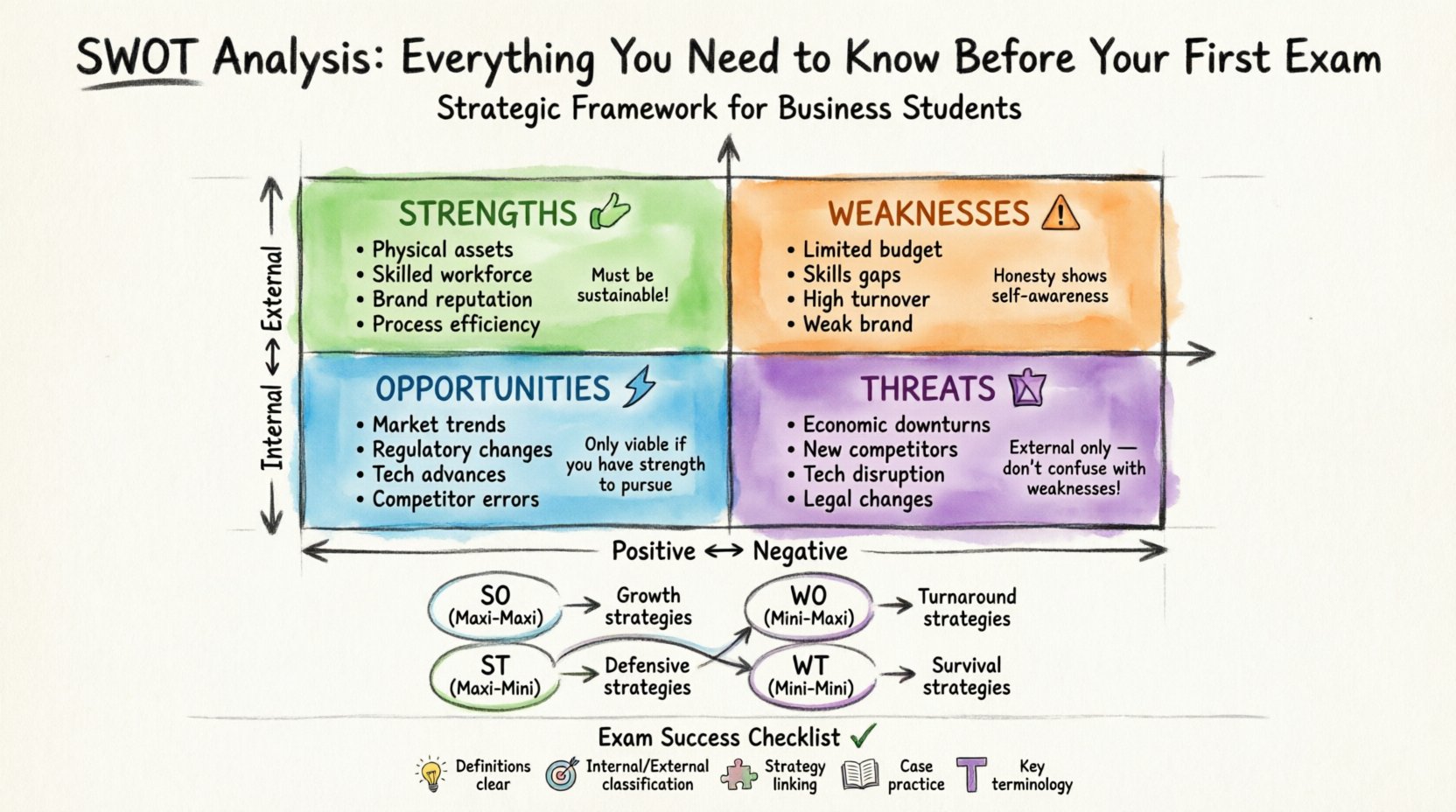
SWOT stands for Strengths, Weaknesses, Opportunities, and Threats. It is a strategic planning technique used to evaluate these four elements of a project or business venture. The framework helps organizations identify internal capabilities that provide an advantage and internal limitations that create obstacles. Simultaneously, it looks outward to recognize favorable conditions in the environment and external risks that could cause trouble.
- Internal Factors: These are things within the organization’s control. They include resources, culture, processes, and personnel.
- External Factors: These are things outside the organization’s control. They include market trends, economic conditions, regulatory changes, and competitor actions.
In an exam context, examiners often test your ability to distinguish between what can be changed internally and what must be adapted to externally. A common error is misclassifying an external market trend as an internal strength. Precision in classification is key to scoring high marks.
The Four Pillars Explained 🧱
To excel in your assessment, you must understand the specific criteria for each of the four components. Vague answers will not suffice. You need to demonstrate depth of knowledge regarding each quadrant.
1. Strengths (S) 💪
Strengths are internal attributes that help an organization achieve its objectives. They are the positive aspects of the internal environment. When answering exam questions, ask yourself: What do we do better than anyone else?
- Physical Assets: State-of-the-art equipment, prime location, or proprietary technology.
- Human Resources: Highly skilled workforce, experienced leadership team, or strong corporate culture.
- Intangible Assets: Brand reputation, patents, trademarks, or customer loyalty.
- Process Efficiency: Lean manufacturing methods or streamlined supply chain logistics.
Exam Tip: A strength must be sustainable. If a competitor can easily copy it, it is a temporary advantage, not a core strength. Differentiating between a core competency and a temporary perk is a frequent testing point.
2. Weaknesses (W) ⚠️
Weaknesses are internal attributes that place the organization at a disadvantage relative to others. These are areas where improvement is needed. They are also within the organization’s control to fix or mitigate.
- Lack of Resources: Limited budget, outdated technology, or insufficient capital.
- Skills Gap: Lack of expertise in specific areas like digital marketing or data analytics.
- Operational Issues: High employee turnover, poor customer service protocols, or slow decision-making processes.
- Market Position: Weak brand recognition or a small market share compared to rivals.
Exam Tip: Be honest in your analysis. Identifying a weakness does not mean the organization is failing; it means there is a gap to be managed. Examiners look for self-awareness in the analysis.
3. Opportunities (O) 🚀
Opportunities are external chances to improve performance or achieve growth. They are not controlled by the organization but can be exploited if the organization is prepared. This is where the external environment intersects with internal capability.
- Market Trends: Growing demand for sustainable products or a shift towards remote work.
- Regulatory Changes: New laws that favor the organization’s business model or open new markets.
- Technological Advances: New software or platforms that can reduce costs or enhance efficiency.
- Competitor Errors: A rival facing a scandal or bankruptcy creates a vacuum to fill.
Exam Tip: An opportunity is only an opportunity if the organization has the strength to pursue it. If you list a trend but the company lacks the capacity to act, it is not a viable opportunity in a strategic context.
4. Threats (T) 🛡️
Threats are external elements that could cause trouble for the business. These are risks that must be monitored and managed. They exist regardless of the organization’s internal health.
- Economic Downturns: Recession, inflation, or rising interest rates affecting consumer spending.
- Competitor Actions: New entrants, price wars, or aggressive marketing campaigns.
- Technological Disruption: New technologies rendering current products obsolete.
- Legal/Regulatory Risks: Stricter compliance requirements or changes in trade policies.
Exam Tip: Threats are external. Do not list internal weaknesses as threats. For example, “our staff is untrained” is a weakness. “Competitors are poaching our staff” is a threat.
Internal vs. External Factors 🔄
One of the most common mistakes in SWOT analysis exams is the misclassification of factors. To ensure accuracy, you must rigorously apply the Internal vs. External filter.
| Factor Type | Control Level | SWOT Category | Example |
|---|---|---|---|
| Internal | High Control | Strength | Proprietary Algorithm |
| Internal | High Control | Weakness | Outdated HR Software |
| External | No Control | Opportunity | New Export Market Opens |
| External | No Control | Threat | Supply Chain Disruption |
When studying for your exam, practice categorizing scenarios. If you can correctly label a factor, you demonstrate a fundamental understanding of strategic management theory. This distinction is often the difference between a passing grade and a top-tier score.
Constructing the Matrix 📋
Once you have identified the four elements, the next step is to organize them into a matrix. This visual representation allows for quick assessment of the strategic landscape. While simple, the matrix serves as the foundation for more complex strategic planning.
Step-by-Step Construction
- Gather Data: Use internal reports, market research, and competitor analysis. Do not rely on assumptions.
- Brainstorm: List all potential factors for each quadrant. Do not filter immediately; quantity leads to quality.
- Categorize: Sort the list into Strengths, Weaknesses, Opportunities, and Threats based on the Internal/External rule.
- Prioritize: Not all factors are equal. Select the top three to five most significant items for each quadrant.
- Review: Check for overlaps. Ensure a factor is not listed in two categories (e.g., do not list “high cost” as both a weakness and a threat).
Exam Tip: Examiners often provide a case study with a long list of facts. Your task is to sift through the noise. Focus on the facts that directly impact strategic viability. Irrelevant details are distractors.
Strategic Implications: The TOWS Matrix 🧩
A basic SWOT analysis is descriptive. It tells you where you stand. To answer higher-level exam questions, you must move to the prescriptive phase. This is where the TOWS matrix comes in. It involves matching internal factors with external factors to generate strategies.
The Four Strategic Quadrants
- SO Strategies (Maxi-Maxi): Use Strengths to maximize Opportunities. This is aggressive growth. Example: Using a strong brand (S) to enter a new market (O).
- WO Strategies (Mini-Maxi): Overcome Weaknesses by taking advantage of Opportunities. This is turnaround. Example: Using new technology (O) to fix outdated infrastructure (W).
- ST Strategies (Maxi-Mini): Use Strengths to minimize Threats. This is defensive. Example: Using cash reserves (S) to weather an economic downturn (T).
- WT Strategies (Mini-Mini): Minimize Weaknesses and avoid Threats. This is survival. Example: Cutting costs (W) to reduce exposure to rising interest rates (T).
In an exam, if asked to recommend a strategy, you must link the recommendation back to the SWOT factors. A generic strategy like “increase marketing” is weak. A strategy like “leverage our high customer retention rate (S) to combat new competitor entry (T)” is strong.
Common Exam Pitfalls ⚠️
Even knowledgeable candidates can lose marks due to specific errors. Being aware of these pitfalls will help you avoid them during the assessment.
- Mixing Internal and External: As mentioned, this is the most frequent error. Ensure your classification is strict.
- Being Too Vague: Avoid phrases like “good management” or “bad economy.” Be specific: “Experienced leadership team” or “Recession in key sector.”
- Ignoring the Environment: Do not analyze a company in a vacuum. The context of the industry matters significantly.
- Listing Symptoms as Causes: “Low profit” is a symptom. The weakness might be “high operational costs.” Identify the root cause.
- Forgetting the Future: SWOT is not just a snapshot of today; it is about future strategy. Opportunities and Threats must be forward-looking.
Practical Application Scenarios 🏢
To solidify your understanding, consider how this applies to a hypothetical scenario often found in exams: A traditional retail bookstore facing the rise of e-commerce.
Internal Analysis
- Strength: Strong community presence and knowledgeable staff.
- Weakness: High overhead costs for physical locations and outdated inventory systems.
External Analysis
- Opportunity: Growing trend of supporting local businesses and experiential shopping.
- Threat: Rapid growth of online retailers offering lower prices and instant delivery.
Strategic Synthesis
A strong answer would suggest an SO strategy: Host in-store events (leveraging Strength) to capitalize on the local support trend (Opportunity). A WT strategy might suggest closing underperforming stores (reducing Weakness) to mitigate cash burn against online competition (Threat).
Final Preparation Checklist ✅
Before you sit for your exam, ensure you have reviewed the following points. This checklist serves as a final verification of your readiness.
- ✅ Definitions: Can you define Strength, Weakness, Opportunity, and Threat clearly?
- ✅ Classification: Can you distinguish between Internal and External factors instantly?
- ✅ Strategies: Do you understand how to link S, W, O, and T to create actionable strategies?
- ✅ Case Studies: Have you practiced applying the framework to different industries (e.g., tech, healthcare, retail)?
- ✅ Terminology: Are you familiar with related terms like Core Competency, PESTLE, and Porter’s Five Forces?
Strategic analysis is not about finding a single “right” answer. It is about logical reasoning supported by evidence. The SWOT framework provides the structure for that reasoning. By mastering the components and their relationships, you equip yourself to handle complex case studies with confidence.
Conclusion on Exam Readiness 🎯
Preparation for a strategic management exam requires more than rote memorization. It demands an understanding of how organizations function within an ecosystem. The SWOT analysis is the lens through which this ecosystem is viewed. Whether you are analyzing a startup or a multinational corporation, the logic remains the same.
Focus on the distinction between what you can control and what you must adapt to. Ensure your strategies are derived directly from your analysis. Avoid generic advice. Always tie your recommendations back to the specific facts provided in the exam question. With this structured approach, you are well-positioned to demonstrate competence and authority in your assessment.
Good luck with your preparation. Apply the framework rigorously, and let the data guide your conclusions.
Related posts:
 Inside the CEO’s Brain: A Step-by-Step Guide to Conducting a Powerful SWOT Analysis
 From Idea to Pitch: How to Use a SWOT Analysis to Validate Your Startup Quickly
 The 5-Point Checklist to Ensure Your SWOT Analysis Actually Drives Strategy
 Stop Guessing Your Next Move: A Deep Dive into Mastering SWOT for MBA Case Studies