


Every business leader, consultant, and strategist has encountered the SWOT analysis. It is the default framework for assessing organizational health. We see it in pitch decks, annual reports, and boardroom meetings. The acronym is familiar: Strengths, Weaknesses, Opportunities, and Threats. Yet, despite its ubiquity, few organizations leverage it effectively. There is a persistent belief that a well-drawn matrix guarantees strategic clarity. This belief is a myth. 🧐
The reality is that a SWOT analysis is often treated as a box-checking exercise rather than a dynamic diagnostic tool. Many teams believe they can produce a perfect version of this analysis that will solve all future planning problems. This expectation sets them up for failure. When the external environment shifts or internal capabilities change, the static document becomes obsolete. It does not reflect the complexity of modern business landscapes. 🌐
This guide examines the five most damaging misconceptions surrounding this framework. By understanding where the standard approach falls short, you can refine your strategic planning process. We will move beyond the surface level to discuss how to integrate this tool into a broader, more resilient decision-making ecosystem. The goal is not to discard the method, but to correct its application.
Understanding the Core Framework 🔍
Before addressing the flaws, we must establish what the framework actually represents. It is a structured planning method used to evaluate the internal and external factors of an organization. The four quadrants are:
- Strengths (S): Internal attributes that are helpful to achieving the objective.
- Weaknesses (W): Internal attributes that are harmful to achieving the objective.
- Opportunities (O): External chances to make a greater profit or gain advantage.
- Threats (T): External elements in the environment that could cause trouble for the business.
While the definitions seem straightforward, the application is where the confusion begins. Teams often list vague items like “good reputation” or “high competition” without digging deeper. A list is not an analysis. An analysis requires context, prioritization, and connection to specific strategic goals. Without these elements, the document remains a collection of observations rather than a roadmap for action. 🗺️
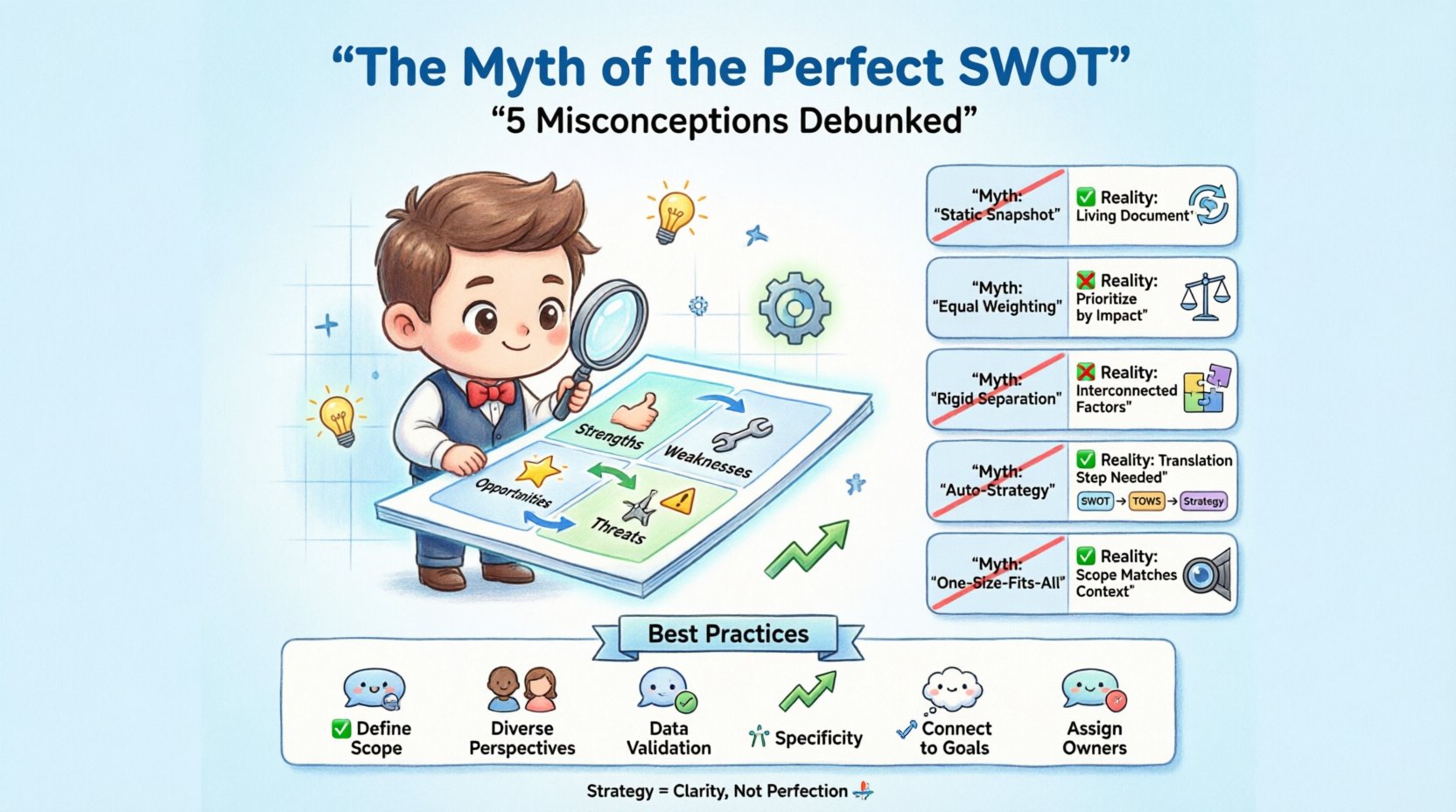
Misconception 1: The SWOT is a Static Snapshot 📸
The most common error is treating the SWOT analysis as a one-time event. Teams often conduct a workshop, create a poster, and file it away. They assume the data remains valid for the next fiscal year. This approach ignores the volatility of the market. 📉
Business environments are fluid. A strength today can become a liability tomorrow. A new technology can render a core competency obsolete within months. If the analysis is static, it provides a false sense of security. It suggests that the strategy is set in stone. This leads to rigidity when adaptation is required.
To correct this, the analysis must be viewed as a living document. It should be revisited regularly. Quarterly reviews are often sufficient to update the data points. Seasonal shifts, regulatory changes, or competitor moves should trigger an immediate review. The process is iterative, not linear. 🔄
Misconception 2: Equal Weighting of All Factors ⚖️
Many strategic plans treat every item in the four quadrants as equally important. The list is generated, and then everyone discusses the items with the same level of intensity. This dilutes focus. 🎯
In reality, not all factors carry the same strategic weight. A minor operational inefficiency is not as critical as a looming regulatory threat. A strong brand reputation may outweigh a temporary cash flow issue. When everything is highlighted as a priority, nothing is prioritized. This creates noise instead of signal.
Effective planning requires filtering. You must distinguish between noise and signal. Use data to validate claims. Is the threat real or perceived? Is the strength sustainable or temporary? Assigning scores or weights to each item helps clarify the hierarchy. This ensures that resources are directed toward the most impactful areas. 🔍
Misconception 3: Internal and External Factors are Rigidly Separated 🧱
There is a rigid boundary drawn between internal factors (Strengths/Weaknesses) and external factors (Opportunities/Threats). The assumption is that the organization controls the left side, and the market controls the right side. This separation is often false. 🤝
Internal actions can create external threats. A poor customer service policy can lead to negative public sentiment, which is an external threat. Conversely, external opportunities often require internal changes to seize them. A new market trend (Opportunity) might require a new skill set (Weakness to address) or investment (Strength to utilize).
Strategic planning must acknowledge the interplay between these domains. A weakness in innovation might prevent you from capitalizing on a market shift. A strength in agility allows you to mitigate a supply chain threat. The quadrants are not silos; they are connected nodes in a network. 🕸️
Misconception 4: The Analysis Guarantees Actionable Outcomes ✅
There is a belief that once the SWOT is complete, the strategy writes itself. The assumption is that the matrix contains the answers. This is a dangerous fallacy. The SWOT is a diagnostic tool, not a prescriptive one. It tells you what is, not what to do. 💡
Without a clear framework for translation, the analysis sits idle. You might identify a major weakness, but the document does not tell you how to fix it. You might spot an opportunity, but not how to capture it. The gap between analysis and execution is where most strategies fail.
Actionable outcomes require a second step. This is often called TOWS analysis or strategy formulation. You must cross-reference the factors. How do you use Strengths to seize Opportunities? How do you use Strengths to mitigate Threats? This cross-matching creates the actual strategic initiatives. Without this translation layer, the SWOT is just a list. 📝
Misconception 5: One Size Fits All Application 🧩
Many organizations apply the same SWOT process to every department, every project, and every product line. A startup uses the same depth of analysis as a multinational corporation. A product launch is treated the same as a long-term corporate vision. This lack of differentiation leads to superficial insights. 🛠️
The scope of the analysis must match the scope of the decision. A tactical decision requires a narrow, specific focus. A strategic decision requires a broad, holistic view. Using a broad SWOT for a specific product feature creates confusion. Using a narrow SWOT for a corporate merger misses the big picture. 🏢
Adapt the depth and breadth of the inquiry to the context. For a quick pivot, a rapid assessment is better than a deep dive. For a decade-long vision, deep diligence is necessary. Tailoring the approach ensures relevance and utility. 🎨
Comparison: Common Myths vs. Strategic Reality 📊
The following table summarizes the key distinctions between the misconceptions and the effective practices.
| Misconception | Strategic Reality |
|---|---|
| SWOT is a one-time workshop. | SWOT is a recurring review cycle. |
| All factors are equally important. | Factors must be prioritized by impact. |
| Internal and external factors are separate. | Internal actions influence external outcomes. |
| The list creates the strategy automatically. | Translation to action is a separate step. |
| One format works for all decisions. | Scope must match the decision context. |
Best Practices for Execution 🛠️
To move from myth to mastery, you must change how you facilitate the planning session. The process matters as much as the output. Here are the steps to ensure high-quality results.
- Define the Scope Clearly: Before starting, state what the analysis is for. Is it for a product line? A department? The whole company? Ambiguity kills focus.
- Invite Diverse Perspectives: Do not limit the session to senior leadership. Frontline employees often see weaknesses and threats that executives miss. Their insights are critical for a complete picture.
- Use Data to Validate: Avoid assumptions. If you claim “strong brand,” have the metrics to prove it. If you claim “market threat,” show the trend data. Evidence strengthens the argument.
- Focus on Specificity: Avoid vague terms. Instead of “good team,” write “team with 5 years of specific technical expertise.” Specificity allows for better planning.
- Connect to Goals: Every item listed should tie back to a strategic objective. If an item does not impact the goal, it does not belong in the analysis.
- Assign Owners: Once the analysis is complete and strategies are formed, assign accountability. Who is responsible for addressing the weakness? Who will lead on the opportunity?
The Role of Context in Strategic Planning 🌍
Context is the missing variable in most analyses. A SWOT that works for a stable industry may fail in a disruptive one. The speed of change dictates the frequency of the analysis. In high-velocity markets, monthly reviews might be necessary. In stable sectors, annual reviews may suffice.
Furthermore, the cultural context matters. If the organization culture discourages admitting weaknesses, the “W” quadrant will be empty or filled with excuses. Leaders must foster psychological safety. Participants must feel safe to identify flaws without fear of retribution. Without this trust, the analysis is performative, not functional. 🤝
Integrating with Other Frameworks 🔗
SWOT is rarely used in isolation. It gains power when integrated with other models. For example, combining SWOT with PESTLE analysis provides a deeper look at external threats and opportunities. Combining it with Porter’s Five Forces helps understand industry competitiveness.
This integration prevents tunnel vision. It ensures that internal strengths are evaluated against external pressures. It creates a more robust strategic foundation. Think of SWOT as the foundation, but not the entire building. 🏗️
Overcoming Resistance to Change 🚧
Even with the right framework, teams often resist the process. They may feel the exercise is bureaucratic. They may feel they already know the answers. To overcome this, leaders must demonstrate the value of the output. Show how the analysis prevented a failure or captured a gain.
Show, don’t just tell. When a team sees the tangible benefit of the analysis, they engage more deeply. Treat the workshop as a problem-solving session, not a reporting exercise. Make it interactive and engaging. Use visual aids to keep attention. Keep the sessions time-boxed to respect productivity. ⏱️
Measuring the Effectiveness of the Analysis 📏
How do you know if the SWOT analysis was useful? You measure the outcomes of the strategy it generated. Did the identified threats materialize? Was the opportunity captured? Did the weaknesses improve?
Track key performance indicators (KPIs) linked to the strategic initiatives. If the strategy was based on the analysis, the KPIs should reflect the logic of the SWOT. If the KPIs do not move, the analysis may have been disconnected from reality. This feedback loop is essential for continuous improvement. 🔄
Final Thoughts on Strategic Clarity 🧭
Strategic planning is not about finding the perfect answer. It is about navigating uncertainty with the best available information. The SWOT analysis is a tool in that toolkit. It is not a magic wand. It requires discipline, honesty, and iteration to work.
By debunking these five misconceptions, you can elevate the quality of your planning. You move from a static document to a dynamic process. You move from vague lists to actionable insights. This shift requires effort, but the return on investment is significant. Organizations that treat strategy as a rigorous discipline outperform those that treat it as a ritual. 🏆
Remember that the goal is not perfection. The goal is clarity. A flawed analysis is better than no analysis, provided you understand its limitations. Use the insights to guide your decisions, but remain flexible. The market will change, and so must your plan. Adaptability is the true strength in strategic planning. 🚀
Related posts:
 Inside the CEO’s Brain: A Step-by-Step Guide to Conducting a Powerful SWOT Analysis
 From Idea to Pitch: How to Use a SWOT Analysis to Validate Your Startup Quickly
 The 5-Point Checklist to Ensure Your SWOT Analysis Actually Drives Strategy
 Stop Guessing Your Next Move: A Deep Dive into Mastering SWOT for MBA Case Studies