

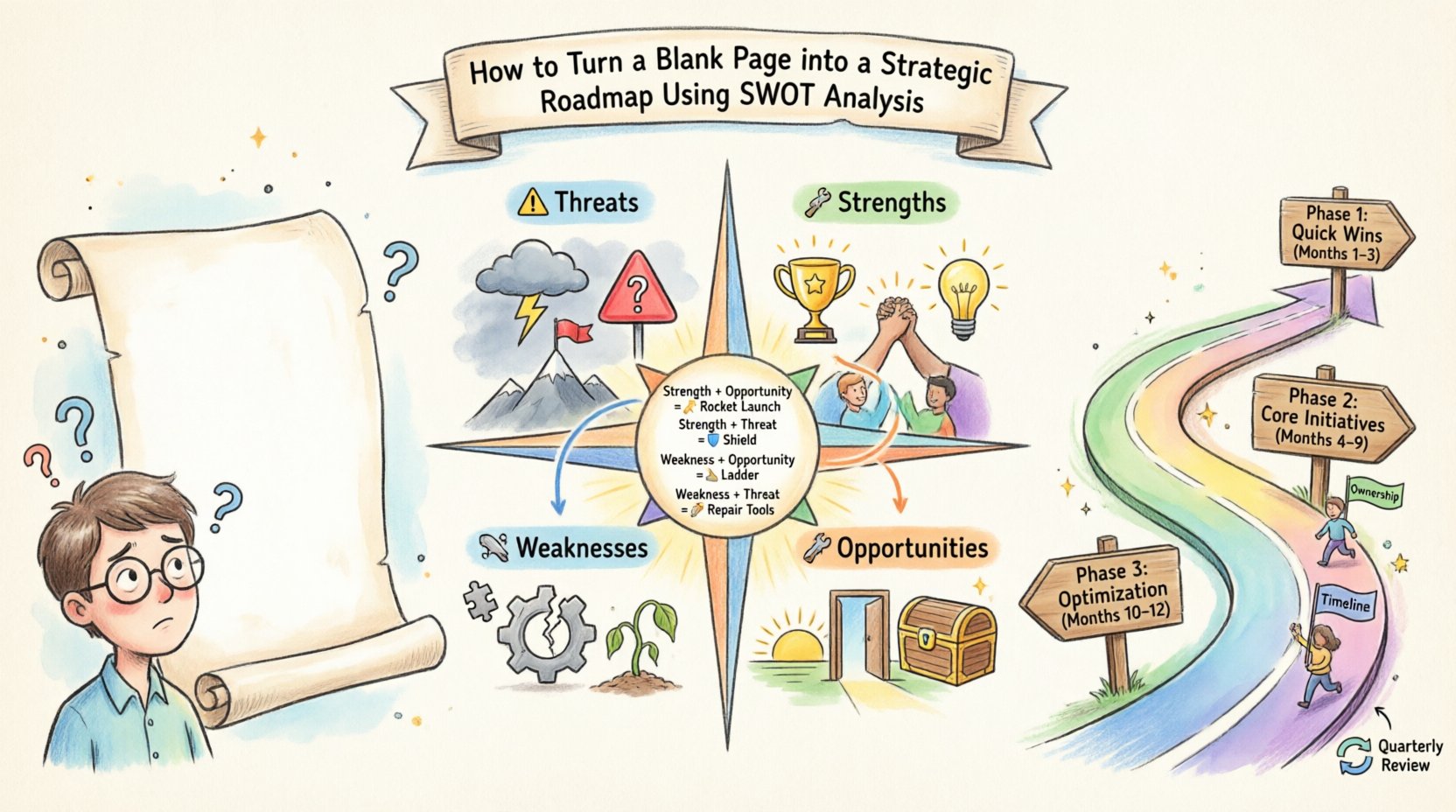
Starting with a blank page is a universal challenge for leaders and strategists. The white space represents potential, but it also embodies uncertainty. Without a framework, that potential can easily dissipate into scattered thoughts. A structured approach transforms that anxiety into a clear path forward. The SWOT analysis serves as a foundational tool for this transformation. It is not merely a checklist; it is a lens for viewing your organization’s position relative to its environment. By applying a rigorous walkthrough, you convert abstract ideas into a tangible strategic roadmap. This guide details the process of moving from analysis to execution without relying on complex tools or proprietary software.
Understanding the Blank Page Paradox 🧠
The fear of the blank page stems from the pressure to be comprehensive immediately. Many teams attempt to plan the entire journey before understanding the terrain. This leads to paralysis. The goal is not to predict the future with certainty, but to prepare for multiple possibilities. A strategic roadmap is a living document. It requires a starting point that is grounded in reality. The SWOT analysis provides that grounding.
When you face a blank document, you are essentially facing a void of information. Filling that void requires a methodical approach to data collection. You must gather inputs from various departments. Sales data, operational feedback, and market research all contribute to the picture. Without these inputs, the roadmap becomes a fantasy. The process begins with acknowledging what you know and identifying what you need to find out. This distinction is critical for effective planning.
- Identify the scope of the strategy.
- Define the time horizon for the roadmap.
- Gather stakeholders for initial input.
- Collect historical performance data.
Setting the Stage for Analysis 🛠️
Before diving into the four quadrants of SWOT, preparation is essential. A hasty analysis often yields superficial results. You need a dedicated session or a series of workshops to ensure depth. The environment matters. Participants should feel safe to share weaknesses without fear of retribution. Psychological safety allows for honest assessment. If the team hides flaws, the roadmap will fail when those flaws manifest.
Define the specific question you are trying to answer. Is the goal to launch a new product? To enter a new market? To improve retention? The context shapes the answers you seek. A generic SWOT is less useful than a specific one. Tailor your questions to the objective. For example, if the goal is market expansion, focus heavily on external opportunities and threats related to geography or demographics.
The Four Pillars of SWOT 🏛️
The SWOT framework divides information into two categories: internal and external, and two categories of impact: positive and negative. This structure forces a balanced view. It prevents overconfidence in internal strengths while ignoring external risks. It also prevents excessive pessimism by highlighting internal capabilities that can mitigate threats.
1. Strengths: Internal Assets 💪
Strengths are attributes that are in your control and give you an advantage. These are the internal factors. They are the reasons why your organization succeeds where others might struggle. Identifying these requires honesty. Sometimes strengths are obvious, like a patent or a strong brand. Other times, they are intangible, like a highly skilled team or a streamlined process.
When listing strengths, focus on what is sustainable. A temporary advantage is not a true strength. Consider the following categories:
- Human Capital: Skills, experience, and leadership quality.
- Intellectual Property: Patents, copyrights, and trade secrets.
- Financial Resources: Cash flow, access to capital, and profitability.
- Operational Efficiency: Supply chain speed, technology stack, and workflow.
Ask your team: What do we do better than anyone else? What unique resources do we possess? Do not inflate these points. If a strength is not currently delivering value, it is not a strategic asset.
2. Weaknesses: Internal Gaps 📉
Weaknesses are internal factors that hinder performance. Acknowledging these is difficult but necessary. A roadmap built on ignoring weaknesses is destined to hit a wall. Weaknesses are often areas where competitors outperform you or where internal processes break down.
Common areas of weakness include:
- Technology: Outdated systems or lack of automation.
- Skills: Gaps in the workforce or training deficiencies.
- Brand: Low market awareness or poor reputation.
- Capacity: Inability to scale production or service delivery.
The key is to distinguish between a weakness and a weakness that matters strategically. Not every gap needs to be fixed immediately. Focus on the weaknesses that directly impact the strategic goals you are trying to achieve.
3. Opportunities: External Avenues 🚀
Opportunities are external factors that the organization can exploit to its advantage. These are trends, market shifts, or regulatory changes that open doors. Unlike strengths, you cannot create opportunities directly; you must recognize and act on them. This requires constant monitoring of the external environment.
Look for opportunities in these areas:
- Market Trends: Changing consumer behaviors or preferences.
- Technology: New tools that improve efficiency or create products.
- Regulations: Laws that favor your business model.
- Competitor Moves: Competitor failures or exits that create space.
An opportunity is only useful if you have the strength to seize it. If you identify a market gap but lack the capacity to serve it, it is not a viable opportunity for your current roadmap.
4. Threats: External Risks ⚠️
Threats are external factors that could cause trouble for the business. These are risks that are outside your direct control. They might be economic downturns, new regulations, or aggressive competitors. The goal is not to eliminate all threats, which is impossible, but to build resilience against them.
Typical threats include:
- Economic Factors: Inflation, interest rates, or recession.
- Competition: Price wars or new entrants with better technology.
- Supply Chain: Disruptions in logistics or raw material availability.
- Political: Changes in government policy or trade tariffs.
For each threat, consider the likelihood and the impact. High likelihood and high impact threats require immediate attention in the roadmap. Low likelihood threats can be monitored.
From Analysis to Action: The Synthesis Phase 🔄
Completing the four quadrants is only the first step. The real value lies in connecting the dots. You must move from listing items to creating strategies. This involves cross-referencing the internal factors with the external factors. A common method is to look for matches between Strengths and Opportunities, or Strengths and Threats.
Consider this matrix to guide your synthesis:
| Internal Factor | External Factor | Strategic Question |
|---|---|---|
| Strength | Opportunity | How can we use this strength to capture this opportunity? |
| Strength | Threat | How can we use this strength to defend against this threat? |
| Weakness | Opportunity | How can we overcome this weakness to take advantage of this opportunity? |
| Weakness | Threat | How do we fix this weakness to avoid this threat? |
This exercise forces you to think dynamically. It moves the conversation from “what is” to “what can be.” It highlights where resources need to be allocated. For instance, if a Strength is leveraged against a Threat, that is a defensive strategy. If a Weakness is addressed to capture an Opportunity, that is an offensive strategy.
Building the Strategic Roadmap 🛣️
Once you have synthesized the SWOT data, you are ready to build the roadmap. A roadmap is a timeline of initiatives designed to achieve strategic goals. It translates high-level strategy into specific actions. The SWOT analysis informs which initiatives are worth pursuing.
1. Prioritization Criteria ✅
You will likely have more ideas than resources allow. Prioritization is the process of deciding what to do first. Use a scoring system based on impact and effort. High impact, low effort items are quick wins. High impact, high effort items are major projects. Low impact items are candidates for elimination or delegation.
Criteria for prioritization include:
- Strategic Alignment: Does this directly support the main goal?
- Feasibility: Do we have the resources and skills?
- Timing: Is this the right time to act?
- Risk: What is the cost of failure?
2. Assigning Ownership 🤝
A roadmap without owners is a wish list. Every initiative must have a single point of accountability. This person is responsible for the outcome, not just the execution. Ownership ensures that tasks do not fall through the cracks. It also clarifies who is responsible for decision-making when obstacles arise.
When assigning ownership:
- Match the initiative to the person’s expertise.
- Ensure the owner has the authority to make necessary decisions.
- Confirm they have the bandwidth to take on the responsibility.
- Document the responsibility clearly in the roadmap.
3. Timeline and Milestones ⏳
Timeframes provide the structure for the roadmap. Break the strategy into phases. Define clear milestones that indicate progress. Milestones should be measurable. Vague goals like “improve performance” are hard to track. Specific goals like “increase efficiency by 10% by Q3” are trackable.
Structure your timeline logically:
- Phase 1: Foundation and Quick Wins (Months 1-3).
- Phase 2: Core Initiatives and Scaling (Months 4-9).
- Phase 3: Optimization and Review (Months 10-12).
Ensure there is buffer time for unexpected delays. Planning is rarely perfect. Buffers protect the timeline from minor disruptions.
Common Pitfalls to Avoid 🚫
Even with a solid framework, errors can occur during the planning process. Being aware of common mistakes helps you navigate them. One common error is treating the SWOT as a one-time event. Strategy is dynamic. Market conditions change, and so should your roadmap.
Another pitfall is focusing too much on the internal factors. While strengths and weaknesses are important, ignoring external threats can be fatal. A company with great internal processes can still fail if the market shifts or a new competitor emerges. Balance is key.
Do not confuse activities with outcomes. A roadmap should focus on results, not just tasks. “Hold a meeting” is an activity. “Define a new policy” is an outcome. “Reduce customer churn” is a strategic result. Focus on the latter.
Maintaining the Roadmap Over Time 🔄
A roadmap is a guide, not a contract. It must be reviewed regularly. Schedule quarterly reviews to assess progress and relevance. During these reviews, ask if the original assumptions still hold true. Has a Strength become a Weakness? Has a Threat materialized? Has an Opportunity closed?
Adjustments are a sign of a healthy strategy, not a failure. If the data changes, the plan must change. This iterative process ensures the organization remains agile. It prevents the team from pursuing a path that no longer makes sense.
- Monitor Key Metrics: Track the indicators that matter most.
- Check External Signals: Keep an eye on industry news and trends.
- Engage Stakeholders: Get feedback from the teams executing the work.
- Document Changes: Record why decisions were made to maintain context.
By following this structured approach, you turn the blank page into a detailed plan. The SWOT analysis provides the insight, and the roadmap provides the direction. This combination builds a foundation for sustainable growth and resilience. You do not need to predict the future perfectly; you only need to be prepared for what comes next.
Related posts:
 Inside the CEO’s Brain: A Step-by-Step Guide to Conducting a Powerful SWOT Analysis
 From Idea to Pitch: How to Use a SWOT Analysis to Validate Your Startup Quickly
 The 5-Point Checklist to Ensure Your SWOT Analysis Actually Drives Strategy
 Stop Guessing Your Next Move: A Deep Dive into Mastering SWOT for MBA Case Studies