


Strategy is often abstract. It lives in meetings, spreadsheets, and dense documents that gather dust on virtual shelves. When leaders attempt to convey a complex direction to a team, they frequently rely on linear text. This approach creates friction. It demands high cognitive load from the audience. People struggle to connect the dots between individual tasks and the broader mission. Visual canvas models offer a solution. They translate abstract concepts into tangible structures. This guide explores how to leverage these frameworks to improve clarity, alignment, and execution across your organization.
Visual communication is not merely about decoration. It is about cognitive efficiency. The human brain processes images significantly faster than text. By organizing strategic information into a visual model, you reduce the time required to understand the core value proposition. You create a shared language for stakeholders. This shared language minimizes ambiguity. It allows teams to focus on execution rather than interpretation.
Understanding the Cognitive Load of Strategy 🧠
Complex strategies often fail because they are communicated poorly. The information is too dense. The relationships between components are unclear. When a leader presents a new initiative, they might list goals, timelines, and responsibilities. However, this list format does not show how these elements interact.
Consider the following challenges that arise in traditional communication:
- Fragmented Information: Details are scattered across multiple documents. No single view exists.
- Lack of Context: Team members see their tasks but not the bigger picture.
- Passive Consumption: Audiences read slides without engaging with the material.
- High Ambiguity: Terms are interpreted differently by different departments.
A visual canvas model addresses these issues directly. It forces the strategist to simplify. It requires the identification of core elements. It highlights connections. When you move from text to a structured visual, you are not just changing the format. You are changing the thinking process.
The Anatomy of a Visual Canvas Framework 📊
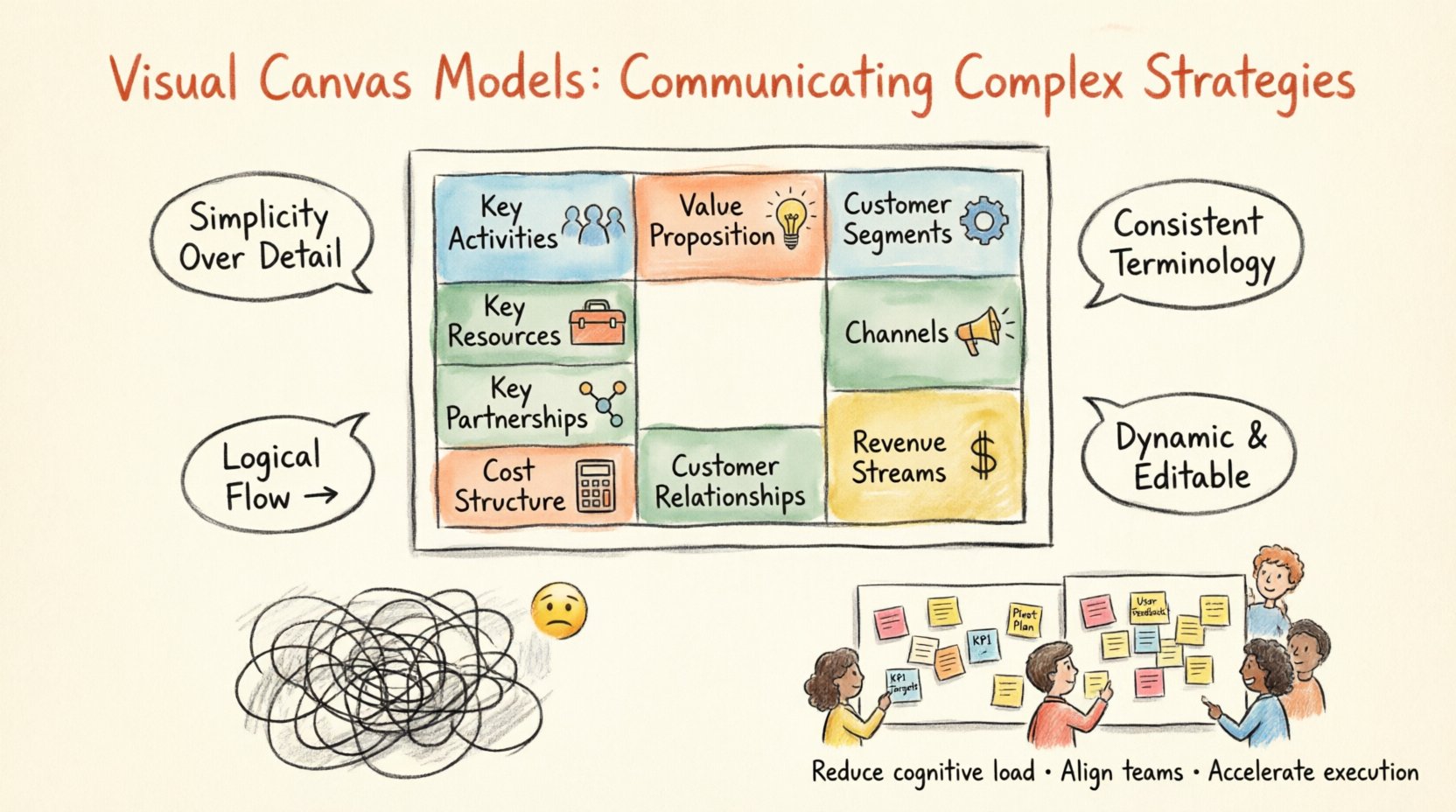
A canvas model is a strategic management tool that describes the logic of how an organization creates, delivers, and captures value. While various iterations exist, the core principle remains consistent. The model divides the business into distinct blocks. Each block represents a critical component of the strategy. The lines connecting them represent relationships.
This structure is particularly effective for communicating complex strategies because it breaks down overwhelming information into manageable chunks. It allows stakeholders to see the whole system without getting lost in the weeds. Below is a breakdown of the essential components typically found in these models.
| Component | Description | Strategic Question |
|---|---|---|
| Value Proposition | What problem are you solving? | Why do customers choose you? |
| Customer Segments | Who are you serving? | Who creates value for whom? |
| Channels | How do you reach them? | How do you deliver value? |
| Revenue Streams | How do you earn money? | What is the economic logic? |
| Key Resources | What assets do you need? | What makes it possible? |
| Key Activities | What must you do? | What actions drive value? |
| Key Partnerships | Who helps you succeed? | Who supports your delivery? |
| Cost Structure | What are the expenses? | What is the financial burden? |
| Customer Relationships | How do you interact? | How do you maintain loyalty? |
Principles of Effective Visual Translation 🎨
Creating a visual canvas is not simply about drawing boxes. It requires adherence to specific principles to ensure the communication is effective. The goal is clarity, not complexity. If the visual is harder to understand than the text, it has failed.
1. Simplicity Over Detail
A canvas is a high-level map. It is not a specification document. Do not clutter the model with excessive data. Use the canvas to show the architecture of the strategy. Detailed metrics belong in appendices or dashboards. The canvas should show the what and the why, not necessarily every how.
2. Logical Flow
Visual models should follow a natural reading pattern. Typically, this means moving from left to right. You start with the customer on the left and move toward the infrastructure on the right. This mimics the journey of value creation. It helps the viewer understand the flow of the business logic.
3. Consistent Terminology
Language matters. If you use different terms for the same concept in different sections, confusion arises. Establish a glossary before you begin. Ensure that every team member interprets “Key Activities” or “Value Proposition” in the same way. Consistency builds trust.
4. Dynamic Nature
A strategy is not static. The visual model should reflect this. It must be easy to update. If a partnership changes, or a resource shifts, the model should be editable. A static document becomes obsolete quickly. A living canvas remains relevant.
Step-by-Step Guide to Mapping Strategy 🗺️
Translating a complex strategy into a visual model requires a disciplined approach. Follow these steps to ensure a robust output.
- Define the Objective: Before drawing anything, clarify why you are creating this model. Is it for internal alignment? For investor communication? For operational planning? The audience dictates the focus.
- Gather Stakeholders: Do not work in isolation. Strategy involves multiple departments. Include representatives from finance, operations, sales, and product. Their input ensures the model is realistic.
- Draft the Customer Side: Start with the customer. Identify who they are. What do they need? How do you reach them? This grounds the strategy in reality.
- Map the Value: Define the unique value you offer. How does it solve the customer’s problem? This is the core of the model.
- Outline the Infrastructure: Once the value is clear, determine what is needed to deliver it. List the resources, activities, and partnerships required.
- Calculate Economics: Finally, address the financials. How does this create revenue? What does it cost? Ensure the logic holds together.
- Review and Iterate: Present the draft to the group. Look for gaps. Is anything missing? Is anything redundant? Refine the model until it tells a coherent story.
Facilitating Alignment and Collaboration 🤝
One of the greatest benefits of a visual canvas is its ability to facilitate alignment. When a team looks at the same visual, they share a common reference point. This reduces the likelihood of siloed thinking. It encourages cross-functional dialogue.
During workshops, use the canvas as a facilitation tool. Place the model on a wall or a digital board. Ask team members to add sticky notes or draw connections. This active participation increases buy-in. When people contribute to the model, they feel ownership of the strategy.
Consider the following scenarios where collaboration is critical:
- Product Development: Ensuring the feature set matches the market need.
- Marketing Campaigns: Aligning messaging with the actual value proposition.
- Operations: Ensuring capacity matches the projected demand.
- Finance: Validating that the cost structure supports the revenue model.
When these groups collaborate on the visual model, they identify conflicts early. For example, marketing might promise a speed of delivery that operations cannot support. The visual model makes this conflict visible immediately. It allows the team to adjust before resources are wasted.
Common Obstacles in Visual Strategy 🚧
Despite the benefits, there are challenges to implementing visual models. Recognizing these pitfalls early can save time and effort.
1. Over-Complexity
It is tempting to add every detail. You might feel that if you leave something out, you are hiding information. Resist this urge. If the visual becomes too dense, it loses its power. It becomes another wall of text, just in boxes.
2. Lack of Context
A canvas does not exist in a vacuum. It needs context. Without a narrative to accompany the visual, stakeholders might misinterpret the connections. Always provide a brief explanation of how the blocks interact.
3. Static Implementation
Many teams create a canvas once and file it away. This defeats the purpose. Strategy evolves. The model must evolve with it. Schedule regular review sessions to update the visual. Treat it as a living document.
4. Ignoring the Human Element
Visuals are powerful, but they are not magic. They do not replace the need for clear communication. Leaders must still explain the strategy verbally. The visual supports the conversation; it does not replace it.
Measuring the Impact of Visual Communication 📈
How do you know if your visual strategy is working? Look for specific indicators of improved understanding and alignment. These metrics go beyond traditional performance data.
- Speed of Decision Making: Do teams make decisions faster because they understand the strategy? Reduced ambiguity should lead to quicker action.
- Consistency of Messaging: Do different departments tell the same story to customers? A shared visual model should align external communications.
- Employee Engagement: Do team members feel more connected to the mission? When people see their role in the bigger picture, engagement often rises.
- Reduced Rework: Are fewer projects being scrapped due to misalignment? Clear strategy reduces wasted effort.
Tracking these indicators helps you refine your approach. If you notice that decisions are still slow, revisit the visual model. Is it too complex? Is the flow confusing? Adjust accordingly.
Sustaining the Visual Narrative Over Time ⏳
Long-term success requires maintaining the visual narrative. This involves integrating the canvas into regular business rhythms. It should not be an annual event. It should be a part of weekly or monthly reviews.
Use the model in planning cycles. When setting quarterly goals, reference the specific blocks of the canvas. This ensures that short-term actions support the long-term strategy. It creates a thread of continuity.
Additionally, onboard new employees using the visual model. It is often easier for a new hire to understand a strategy through a diagram than through a handbook. The visual provides a quick snapshot of the business logic. It accelerates the learning curve.
Integrating Technology Without Dependency 🖥️
While digital tools can assist in creating and sharing these models, the strategy does not depend on specific software. The value lies in the logic, not the medium. You can use physical whiteboards, paper, or simple drawing applications. The key is accessibility.
Ensure the model is available to everyone who needs it. If it is locked in a proprietary system, it limits collaboration. If it is on a shared drive, it is accessible. The goal is to make the strategy visible to all.
Final Thoughts on Strategic Clarity 🌟
Communicating complex strategies is one of the most important responsibilities of leadership. Text-heavy approaches often obscure the path forward. Visual canvas models provide clarity. They simplify complexity. They align teams.
By focusing on the core components of value creation, you create a framework that is both flexible and robust. You empower your team to see the connections between their daily work and the broader mission. This visibility drives better decisions. It fosters a culture of transparency.
Start small. Pick one strategic initiative. Map it out visually. Share it with your team. Gather feedback. Iterate. Over time, this practice becomes part of your organizational DNA. It transforms how you think about strategy. It moves you from guessing to knowing.
Remember, the goal is not perfection. It is understanding. As long as the visual model helps people understand the strategy better than words alone, it is succeeding. Keep it simple. Keep it updated. Keep it shared.
Related posts:
 Business Model Canvas: How to Validate Business Model Assumptions Before Pitching Investors
 Pivoting Your Business Model Canvas Based on Real Market Data
 Business Model Canvas: Identifying Critical Weaknesses in Early Stage Business Models
 Business Model Canvas: Designing Scalable Business Models for Hypergrowth Startups