

In today’s volatile market environment, the ability to pivot is not just an advantage; it is a requirement for survival. Corporate leaders often possess deep industry knowledge, yet they frequently struggle with the mechanics of structural change. Teaching business model innovation bridges the gap between traditional strategy and modern execution. This guide outlines a robust approach to training executives using the Business Model Canvas (BMC) framework.
The objective is not merely to introduce a diagram, but to cultivate a mindset where leaders view value creation as a dynamic system rather than a static asset. Through structured learning, organizations can foster a culture where innovation is repeatable and scalable.
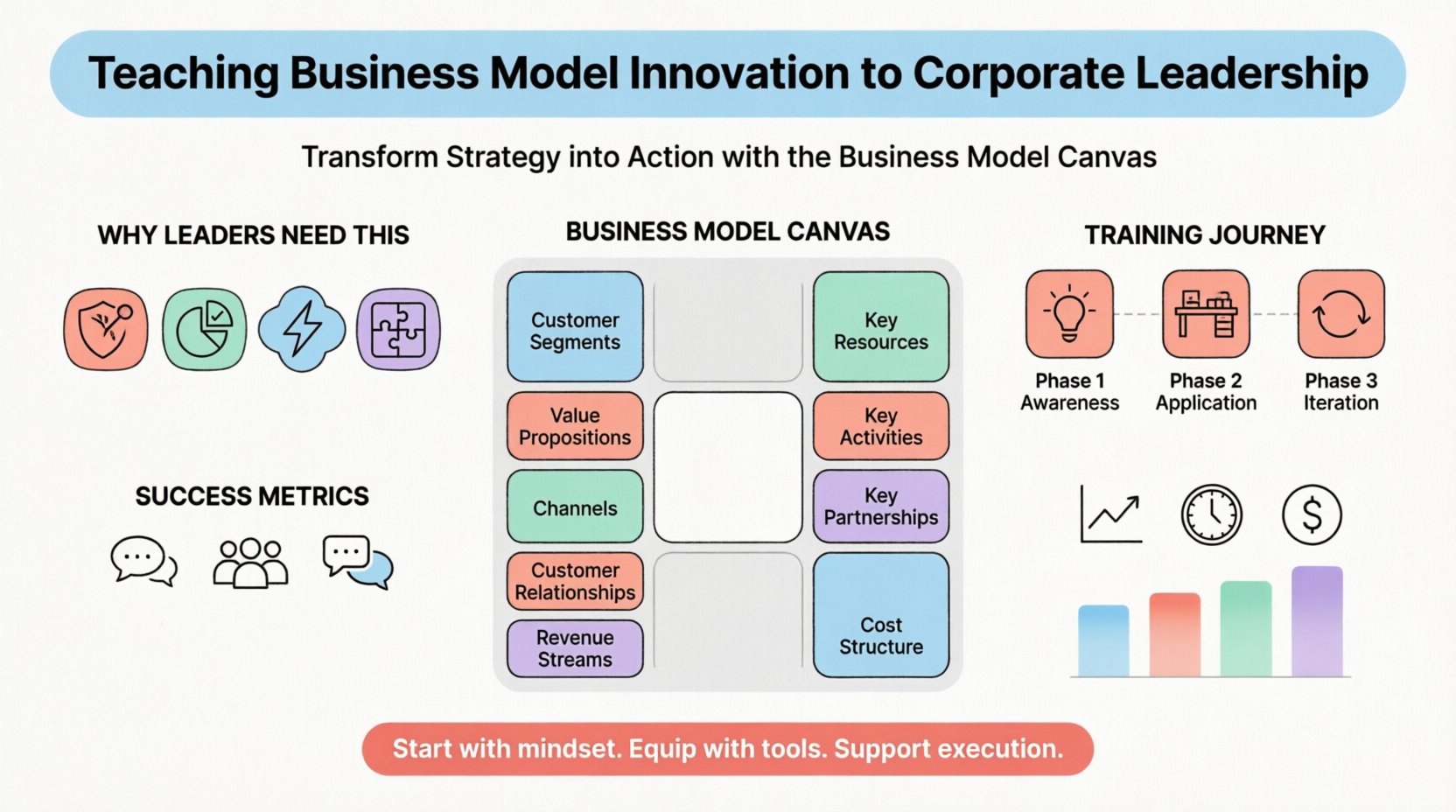
🚀 Why Corporate Leaders Need This Skill
Strategic planning often remains disconnected from operational reality. Leaders are tasked with setting vision, yet they lack the tools to visualize how that vision translates into revenue, cost structures, and customer relationships. Training in business model innovation addresses this disconnect.
- Market Disruption: Competitors often do not attack your product directly; they attack your value proposition. Leaders need to see these shifts before they happen.
- Resource Optimization: Understanding the cost structure and revenue streams allows for better capital allocation.
- Agility: A visual framework allows for rapid hypothesis testing without committing massive budgets prematurely.
- Alignment: When the C-suite speaks the same language, execution becomes smoother and cross-functional friction decreases.
Without this training, innovation remains the domain of the R&D department or a specific innovation lab. By integrating it into leadership development, innovation becomes a core competency of the organization.
📊 The Framework: Business Model Canvas (BMC)
The Business Model Canvas is a strategic management template for developing new or documenting existing business models. It serves as the visual backbone for these training sessions. It deconstructs a business into nine fundamental building blocks.
Understanding the Nine Building Blocks
To teach this effectively, facilitators must ensure leaders understand the interconnectivity of these blocks. Changing one often impacts the others.
- Customer Segments: Who are we creating value for? Who are the most important customers?
- Value Propositions: What bundle of products and services create value for a specific customer segment?
- Channels: Through which channels do our customer segments want to be reached?
- Customer Relationships: What type of relationship does each customer segment expect us to establish?
- Revenue Streams: For what value are our customers really willing to pay?
- Key Resources: What key resources does our value proposition require?
- Key Activities: What key activities does our value proposition require?
- Key Partnerships: Who are our key suppliers and partners?
- Cost Structure: What are the most important costs inherent in our business model?
Traditional Strategy vs. Business Model Canvas
Understanding the difference helps leaders appreciate why this tool is necessary for modern innovation.
| Feature | Traditional Strategic Planning | Business Model Canvas |
|---|---|---|
| Format | Linear document (50+ pages) | Visual one-page diagram |
| Focus | Financial projections and market share | Value creation and delivery logic |
| Flexibility | Static, updated annually | Dynamic, updated iteratively |
| Collaboration | Top-down decision making | Cross-functional workshop style |
| Speed | Slow to develop and review | Rapid prototyping and testing |
🛠️ Structuring the Training Program
Effective training for executives requires a specific pedagogical approach. Standard classroom methods often fail with senior leaders who are skeptical of theory without practical application. The program should follow a phased approach.
Phase 1: Awareness and Context
The first session should not focus on filling out the canvas immediately. It must focus on the “why.” Leaders need to understand the limitations of their current models.
- Case Studies: Analyze successful pivots in the industry. Discuss how a competitor changed their revenue model.
- Diagnostic Audit: Have leaders map their current business model on a large scale. Identify bottlenecks.
- Terminology: Ensure everyone understands the nine blocks equally to prevent communication gaps later.
Phase 2: Application and Prototyping
Once the concepts are understood, leaders move to application. This is where the real learning happens.
- Group Workshops: Break leaders into cross-functional groups. Assign them a new customer segment to target.
- Redesign Sessions: Challenge them to redesign one block of the model without changing the core value proposition.
- Stress Testing: Ask “What if?” questions. What if the cost structure doubles? What if a new regulation changes the channels?
Phase 3: Iteration and Implementation
Training ends only when action begins. Leaders must take the canvas back to their teams and pilot the changes.
- Experiment Backlogs: Create a list of experiments to validate the new model elements.
- Review Cadence: Schedule monthly check-ins to review progress on the new business model.
- Feedback Loops: Establish how customer feedback will be integrated into the model updates.
🤝 Facilitation Techniques for Executives
Facilitating a workshop for C-level executives requires a different skill set than training junior staff. The facilitator must maintain authority while encouraging vulnerability. Leaders are used to having the answers; this training asks them to admit they do not have all the answers.
Psychological Safety
Innovation requires risk. If leaders feel their job is on the line for a failed hypothesis, they will not engage. The facilitator must set ground rules that emphasize learning over judgment.
- Confidentiality: Discussions about internal weaknesses remain within the room.
- No Hierarchy: During the workshop, titles are set aside. The best idea wins, regardless of rank.
- Failure as Data: Frame failed experiments as valuable data points, not personal defeats.
Managing Cognitive Biases
Executives are prone to specific biases that hinder innovation. Training must explicitly address these.
- Sunk Cost Fallacy: Leaders often cling to failing models because of past investment. Teach them to cut losses based on future potential.
- Confirmation Bias: Ensure teams seek disconfirming evidence for their new ideas, not just validation.
- Status Quo Bias: Actively challenge the “we have always done it this way” mentality.
📈 Measuring Success in Innovation
How do you know the training worked? Success is not just about filling out a canvas. It is about tangible shifts in behavior and output.
Qualitative Metrics
- Engagement: Are leaders actively participating in workshops or checking out mentally?
- Language Shift: Do team meetings begin to use terms like “value proposition” and “revenue streams” naturally?
- Cross-Functional Collaboration: Is the silo between sales, product, and finance breaking down?
Quantitative Metrics
- Experiment Velocity: How many hypotheses are being tested per quarter?
- Revenue Diversification: Is there growth in non-core revenue streams?
- Time-to-Market: Has the time from idea to pilot decreased?
| Level of Maturity | Indicator |
|---|---|
| Novice | Can draw the canvas accurately |
| Intermediate | Can identify gaps in the current model |
| Advanced | Can rapidly prototype and validate new models |
| Expert | Teaches others and institutionalizes the process |
⚠️ Common Pitfalls in Leadership Training
Even with the best intentions, these programs can fail. Awareness of common pitfalls allows facilitators to navigate them.
One-Size-Fits-All Approach
A tech company needs a different training focus than a manufacturing firm. A manufacturing firm focuses on supply chain and physical channels. A tech company focuses on networks and data. Tailor the case studies and examples to the specific industry context.
Lack of Follow-Up
A two-day workshop is often insufficient. If leaders return to their desks and face the same KPIs and pressures, they will revert to old habits. There must be a mechanism to support the new behaviors.
- Coaching: Provide access to coaches who understand the BMC framework.
- Resources: Give leaders templates and checklists they can use immediately.
- Accountability: Tie innovation goals to performance reviews where appropriate.
Confusing Strategy with Innovation
Strategy is about choosing where to play. Innovation is about how to win. Training must clarify that the Business Model Canvas helps define the “how.” Do not let the canvas become a strategic plan document. It remains a model of how the business works.
Ignoring the Customer
It is common for leaders to fill out the canvas based on internal assumptions. This leads to “inside-out” thinking. Training must emphasize that every block must be validated with external customer feedback. If the Value Proposition is not validated, the rest of the canvas is irrelevant.
🔍 Deep Dive: Specific Block Challenges
When teaching specific blocks, leaders often encounter resistance. Here is how to handle common sticking points.
Revenue Streams 💰
Leaders are often comfortable with transactional revenue (selling a product). Innovation often requires subscription models, licensing, or freemium structures.
- Challenge: Fear of cannibalizing existing revenue.
- Solution: Map the cannibalization risk explicitly. Show how the new model protects the old one or extends its lifecycle.
Key Partnerships 🤝
Organizations often prefer to build everything internally. However, innovation often requires ecosystem thinking.
- Challenge: Concern over losing control or IP.
- Solution: Analyze the partner portfolio. Identify non-core activities that can be outsourced to accelerate speed.
Customer Relationships ❤️
This block is often overlooked in favor of product features. However, retention is often cheaper than acquisition.
- Challenge: Assuming all customers want the same relationship.
- Solution: Segment customers by relationship type. Some may want self-service, others may need dedicated account management.
🌱 Sustaining the Culture
Training is an event; culture is a habit. To ensure the impact lasts, the organization must embed these tools into daily operations.
- Meeting Templates: Change the standard agenda for strategic reviews to include a “Business Model Health Check.”
- Where are the leaks?
- Where is the growth opportunity?
- Onboarding: Include business model training for new hires to ensure continuity.
- Recognition: Reward teams that successfully pivot or validate new models, not just those that hit sales targets.
🏁 Final Thoughts on Implementation
Teaching business model innovation to corporate leadership is a journey of unlearning and relearning. It requires humility to admit that the current model is not permanent. It requires discipline to follow the process of testing and iteration.
By using the Business Model Canvas as a shared language, organizations can align their vision with their operational reality. The result is not just a better product, but a more resilient organization capable of adapting to whatever the market demands next.
Start with the mindset. Equip the leaders with the tools. Support the execution. The competitive advantage belongs to those who can evolve their business models faster than their competitors can react.
Related posts:
 Business Model Canvas: How to Validate Business Model Assumptions Before Pitching Investors
 Pivoting Your Business Model Canvas Based on Real Market Data
 Business Model Canvas: Identifying Critical Weaknesses in Early Stage Business Models
 Business Model Canvas: Designing Scalable Business Models for Hypergrowth Startups