


Building a company is a journey of creation, but planning for its departure is an act of strategy. Many founders focus intensely on product development and customer acquisition while neglecting the structural integrity required for a successful exit. An exit strategy is not merely a financial event; it is the culmination of how a business model is constructed. When the Business Model Canvas (BMC) is designed with endgame objectives in mind, the path to liquidity becomes clearer and more valuable.
This guide explores the technical intersection between exit planning and business model architecture. It is not about selling early for a quick payout. It is about building a vessel that is structurally sound enough to survive the rigors of due diligence and attractive enough to command a premium valuation. We will dissect each component of the Business Model Canvas through the lens of an acquirer or public market investor.
Foundations of Exit-Oriented Design 🏗️
Traditional business planning often treats the exit as a distant horizon. Strategic exit alignment requires treating the exit as a design constraint. Just as an engineer calculates load-bearing walls before pouring concrete, a founder must calculate acquisition value drivers before scaling operations. The Business Model Canvas provides the framework to visualize these drivers across nine building blocks.
Alignment does not mean sacrificing growth for the sake of a sale. It means ensuring that every growth initiative contributes to a narrative that is compelling to a buyer. If a company is built to be acquired, its metrics, relationships, and resource allocation must reflect that intent from day one.
Value Propositions and Strategic Fit 💎
The Value Proposition is the core reason customers choose one company over another. In the context of an exit, this proposition must be defensible and non-trivial. Acquirers look for proprietary technology, unique data assets, or exclusive market positions.
- Defensibility: Is the value proposition easily replicated? If a competitor can copy the core offering in weeks, the valuation multiple will suffer.
- Strategic Fit: Does the value proposition solve a problem the acquirer wants to own? For example, a logistics startup might be more valuable to a large retailer than to a tech giant.
- Integration Potential: Can the value proposition be absorbed into the acquirer’s existing ecosystem without significant friction?
Founders often build value propositions based on current market trends. For exit alignment, the proposition must address long-term structural shifts. If the market is consolidating, a fragmented value proposition is risky. If the market is fragmenting, a monolithic proposition might be harder to integrate.
Customer Segments and Acquisition Logic 🧩
The Customer Segment block defines who the business serves. Acquirers analyze this block to understand market concentration and risk. A diversified customer base is generally preferred, but a concentrated base can offer deeper stickiness.
- Concentration Risk: If 50% of revenue comes from one client, an acquirer will discount the valuation heavily. This is a primary risk factor in due diligence.
- Segment Growth: Are the current segments growing or shrinking? Acquirers pay for future potential, not past performance.
- Geographic Reach: Does the customer base span multiple jurisdictions? A global footprint often commands a higher multiple than a local one.
When designing customer acquisition strategies, consider who the logical buyer is. If you are selling to small businesses, a larger enterprise platform might be your acquirer. If you are selling to enterprise clients, you need to align your compliance and security standards with what large corporations require.
Revenue Streams and Financial Health 💰
Revenue models are the heartbeat of valuation. The structure of revenue determines the predictability of cash flow, which is the primary input for valuation multiples.
- Recurring Revenue: Subscription models typically command higher multiples than one-time transactions. Predictability reduces risk for the buyer.
- Revenue Quality: Is the revenue gross margin positive? High growth with negative margins is a red flag for traditional buyers.
- Diversification of Streams: Relying on a single product line is risky. A mix of services, software, and hardware can stabilize valuation.
Founders must document the logic behind their pricing. Acquirers will scrutinize price elasticity and discount structures. A clear understanding of unit economics is essential. If customer acquisition costs exceed lifetime value, the exit story collapses.
Key Resources and Moats 🛡️
Key Resources are the assets required to make the business model work. In an exit context, these resources form the “moat” that protects profitability.
- Intellectual Property: Patents, trademarks, and proprietary code are tangible assets that add value.
- Human Capital: Key employees are often retained during acquisition. Their knowledge must be documented and transferable.
- Brand Equity: A strong brand reduces marketing costs for the acquirer and provides immediate market trust.
Resource alignment involves ensuring that critical assets are owned by the legal entity, not by individuals. This is a common pitfall where founders hold IP personally, complicating the transfer of ownership during an exit.
Key Activities and Operational Scalability ⚙️
Key Activities are the most important things a company must do to make its business model work. For an exit, these activities must be scalable and systematized.
- Process Documentation: If operations rely on tribal knowledge, the value is hard to transfer. Standard Operating Procedures (SOPs) are critical.
- Technology Stack: Is the technology built on open standards or proprietary black boxes? Open standards facilitate easier integration.
- Automation: Manual processes limit scalability. Acquirers prefer businesses that can grow without linear increases in headcount.
Operational efficiency is a direct driver of EBITDA. Since many exits are valued based on EBITDA multiples, optimizing key activities directly increases the bottom line.
Partnerships and Ecosystem Fit 🤝
Key Partnerships include the network of suppliers and partners that make the business model work. Strategic partnerships can signal market validation and reduce risk.
- Supplier Dependency: Are you reliant on a single supplier? This introduces supply chain risk.
- Channel Partnerships: Do you have exclusive distribution agreements? These can be valuable assets in a deal.
- Ecosystem Integration: Are you integrated with major platforms (e.g., cloud providers, marketplaces)? This reduces customer acquisition costs and increases stickiness.
Partnerships should be formalized with contracts that survive ownership changes. Verbal agreements are insufficient for due diligence. Ensure that partner agreements include clauses regarding assignment and transfer.
Cost Structure and Margin Efficiency 📉
Cost Structure defines all costs incurred to operate the business model. Exit alignment requires a focus on fixed versus variable costs.
- Fixed Costs: High fixed costs create leverage. Once the break-even point is reached, additional revenue flows directly to profit.
- Variable Costs: High variable costs mean margins are sensitive to volume fluctuations. Acquirers prefer predictable margins.
- Efficiency Ratios: Monitor metrics like burn rate and operating leverage. These are closely watched by investors and acquirers.
Cost discipline is not just about saving money; it is about demonstrating financial maturity. A founder who understands cost drivers is seen as a lower risk.
Customer Relationships and Retention 🔄
Customer Relationships define how the company interacts with its customer segments. Churn rates are a critical metric for any potential buyer.
- Retention Rates: High retention indicates product-market fit and reduces the need for constant new acquisition.
- Support Models: Is support automated or human-led? Automated support scales better.
- Community Engagement: A strong community can act as a barrier to entry for competitors.
Acquirers will test the resilience of customer relationships during the transition period. A sudden drop in engagement after an announcement signals potential issues.
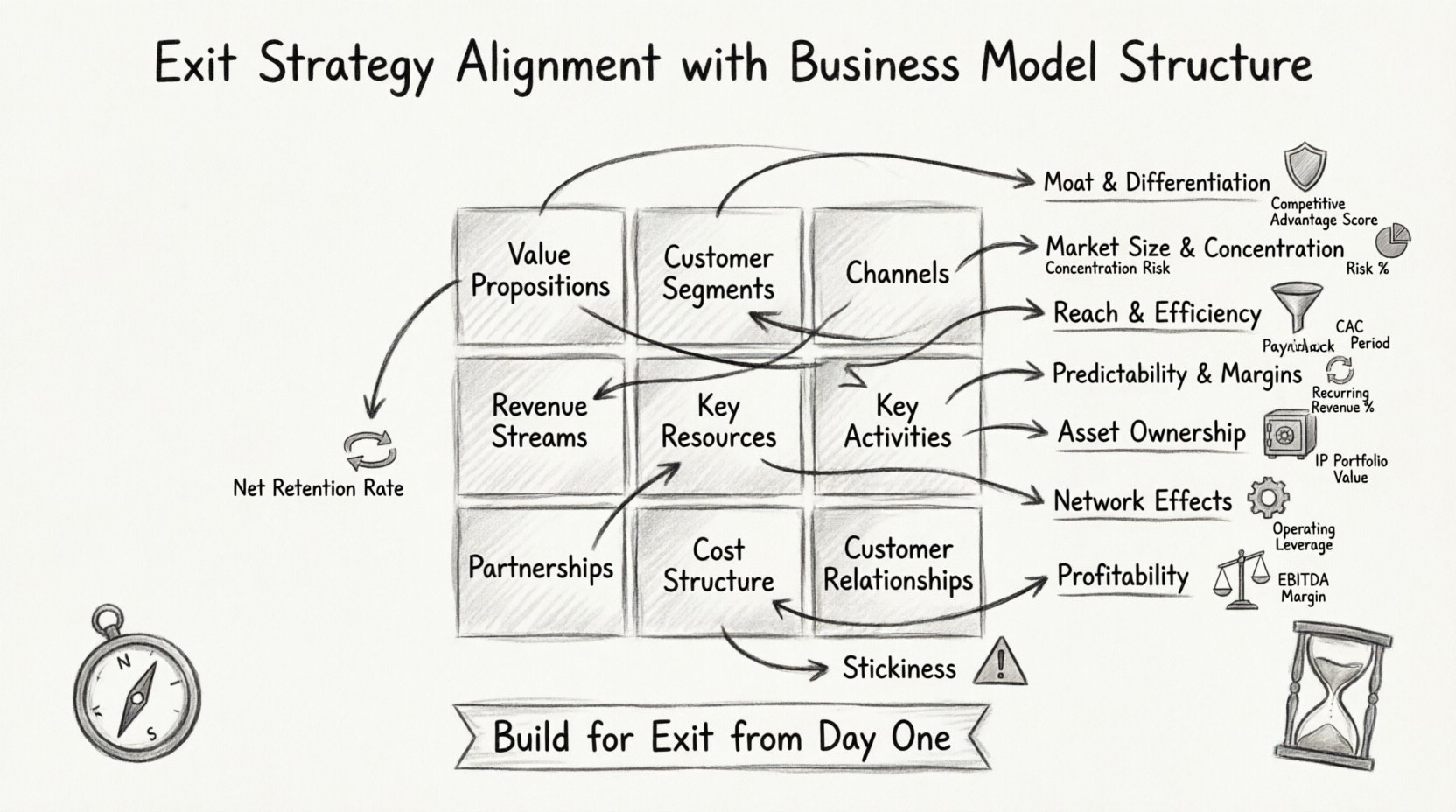
Mapping Exit Drivers to Canvas Blocks 🗺️
To visualize how the Business Model Canvas components translate to exit value, refer to the following matrix. This helps in auditing current structures against acquisition criteria.
| BMC Block | Exit Driver Focus | Key Metric for Valuation |
|---|---|---|
| Value Proposition | Moat & Differentiation | Competitive Advantage Score |
| Customer Segments | Market Size & Concentration | Concentration Risk % |
| Channels | Reach & Efficiency | CAC Payback Period |
| Revenue Streams | Predictability & Margins | Recurring Revenue % |
| Key Resources | Asset Ownership | IP Portfolio Value |
| Key Activities | Scalability | Operating Leverage |
| Partnerships | Network Effects | Partner Dependency % |
| Cost Structure | Profitability | EBITDA Margin |
| Customer Relationships | Stickiness | Net Retention Rate |
Timing the Exit Event ⏱️
Timing is a function of market conditions and internal readiness. An exit is successful when the company is strong enough to negotiate terms but before market headwinds turn against it.
- Market Cycles: Tech valuations fluctuate. Exiting during a peak cycle can double the outcome compared to a trough.
- Competitive Landscape: If a competitor is struggling, your market share becomes more valuable. If they are thriving, they might become the acquirer.
- Internal Milestones: Reach key operational milestones before marketing the business. Proof of concept is good; proof of scale is better.
Common Pitfalls in Structural Alignment ⚠️
Avoiding common mistakes is as important as executing the right strategy. These pitfalls often destroy value at the last minute.
- Founder Dependency: If the business stops working without the founder, it is not a sellable asset. Decentralize leadership.
- Legal Fragmentation: Ensure all entities are consolidated. Multiple subsidiaries can complicate the transfer of assets.
- Over-Optimization: Do not strip resources too early for short-term profit. Maintain the ability to innovate.
- Ignoring Culture: Acquirers assess cultural fit. A toxic culture can kill a deal.
Final Considerations for Long-Term Value 🌟
Aligning an exit strategy with business model structure is a continuous process. It requires regular audits of the Business Model Canvas as the company evolves. The goal is to build a company that is valuable regardless of the exit, but structured to maximize value when an exit occurs.
Founders who approach this with discipline find that their companies become more resilient, efficient, and attractive to partners and investors along the way. The exit is simply the final step in a series of strategic choices made from the beginning. By embedding these principles into the canvas, the path to liquidity becomes a natural outcome of sound business architecture.
Remember, the best exit strategy is the one that aligns with the long-term vision of the organization while satisfying the financial objectives of the stakeholders. It is a balance of art and science, structure and flexibility. Keep the structure robust, and the outcome will follow.
Related posts:
 Business Model Canvas: How to Validate Business Model Assumptions Before Pitching Investors
 Pivoting Your Business Model Canvas Based on Real Market Data
 Business Model Canvas: Identifying Critical Weaknesses in Early Stage Business Models
 Business Model Canvas: Designing Scalable Business Models for Hypergrowth Startups