


Launching a new venture is an act of faith. Statistics indicate that a significant percentage of new businesses fail within the first few years. Often, the failure is not due to a lack of effort, but a lack of clarity regarding how the business actually functions and generates value. To navigate this uncertainty, entrepreneurs require a structured framework to map out their strategy before committing significant capital.
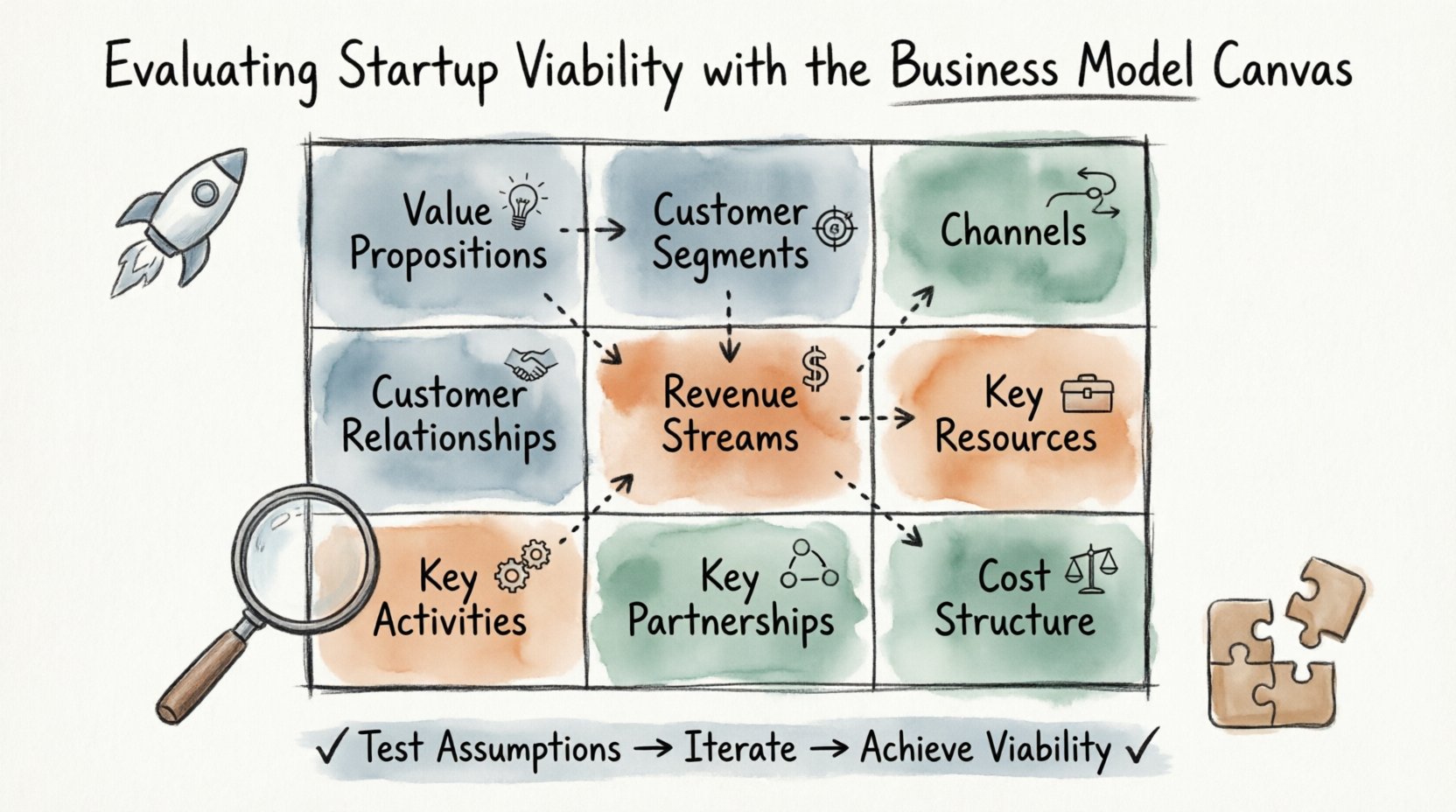
The Business Model Canvas (BMC) offers exactly this structure. It provides a visual chart with elements describing a firm’s or product’s value proposition, infrastructure, customers, and finances. By breaking down a company into nine distinct building blocks, founders can test assumptions and evaluate viability systematically. This guide details how to use this framework to assess whether a startup idea has the potential to succeed in a competitive market.
🧠 Understanding the Core Framework
The Business Model Canvas is not merely a business plan; it is a dynamic tool for hypothesis testing. It forces clarity on how an organization creates, delivers, and captures value. When evaluating viability, you are essentially asking: “Do these nine blocks fit together logically to sustain operations and generate profit?”
Each block represents a critical component of the business. Ignoring one can lead to structural weaknesses that become apparent only after launch. For a robust viability assessment, every block must be scrutinized for internal consistency and external market alignment.
💎 1. Value Propositions: The Heart of Viability
This block defines the bundle of products and services that create value for a specific customer segment. It is the primary reason customers turn to one company over another. For a startup to be viable, the value proposition must solve a real problem or fulfill a need better than existing alternatives.
Viability Assessment Questions
- Is the problem acute? Is the customer pain point significant enough to warrant a solution?
- Is the solution unique? Does the offering possess a competitive advantage that is defensible?
- Is it tangible? Can the value be clearly communicated and understood by the target audience?
Many startups fail because they create a solution in search of a problem. A viable value proposition answers the “why” clearly. It must align with customer jobs-to-be-done. If you cannot articulate the value in a single sentence, the core of your business may be flawed.
Types of Value Propositions
- Performance: Better speed, reliability, or features.
- Customization: Tailored to specific client needs.
- Design: Aesthetic appeal or user experience.
- Price: Cost advantage compared to competitors.
- Convenience: Ease of use or accessibility.
👥 2. Customer Segments: Who Are You Serving?
A startup cannot be viable if it tries to serve everyone. Viability often comes from deep focus on a specific niche. The Customer Segments block defines the different groups of people or organizations an enterprise aims to reach and serve.
Identifying the right segment is crucial for resource allocation. Marketing budgets, product features, and sales channels should all align with the specific needs of this group.
Viability Indicators
- Market Size: Is the segment large enough to sustain growth?
- Accessibility: Can you actually reach these customers through available channels?
- Willingness to Pay: Does the segment have the budget to solve their problem?
- Retention Potential: Will they return for future purchases?
Startups often make the mistake of targeting “everyone.” A viable model narrows the focus to early adopters who are most likely to buy first. These customers often tolerate imperfect products and provide feedback for improvement. Without a defined segment, customer acquisition costs will skyrocket, eroding viability.
🛣️ 3. Channels: How Do You Reach Them?
Channels are the touchpoints through which customers interact with the company. They serve as the delivery mechanism for the value proposition. Viability depends on the efficiency of these channels. If the cost of acquisition exceeds the lifetime value, the business model is unsustainable.
Evaluating Channel Efficiency
| Channel Type | Pros | Cons |
|---|---|---|
| Direct (Website) | High control, low cost per unit | Requires traffic generation effort |
| Partnerships | Access to existing audience | Shared revenue, dependency |
| Physical Stores | Tangibility, immediate service | High overhead, limited reach |
| Social Media | Low barrier to entry, viral potential | Algorithm changes, low conversion |
When assessing viability, consider the customer journey. Does the chosen channel match where the customer looks for information? For example, selling complex B2B software via a billboard is inefficient. Selling B2C fashion via TikTok is effective. Alignment reduces friction and increases conversion rates.
🤝 4. Customer Relationships: How Do You Interact?
This block describes the types of relationships a company establishes with specific customer segments. Relationships can range from personal assistance to automated services. The type of relationship established drives customer acquisition, retention, and upselling.
Relationship Strategies
- Personal Assistance: Direct human interaction.
- Dedicated Personal Assistance: A dedicated account manager.
- Self-Service: Automated tools with no human intervention.
- Automated Services: Personalized algorithms based on data.
- Communities: User forums or groups.
- Co-creation: Working with customers to build products.
Viability requires a relationship model that matches the price point and complexity. High-ticket items usually require personal relationships to build trust. Commodity products thrive on self-service. Misalignment here leads to high churn or excessive support costs.
💰 5. Revenue Streams: How Do You Earn?
This is the lifeblood of any startup. Revenue Streams represent the cash a company generates from each customer segment. A viable business model must have a clear path to profitability. It is not enough to have users; they must pay.
Revenue Models to Analyze
- Asset Sale: Selling ownership of a physical product.
- Usage Fee: Charging based on how much a service is used.
- Subscription Fees: Recurring revenue for access.
- Lending/Renting: Temporary access to assets.
- Advertising: Selling audience attention.
When evaluating viability, calculate the Unit Economics. If the Cost of Customer Acquisition (CAC) is higher than the Lifetime Value (LTV), the model is broken. A viable startup typically aims for an LTV to CAC ratio of at least 3:1. This ensures that every dollar spent on growth returns three dollars over time.
Revenue Viability Checklist
- Is the pricing strategy aligned with perceived value?
- Are there multiple streams to mitigate risk?
- Is the payment process frictionless?
- Are there clear upsell or cross-sell opportunities?
🏗️ 6. Key Resources: What Do You Need?
Key Resources are the most important assets required to make a business model work. They can be physical, intellectual, human, or financial. Without these resources, the value proposition cannot be delivered.
Resource Categories
- Physical: Buildings, vehicles, machines.
- Intellectual: Patents, copyrights, brands, data.
- Human: Talent, management, sales force.
- Financial: Cash, credit lines, equity.
Viability assessment here focuses on scarcity and cost. Do you need resources that are currently unavailable or prohibitively expensive? Startups often underestimate the need for capital. A viable model accounts for the runway required to reach profitability. If the key resources require heavy upfront investment without immediate return, the risk profile increases significantly.
⚙️ 7. Key Activities: What Must You Do?
Key Activities are the most important things a company must do to make its business model work. These vary by business type. For a manufacturing company, production is key. For a software company, development and maintenance are key.
Activity Types
- Production: Designing, making, and delivering a product in quantity or of specific quality.
- Problem Solving: Creating new solutions to individual customer problems.
- Platform/Network: Maintaining and improving the platform.
Assess viability by asking if these activities are scalable. Can the team execute these activities without a linear increase in cost? If a key activity requires constant manual intervention that cannot be automated, margins will suffer. Scalability is a hallmark of viable startup models.
🤝 8. Key Partnerships: Who Helps You?
Key Partnerships are the network of suppliers and partners that make the business model work. Companies form partnerships to optimize efficiency, reduce risk, or acquire resources. Not every startup needs partners, but those that do must evaluate the dependency.
Partnership Motivations
- Optimization and Efficiency: Non-core activities are outsourced.
- Reduction of Risk and Uncertainty: Sharing risk with partners.
- Acquisition of Resources: Accessing technology or markets.
Viability depends on the stability of these relationships. If a critical partner can cut ties easily, the business is fragile. Diversify suppliers and avoid single points of failure. Evaluate the terms of partnership agreements carefully to ensure they do not eat into profit margins.
💸 9. Cost Structure: What Are the Costs?
The Cost Structure comprises all costs incurred to operate a business model. It is the flip side of the Revenue Streams. A viable business has a cost structure that allows for healthy margins after covering expenses.
Cost Drivers
- Fixed Costs: Salaries, rent, utilities.
- Variable Costs: Materials, transaction fees, hosting.
- Economies of Scale: Costs decrease as volume increases.
- Economies of Scope: Costs decrease as product range increases.
When analyzing viability, compare the Cost Structure against the Revenue Streams. Is the business driven by cost leadership or value creation? Cost leadership requires low prices and high volume. Value creation requires high margins and lower volume. Confusing these two strategies often leads to failure. Ensure your pricing covers the variable costs and contributes to fixed costs.
📉 Strategic Alignment and Risk Analysis
Once all nine blocks are filled, the true evaluation begins. This involves looking at the connections between the blocks. Do the Key Activities support the Value Proposition? Do the Channels reach the Customer Segments defined? This alignment is critical for operational viability.
Interconnectivity Matrix
| Block A | Block B | Viability Check |
|---|---|---|
| Value Prop | Revenue Stream | Does the price reflect the value delivered? |
| Customer Segments | Channels | Can we reach them efficiently? |
| Key Resources | Key Activities | Do we have the tools to do the work? |
| Cost Structure | Revenue Streams | Are margins sustainable? |
Additionally, perform a risk assessment. Identify the assumptions that are riskiest. If the startup relies on a specific technology that might not work, that is a high risk. If it relies on a specific customer behavior that hasn’t been proven, that is also high risk. Prioritize testing these assumptions.
🔄 The Iteration Process
A business model is rarely perfect on the first draft. Viability is often achieved through iteration. Use the Canvas as a living document. As you gather data from the market, update the blocks.
Steps for Iteration
- Hypothesize: Fill out the canvas based on your current assumptions.
- Validate: Talk to customers, run experiments, test channels.
- Measure: Collect data on conversion, retention, and costs.
- Pivot or Persevere: If data contradicts the model, change the relevant blocks.
Do not fall in love with the initial idea. Fall in love with the problem you are solving. If the data shows that a different segment or a different value proposition works better, adjust the model. Flexibility is a key trait of viable startups.
⚠️ Common Pitfalls in Evaluation
Even with a structured framework, founders can make mistakes. Being aware of these pitfalls helps in maintaining objectivity.
- Ignoring Costs: Focusing only on revenue and forgetting overhead.
- Overestimating Demand: Assuming customers will buy without proof.
- Underestimating Competition: Assuming no one else is solving the problem.
- Complexity Creep: Adding too many features or segments too early.
- Ignoring Cash Flow: Profit does not equal cash. Timing of payments matters.
✅ Finalizing the Viability Assessment
Evaluating startup viability is not a one-time event. It is an ongoing process of validation and refinement. By systematically analyzing each component of the Business Model Canvas, founders can identify weaknesses before they become fatal flaws. The goal is not just to start a business, but to build a sustainable one.
Startups that take the time to map their model thoroughly are better positioned to secure funding and navigate market challenges. The clarity provided by this framework allows for better decision-making. It transforms abstract ideas into concrete operational plans.
Remember that viability is relative to the market context. A model that works in one industry may fail in another. Always ground your assessment in real-world data and feedback. Continuous learning and adaptation are the true drivers of long-term success.
Use this guide as a checklist. Review each section. Challenge your assumptions. If the numbers add up and the logic holds, you have a strong foundation. If not, go back to the drawing board. The canvas is a tool for truth, not for validation of preconceived notions.
Related posts:
 Business Model Canvas: How to Validate Business Model Assumptions Before Pitching Investors
 Pivoting Your Business Model Canvas Based on Real Market Data
 Business Model Canvas: Identifying Critical Weaknesses in Early Stage Business Models
 Business Model Canvas: Designing Scalable Business Models for Hypergrowth Startups