


In the landscape of modern business strategy, the development of a Minimum Viable Product (MVP) represents a critical juncture. It is the phase where theoretical concepts meet market reality. Within the Business Model Canvas, the Key Resources block serves as the foundation that supports value creation. For an MVP, this allocation requires precision, discipline, and a clear understanding of what is necessary versus what is merely desirable.
Allocating resources for an MVP is not about having everything ready for a full-scale launch. It is about identifying the essential assets required to test hypotheses, gather validated learning, and iterate based on user feedback. This guide explores how to manage these resources effectively, ensuring that your team focuses on what truly drives growth without unnecessary expenditure or distraction.
Understanding Key Resources in the BMC Framework 🧩
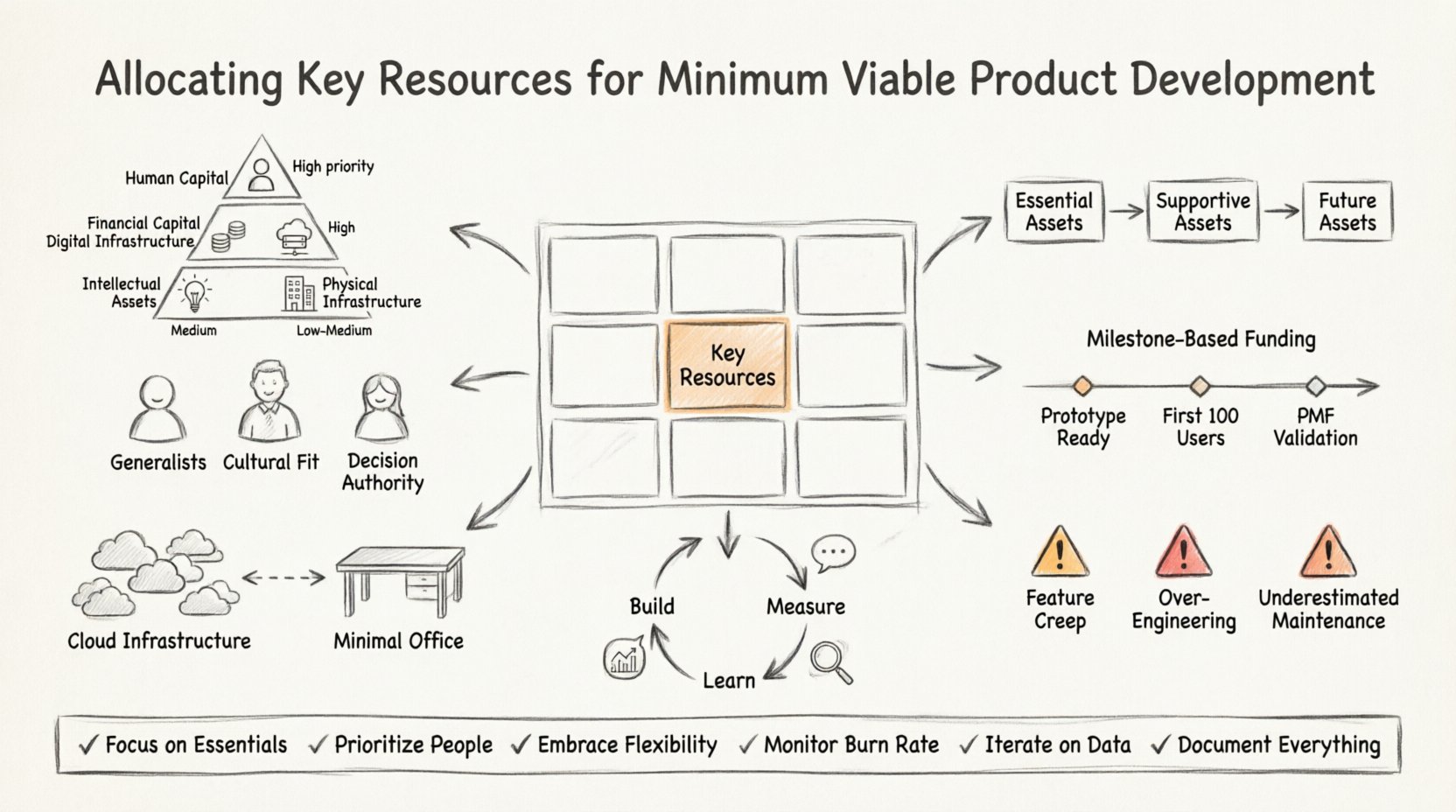
The Business Model Canvas organizes a business into nine building blocks. Among these, Key Resources are the assets required to make a business model work. In the context of an MVP, these resources define the boundaries of what can be built and sold initially. They act as the fuel for your value proposition and the structure for your customer relationships.
When planning for an MVP, the goal is not to replicate the resource structure of a mature enterprise. Instead, the objective is to establish a lean operational base. This involves distinguishing between:
- Essential Assets: Those without which the product cannot function or deliver value.
- Supportive Assets: Those that enhance the experience but are not immediately critical for validation.
- Future Assets: Those needed for scaling after the MVP phase proves successful.
Clarity here prevents the common trap of over-investing in features or infrastructure that do not directly influence the initial validation loop. By focusing on the core requirements, teams can preserve capital and maintain agility.
Categorizing Resources for MVP Success 📊
To allocate effectively, it is helpful to classify resources into distinct categories. This structure allows for better tracking and decision-making during the development lifecycle. The following table outlines the primary categories relevant to an MVP within the Business Model Canvas framework.
| Resource Category | Definition | MVP Priority | Examples |
|---|---|---|---|
| Human Capital | The people who create, manage, and deliver the product. | High | Founders, Lead Developer, Product Manager, Early Users |
| Intellectual Assets | Knowledge, data, and proprietary methods. | Medium | Source Code, Algorithms, User Research Data, Brand Guidelines |
| Financial Capital | The funding available for operations and development. | High | Cash Reserves, Seed Funding, Operating Budget |
| Physical Infrastructure | Tangible assets required for operations. | Low to Medium | Office Space, Servers, Hardware Prototypes |
| Digital Infrastructure | Cloud services, software tools, and platforms. | High | Hosting Environment, Analytics Tools, Communication Platforms |
Understanding these categories helps in prioritizing budget and time. For instance, human capital often demands the highest attention early on, whereas physical infrastructure can often be minimized or outsourced.
Human Capital and Team Composition 👥
The most significant resource in any startup is the team itself. During the MVP phase, the composition of your team dictates the speed of execution and the quality of the output. Unlike mature organizations that rely on specialized silos, an MVP team requires versatility.
When building this core group, consider the following principles:
- Generalists over Specialists: Early-stage teams benefit from individuals who can wear multiple hats. A developer who understands basic design or a marketer who understands the product logic adds significant value.
- Cultural Fit: Shared values regarding risk, speed, and learning are crucial. A team aligned on the mission can navigate uncertainty better than a group of highly skilled individuals with conflicting priorities.
- Decision-Making Authority: Empower the team to make decisions without excessive bureaucracy. Speed is a competitive advantage in the MVP phase.
It is important to avoid the temptation to hire senior executives too early. While experience is valuable, high-level strategic roles often cost more than a lean team of builders. Instead, focus on roles that directly contribute to the creation of the product and the validation of the business model.
Outsourcing vs. In-House
One of the most common questions in resource allocation is whether to build in-house or outsource. For an MVP, the answer often lies in a hybrid approach.
- Core Competencies: Keep the core logic and product definition in-house. This ensures intellectual property remains secure and the vision stays intact.
- Commodity Tasks: Consider outsourcing non-differentiating tasks such as specific legal reviews, initial graphic design, or specialized testing. This frees up internal capacity for strategic development.
Intellectual Property and Knowledge Assets 🧠
Intellectual assets include patents, proprietary code, customer data, and operational know-how. In the early stages, the focus is less on protecting every detail and more on leveraging knowledge to move forward.
Key considerations for managing these assets include:
- Code Ownership: Ensure that all code written for the MVP is clearly owned by the entity. This prevents future legal complications regarding intellectual property.
- Data Privacy: Collect only the data necessary for the MVP. Excessive data collection increases liability and storage costs without adding immediate value.
- Documentation: Document processes and decisions. This knowledge transfer becomes critical when the team grows or when new members join the project.
Do not spend excessive time on formal IP protection before validating the market need. The cost of filing patents can drain resources better spent on product iteration. Prioritize market validation over legal formalities until the product proves viable.
Financial Resources and Budgeting 💰
Financial capital is the lifeblood of the MVP phase. Effective allocation here means extending the runway while achieving milestones. Budgeting for an MVP requires a different mindset than budgeting for a full product launch.
Adopt a milestone-based funding strategy:
- Define Milestones: Break the development process into clear stages (e.g., prototype, beta, public launch).
- Allocate per Milestone: Only commit funds necessary to reach the next stage. Do not fund the entire year upfront.
- Monitor Burn Rate: Track expenses closely. If the burn rate exceeds the value of learning gained, adjust the strategy immediately.
Financial discipline does not mean being cheap; it means being efficient. Every dollar spent should contribute to either building the product or learning from the market. If a feature does not serve these two goals, it is likely a candidate for elimination.
Physical and Digital Infrastructure 🖥️
Infrastructure forms the backbone of product delivery. For an MVP, the trend is to utilize scalable, pay-as-you-go solutions rather than investing in permanent assets.
Digital Infrastructure
Cloud computing has revolutionized resource allocation for digital products. Instead of purchasing servers, teams can rent computing power based on demand. This flexibility allows for:
- Scalability: Increase resources when user traffic spikes.
- Cost Efficiency: Pay only for what is used.
- Reduced Maintenance: The service provider handles security patches and hardware updates.
When selecting tools and platforms, prioritize those that integrate well with each other. A fragmented tech stack increases complexity and maintenance overhead.
Physical Infrastructure
Physical assets are often a necessity only if the product requires them (e.g., hardware IoT devices). For software products, physical infrastructure should be minimal. Remote work capabilities reduce the need for large office spaces. If a physical presence is required, consider shared workspaces or co-working environments to minimize fixed costs.
Common Pitfalls in Resource Planning ⚠️
Even with a solid plan, teams often encounter obstacles during the MVP phase. Recognizing these pitfalls early can save significant resources.
- Feature Creep: Adding features because they “might be useful” later. This dilutes focus and delays the launch. Stick to the core value proposition.
- Over-Engineering: Building a system that can handle millions of users when you currently have ten. Design for the current reality, not the future fantasy.
- Underestimating Maintenance: Development is only part of the cost. Maintenance, support, and updates require ongoing resources.
- Ignoring Customer Support: Early users need hand-holding. Allocate resources to support channels to gather qualitative feedback.
These pitfalls often stem from a lack of clarity on the MVP goal. If the goal is validation, resources should flow toward measurement and feedback, not just feature development.
Validation and Iteration Loops 🔄
Resource allocation is not a one-time event. It is an ongoing process tied to the feedback loops of the MVP. As you gather data, your understanding of what resources are needed will change.
Implement a review cadence:
- Weekly Reviews: Assess progress against milestones. Are we spending resources effectively?
- Monthly Strategy Checks: Evaluate if the current resource mix aligns with market feedback. Pivot if necessary.
- Post-Launch Analysis: After the MVP is released, analyze which resources drove the most value and which were wasted.
This iterative approach ensures that the Business Model Canvas remains accurate. If the Key Resources block changes, the Value Proposition and Customer Relationships may need adjustment as well. The canvas is a living document that reflects the current state of the business.
Preparing for Growth and Scaling 📈
The end goal of an MVP is often to transition into a scalable product. Resource allocation for this transition requires foresight. You must build the foundation now that can support growth later.
Consider the following factors:
- Technical Debt: Avoid shortcuts that will make scaling difficult. Clean code and modular architecture are investments that pay off later.
- Team Growth: Plan for hiring processes that can scale. Documentation and training materials should be ready for new employees.
- Process Maturity: As the team grows, informal processes break down. Establish standard operating procedures early.
Scaling is not just about adding more people or servers. It is about maintaining the efficiency and culture that made the MVP successful. Resource allocation during the MVP phase should set the stage for this transition without over-committing to structures that are premature.
Summary of Best Practices ✅
Allocating key resources for Minimum Viable Product development is a balancing act between ambition and reality. By leveraging the Business Model Canvas, teams can ensure that every asset contributes to the core mission. The following points summarize the approach for success:
- Focus on Essentials: Identify the minimum set of resources required to test your hypotheses.
- Prioritize Human Capital: Invest in the right people before investing in expensive tools or infrastructure.
- Embrace Flexibility: Use cloud services and modular processes that allow for easy adjustment.
- Monitor Financial Health: Keep burn rates low and extend the runway through disciplined spending.
- Iterate Based on Data: Adjust resource allocation as you learn from user feedback.
- Document Everything: Preserve knowledge to ensure continuity and scalability.
The path from concept to market-ready product is fraught with challenges. However, by treating resource allocation as a strategic function rather than an administrative task, teams can navigate these challenges with confidence. The goal is not to build the perfect product immediately, but to build the right product efficiently. This disciplined approach to resources lays the groundwork for sustainable growth and long-term success in the market.
Remember that the MVP is a learning tool. Every resource spent should buy learning. If a resource does not contribute to learning or value delivery, it is likely a drain on the business. By keeping this principle at the forefront of your planning, you ensure that the Business Model Canvas remains a practical guide for execution rather than a static theoretical exercise.
Related posts:
 Business Model Canvas: How to Validate Business Model Assumptions Before Pitching Investors
 Pivoting Your Business Model Canvas Based on Real Market Data
 Business Model Canvas: Identifying Critical Weaknesses in Early Stage Business Models
 Business Model Canvas: Designing Scalable Business Models for Hypergrowth Startups