


Every business operates within a landscape of uncertainty. Whether it is supply chain interruptions, regulatory shifts, or technological failures, operational risk is an inherent part of commerce. For organizations utilizing the Business Model Canvas (BMC), identifying and managing these risks is not just a compliance task—it is a strategic imperative. One of the most effective methods to mitigate these exposures lies in the Key Partnerships building block.
By strategically aligning with external entities, companies can distribute risk, access specialized capabilities, and build resilience against market volatility. This guide explores how to structure and manage partnerships specifically to reduce operational risk exposure. We will examine the mechanics of risk transfer, the importance of due diligence, and the frameworks required to sustain these alliances over time.
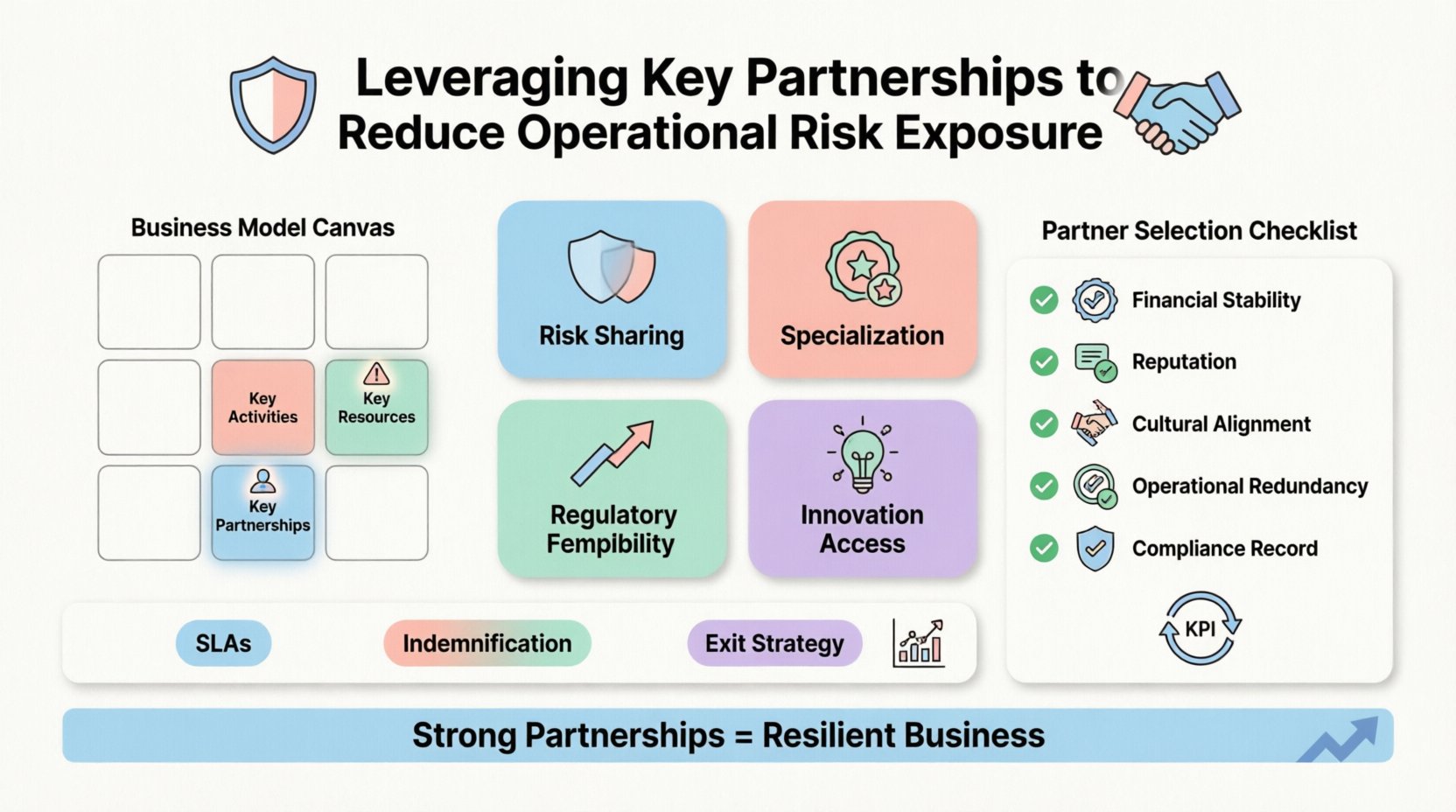
📉 Understanding Operational Risk in the Business Model Canvas
Before addressing partnerships, it is necessary to define where risk originates within the Business Model Canvas framework. The BMC visualizes the logic of how an organization creates, delivers, and captures value. Risk does not exist in a vacuum; it attaches to specific components of the model.
Operational risk refers to the risk of loss resulting from inadequate or failed internal processes, people, and systems, or from external events. In the context of the BMC, this often manifests in the following areas:
- Key Activities: If the core operations rely on a single internal team or process, a disruption can halt value creation.
- Key Resources: Dependence on a specific asset, intellectual property, or human capital creates fragility.
- Key Partnerships: Relying on external vendors without proper controls introduces third-party risk.
- Customer Relationships: Poor service delivery or reputation damage affects revenue streams.
- Cost Structure: Unexpected cost spikes due to supplier price hikes or compliance fines.
Traditionally, businesses attempt to manage these risks internally. However, internal controls have limits. External partnerships offer a mechanism to offload or share these burdens. When a partner takes on a function that is high-risk or low-competence for the main organization, the exposure shifts. The goal is not to eliminate risk entirely, but to optimize its management across the network.
🤝 The Strategic Value of Partnerships for Risk Mitigation
Strategic alliances are often viewed through the lens of growth or revenue generation. While they do facilitate expansion, their role in risk management is equally critical. A well-structured partnership acts as a buffer against instability.
Here are the primary mechanisms through which partnerships reduce operational exposure:
- Risk Sharing: Joint ventures and co-development agreements allow two or more entities to share the financial and operational burden of a project. If a venture fails, the loss is distributed rather than absorbed by one party.
- Specialization: Outsourcing non-core activities to specialized firms reduces the risk of failure due to lack of expertise. A logistics partner knows the supply chain better than a tech company does.
- Capacity Flexibility: Partners can provide surge capacity during peak demand without requiring permanent capital investment. This prevents over-extension during growth phases.
- Regulatory Compliance: In highly regulated industries, partnering with established local entities can navigate complex legal landscapes more effectively than going it alone.
- Innovation Access: Collaborating with startups or research institutions can reduce the risk of technological obsolescence by sharing R&D costs.
It is important to note that partnerships introduce a new variable: the risk of the partner failing. Therefore, the net benefit depends on the strength of the partner’s own risk controls.
🧐 Identifying the Right Partners for Risk Reduction
Selecting a partner based solely on cost or speed is a common error that increases operational risk. The selection process must prioritize stability, reputation, and alignment. To ensure the right fit, organizations should evaluate potential partners against specific criteria.
The following table outlines key evaluation factors and their impact on risk exposure:
| Factor | Low Risk Indicator | High Risk Indicator |
|---|---|---|
| Financial Stability | Consistent revenue, healthy cash flow, low debt ratios | Reliant on funding rounds, high debt, volatile earnings |
| Reputation | Long history, positive client testimonials, industry awards | History of lawsuits, negative press, frequent management changes |
| Cultural Alignment | Shared values, transparent communication styles, ethical standards | Conflicting priorities, opacity in decision-making, aggressive sales tactics |
| Operational Redundancy | Multiple backup suppliers, robust disaster recovery plans | Single point of failure, no contingency plans for downtime |
| Compliance Record | Clean audit history, adherence to industry standards | Frequent fines, regulatory investigations, poor safety records |
When evaluating partners, look beyond the surface metrics. Conduct background checks that include financial health, legal standing, and operational history. A partner with a strong track record in your specific sector is preferable to a generalist with a lower price tag.
📝 Structuring Agreements for Risk Transfer
Once a partner is selected, the contractual framework becomes the primary tool for risk allocation. The agreement should clearly define responsibilities, liabilities, and expectations. Vague contracts are a leading cause of operational friction and legal disputes.
Key clauses to consider when drafting partnership agreements include:
- Service Level Agreements (SLAs): Define specific performance metrics. If a partner fails to meet uptime, delivery times, or quality standards, there must be defined remedies or penalties.
- Indemnification: Ensure the partner agrees to compensate you for losses arising from their negligence, misconduct, or breach of contract.
- Force Majeure: Clearly outline what happens during unforeseen events (natural disasters, pandemics). Does the contract suspend, or does it terminate?
- Exit Strategies: Define the conditions under which the partnership can be terminated. Include notice periods, transition support, and data handover requirements to prevent operational paralysis.
- Data Security and Privacy: If the partnership involves data sharing, strict protocols must be in place to prevent breaches that could damage your reputation.
- Intellectual Property Rights: Clarify who owns the output of the collaboration to avoid future disputes over assets.
It is advisable to involve legal counsel in this process. However, business leaders must also understand these terms to ensure they align with operational realities. A contract that is legally sound but operationally unfeasible will lead to failures in execution.
📊 Monitoring and Managing Partner Performance
Signing a contract is the starting line, not the finish line. Operational risk can creep in over time as partners change strategies, leadership, or financial standing. Continuous monitoring is essential to maintain risk levels.
Establish a governance framework for managing the relationship. This should include:
- Regular Audits: Periodically review the partner’s operations. This can be done through site visits, document reviews, or third-party audits.
- Performance Reviews: Schedule quarterly or monthly meetings to discuss SLA adherence. Use data to drive these conversations.
- Communication Channels: Maintain open lines of communication. Issues are often detected early through informal channels before they become formal incidents.
- Key Performance Indicators (KPIs): Track metrics specific to risk, such as incident rates, compliance violations, or delivery delays.
- Relationship Health Checks: Assess the strategic alignment annually. Has the partner’s focus shifted away from your needs?
Transparency is key. Partners should be encouraged to report issues immediately. A culture of blame will hide problems until they become crises. Conversely, a culture of transparency allows for collaborative problem-solving.
⚠️ Common Pitfalls in Partnership Risk Management
Even with careful planning, organizations often stumble in partnership management. Recognizing common pitfalls can help avoid them.
- Over-Reliance: If a single partner handles 90% of a critical function, the risk of disruption is high. Diversification is necessary. Maintain backup partners for critical operations.
- Communication Gaps: Assumptions about what is understood often lead to errors. Document everything and confirm understanding.
- Ignoring Culture: Technical skills matter, but cultural fit matters more for long-term stability. Misaligned values lead to friction in crisis situations.
- Cost-Centric Selection: Choosing the cheapest partner often results in higher long-term costs due to errors, delays, or renegotiations.
- Lack of Internal Oversight: Assigning a partnership to one person without oversight creates a single point of failure. Ensure the risk management team is aware of the partnership status.
🏗️ Building Resilience Through Collaboration
The ultimate goal of leveraging partnerships is resilience. A resilient organization can absorb shocks and recover quickly. Partnerships contribute to this by creating a network effect where information and resources flow freely during disruptions.
Consider the following strategies to build this resilience:
- Crisis Management Plans: Develop joint crisis plans with key partners. Know who to call, what data is needed, and how to communicate during an emergency.
- Joint Innovation: Work with partners to develop new solutions for emerging risks. For example, if a new regulation is coming, a partner might have already developed the compliance software or process.
- Knowledge Sharing: Share insights about market trends and risk indicators. A partner in a different region might see a supply chain issue before it reaches your local market.
- Employee Cross-Training: If feasible, allow teams to cross-train with partner organizations. This ensures continuity if key personnel leave.
Resilience is not just about surviving a threat; it is about maintaining value creation despite the threat. Partnerships allow you to tap into a broader ecosystem of capabilities, making the organization less vulnerable to internal bottlenecks.
🔄 The Lifecycle of a Risk-Aware Partnership
Managing risk is a continuous cycle. It begins before the partnership starts and continues long after the initial agreement is signed.
Phase 1: Identification
Identify which risks are best handled internally and which are better suited for partners. High-risk, non-core activities are prime candidates for outsourcing.
Phase 2: Selection
Conduct the due diligence outlined earlier. Verify the partner’s ability to manage the specific risks associated with the task.
Phase 3: Contracting
Draft agreements that clearly allocate risk. Ensure the legal language matches the operational reality.
Phase 4: Execution
Monitor performance and compliance. Maintain open communication channels.
Phase 5: Review
Periodically reassess the partnership. If the risk profile changes, renegotiate or terminate the agreement.
Phase 6: Termination or Renewal
Plan the exit strategy from the beginning. Ensure that ending the relationship does not disrupt operations or expose sensitive data.
📈 Measuring Success and Risk Reduction
How do you know if your partnerships are actually reducing operational risk? You need metrics to track this. Quantitative and qualitative measures should be combined.
- Incident Frequency: Track the number of operational disruptions caused by partners over time. A downward trend indicates success.
- Cost of Risk: Monitor the costs associated with errors, fines, or downtime. If these decrease, the partnership strategy is working.
- Recovery Time: Measure how quickly operations return to normal after a disruption. Effective partners should help shorten this time.
- Compliance Score: Track audit results. A higher compliance score suggests better risk management.
- Partner Satisfaction: Surveys can reveal friction points before they become major issues.
Regularly report these metrics to leadership. This keeps risk management visible and prioritized within the organization.
🌐 The Future of Partnership Risk Management
The landscape of business partnerships is evolving. As digital transformation accelerates, the nature of operational risk changes. Cybersecurity, data privacy, and AI ethics are becoming central concerns.
Future partnerships will require:
- Enhanced Data Governance: Clearer rules on how data is shared and protected across organizational boundaries.
- Agile Contracting: Contracts that can adapt quickly to changing market conditions without lengthy renegotiations.
- Ecosystem Thinking: Viewing partnerships not as isolated contracts but as nodes in a broader network of value creation.
Organizations that adapt their risk management frameworks to these changes will maintain a competitive advantage. Those that rely on outdated models will find themselves vulnerable to disruptions that could have been mitigated.
🛠️ Actionable Steps for Implementation
To begin integrating these principles into your Business Model Canvas, take the following steps:
- Map Your Current Partnerships: List all current partners and the risks associated with each.
- Assess Risk Exposure: Determine which risks are critical and which are acceptable.
- Review Contracts: Audit existing agreements for adequate risk clauses.
- Establish Governance: Create a team or committee responsible for partnership oversight.
- Develop Metrics: Define how you will measure risk reduction.
- Train Teams: Ensure staff understand the importance of partnership risk management.
By following this roadmap, you can transform your partnerships from potential vulnerabilities into strategic assets. The goal is not to avoid all risk, but to manage it intelligently so that the organization can grow with confidence.
🔍 Summary of Key Takeaways
Operational risk is an unavoidable part of business, but it does not have to be a threat to survival. The Business Model Canvas provides a framework for visualizing where risk lies, and Key Partnerships offer a powerful lever to manage it.
- Partnerships allow for risk sharing, specialization, and capacity flexibility.
- Due diligence is critical; select partners based on stability and alignment, not just cost.
- Contracts must clearly define liabilities, exit strategies, and performance standards.
- Continuous monitoring and governance prevent risk from creeping in over time.
- Resilience is built through collaboration, crisis planning, and transparent communication.
Implementing these strategies requires commitment and discipline. However, the payoff is a more robust, adaptable, and secure business model. In an unpredictable world, strong partnerships are one of the few reliable foundations for long-term success.
Related posts:
 Business Model Canvas: How to Validate Business Model Assumptions Before Pitching Investors
 Pivoting Your Business Model Canvas Based on Real Market Data
 Business Model Canvas: Identifying Critical Weaknesses in Early Stage Business Models
 Business Model Canvas: Designing Scalable Business Models for Hypergrowth Startups