

Business strategy often falters not because of a lack of vision, but due to a misalignment between how value is created and how it is delivered. In the context of the Business Model Canvas, the Channels block represents the touchpoints where a company interacts with its customers. However, these channels are not isolated mechanisms; they are the arteries of the customer journey. Understanding the precise mapping between customer journey stages and distribution channels is critical for operational efficiency and customer satisfaction.
This guide provides a technical examination of aligning distribution strategies with customer expectations. It moves beyond surface-level definitions to explore the structural integration required for sustainable growth. We will analyze the mechanics of channel selection, the lifecycle of customer interaction, and the metrics necessary to validate the alignment.
📦 The Core Components: Business Model Canvas & Customer Journey
Before integrating these two frameworks, one must understand their individual mechanics. The Business Model Canvas (BMC) is a strategic management template. Within this canvas, the Channels component describes how a company communicates with and reaches its Customer Segments to deliver a Value Proposition.
- Communication: How customers learn about the offering.
- Distribution: How the product or service reaches the customer.
- Sales: Where the transaction occurs.
- After-sales: How support and retention are managed.
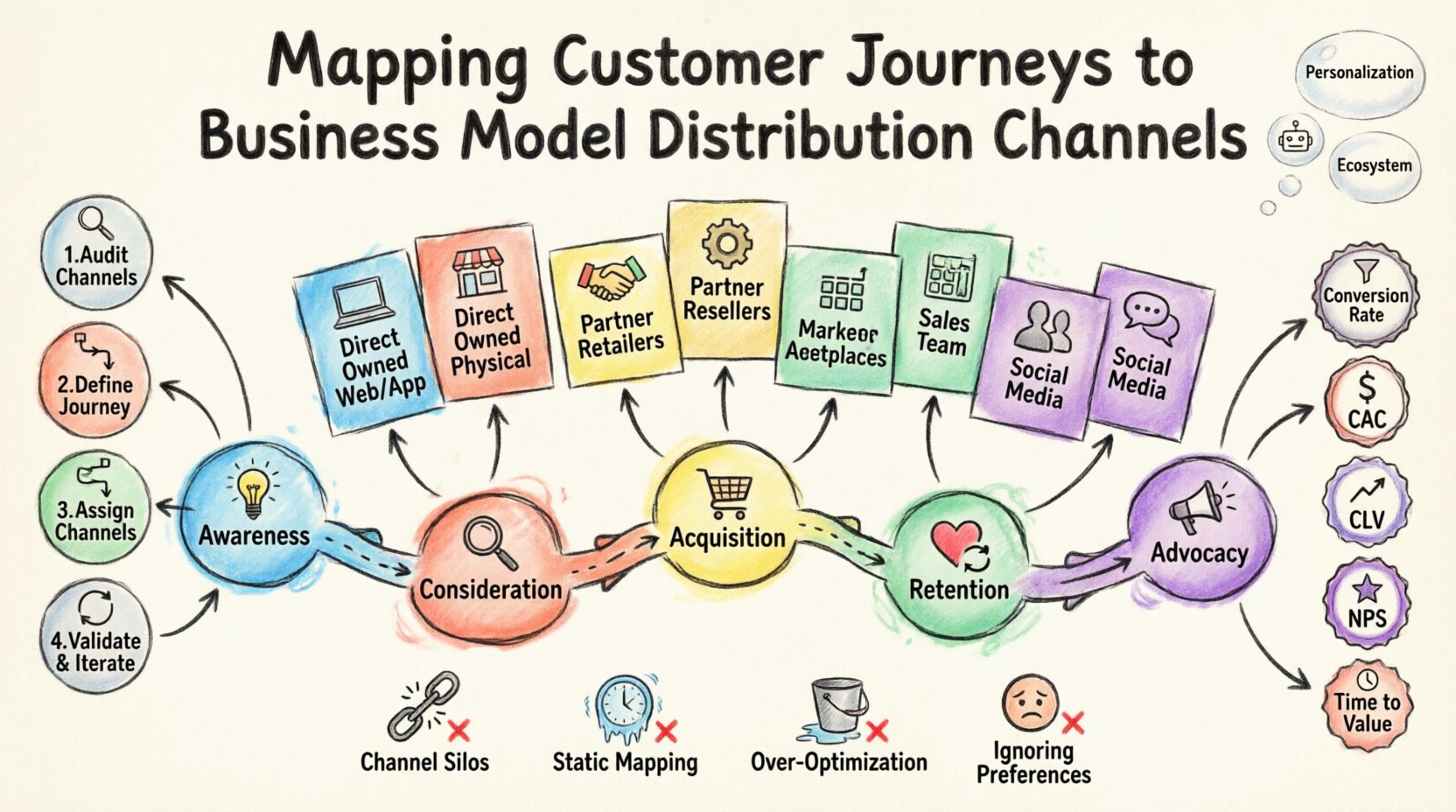
Conversely, the Customer Journey Map (CJM) visualizes the process a person goes through when engaging with a company. It is not merely a timeline but a representation of emotional states and functional needs at each stage. The typical stages include:
- Awareness: The customer realizes a need or problem.
- Consideration: The customer evaluates potential solutions.
- Acquisition: The decision is made, and the purchase occurs.
- Retention: The customer continues to use the product or service.
- Advocacy: The customer recommends the solution to others.
The friction occurs when the Business Model Canvas channels do not support the specific needs of the customer at the specific stage of their journey. For instance, a high-touch sales channel may be appropriate for the Acquisition stage but completely inappropriate for the Awareness stage, where information density and accessibility are paramount.
🔗 The Intersection: Aligning Touchpoints with Lifecycle Stages
Mapping these two concepts requires a deliberate analysis of channel capabilities against customer intent. Each channel has a specific cost structure, reach, and utility. The goal is to place the right channel at the right moment in the journey.
Consider the Awareness stage. The customer is searching for information. If the distribution channel is a physical retail store, the cost of entry for the customer is high. If the channel is a search engine optimized blog post, the barrier to entry is low. The mapping strategy dictates which channel serves the information need most efficiently.
In the Acquisition stage, the focus shifts to conversion. Here, the channel must facilitate the transaction. This could be an e-commerce cart, a point-of-sale terminal, or a sales representative. The mapping process involves ensuring that the handoff from the marketing channel to the sales channel is seamless. A disconnect here results in lost revenue.
Retention and Advocacy are often overlooked in the initial mapping. A channel that works for acquisition might fail to support post-purchase satisfaction. For example, a mobile app may be excellent for purchasing but poor for complex troubleshooting. The mapping must account for the entire lifecycle, not just the point of sale.
📊 Channel Types and Journey Stage Compatibility
To facilitate this mapping, we categorize channels based on their primary function and reach. The following table outlines the relationship between channel types and their optimal placement within the customer journey.
| Channel Type | Primary Function | Optimal Journey Stage | Key Characteristic |
|---|---|---|---|
| Direct Owned (Web/App) | Full control over experience | Consideration to Retention | High data visibility, scalable |
| Direct Owned (Physical) | Personal interaction | Awareness to Acquisition | High trust, high cost |
| Partner (Retailers) | Extended reach | Awareness to Acquisition | Leveraged audience, less control |
| Partner (Resellers) | Value-added services | Consideration to Acquisition | Technical expertise, local presence |
| Indirect (Marketplaces) | Aggregated traffic | Awareness to Acquisition | High volume, high competition |
| Direct (Sales Team) | Consultative selling | Consideration to Acquisition | High touch, relationship-based |
| Communication (Social) | Engagement & Branding | Awareness to Advocacy | Two-way dialogue, viral potential |
Notice that no single channel fits every stage. A robust business model distributes channels across the journey to ensure coverage without redundancy. For example, using a sales team for general Awareness is cost-prohibitive, while using a website for complex B2B Acquisition might be insufficient without human guidance.
🛠️ Methodology: Step-by-Step Mapping Process
Executing this mapping requires a structured approach. It is not enough to list channels; one must validate their performance against journey metrics. The following steps outline the implementation process.
1. Audit Existing Channels
Begin by cataloging every current touchpoint. This includes websites, physical locations, social media profiles, call centers, and third-party partners. For each channel, document the following:
- Cost Structure: Fixed and variable costs associated with maintaining the channel.
- Reach: The total number of potential customers accessible through this channel.
- Function: What specific action does this channel enable? (e.g., browsing, buying, supporting).
- Current Performance: Historical data on conversion rates and customer satisfaction scores.
2. Define Customer Journey Stages
Refine the definition of the journey stages specific to your offering. A subscription service journey differs from a one-time hardware purchase. Define the specific triggers for moving from one stage to the next. For example, in a subscription model, the trigger for “Retention” is the successful billing cycle completion.
- Define Triggers: What action moves a user from Awareness to Consideration?
- Define Friction Points: Where do users currently drop off?
- Define Emotional State: How does the customer feel at each stage? (e.g., curious, skeptical, satisfied).
3. Assign Channels to Stages
Map the audited channels to the defined journey stages. This is an exercise in resource allocation. Ensure that every stage has at least one channel assigned, but avoid overloading a stage with channels that compete for the same attention.
- Awareness: Assign channels focused on visibility and information distribution.
- Consideration: Assign channels focused on comparison and education.
- Acquisition: Assign channels focused on transaction completion.
- Retention: Assign channels focused on support and updates.
4. Validate and Iterate
Once mapped, test the alignment. Deploy tracking mechanisms to measure the flow of customers between channels and stages. If data shows high drop-off between Awareness and Consideration, the channel assigned to Awareness may be delivering the wrong message, or the channel assigned to Consideration may be inaccessible.
📈 Metrics for Channel Alignment
To ensure the mapping is effective, specific metrics must be tracked. Standard revenue figures are insufficient for analyzing channel-journey alignment. The following metrics provide insight into the health of the distribution strategy.
- Channel Conversion Rate: The percentage of users moving from one stage to the next within a specific channel.
- Customer Acquisition Cost (CAC): The total cost of sales and marketing divided by the number of new customers acquired through specific channels.
- Customer Lifetime Value (CLV): The net profit attributed to the entire future relationship with a customer acquired through a specific channel.
- Net Promoter Score (NPS): A measure of satisfaction and loyalty, segmented by the primary channel used for acquisition.
- Time to Value: The time elapsed between the first touchpoint and the first instance of value realization.
By segmenting these metrics by channel, organizations can identify which parts of the journey are optimized and which require intervention. A channel with low CAC but low CLV suggests a mismatch between the customer expectations set by the channel and the actual product delivery.
⚠️ Common Pitfalls in Channel Mapping
Even with a robust strategy, organizations often stumble during execution. Recognizing these pitfalls early can prevent significant resource waste.
1. Channel Silos
Data often resides in separate systems for sales, marketing, and support. This fragmentation prevents a holistic view of the customer journey. If the marketing team does not know which channel a customer used for support, they cannot optimize the acquisition message.
- Solution: Implement unified data tracking to link interactions across all touchpoints.
2. Static Mapping
Customer behavior evolves. A channel that was dominant five years ago may be obsolete today. Treating the map as a permanent document leads to stagnation.
- Solution: Review the channel-journey map quarterly to account for market shifts and new technologies.
3. Over-Optimization of Acquisition
Many organizations pour resources into the Acquisition stage while neglecting Retention. This creates a “leaky bucket” scenario where high acquisition costs are offset by high churn.
- Solution: Allocate budget to Retention channels proportionally to the CLV of acquired customers.
4. Ignoring Customer Preferences
Businesses often force customers into channels that are convenient for the company rather than the customer. This creates friction and reduces satisfaction.
- Solution: Conduct regular surveys to understand channel preferences and adjust the map accordingly.
🔄 Sustaining the Alignment
The relationship between distribution channels and customer journeys is dynamic. It requires continuous monitoring and adjustment. As new technologies emerge, such as voice interfaces or augmented reality shopping, new channels will appear that must be integrated into the existing map.
Organizations must maintain a culture of agility. When a new channel is introduced, it should not be treated as an add-on but as a potential replacement or enhancement for existing touchpoints. The integration must answer the question: “Does this new channel improve the efficiency or effectiveness of the current journey?”
Furthermore, internal alignment is crucial. The sales team, marketing team, and product development team must share a common understanding of the journey map. If sales promises something the product cannot deliver through the designated channel, the entire model collapses. Cross-functional collaboration ensures that the distribution strategy remains consistent with the value proposition.
🚀 Future Considerations in Distribution
Looking ahead, the distinction between channels may blur. Omnichannel experiences will become the standard, where the customer moves fluidly between digital and physical touchpoints without interruption. The mapping process must account for this fluidity.
- Personalization: Advanced data analytics will allow for channel customization based on individual user behavior.
- Automation: Chatbots and automated workflows will handle routine interactions, freeing human agents for complex journey stages.
- Ecosystem Integration: Partnerships will deepen, embedding the value proposition directly into third-party platforms.
Preparing for these shifts requires a foundational understanding of the current mapping. Without a clear view of the present state, adaptation to the future becomes a guessing game. The rigor applied to this mapping today determines the flexibility of the business model tomorrow.
📝 Summary of Implementation
Successfully mapping customer journeys to business model distribution channels is a discipline of precision and observation. It involves understanding the structural requirements of the Business Model Canvas and the psychological progression of the customer. By aligning these two elements, organizations can reduce friction, lower acquisition costs, and increase customer loyalty.
The process demands a comprehensive audit, a clear definition of journey stages, and a rigorous assignment of channels. It requires the measurement of specific metrics to validate performance and the avoidance of common pitfalls like silos and static planning. Ultimately, this mapping serves as the blueprint for how value flows from the enterprise to the end user, ensuring that every interaction contributes to the overall strategic objective.
Related posts:
 Business Model Canvas: How to Validate Business Model Assumptions Before Pitching Investors
 Pivoting Your Business Model Canvas Based on Real Market Data
 Business Model Canvas: Identifying Critical Weaknesses in Early Stage Business Models
 Business Model Canvas: Designing Scalable Business Models for Hypergrowth Startups