


Securing funding is a milestone, but validating a revenue engine is the engine that keeps the vehicle moving. Venture capital firms do not simply fund ideas; they fund mechanisms for generating value at scale. When a founder presents a pitch deck, the most scrutinized section is often the revenue strategy. Investors look for clarity, scalability, and resilience in how a company captures value from its customers.
The Business Model Canvas provides a structured way to visualize this strategy. Within this framework, the Revenue Streams block is critical. It must align with the Value Proposition and Cost Structure to create a viable path to profitability. This guide explores the monetization models that signal maturity to investors, how they integrate into the canvas, and the metrics that prove viability.
The Investor Perspective: Beyond the Pitch Deck 🧠
Understanding what venture capitalists seek requires stepping outside the founder’s mindset. While founders focus on product features and user growth, investors focus on unit economics and market potential. They need to see a clear trajectory from zero to one, and from one to a hundred.
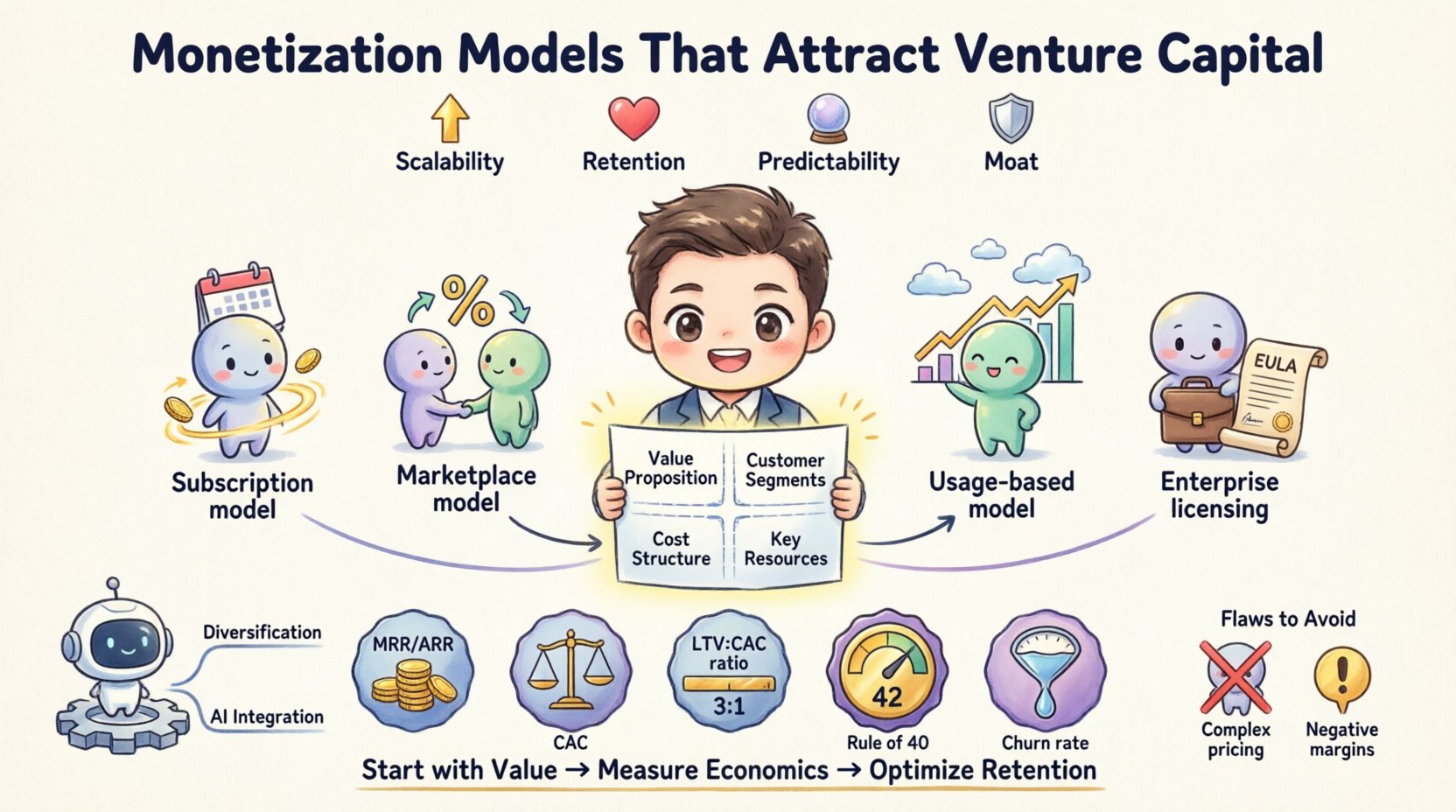
When evaluating a startup, serious capital looks for specific characteristics in the monetization approach:
- Scalability: Can revenue grow significantly without a linear increase in costs?
- Retention: Does the model encourage customers to stay and spend more over time?
- Predictability: Is there a stable forecast for future cash flow?
- Moat: Does the pricing strategy create barriers against competitors?
A model that relies on one-off transactions without a path to recurring revenue often struggles to justify high valuations. Investors prefer structures that compound value. This does not mean every company needs a subscription model, but the underlying math must demonstrate sustainable growth.
Core Revenue Models VCs Favor 💰
Different industries require different approaches to capturing value. However, certain patterns have historically resonated more deeply with institutional investors. Below are the primary models that demonstrate robust financial planning.
1. Subscription & Recurring Revenue 🔄
This model remains the gold standard for many technology sectors. It involves charging customers a recurring fee to access a product or service. The appeal lies in the predictability. When you know exactly how much revenue you will generate next month, forecasting becomes more accurate, and risk decreases.
Key advantages include:
- High Customer Lifetime Value (LTV): Customers pay over months or years, increasing the total revenue per user.
- Lower Churn Risk: Habitual usage often leads to stickiness.
- Valuation Multiples: Recurring revenue streams often command higher valuation multiples compared to one-time sales.
For this model to work, the cost of acquiring a customer must be significantly lower than the revenue they generate over time. If the acquisition cost eats up all the profit from the first year, the model is unsustainable regardless of the subscription structure.
2. Transaction & Marketplace Fees 🤝
Marketplace models facilitate exchanges between two or more parties. The platform takes a cut of every transaction. This is common in logistics, real estate, and gig economy sectors.
Investors scrutinize this model closely because it relies on liquidity. The platform must be active enough to facilitate transactions, but not so large that it becomes unwieldy. Key considerations include:
- Network Effects: Does more supply drive more demand, and vice versa?
- Take Rate: What percentage of the transaction value is captured as revenue?
- Friction: Is the transaction easy enough to happen frequently?
Successful marketplaces demonstrate that they can take a significant portion of the transaction value without killing the volume of trades. If the fee is too high, participants will bypass the platform.
3. Usage-Based & Consumption Models 📊
Also known as pay-as-you-go, this model charges customers based on how much they use the service. This is prevalent in cloud computing, API services, and utility-like software.
This approach aligns the platform’s success directly with the customer’s success. If the customer uses more, the platform earns more. Benefits include:
- Low Barrier to Entry: Customers can start small and scale up as their needs grow.
- Revenue Growth: As customers expand their usage, revenue expands automatically without upselling.
- Flexibility: Adapts to fluctuating demand.
The challenge lies in managing margins. If usage spikes, infrastructure costs might spike as well. The model must ensure that the cost of serving a user does not exceed the revenue generated from that usage.
4. Licensing & Enterprise Contracts 🏢
For B2B solutions, selling licenses or signing enterprise agreements can provide massive upfront revenue. This model often involves selling the right to use software or intellectual property.
Strategic elements for this model include:
- High Contract Value: Deals often reach six or seven figures annually.
- Long Sales Cycles: Requires patience and a dedicated sales team.
- Implementation Complexity: Often requires professional services to deploy.
Investors appreciate the stability of enterprise contracts, though they prefer a mix of recurring licensing fees and one-time implementation fees to balance cash flow.
Aligning with the Business Model Canvas 📐
The Business Model Canvas is not a static document; it is a dynamic map of the business. The Revenue Streams block cannot exist in isolation. It must interact with other building blocks to create a cohesive system. Here is how monetization fits into the broader canvas.
| Canvas Block | Relationship to Monetization | Key Question for Founders |
|---|---|---|
| Value Proposition | Revenue is the price paid for value. If the value is weak, pricing power is low. | Does the customer perceive enough value to justify the cost? |
| Customer Segments | Different segments respond to different pricing models. | Are we charging the right segment the right price? |
| Cost Structure | Revenue must exceed the cost of delivery to generate profit. | Is the margin positive after fixed and variable costs? |
| Key Resources | Assets required to deliver the paid service. | Do we own the assets necessary to sustain the revenue? |
When filling out the canvas, founders often treat Revenue Streams as an afterthought. They assume that once the product is built, money will follow. This is a dangerous assumption. The revenue model should be defined during the Value Proposition phase. It dictates which customers are targeted and how the product is built.
Key Financial Metrics for Due Diligence 📈
Once a monetization model is selected, it must be measured. VCs do not look at total revenue alone. They analyze the quality of that revenue. Specific metrics provide insight into the health of the business.
- Monthly Recurring Revenue (MRR): The predictable revenue expected every month. Crucial for subscription models.
- Annual Recurring Revenue (ARR): MRR multiplied by 12. Provides an annualized view of performance.
- Customer Acquisition Cost (CAC): The total sales and marketing cost divided by the number of new customers acquired.
- Rule of 40: The sum of growth rate and profit margin. A score of 40% or higher is often considered healthy in SaaS.
- Churn Rate: The percentage of customers who stop using the service over a given period.
- LTV:CAC Ratio: The lifetime value of a customer compared to the cost of acquiring them. A ratio of 3:1 is typically the target.
Transparency in these numbers builds trust. Hiding churn or inflating LTV projections is a common red flag during due diligence. Founders should be prepared to explain the assumptions behind every metric.
Common Structural Flaws to Avoid ⚠️
Even with a solid model, execution errors can undermine investor confidence. Several patterns frequently appear in pitches that signal poor financial planning.
- Undefined Pricing Strategy: Starting with “negotiated pricing” suggests a lack of confidence in the product’s value. Fixed pricing tiers are preferred.
- Over-reliance on Grants: Funding that does not require repayment is attractive, but it does not prove market demand.
- Ignoring Gross Margins: High revenue with negative gross margins indicates a business that loses money on every unit sold.
- Short-Term Focus: Prioritizing quick cash flow over long-term asset building can limit valuation potential.
- Complex Fee Structures: If a customer needs a calculator to understand what they owe, the model is likely too complex.
Investors want simplicity. They want to understand exactly where the money comes from and how much it costs to get it. Complexity often hides inefficiency.
Future-Proofing Your Revenue Strategy 🔮
The market changes. Technologies evolve. A monetization model that works today might become obsolete in five years. Founders must build flexibility into their financial planning.
Consider these factors for longevity:
- Dynamic Pricing: Can the model adapt to market conditions without alienating customers?
- Diversification: Relying on a single customer or a single product line is risky. Diversified revenue streams mitigate this.
- Adoption of New Tech: AI and automation can reduce costs, improving margins. Ensure the model captures these efficiencies.
- Regulatory Compliance: Data privacy laws and financial regulations can impact how revenue is collected and reported.
A resilient model anticipates change. It is built on fundamentals that remain relevant even as the landscape shifts. This includes strong relationships with customers and a clear value exchange.
Strategic Implementation Steps 🛠️
Moving from concept to a funded venture requires deliberate steps. Here is a logical progression for refining your monetization strategy.
- Define the Value: Clearly articulate what problem is being solved. Revenue is a byproduct of solving a painful problem.
- Identify the Payer: Who writes the check? Sometimes the user is not the payer.
- Test Pricing: Run experiments with different price points to find the sweet spot between volume and margin.
- Map the Unit Economics: Calculate the profit per unit before scaling.
- Document the Model: Write it down clearly. If it cannot be explained simply, it needs refinement.
- Align the Team: Ensure sales, product, and finance teams understand the revenue logic.
Documentation is key. Investors will ask for detailed financial models. These documents should reflect the Business Model Canvas logic. They should show how revenue scales with costs and how risks are managed.
The Intersection of Growth and Profit 📉📈
A common debate in startups is growth versus profitability. Early-stage companies often prioritize growth to capture market share. Later stages require a shift toward profitability to sustain operations.
VCs understand this trade-off. They fund growth when the unit economics promise future profitability. They do not fund growth when the math does not work. A monetization model must eventually support a path to positive cash flow.
Key considerations for balancing this equation:
- Blended Payback Period: How long does it take to recover the cost of acquiring a customer?
- Operating Leverage: As revenue grows, do costs grow slower?
- Capital Efficiency: How much capital is required to generate a dollar of revenue?
Focusing on efficiency signals maturity. It shows that the founder understands the cost of capital and is not burning cash without a return.
Conclusion 🏁
Selecting the right monetization model is one of the most critical decisions a founder makes. It defines the relationship with customers, the structure of the company, and the potential for future valuation. By aligning revenue streams with the Business Model Canvas and focusing on scalable, predictable models, startups can attract serious venture capital.
Investors look for clarity, data, and a deep understanding of the market. They want to see that the path to revenue is mapped out and that the risks are understood. A well-structured monetization strategy demonstrates that the team is ready to build a lasting enterprise, not just a temporary product.
Start with the value. Measure the economics. Optimize for retention. This disciplined approach creates the foundation for sustainable growth and investment.
Related posts:
 Business Model Canvas: How to Validate Business Model Assumptions Before Pitching Investors
 Pivoting Your Business Model Canvas Based on Real Market Data
 Business Model Canvas: Identifying Critical Weaknesses in Early Stage Business Models
 Business Model Canvas: Designing Scalable Business Models for Hypergrowth Startups