


Startups operate in an environment defined by uncertainty. While innovation drives growth, many ventures fail not because the idea lacks merit, but because the underlying business structure contains structural faults. A robust business model is the backbone of any organization. When that backbone is compromised, the entire entity becomes unstable. This guide provides a systematic approach to diagnosing vulnerabilities within the Business Model Canvas. It focuses on analytical rigor rather than optimism.
Early-stage founders often prioritize product development over business architecture. They assume demand will exist once the product is built. This assumption creates a blind spot. Weaknesses in revenue streams, customer acquisition channels, or cost structures can remain invisible until capital runs out. Identifying these issues requires a cold, hard look at each building block. It requires asking difficult questions about viability and scalability.
The Diagnostic Framework for Business Architecture 🔍
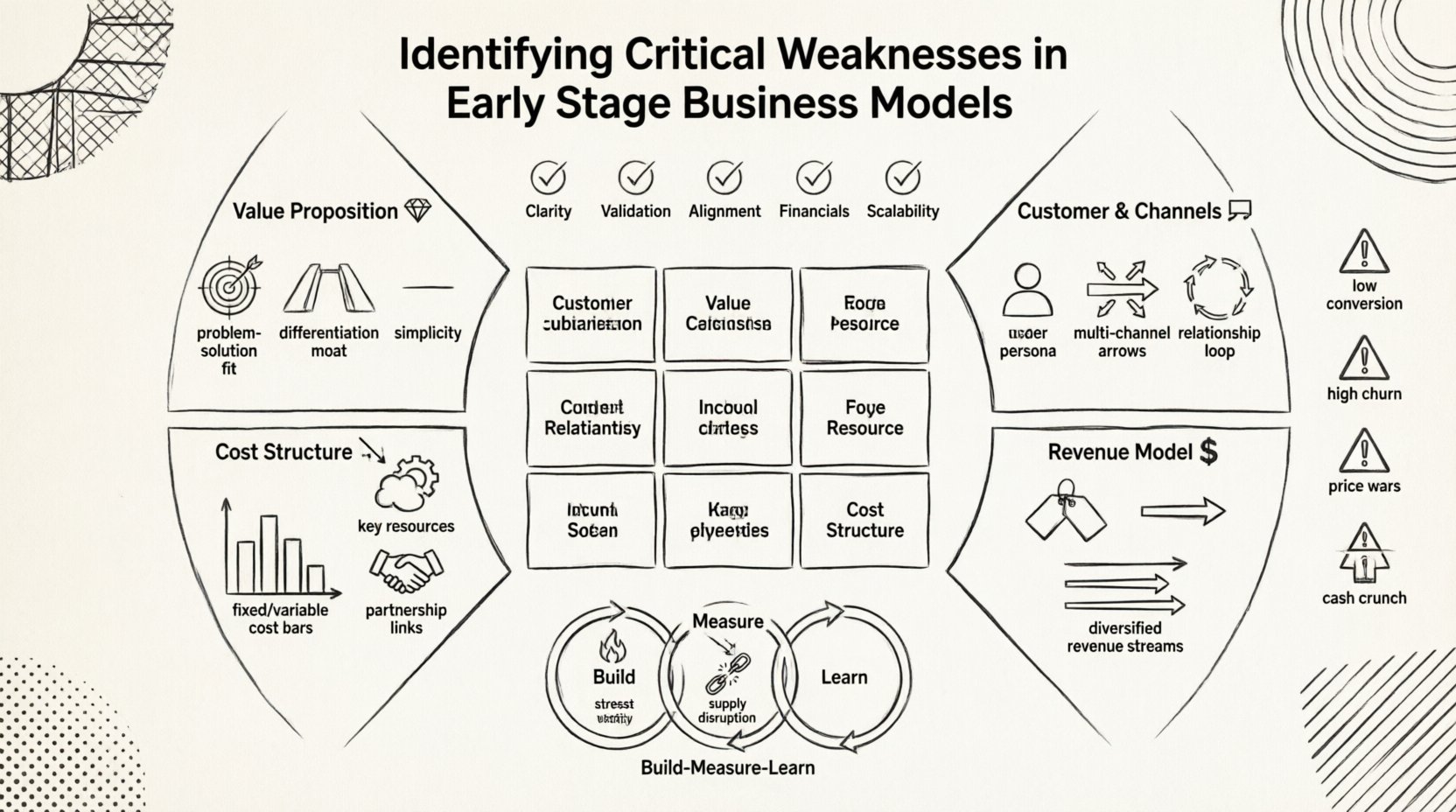
Before diving into specific blocks, one must establish a baseline for analysis. The Business Model Canvas consists of nine distinct elements. Each element interacts with the others. A weakness in one area often exacerbates a problem in another. For instance, a high customer acquisition cost can render a profitable revenue model unviable if the lifetime value is too low.
To conduct a thorough audit, consider the following diagnostic questions for each block:
- Clarity: Is the definition of the value proposition unambiguous?
- Validation: Has the assumption been tested with real data?
- Alignment: Do the resources match the activities required?
- Financials: Does the math support the strategic intent?
- Scalability: Can the model handle growth without breaking?
This framework shifts the focus from “what are we building?” to “how does this sustain itself?”. It moves the conversation from creative ideation to operational reality.
Value Proposition Vulnerabilities 💎
The value proposition is the core of the business. It answers the question: why should a customer choose this product over a competitor or doing nothing at all? Weaknesses here are often the most fatal. They manifest as a lack of differentiation or a solution looking for a problem.
1. The Problem-Solution Fit
Many early-stage ventures solve problems that customers do not perceive as painful. This is known as a “vitamin” rather than a “painkiller”. A critical weakness occurs when the perceived value does not justify the cost of acquisition.
- Indicators: Low conversion rates, high churn, negative feedback on core features.
- Impact: Revenue stagnation, wasted marketing spend.
2. Differentiation Failure
Copycat models are risky. If a competitor can replicate your offering with fewer resources, your position is fragile. A strong value proposition must possess a moat. This could be intellectual property, network effects, or proprietary data.
- Indicators: Price wars, feature parity with larger incumbents.
- Impact: Margin compression, loss of market share.
3. Overcomplication
Complexity creates friction. If the value proposition requires a steep learning curve or significant behavioral change without clear incentives, adoption will stall. Simplicity is often a competitive advantage.
- Indicators: Long sales cycles, high support ticket volume.
- Impact: Reduced velocity, operational drag.
Customer Segments and Channel Mismatches 📢
Knowing who you serve is as important as knowing what you sell. A common weakness involves targeting a segment that lacks the budget or the need for the solution. Another frequent error is selecting channels that do not reach the intended audience.
1. Target Audience Definition
“Everyone” is not a customer segment. Broad targeting dilutes messaging and increases acquisition costs. Weaknesses here appear when the team cannot articulate the specific persona.
- Indicators: Inconsistent messaging, broad but shallow engagement.
- Impact: Inefficient marketing spend, low brand affinity.
2. Channel Effectiveness
The channel is how the product reaches the customer. Early-stage businesses often rely on a single channel. If that channel changes algorithm, price, or availability, the business collapses.
- Indicators: Over-reliance on one platform, rising cost per click.
- Impact: Sudden revenue drops, lack of control.
3. Relationship Maintenance
Acquiring a customer is only half the battle. Retaining them requires a defined relationship model. Weaknesses occur when there is no mechanism for engagement after the sale.
- Indicators: High churn rate, low repeat purchase frequency.
- Impact: Constant need to replace lost revenue.
Revenue Model Flaws 💰
Revenue streams are the lifeblood of the organization. A business model can have a great product and a loyal customer base but still fail if the monetization strategy is flawed. This section analyzes pricing, payment terms, and revenue diversity.
1. Pricing Strategy
Pricing is not just about covering costs; it is about capturing value. Underpricing signals low quality and kills margins. Overpricing creates a barrier to entry that limits market penetration. The weakness lies in the disconnect between price and perceived value.
- Indicators: Frequent discounting, complaints about cost.
- Impact: Low profitability, brand devaluation.
2. Payment Cycles
Cash flow is critical. If you pay suppliers before receiving payment from customers, you face liquidity risks. This is common in B2B service models where net-60 terms are standard.
- Indicators: Constant cash crunch, inability to fund operations.
- Impact: Operational delays, potential insolvency.
3. Revenue Diversification
Dependence on a single revenue stream is a vulnerability. If that stream dries up, the business has no safety net. A healthy model often includes a mix of subscription, transactional, and licensing revenue.
- Indicators: 90% of revenue from one product or client.
- Impact: Extreme sensitivity to market shifts.
Cost Structure and Resource Risks 📉
Profit is what remains after costs are deducted from revenue. Many startups ignore cost structures until it is too late. High fixed costs can lead to rapid burnout during slow periods. High variable costs can prevent scaling.
1. Fixed vs. Variable Costs
Early-stage companies often accumulate fixed costs too quickly. Hiring full-time staff, leasing office space, and purchasing expensive software licenses create a high break-even point. Variable costs allow flexibility.
- Indicators: High burn rate relative to revenue growth.
- Impact: Runway reduction, forced layoffs.
2. Key Resources
Identifying the assets required to deliver value is essential. If the model relies on human capital that is scarce or expensive, scalability is limited. If it relies on proprietary technology that is unproven, execution risk is high.
- Indicators: Inability to hire, technical debt accumulation.
- Impact: Delivery delays, quality issues.
3. Key Partnerships
External partners can reduce costs and accelerate growth. However, reliance on partners introduces risk. If a partner raises prices or exits the market, the business is exposed.
- Indicators: Lack of control over supply chain, dependency clauses.
- Impact: Margin erosion, service disruption.
Common Weakness Indicators Summary 📊
The following table summarizes common weaknesses across the Business Model Canvas. This serves as a quick reference for identifying red flags during internal reviews.
| Block | Common Weakness | Warning Sign |
|---|---|---|
| Value Proposition | Lack of differentiation | Customers say “it’s okay” instead of “I need it” |
| Customer Segments | Wrong audience targeting | High bounce rate, low engagement |
| Channels | Single point of failure | Algorithm changes halt traffic |
| Revenue Streams | Poor pricing power | Discounts required for closing deals |
| Key Resources | Over-reliance on talent | Key person risk, turnover issues |
| Cost Structure | High fixed costs | High burn rate before revenue |
The Iteration Process and Validation 🔄
Identifying weaknesses is only the first step. The second step is addressing them through iteration. This requires a mindset of continuous improvement. Data must drive decisions, not intuition.
1. The Build-Measure-Learn Loop
Start small. Build a minimum viable product to test specific assumptions. Measure the results objectively. Learn from the data. If the data indicates a weakness, pivot or persevere based on evidence.
- Action: Run A/B tests on pricing and messaging.
- Action: Conduct user interviews to validate pain points.
- Action: Analyze cohort retention over time.
2. Stress Testing the Model
Simulate adverse scenarios. What happens if customer acquisition costs double? What if churn increases by 10%? This prepares the leadership team for potential shocks.
- Scenario A: Revenue drops 50%. Can we survive?
- Scenario B: Costs rise 30%. Do we have margin room?
- Scenario C: Competitor enters with lower prices. Do we have a defense?
BMC Block Stress Test Checklist ✅
Use this checklist to evaluate the resilience of each block within your canvas.
| Block | Stress Test Question | Pass Criteria |
|---|---|---|
| Value Prop | Can we explain this in one sentence? | Clear, concise, compelling answer |
| Channels | What if this channel disappears tomorrow? | Alternative channel identified |
| Revenue | How long until we break even? | Clear path to profitability |
| Costs | What is our cash runway? | At least 12 months of runway |
| Partners | Can we operate without them? | Backup plan exists |
Long-term Sustainability Checks 🌱
Weaknesses are not always immediate threats. Some are latent issues that surface over time. Sustainability requires looking beyond the next quarter. It involves assessing market trends, regulatory changes, and technological shifts.
1. Market Trends
Is the market growing or shrinking? Entering a declining market requires a very different strategy than entering a growing one. A weakness exists if the business model is built on a trend that is peaking.
- Check: Analyze industry growth rates.
- Check: Monitor competitor exit rates.
2. Regulatory Compliance
Legal frameworks change. Data privacy, labor laws, and industry-specific regulations can impact costs and operations overnight. Ignoring this creates a liability.
- Check: Review compliance costs regularly.
- Check: Consult legal counsel on upcoming changes.
3. Technological Obsolescence
Technology evolves rapidly. A model built on current tech stacks may become obsolete quickly. Continuous innovation is necessary to maintain relevance.
- Check: Allocate budget for R&D.
- Check: Stay updated on emerging tech trends.
Final Thoughts on Business Model Resilience 💡
Building a resilient business is an ongoing process. It requires constant vigilance and a willingness to admit when assumptions are wrong. By systematically auditing the Business Model Canvas, founders can identify critical weaknesses before they become existential threats. This approach prioritizes long-term stability over short-term gains.
The goal is not perfection. It is viability. A business does not need to be flawless to succeed, but it does need to be adaptable. When weaknesses are found, they are opportunities to refine the strategy. Use data to guide these refinements. Avoid emotional attachment to specific features or channels. Focus on the fundamental economics of the operation.
Remember that every element of the model is connected. A change in one area ripples through the others. Maintain a holistic view. Regular reviews ensure that the model evolves alongside the market. This discipline separates surviving ventures from those that fade away.
Start the audit today. Look at the canvas with fresh eyes. Identify the cracks. Reinforce the foundation. This is the path to sustainable growth.
Related posts:
 Business Model Canvas: How to Validate Business Model Assumptions Before Pitching Investors
 Pivoting Your Business Model Canvas Based on Real Market Data
 Business Model Canvas: Designing Scalable Business Models for Hypergrowth Startups
 Business Model Canvas: Aligning Value Propositions with Customer Segments for Product Market Fit