
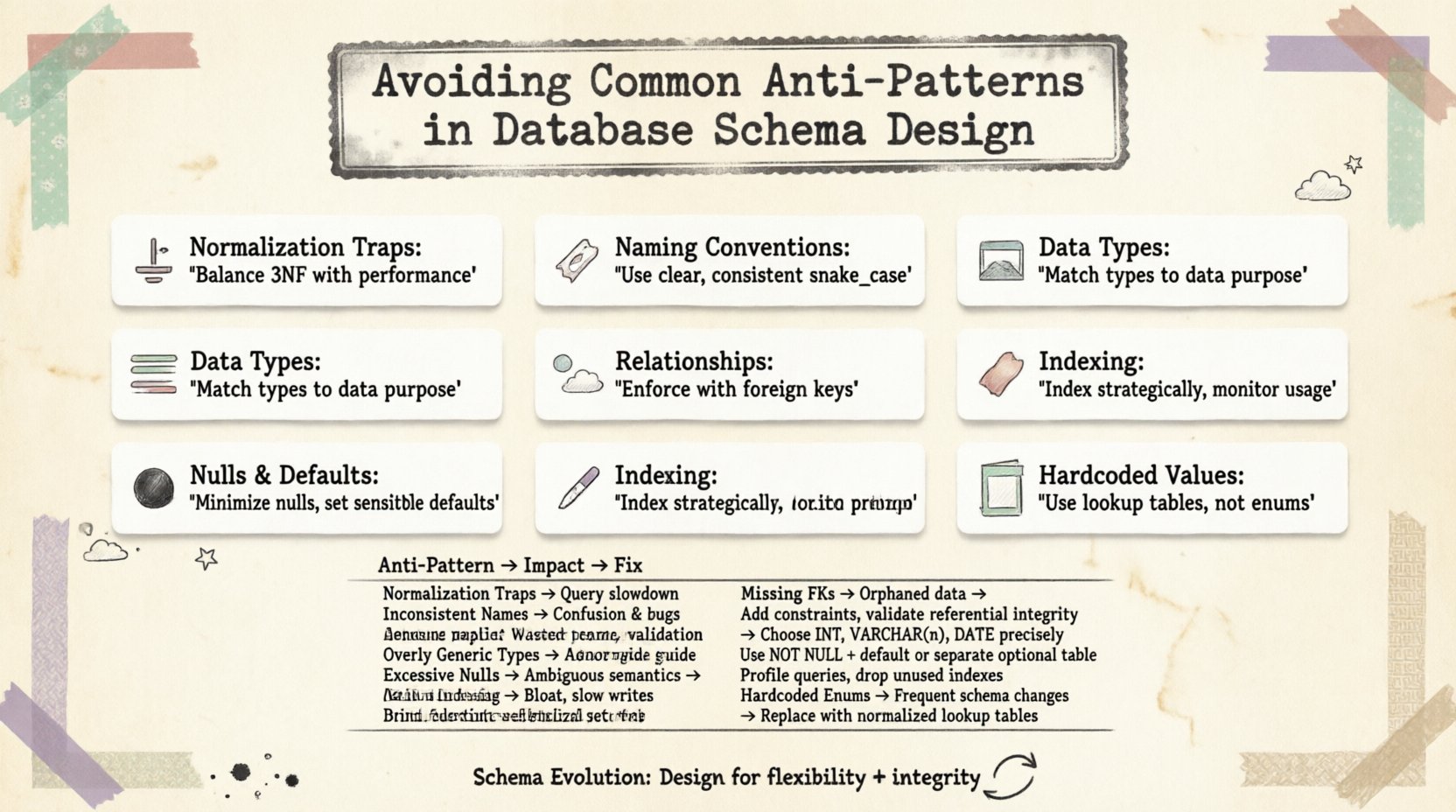
The foundation of any robust data management system lies in its schema. A well-constructed Entity Relationship Diagram (ERD) ensures data integrity, performance, and scalability. However, even experienced developers occasionally fall into traps that compromise the system later. These mistakes are known as anti-patterns. Recognizing and avoiding them is crucial for maintaining a healthy database architecture over time. This guide explores common pitfalls and provides practical strategies to ensure your data modeling decisions stand the test of time.
1. Normalization Traps ⚖️
Normalization is a technique used to organize data to reduce redundancy and improve data integrity. While it is a fundamental concept, applying it without nuance can lead to performance issues. The goal is not to reach the highest normal form blindly, but to find a balance that suits the workload.
Over-Normalization: Creating too many tables for minor distinctions can force complex joins. Every join operation requires processing power and I/O. If your application frequently reads data across these tables, response times will suffer.
Under-Normalization: Storing data in a single massive table often leads to redundancy. If a piece of information changes, you must update multiple rows. This increases the risk of inconsistent data states.
The Fix: Aim for Third Normal Form (3NF) as a baseline. Evaluate join costs against read/write frequency. For read-heavy workloads, consider controlled denormalization to store derived data in specific columns.
2. Ambiguous Naming Conventions 🏷️
Naming tables and columns is not just about aesthetics; it is about clarity. When a developer reads a schema months later, names should be self-explanatory. Ambiguity leads to errors and slows down development cycles.
Shortcuts: Avoid single-letter column names like
a,b, orc. These provide no context about the data stored.Inconsistent Prefixes: Do not mix
tbl_userswithusers. Stick to a single convention, such as plural nouns for tables and singular for columns.Reserved Words: Avoid using keywords from the query language as table or column names. This requires constant escaping and confuses readers.
Standard Approach: Use snake_case for consistency. Ensure names describe the content accurately, such as
created_atinstead ofdate.
3. Inappropriate Data Types 📏
Selecting the correct data type is critical for storage efficiency and data accuracy. Using a generic type like a string for everything might seem flexible, but it introduces validation issues and slows down queries.
Storing Dates as Strings: Never store dates as text unless the format varies wildly and cannot be standardized. Text storage prevents date arithmetic and range queries from working efficiently.
Floats for Money: Floating-point numbers introduce rounding errors. For financial data, use fixed-point types or integers representing the smallest currency unit (e.g., cents).
Overly Large Integers: If you know a number will never exceed 100, do not allocate a 64-bit integer. Smaller types save storage space and can improve index performance.
Character Limits: Define appropriate lengths. Storing a full name in a 255-character field is fine, but storing a short code in 255 characters wastes space.
4. Weak Relationship Modeling 🔗
Relationships define how tables interact. Poor modeling here leads to data anomalies and difficulty in querying. Foreign keys are the glue that holds relational data together.
Missing Foreign Keys: Relying on application logic to enforce relationships is risky. If the application fails, the database remains unaware of the broken link. Use constraints to maintain integrity.
Circular References: Ensure relationships do not create circular dependencies that confuse query execution plans. While some circularity is unavoidable, keep it minimal.
Many-to-Many Without Junction: Do not store multiple IDs in a single column. Use a junction table to manage many-to-many relationships explicitly.
On Delete Behavior: Define what happens when a parent record is deleted. Should child records cascade, or should the operation be blocked? This decision impacts data safety.
5. Misusing Nulls and Defaults 🌑
Handling missing data is one of the most common sources of bugs. The way you configure nullability and default values determines how your application handles gaps in information.
Too Many Nulls: If a column is nullable everywhere, the application must check for nulls constantly. This clutters logic with conditional statements.
Default Values: Use sensible defaults to prevent nulls where possible. For example, set a status column to ‘active’ rather than null upon creation.
Boolean Ambiguity: Avoid using integers (0 or 1) for boolean flags if the system supports actual boolean types. It improves readability and reduces conversion errors.
Validation: Ensure business rules validate data before it enters the schema. The database should not be the only place where data is checked.
Common Anti-Patterns vs. Recommended Practices
Anti-Pattern | Impact | Recommended Practice |
|---|---|---|
Using | Wasted storage, slower indexes | Use specific types like |
Storing JSON in a standard column | Hard to query, no validation | Use native JSON types if supported, or separate normalized tables |
Primary Keys as Foreign Keys | Hard to scale, tight coupling | Use surrogate keys (UUID or auto-increment) for relationships |
Hardcoded values in schema | Requires schema change for updates | Use lookup tables or configuration tables |
Ignoring Indexes | Slow queries on large datasets | Index frequently queried columns, especially foreign keys |
6. Indexing Without Purpose 🏷️
Indexes speed up data retrieval but slow down data writing. Every index consumes disk space and requires maintenance. Adding them indiscriminately degrades overall performance.
Over-Indexing: Creating an index on every column might seem safe, but write operations (INSERT, UPDATE, DELETE) become slower because the database must update every index.
Low Cardinality: Indexing columns with few unique values (like
genderorstatus) is often inefficient. The database engine may ignore the index in favor of a full table scan.Composite Keys: Order matters. Place the most selective column first in a composite index to maximize filtering capability.
Monitoring: Regularly review index usage. Remove unused indexes to reclaim space and improve write speeds.
7. Hardcoded Values in Schema 🧱
Embedding business logic or specific values directly into the schema structure creates rigidity. If a business rule changes, the schema may require a migration, which is risky and disruptive.
Enum Overload: Do not use database enums for lists that change frequently. A migration is needed to alter the enum type.
Lookup Tables: Instead, use reference tables. This allows adding new values without altering the database structure.
Configuration Separation: Keep business rules in application code or configuration files, not in the database schema itself.
Flexibility: Design the schema to handle growth. Assume requirements will evolve and build a structure that accommodates change.
Final Thoughts on Schema Evolution 🔄
Database design is not a one-time task. It evolves as the application grows. The goal is to create a structure that is flexible enough to adapt but strict enough to maintain integrity. By avoiding these common anti-patterns, you reduce technical debt and ensure the system remains performant. Regularly review your ERD during development cycles. Collaborate with other engineers to validate assumptions. A solid schema supports the application, while a poor one hinders progress.
Focus on clarity, consistency, and performance. These principles guide the decision-making process better than any specific tool or technology. When the foundation is sound, the entire system benefits from stability and ease of maintenance.