At the heart of ArchiMate lies a simple but powerful idea: enterprise architecture becomes easier to understand when it is broken into clear, interconnected layers. These layers—Business, Application, and Technology—serve as the structural backbone of the ArchiMate language. They allow architects to describe how strategy turns into processes, how processes rely on systems, and how systems run on concrete technology.
This layered structure is why many teams rely on ArchiMate tools and EA modeling software to build a consistent, end-to-end view of their organization. Rather than juggling disconnected diagrams or text-heavy documents, the ArchiMate framework provides a unified way to visualize how everything works together.
The Business Layer: Where Value Is Defined
The Business Layer is the most human-facing part of the architecture. It describes what the organization does, who performs the work, and what value is delivered to customers or internal stakeholders. Instead of looking at systems or servers, the focus is on capabilities, processes, roles, and services.

This layer answers questions such as:
- What services does the business offer?
- Which roles or actors perform specific activities?
- How do processes create and deliver value?
- What capabilities does the organization rely on?
When modeled with clarity, the Business Layer becomes a powerful communication tool. It helps managers understand dependencies, supports capability-based planning, and allows teams to map strategy to operations. Many organizations begin their ArchiMate journey here because it establishes a shared view that both business and IT can understand.
The Application Layer: Connecting Business Needs to Digital Solutions
The Application Layer sits between business operations and technology execution. It defines the software systems that support business functions, the services they expose, and the data they manage. This layer is where most enterprise architecture discussions tend to converge: which applications are essential, which overlap, and how information flows between them.

In practice, this layer clarifies:
- What systems support key business activities
- How applications interact and integrate
- What services each application provides
- How data is created, consumed, or exchanged
When visualized using EA modeling tools, these relationships reveal redundancies, integration gaps, and modernization opportunities. The Application Layer also plays a central role in cloud migration planning, SaaS adoption, and rationalization projects, all of which benefit from a clear and standardized modeling language like ArchiMate.
The Technology Layer: The Foundation Supporting Everything Above
The Technology Layer captures the infrastructure, platforms, and runtime environments that power the applications. It covers physical resources such as servers, networks, and devices, as well as virtualized and cloud-based components like containers, VMs, and Kubernetes clusters.
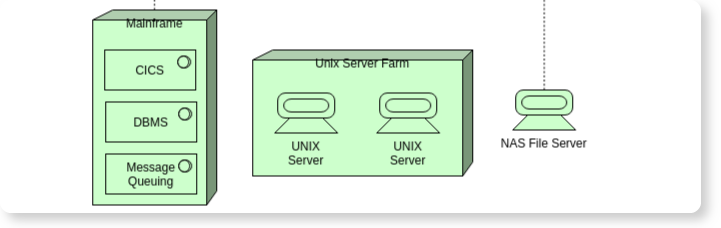
This layer answers questions like:
- What infrastructure supports each application?
- Which platforms, databases, or middleware are in use?
- How do deployment environments relate to one another?
- Where are potential risks, constraints, or bottlenecks?
Modern architectures are rarely simple, and with the rise of hybrid cloud and virtualization, the Technology Layer has become essential for mapping system dependencies. ArchiMate’s structured notation makes it easier for architects to model this complexity without losing clarity.
The Power of Traceability Across Layers
Although each layer has its own purpose, ArchiMate’s real strength emerges when they are connected. Business processes can be linked to the applications that automate them and to the technology that supports those systems. This vertical traceability is one of the reasons ArchiMate is increasingly used in digital transformation programs.
By seeing all three layers in a unified model, organizations can:
- Identify how a change in technology impacts business capabilities
- Pinpoint which processes depend on outdated or duplicate systems
- Assess risks when planning modernization or migration
- Communicate cross-layer dependencies to non-technical leaders
A good ArchiMate tool enhances this by enabling filtering, layering controls, and automated dependency analysis.
Tips: Other than the layers, relationship in the ArchiMate Diagram is also very important, learn more about The Power of Relationships.
Why the Three-Layer Structure Still Matters Today
In an era of rapid change, enterprises need a modeling language that makes complexity manageable. The three pillars of ArchiMate provide exactly that. Instead of isolated diagrams or inconsistent documentation, teams gain a structured view that aligns strategy, operations, systems, and infrastructure.
Whether you are rationalizing your app portfolio, planning a cloud migration, designing business capabilities, or simply trying to communicate architecture clearly, the Business, Application, and Technology layers remain the foundation of effective enterprise architecture modeling.
By understanding these layers, architects can model more strategically, communicate more effectively, and guide transformation with greater confidence.
Learn more: Modeling the “Why”: How to Use ArchiMate’s Motivation Layer to Strengthen Strategic Design