Many architecture diagrams explain what an organization does or how systems work, but few communicate why those decisions matter. That is where ArchiMate’s Motivation Layer becomes essential. It offers a structured view of purpose, intent, and justification, helping you link strategic thinking with real architectural decisions.
When you work with a modern ArchiMate modeling tool such as VP Online, it becomes easier to visualize strategic drivers, capture business motivations, and communicate them across teams. This article explains what the Motivation Layer is, why it matters, and how you can integrate it into your strategic design.
1. What Is ArchiMate’s Motivation Layer?
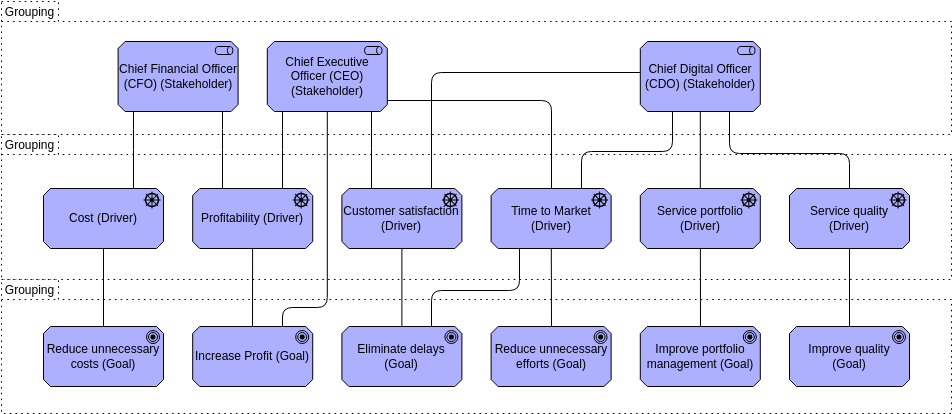
ArchiMate’s Motivation Layer describes the reasoning behind architectural choices. While most modeling focuses on processes, capabilities, and technology, the Motivation Layer highlights the elements that shape these decisions. These include:
- Drivers: The forces or challenges prompting change
- Assessments: Opportunities, issues, or risks
- Goals: What the organization intends to achieve
- Outcomes: The measurable results of strategic efforts
- Principles: Rules or guidelines influencing design
- Requirements: Conditions that must be met
- Constraints: Limitations that shape the scope
In an ArchiMate tool, these elements form a structured, interconnected map that shows how each architectural decision traces back to strategic intent.
2. Why the Motivation Layer Matters in Strategy
Strategy work often suffers from ambiguity. Different teams interpret goals differently, resulting in misaligned priorities. The Motivation Layer resolves this problem by offering:
- A shared understanding of purpose
It explains why decisions are made, ensuring teams act with aligned expectations. - Clear traceability
Goals connect to requirements, which connect to capabilities, processes, applications, and technology. With an ArchiMate diagramming tool, you can walk through the chain from intent to execution. - Better decision-making
Explicit motivations reduce arbitrary choices. Stakeholders can compare alternatives based on strategic alignment. - Improved communication
Non-technical teams understand motivations more easily than technical specifications. This helps transform enterprise architecture into a strategy-supporting conversation.
When using VP Online as your ArchiMate software, you can visualize these motivations through layers, viewpoints, and automated relationships that keep your models consistent.
3. Key Elements of the Motivation Layer and How They Work Together
- Drivers
Drivers identify what is pushing the organization toward change. Examples include evolving customer expectations, regulatory updates, or cost pressures. - Assessments
Assessments describe what those drivers mean. These may be opportunities that the organization wants to capture or problems it must address. - Goals and Outcomes
Goals define direction; outcomes define success. When you visualize these elements in an ArchiMate tool, you create measurable targets that map directly to capabilities and initiatives. - Principles and Requirements
Principles guide decision-making, and requirements specify what must be delivered to achieve the intended outcomes. - Constraints
Constraints describe limits such as budget, compliance, or resource availability. They ensure your strategy remains realistic.
Together, these components build a coherent narrative that explains why your architecture exists in its current form.
4. How to Integrate the Motivation Layer into Your Strategy
Integrating the Motivation Layer into your strategic design does not require complex modeling. Instead, focus on making motivations clear, structured, and traceable. Here is a simple approach:
4.1 Start with Drivers and Assessments
Identify what is influencing your organization. Are you responding to market disruption, technological advancement, or internal performance challenges? Map these forces first.
4.2 Translate Drivers into Goals and Outcomes
Turn each driver into a set of strategic intentions. Ask:
- What are we trying to achieve?
- What will success look like?
VP Online’s ArchiMate diagram maker provides templates and viewpoints to visualize these connections instantly.
4.3 Define Principles and Requirements
After setting goals, outline the principles that guide decision-making and the requirements that must be fulfilled.
For example:
- Principle: Standardize digital services
- Requirement: Implement a unified customer identity system
4.4 Link Requirements to Capabilities, Processes, and Systems
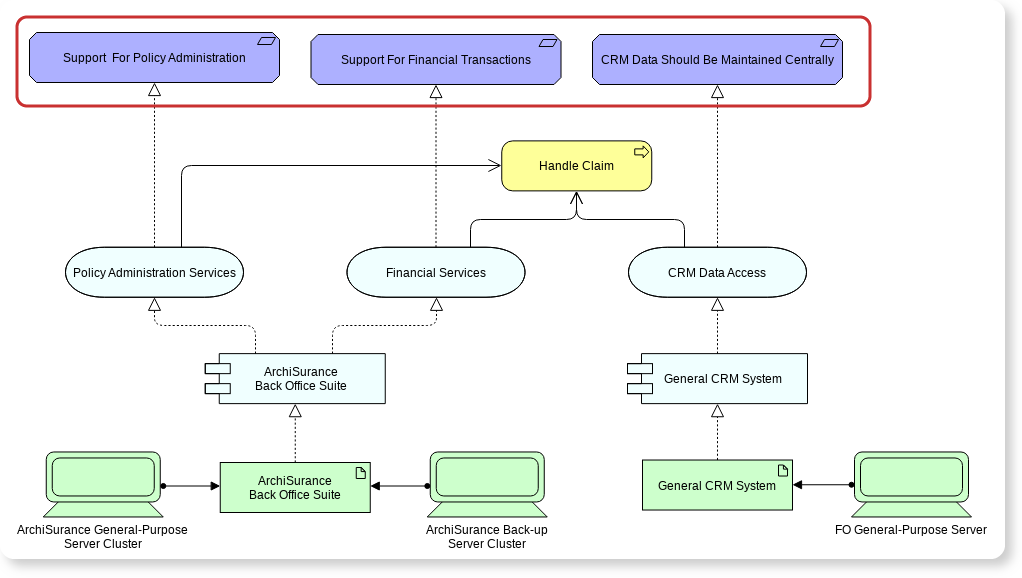
Once motivations are established, connect them to the architecture layers. This is where your ArchiMate modeling tool becomes essential. With VP Online, you can link motivations to Business, Application, and Technology layers for complete traceability.
4.5 Use Motivation Viewpoints to Communicate Strategy
ArchiMate includes defined viewpoints such as:
- Goal Realization Viewpoint
- Motivation Viewpoint
- Stakeholder Viewpoint
- Requirements Realization Viewpoint
These provide ready-made structures that focus on just the motivations, making it easier to communicate intent to executives and project teams.
5. How an ArchiMate Tool Helps You Model the “Why” More Effectively
Using an ArchiMate tool enhances clarity, alignment, and strategic communication. Here are some benefits of working in VP Online:
- Centralized Strategy Modeling
Capture drivers, goals, outcomes, and requirements in one workspace. - Automatic Relationship Management
Ensure connections are valid and visually consistent. - Templates and Viewpoints
Start modeling faster with predefined viewpoints from the Motivation Layer. - Cross-Layer Traceability
Link motivations to business capabilities, application services, and technology components. - Collaboration Features
Teams can comment, update, and align their understanding in real time.
If you want a simplified, browser-based ArchiMate modeling tool, VP Online offers an accessible way to work with the Motivation Layer without installing complex software.
6. Best Practices for Modeling the Motivation Layer
- Keep motivations concise
Avoid vague goals like “be more innovative.” Choose measurable, clear intentions. - Maintain traceability
Always connect motivations to real architectural elements. An ArchiMate tool automates much of this work. - Use viewpoints strategically
Do not overload diagrams. Choose viewpoints that match your audience. - Review motivations regularly
Drivers change over time. Update your Motivation Layer to match evolving strategy.