
Mastering VPasCode: AI-Driven Architecture in the VP AI Ecosystem
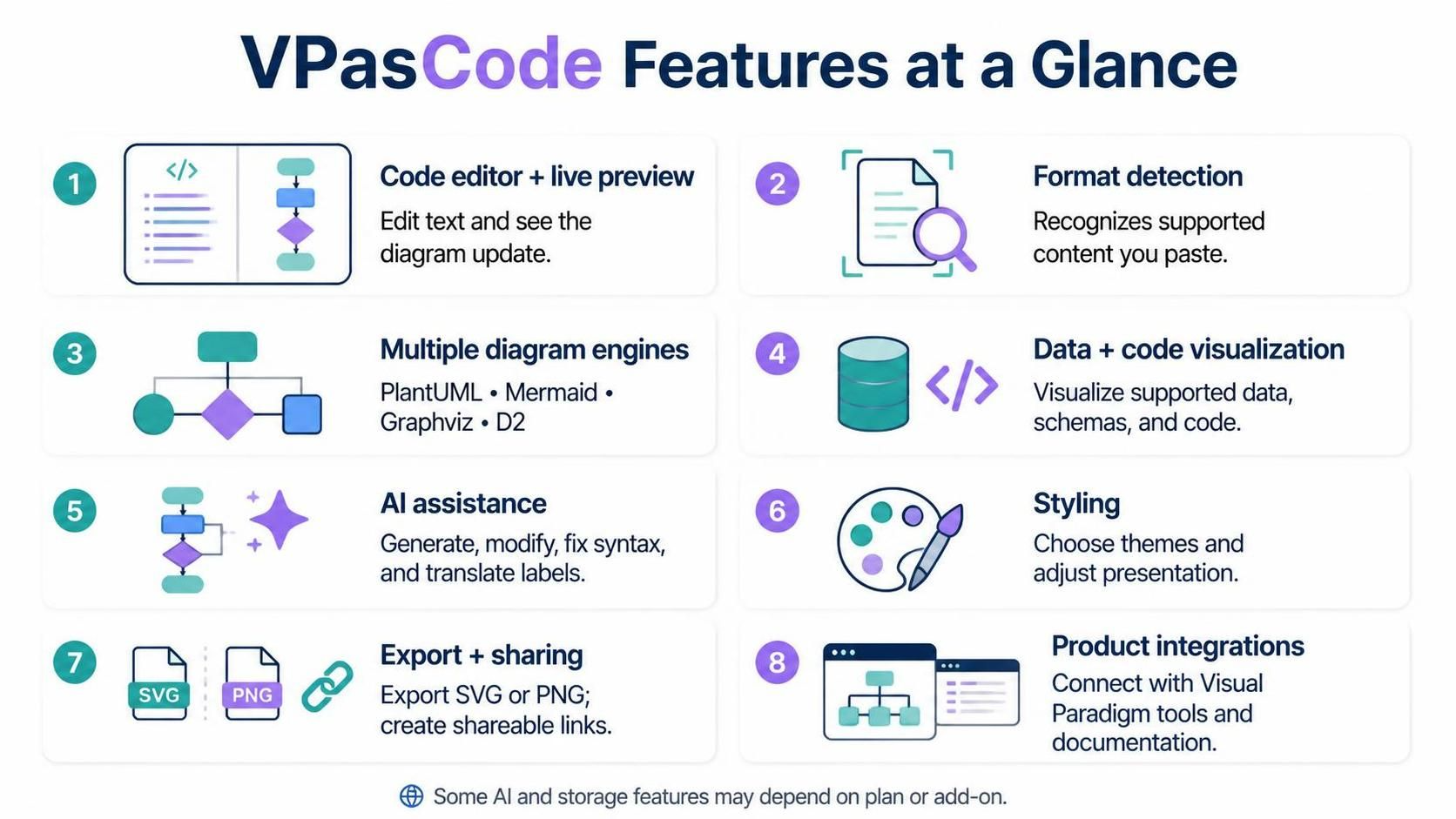
In the modern landscape of system design and software architecture, the barrier between abstract thought and visual representation must be as low as possible. Visual Paradigm’s VPasCode addresses this by transforming the traditional modeling workflow into a dynamic, code-driven experience. This tutorial explores the architectural philosophy behind VPasCode, focusing on how its multi-engine support, live preview capabilities, and AI integration create a cohesive environment for technical documentation.
Understanding the Core Architecture: The Live Preview Paradigm
The foundation of VPasCode is its Code Editor + Live Preview architecture. Unlike traditional GUI-based modeling tools where users drag and drop shapes that must be manually aligned, VPasCode utilizes a declarative approach. The user writes code in a text editor, and the system renders the diagram in real-time.
This architecture offers several distinct advantages:
- Version Control Compatibility: Since the model is stored as text, it can be managed using Git or other version control systems, allowing for diff tracking and collaborative history.
- Velocity: Experienced users can construct complex systems much faster by typing code than by navigating menus and resizing boxes.
- WYSIWYG Feedback: The Live Preview feature ensures that the visual output is always synchronized with the underlying logic, preventing syntax errors from breaking the diagram.
The Power of Multi-Engine Support
One of the most robust features of the VPasCode ecosystem is its ability to support Multiple Diagram Engines. Rather than being locked into a single proprietary syntax, VPasCode acts as a unified interface for several industry-standard engines:
- PlantUML: The most popular choice for UML diagrams, sequence diagrams, and architecture flows.
- Mermaid: Widely used in technical documentation (like Markdown files) for flowcharts and state diagrams.
- Graphviz: Preferred for generating directed graphs, organizational charts, and dependency trees.
- D2 (Declarative Diagramming): A modern language designed for creating dynamic diagrams with a focus on layout automation.
This flexibility allows teams to adopt the specific syntax best suited for their current task without switching tools.
Workflow Optimization: Format Detection and Visualization
To minimize friction during the modeling process, VPasCode employs Format Detection. When a user pastes text or code into the editor, the system automatically analyzes the content structure to identify the appropriate diagram engine. This eliminates the manual configuration often required when switching between formats.
Furthermore, the platform extends beyond simple flowcharts through Data and Code Visualization. It can parse supported data schemas and programming files to generate visual representations of complex data structures. This capability bridges the gap between raw code repositories and high-level architectural diagrams.
Integrating AI into the Modeling Lifecycle
The AI Assistance feature represents a significant leap forward in diagramming. It does not merely act as a spellchecker; it acts as a generative partner. The AI can:
- Generate full diagram syntax from natural language prompts.
- Modify existing diagrams to reflect architectural changes.
- Fix syntax errors automatically.
- Translate labels to different languages, ensuring global collaboration.
Example: AI-Generated Sequence Diagram
When using the AI to generate a sequence diagram, the system might output code similar to the following:
@startuml
actor User
participant "API Server" as Server
database "Database" as DB

User -> Server: Login Request
Server -> DB: Verify Credentials
DB --> Server: User Found
Server --> User: Authentication Token
@enduml
Styling, Export, and Integration
Once the logic is defined, the visual presentation is handled through Styling options. Users can select themes and adjust presentation styles, with specific interfaces available for complex themes like those in PlantUML. The output is versatile, supporting exports as SVG or PNG for high-fidelity documentation, alongside the creation of shareable links.
Finally, Product Integrations ensure that this code-centric approach fits into the broader Visual Paradigm ecosystem, allowing for seamless movement between VPasCode and other documentation workflows.
Conclusion
VPasCode represents a shift towards “Infrastructure as Code” applied to system architecture. By combining the precision of code editors with the creativity of visual design, and augmenting it with AI capabilities, it provides a powerful toolkit for modern technical professionals.