


Building a sustainable business requires more than just a great idea. It demands a rigorous understanding of financial mechanics. For early-stage ventures, the interplay between fixed and variable costs is often the deciding factor between survival and failure. This guide explores how founders can navigate cost structures within the Lean Startup methodology and the Business Model Canvas framework.
Understanding these dynamics allows entrepreneurs to allocate resources efficiently, test hypotheses without burning capital, and pivot when necessary. We will dissect the components of cost structures, map them to specific business model blocks, and provide actionable strategies for maintaining financial health during the growth phase.
💰 The Anatomy of Startup Costs
Before integrating costs into a strategic model, one must clearly distinguish between the types of expenses involved. In the context of a startup, costs generally fall into two primary categories. Recognizing the difference is the first step toward financial control.
Fixed Costs: The Baseline of Operations
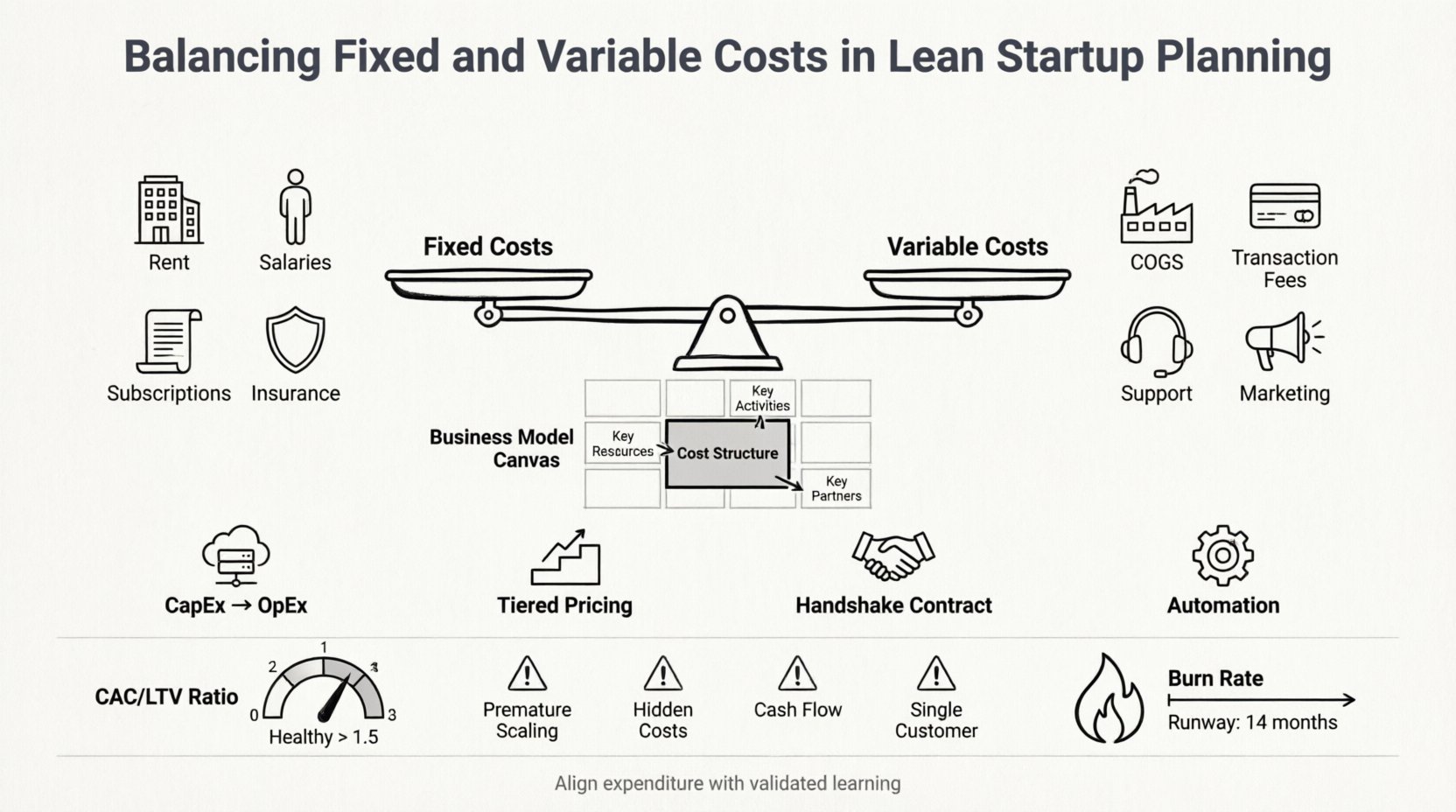
Fixed costs are expenses that remain constant regardless of the volume of goods or services produced. These are the costs you incur even if you have zero customers. In the early stages of a venture, fixed costs can be a significant burden if not managed carefully.
- Personnel Salaries: Core team members often receive fixed compensation, regardless of daily output.
- Rent and Utilities: Office space leases, internet bills, and electricity charges usually do not fluctuate with revenue.
- Software Subscriptions: Annual licenses for infrastructure or management tools often require upfront or recurring fixed payments.
- Insurance and Legal Fees: Compliance costs and liability protection are typically static over a set period.
While fixed costs provide stability, they create a break-even threshold. Until revenue exceeds these costs, the business is operating at a loss. Lean planning suggests minimizing these commitments until market validation occurs.
Variable Costs: The Cost of Growth
Variable costs change in direct proportion to the level of output. As you sell more, these costs rise. As you sell less, they fall. This flexibility is crucial for startups that need to remain agile.
- Cost of Goods Sold (COGS): Raw materials, manufacturing components, or direct labor tied to production.
- Transaction Fees: Payment processing charges that occur per sale.
- Customer Support: Costs that scale with the number of active users or support tickets.
- Marketing Spend: Advertising budgets often adjust based on the volume of leads generated or campaigns run.
Variable costs allow a company to scale up or down without immediate financial distress. However, if variable costs are too high relative to pricing, margins will erode quickly as volume increases.
🗺️ Integrating Cost Structure into the Business Model Canvas
The Business Model Canvas (BMC) is a strategic management template for developing new or documenting existing business models. One of its nine building blocks is specifically dedicated to costs: Cost Structure. This block captures all costs incurred to operate a business model.
When using the BMC, the Cost Structure block does not exist in a vacuum. It interacts dynamically with the Revenue Streams block and the Key Activities and Key Resources blocks.
Mapping Costs to Canvas Blocks
| BMC Block | Cost Type | Examples |
|---|---|---|
| Key Resources | Fixed | Investment in proprietary technology, real estate, or specialized talent acquisition. |
| Key Activities | Variable | Marketing campaigns, customer service hours, server usage scaling. |
| Key Partners | Mixed | Outsourced development (variable) vs. Long-term supplier contracts (fixed). |
| Value Proposition | Fixed | R&D costs to create the product before launch. |
By mapping costs to these specific blocks, founders can identify which areas of the business model drive the most financial risk. For instance, if Key Resources are heavily fixed, the startup has high operational leverage. If Key Activities are variable, the startup has high flexibility but potentially lower margins.
The Lean Startup Context
The Lean Startup methodology emphasizes validated learning, experimentation, and iterative product releases. This approach changes how costs are viewed. Traditional business planning often assumes a linear path to scale. Lean planning assumes uncertainty.
- Build-Measure-Learn: Costs are incurred in cycles. You spend on building a Minimum Viable Product (MVP), measure the results, and learn whether to pivot or persevere.
- Critical Waste: Lean thinking identifies any expenditure that does not contribute to validated learning as waste. Fixed costs that do not support the current hypothesis should be scrutinized.
- Agile Funding: Capital is deployed in tranches based on milestone achievement, rather than a single large infusion.
In this context, balancing costs means aligning expenditure with learning. A high fixed cost structure limits the ability to pivot quickly because the overhead remains regardless of the direction change.
⚖️ Strategic Approaches to Cost Balancing
Founders cannot simply eliminate costs; they must optimize the ratio between fixed and variable to match the business lifecycle. Here are strategies to achieve this balance effectively.
1. Shift from CapEx to OpEx
Capital Expenditure (CapEx) involves purchasing assets that will be used over a long period. Operating Expenditure (OpEx) covers day-to-day costs. Modern startups often prefer OpEx models.
- Cloud Infrastructure: Instead of buying servers (CapEx), use cloud hosting that charges by usage (Variable/OpEx).
- Outsourcing: Hire contractors for non-core tasks rather than full-time employees. This converts labor costs from fixed to variable.
- Subscription Models: Rent software rather than buying perpetual licenses. This spreads costs over time and reduces upfront risk.
2. Implement Tiered Pricing Models
Pricing strategy directly influences the cost structure. Offering tiered services allows you to manage variable costs based on user demand.
- Basic Tier: Low cost to serve, low margin, high volume.
- Premium Tier: Higher cost to serve, higher margin, lower volume.
- Custom Tier: Highest variable cost, highest margin, tailored for enterprise clients.
This approach ensures that high fixed costs are covered by the stable base, while variable costs are managed by the flexibility of the premium tiers.
3. Negotiate Flexible Contracts
When engaging with suppliers or service providers, terms matter. Seek contracts that allow scaling up or down without penalty.
- Volume Discounts: Agree on lower unit costs as volume increases, keeping variable costs manageable.
- Pay-as-you-go: Avoid long-term commitments for services that are uncertain in demand.
- Performance-Based: Where possible, tie payments to deliverables or outcomes rather than time spent.
4. Automate Where Possible
Automation reduces the variable cost of labor. While setting up automation requires an initial fixed investment, it lowers the marginal cost of each additional unit sold.
- Customer Onboarding: Use automated emails and workflows to reduce support team workload.
- Reporting: Implement dashboards that generate data automatically, saving analyst hours.
- Order Fulfillment: Integrate systems to process orders without manual intervention.
📊 Measuring Performance & Unit Economics
Once costs are structured, they must be measured. Traditional accounting looks at total profit. Lean startups focus on Unit Economics. This metric tells you how much profit is generated by a single unit of business, such as one customer or one transaction.
Customer Acquisition Cost (CAC)
CAC represents the total cost of sales and marketing divided by the number of new customers acquired. This is a variable cost metric. If CAC is too high relative to revenue, the variable cost structure is unsustainable.
- Formula: Total Marketing Spend / New Customers.
- Goal: Keep CAC low enough to allow for a positive Lifetime Value (LTV).
Customer Lifetime Value (LTV)
LTV predicts the net profit attributed to the entire future relationship with a customer. This metric helps determine how much variable cost can be justified in acquiring that customer.
- Formula: Average Purchase Value × Purchase Frequency × Customer Lifespan.
- Ratio: A healthy LTV:CAC ratio is typically 3:1 or higher.
Burn Rate and Runway
These metrics track the fixed cost burden. Burn rate is the rate at which a company spends its venture capital. Runway is the amount of time until the company runs out of money.
- Monitoring Fixed Costs: If fixed costs are high, the burn rate increases even if revenue is flat.
- Managing Runway: Startups must maintain a runway of at least 12-18 months to allow for pivots without immediate financial pressure.
🚧 Navigating Common Financial Pitfalls
Even with a solid plan, founders often stumble on financial management. Awareness of these pitfalls can prevent costly mistakes.
Pitfall 1: Premature Scaling
Increasing fixed costs before validating demand is a common error. Hiring a large sales team or renting a large office before the product is proven creates a rigid cost structure that is hard to reverse.
- Prevention: Hire only as needed. Validate the product with a small team first.
Pitfall 2: Ignoring Hidden Variable Costs
Startups often focus on direct costs and forget hidden variable costs. These include payment gateway fees, chargebacks, returns, and customer support time.
- Prevention: Conduct a full audit of all touchpoints in the customer journey to identify every potential cost.
Pitfall 3: Confusing Revenue with Cash
Revenue is recognized when earned, but cash is received when paid. High fixed costs require cash flow to cover them. If revenue is accrued but cash is delayed, fixed obligations may go unpaid.
- Prevention: Manage working capital carefully. Negotiate payment terms that align with your receivables.
Pitfall 4: Over-Reliance on a Single Customer
If a large portion of revenue comes from one client, variable costs related to that client can become a risk. Losing them creates a sudden drop in revenue while fixed costs remain.
- Prevention: Diversify the customer base to distribute risk across multiple revenue streams.
🔮 Future-Proofing Your Financial Model
The business landscape changes rapidly. A cost structure that works today may be obsolete tomorrow. Founders must build flexibility into their financial planning.
Scenario Planning
Develop multiple financial models based on different scenarios. This prepares the team for various outcomes.
- Best Case: High growth, revenue exceeds projections. Can the fixed cost structure handle the scale?
- Worst Case: Low growth, revenue stagnates. Can the business survive with only variable costs covering expenses?
- Base Case: Moderate growth. Is the current balance sustainable?
Regular Cost Audits
Conduct quarterly reviews of all expenditures. Ask the following questions for every line item:
- Does this directly contribute to the current hypothesis?
- Can this be made variable?
- Is the return on investment positive?
Adapting to Market Shifts
External factors like inflation or supply chain disruptions can alter cost structures overnight. A flexible model allows for quick adjustments.
- Supplier Diversification: Do not rely on a single source for critical components.
- Dynamic Pricing: Be prepared to adjust prices if variable costs rise significantly.
- Remote Work: Utilizing remote teams can reduce fixed real estate costs significantly.
Final Considerations on Financial Discipline
Financial discipline is not about being cheap; it is about being strategic. Every dollar spent should have a purpose linked to value creation or validated learning. The balance between fixed and variable costs is not a static target but a dynamic equilibrium that shifts with the company’s maturity.
Early-stage startups generally benefit from a higher proportion of variable costs. This maximizes optionality and minimizes risk. As the company proves its model and scales, fixed costs may increase to capture economies of scale and secure long-term advantages.
By integrating these cost principles into the Business Model Canvas and adhering to Lean Startup methodologies, founders can build resilient organizations. The goal is not just to survive the initial launch, but to create a foundation capable of sustainable growth and long-term value generation.
Remember, the numbers tell a story. Listen to them closely, and let them guide your strategic decisions. With careful planning and continuous monitoring, balancing costs becomes a competitive advantage rather than a constraint.