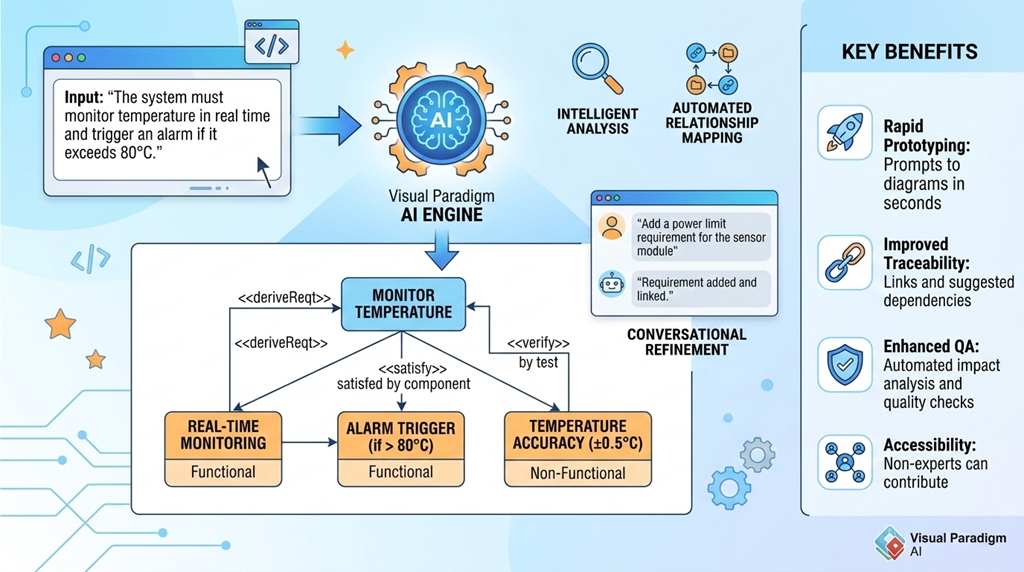
In systems engineering, clarity and precision are essential. Requirements define what a system must do, how it should perform, and under what constraints it must operate. Traditionally, capturing and managing these requirements has been a manual, time-consuming process—prone to misinterpretation and inconsistency. With the rise of AI-driven modeling tools, engineers now have a more efficient, accurate, and collaborative way to define and manage system requirements.
What Are SysML Requirement Diagrams?
SysML (Systems Modeling Language) Requirement Diagrams are a standardized way to represent system requirements in a visual format. These diagrams help teams capture both functional (what the system does) and non-functional (how the system performs) requirements, such as performance, safety, and reliability constraints.
Using a structured notation, SysML Requirement Diagrams establish critical relationships between requirements and other system elements. For example:
- A requirement can be derived from a higher-level goal (
<<deriveReqt>>) - It can be satisfied by a component or subsystem (
<<satisfy>>) - It can be verified through testing (
<<verify>>)
These relationships ensure traceability across the development lifecycle—from concept to deployment—making it easier to validate that all requirements are met and to manage changes effectively.
The Role of Visual Paradigm in Systems Engineering
Visual Paradigm is a comprehensive modeling platform that supports a wide range of modeling languages, including the full SysML suite, UML, and BPMN. It enables teams to design, analyze, and document complex systems using a unified toolset.
The platform is widely used in aerospace, automotive, defense, and industrial automation—industries where system complexity demands rigorous modeling. Beyond diagramming, Visual Paradigm supports agile project management, database design, and team collaboration, making it a one-stop solution for systems engineering teams.
One of its most powerful features is the AI Diagram Generator, which uses natural language to create formal SysML models automatically.
How AI Transforms SysML Requirement Modeling
The Visual Paradigm AI Diagram Generator leverages artificial intelligence to convert plain-text descriptions into structured SysML Requirement Diagrams. This capability dramatically reduces the time and effort required to create and refine system models.
Here’s how it works:
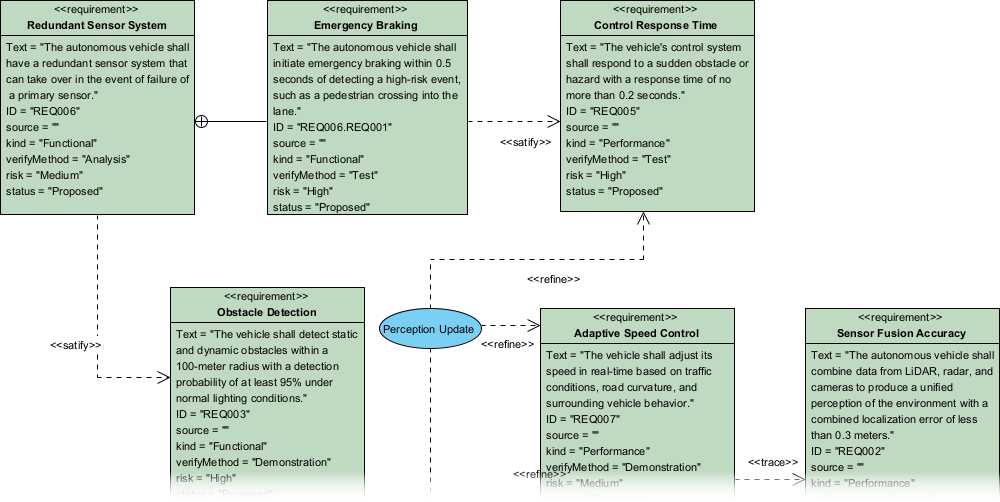
Visual Paradigm Desktop: AI Enabled Modeler
VP Desktop stands as the powerhouse for serious SysML work. It’s Visual Paradigm’s flagship application where AI meets robust, offline modeling. You start by describing your requirements in natural language, and the AI generates a solid SysML requirement diagram instantly—complete with «requirement» blocks, deriveReqt, satisfy, verify, and trace relationships.
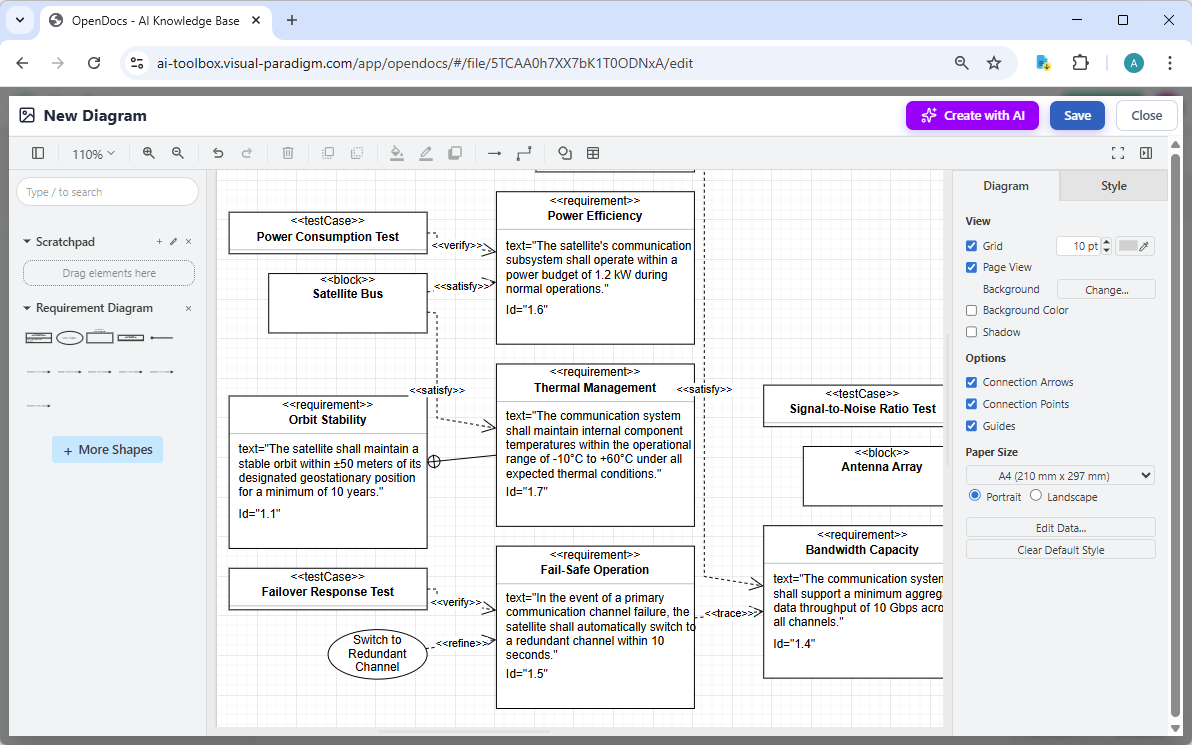
Visual Paradigm OpenDocs: Smart, AI Powered Knowledge Management Platform
OpenDocs transforms how teams share and evolve requirements. Think of it as a smart wiki or knowledge base with living diagrams. Generate your SysML requirement diagram in VP Desktop or via chat, then embed it directly into dynamic documents.
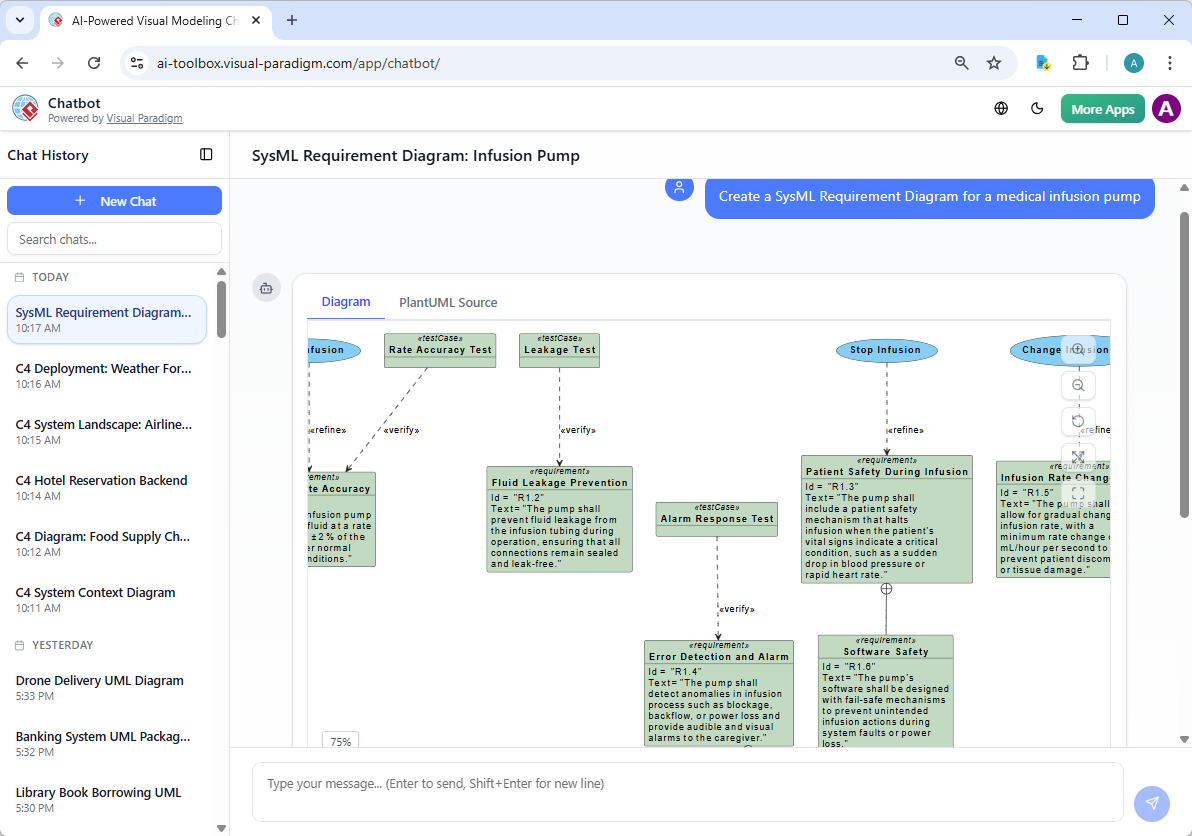
Visual Paradigm AI Chatbot for Visual Modelers
Need quick prototypes or iterative brainstorming? Visual Paradigm’s AI Visual Modeling Chatbot turns natural language into diagrams through simple conversation. Describe your system’s requirements—”The vehicle shall maintain stability under 2G lateral acceleration, with derived safety and performance sub-requirements”—and watch a compliant SysML requirement diagram appear.
Key Benefits of AI-Powered SysML Modeling
🚀 Rapid Prototyping
From a natural language prompt to a formal diagram in seconds, teams can quickly prototype system requirements. This accelerates early-stage design and enables faster feedback cycles.
🔗 Improved Traceability
AI can suggest traceability links between requirements and design elements, reducing the risk of missed or orphaned requirements. This supports the creation of traceability matrices, which are essential for compliance and verification.
🛡️ Enhanced Quality Assurance
Automated tools can perform impact analysis—identifying which components are affected by a change to a requirement. They can also flag issues like unverified or unmet requirements, improving overall system quality.
🧑💻 Accessibility
Not every stakeholder is an expert in SysML. The AI-powered interface allows non-technical team members—such as product managers or domain experts—to contribute to the modeling process with minimal training.
📄 Automated Documentation
Beyond the visual model, the AI can generate:
- Requirement text
- Summary reports
- Compliance documentation
- Test case suggestions
This reduces manual documentation work and ensures consistency across deliverables.
Real-World Applications
AI-powered SysML modeling is particularly valuable in industries with strict regulatory requirements, such as:
- Automotive: Managing safety and functional requirements for ADAS (Advanced Driver Assistance Systems)
- Aerospace: Ensuring all system functions meet FAA or EASA standards
- Medical Devices: Validating compliance with FDA and ISO 13485
In these domains, traceability and verification are not optional—they are mandatory. AI-assisted modeling helps teams meet these demands efficiently.
Conclusion
The integration of AI into SysML requirement modeling marks a significant shift in systems engineering. By automating the creation of requirement diagrams, tools like Visual Paradigm’s AI Diagram Generator make it faster, easier, and more accurate to define and manage system requirements.
This approach supports better collaboration, stronger traceability, and higher-quality systems—all while reducing the burden on engineering teams.
References
- Beginner’s Guide to SysML Requirement Diagrams – Visual Paradigm Blog: Step-by-step introduction to SysML requirement diagrams: purpose (capturing, organizing, and tracing textual requirements), key elements (requirements, deriveReqt, satisfy, verify, refine, trace relationships), notation, hierarchy creation, and practical creation tips in Visual Paradigm for effective requirements management in systems engineering.
- AI-Powered SysML Requirement Diagram Tool – Visual Paradigm: Explains how the AI chatbot generates editable SysML requirement diagrams from natural language prompts (e.g., system goals, stakeholder needs), automatically creates requirement elements, derives hierarchies (master/slave, refine, satisfy/verify links), adds traceability, generates reports, and supports rapid iteration in MBSE workflows.
- SysML Requirement Diagram: Guide to AI-Powered Requirements Engineering – Visual Paradigm AI: In-depth walkthrough of SysML requirement diagrams with AI assistance: defining textual requirements, establishing traceability relationships (satisfy, verify, deriveReqt, refine), using containment hierarchies, AI-driven generation/refinement from prompts, validation checks, report export, and integration with other SysML diagrams for complete systems engineering traceability.
- Establishing Traceability Using Matrix and ETL Table – Visual Paradigm SysML Guide: Best practices for SysML traceability: using dependency matrices to visualize relationships (satisfy, verify, deriveReqt, trace), ETL (Extract-Transform-Load) tables for bulk editing/imports, requirement coverage analysis, impact assessment, and ensuring compliance between requirements and design/verification elements throughout the system lifecycle.
- AI Chatbot for SysML & UML Modeling – Visual Paradigm: Conversational AI assistant trained on SysML standards; generates requirement diagrams and other SysML/UML artifacts from text descriptions, supports iterative refinements (add/remove requirements, adjust relationships, query explanations), intelligent suggestions, traceability checks, and seamless export to Visual Paradigm desktop/cloud for advanced MBSE tasks.
- Visual Paradigm: The All-in-One Visual Modeling Platform – Cybermedian: Comprehensive overview of Visual Paradigm as a unified toolset for UML, SysML, BPMN, ArchiMate, and more; highlights AI integration for diagram generation, requirements traceability, model validation, collaboration, and cross-industry applications in software, systems, and enterprise architecture.
- Comprehensive Review: Visual Paradigm’s AI Diagram Generation Features – Fliplify: Third-party evaluation praising AI’s standards-compliant automation across SysML (including requirement diagrams), conversational editing, traceability support, time savings, high accuracy with domain prompts, and overall enhancement of model-based systems engineering productivity.