Mastering NotesKeep: AI-Driven Architecture for Unified Engineering Notes
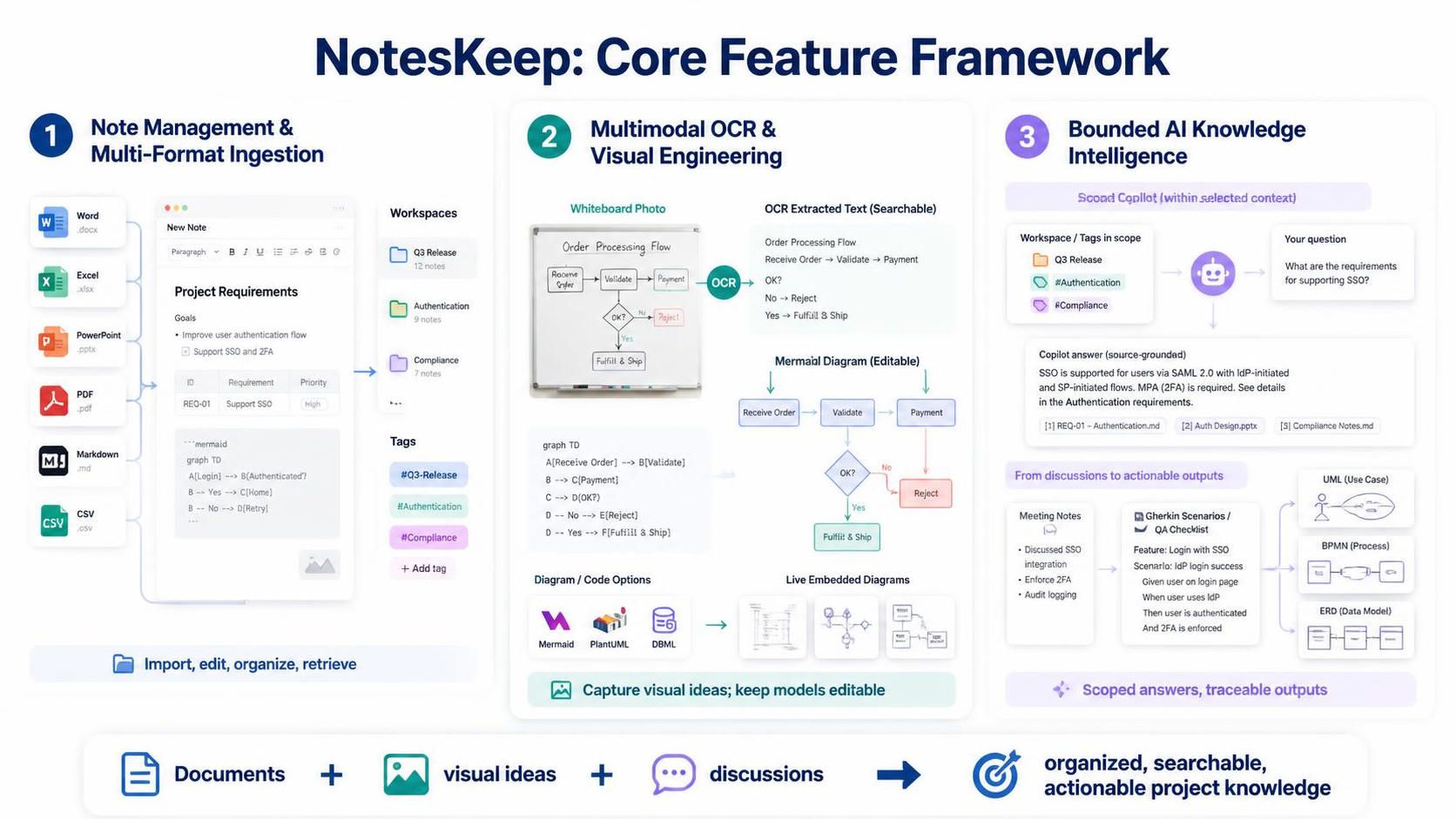
In modern software engineering, the gap between a spontaneous idea and a deployable feature is often bridged by documentation. However, managing this documentation across various formats—from raw meeting notes to complex system diagrams—can be a significant bottleneck. NotesKeep addresses this by creating a unified framework that integrates Note Management, Multimodal Visual Engineering, and Bounded AI Intelligence.
This tutorial breaks down the technical architecture of the NotesKeep framework, demonstrating how it transforms unstructured inputs into actionable, traceable project knowledge.
1. The Foundation: Note Management & Multi-Format Ingestion
The core of any knowledge management system is the ability to ingest, organize, and retrieve information. NotesKeep solves the “format fragmentation” problem by supporting a universal ingestion pipeline.
Universal Document Parsing
Instead of forcing users to manually re-type content from legacy documents, NotesKeep utilizes a parser that converts static files into a living, editable rich-text format. The system supports:
- Office Suites: Microsoft Word (.docx), Excel (.xlsx), and PowerPoint (.pptx).
- Technical Formats: PDFs (parsed for text and structure), Markdown (.md), and CSVs.
Technical Insight: This conversion process abstracts the underlying file format complexity, presenting the data as a standardized “Rich Note” that can be manipulated by the editor.
Multi-Dimensional Taxonomy
Once ingested, documents are organized using a hierarchical structure:
- Workspaces: Logical containers for specific projects (e.g., “Q3 Release”).
- Tag Matrices: Cross-cutting metadata tags (e.g., #Authentication, #Compliance) that allow for non-linear retrieval across different project silos.
2. Visual Engineering: Bridging Whiteboards and Code
Engineering relies heavily on visual communication. NotesKeep introduces a unique workflow called Multimodal OCR & Visual Engineering, which digitizes hand-drawn ideas and converts them into editable, version-controlled diagrams.
The Whiteboard-to-Code Pipeline
The system is designed to handle the transition from “spontaneous creativity” to “formal specification” through three distinct stages:
- Visual Ingestion (OCR): A photo of a whiteboard (e.g., a flowchart) is uploaded. The Multimodal OCR Vision engine scans the image, extracting text and logical connections.
- Intent Recognition: The system identifies the logical flow (e.g., “Receive Order” -> “Validate” -> “Payment”) and converts it into a searchable text format.
- Diagram-as-Code Conversion: The extracted flow is translated into code-based diagramming syntax, specifically supporting
MermaidandPlantUML.
Syntax Generation Example
When the system extracts a flow from a whiteboard, it generates a structured graph definition. Below is a representation of how the system converts a visual “Order Processing Flow” into code:
graph TD
    A[Receive Order] --> B[Validate]
    B --> C[Payment]
    C --> D[OK?]
    D -- No --> E[Reject]
    D -- Yes --> F[Fulfill & Ship]
Live Ecosystem Syncing
Unlike static images, NotesKeep allows these diagrams to be “live.” It supports direct embedding of active assets from tools like Excalidraw and Visual Paradigm. This ensures that the documentation remains synchronized with the evolving design of the software.
3. Bounded AI Knowledge Intelligence
The final layer of the framework is the AI Copilot. Unlike generic chatbots that hallucinate or search the entire internet, NotesKeep employs Scoped Retrieval (RAG) (Retrieval-Augmented Generation).
Context-Aware Querying
The AI is restricted to specific Workspaces or Tag contexts. This ensures that answers are sourced strictly from the project’s knowledge base, providing inline citations.
Automated Requirements Synthesis
The system can analyze raw text (such as meeting transcripts) and synthesize formal engineering artifacts. This includes:
- Gherkin Scenarios: Converting natural language into Given/When/Then test cases.
- UML Modeling: Generating Use Case diagrams, BPMN flows, and Entity-Relationship Diagrams (ERD) from raw requirements.
Technical Implementation: The RAG Architecture
The interaction between the user’s query and the AI backend follows a precise architectural pattern to ensure traceability:
User Query: "What are the requirements for SSO?"
    |
    v
[1] Context Scope: Filter Workspaces (Q3 Release) & Tags (#Authentication)
    |
    v
[2] Vector Search: Retrieve relevant snippets from:
    - Auth Design.pptx
    - Compliance Notes.md
    |
    v
[3] LLM Generation: Synthesize answer with citations
    |
    v
[4] Output: "SSO is supported via SAML 2.0... [1] REQ-01"
Conclusion
The NotesKeep framework represents a shift from static documentation to a dynamic “Living Knowledge Base.” By combining robust file ingestion, visual-to-code OCR, and bounded AI intelligence, it allows teams to move seamlessly from a whiteboard sketch to a fully documented, testable software feature.