


Introduction to UML and the Evolving Role of AI in Software Architecture
Unified Modeling Language (UML) remains a cornerstone of software engineering, providing a standardized, visual approach to analyzing, designing, and documenting complex systems. Developed and maintained by the Object Management Group (OMG), UML offers a robust framework for modeling both the static structure and dynamic behavior of software systems—enabling clear communication among engineers, product owners, and stakeholders.
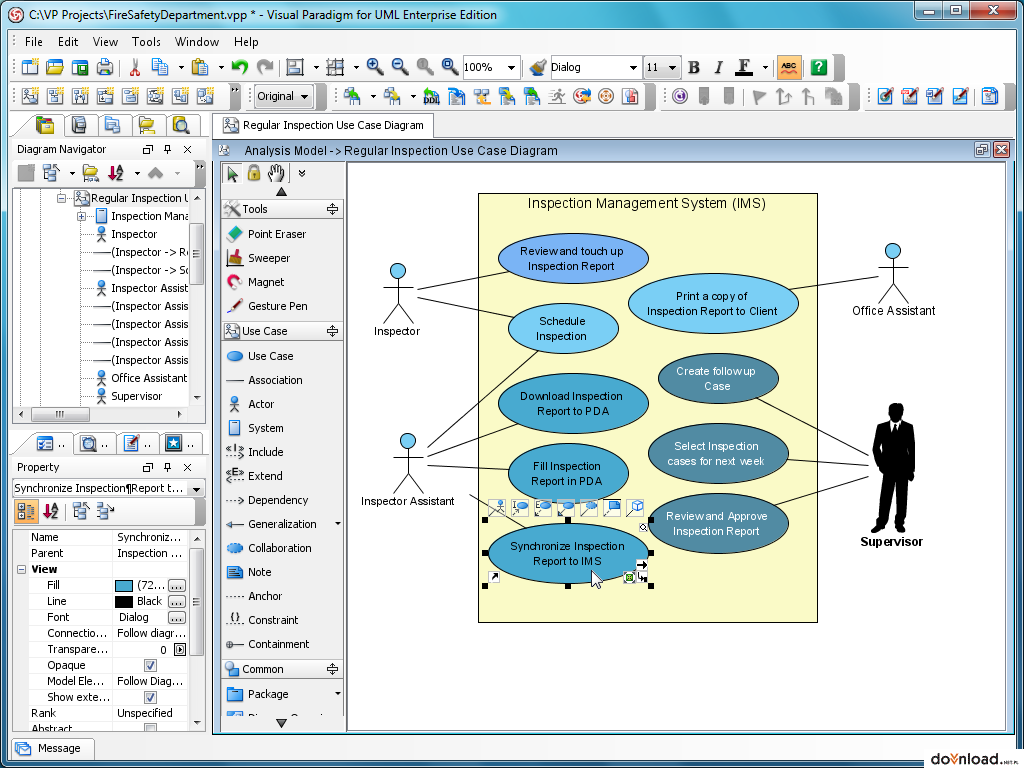
Modern software development is no longer about creating isolated features; it’s about building interconnected, responsive, and scalable architectures. In this context, UML’s ability to represent relationships, workflows, state transitions, and component interactions becomes indispensable. However, traditionalUML modeling suffers from significant inefficiencies: it is time-consuming, requires specialized knowledge, and struggles to keep pace with rapidly changing requirements—especially in agile and DevOps-driven environments.
VP AI: How Visual Paradigm AI Transforms UML Modeling in Practice
Visual Paradigm has redefined the boundaries of UML modeling with the integration of generative artificial intelligence—offering an intelligent, automated workflow that shifts the focus from manual diagramming to strategic system design.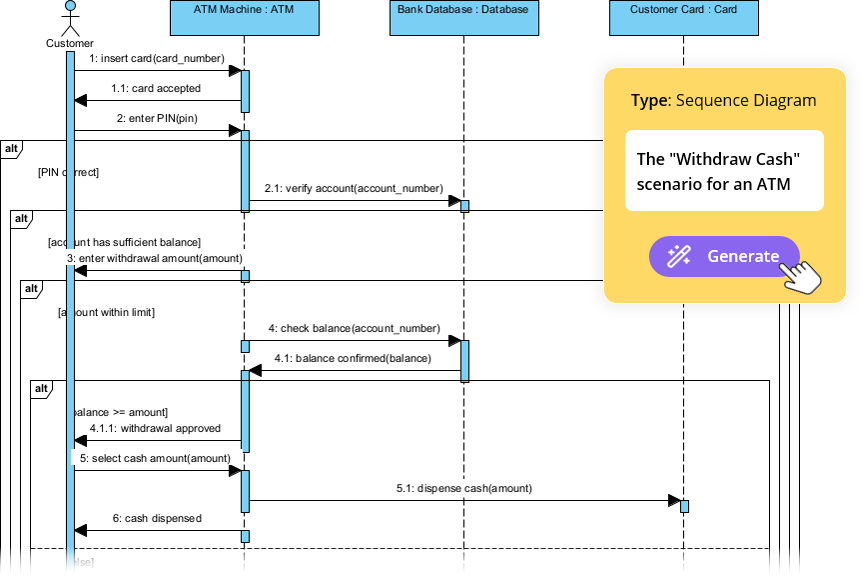
Unlike generic AI tools that produce crude visual outputs, Visual Paradigm’s AI capabilities are deeply embedded into its modeling ecosystem. Its AI Diagram Generatorleverages natural language processing (NLP) to parse plain text prompts—such as ‘Generate a use case diagram for a hospital appointment scheduling system with patients, doctors, and staff’—and convert them into fully structured, professional-grade UML diagrams in seconds.
This capability introduces a fundamental shift in how teams approach system modeling:
- Accelerated Onboarding: Business analysts, product managers, and junior developers can generate initial models without prior UML training, reducing dependency on senior architects for early-stage design.
- Iterative Design at Scale: In agile sprints, where requirements evolve rapidly, AI enables teams to regenerate diagrams from updated descriptions—reducing rework and maintaining design consistency across iterations.
- Enhanced Accuracy and Compliance: AI-generated diagrams are not just visual; they are structured according to UML 2.x standards, with proper labeling, relationships, and real-world semantics that prevent common modeling errors like invalid dependencies or missing lifelines.
- Improved Collaboration: Teams can share AI-generated models via chatbots or export them to multiple formats (SVG, PlantUML, JSON, PNG), enabling seamless integration into documentation, codebases, or design review meetings.
For enterprises managing complex systems—such as banking, healthcare, or logistics—the ability to rapidly prototype and validate system behavior is not just a convenience; it’s a strategic imperative. Visual Paradigm’s AIremoves the bottleneck of manual diagram creation, allowing organizations to allocate human capital toward higher-value tasks: refinement, stakeholder alignment, and system implementation.
VP Tools & Resources: Why Visual Paradigm Is the Premier Choice for UML Implementation
While many tools offer UML diagramming capabilities, few provide the full spectrum of features, scalability, and intelligent automation that Visual Paradigm delivers. In today’s distributed, cloud-based development landscape, teams require tools that support:
- Real-time collaboration across geographies
- Seamless integration with version control and CI/CD pipelines
- Native support for both structural and behavioral diagrams
- AI-assisted modeling that scales with project complexity
Visual Paradigm stands out by offering a complete, end-to-end software modeling solution built around enterprise-grade standards and modern development workflows. It supports all 14 core UML diagram types—including those designed for system-level insight—while maintaining intuitive navigation and editing capabilities.
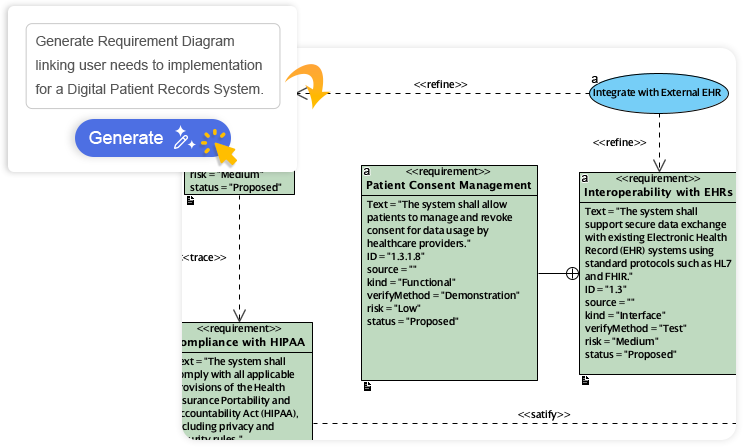
Furthermore, the platform is accessible across multiple environments: desktop applications, web-based editors, and mobile interfaces, with cloud-based sharing and real-time editing. This makes it ideal for global teams operating under tight timelines and evolving scope.
Its ecosystem includes:
- AI-powered modeling assistants (chatbot, prompt-based generation)
- Automated code generation and reverse engineering (from UML to Java, C#, JavaScript)
- Model versioning and change tracking (with audit logs and diffs)
- Integration with Jira, Confluence, GitLab, and Azure DevOps
- Enterprise security and compliance features (role-based access, audit trails)
For organizations investing in software architecture maturity, Visual Paradigm is not just a modeling tool—it’s a strategic enabler of clarity, consistency, and speed in system design.
VP Features: In-Depth Exploration of Key UML Capabilities
Visual Paradigm’s UML features are designed to support every phase of the software lifecycle—from initial concept to final deployment. The following breakdown details how specific features empower teams to build robust, maintainable systems.
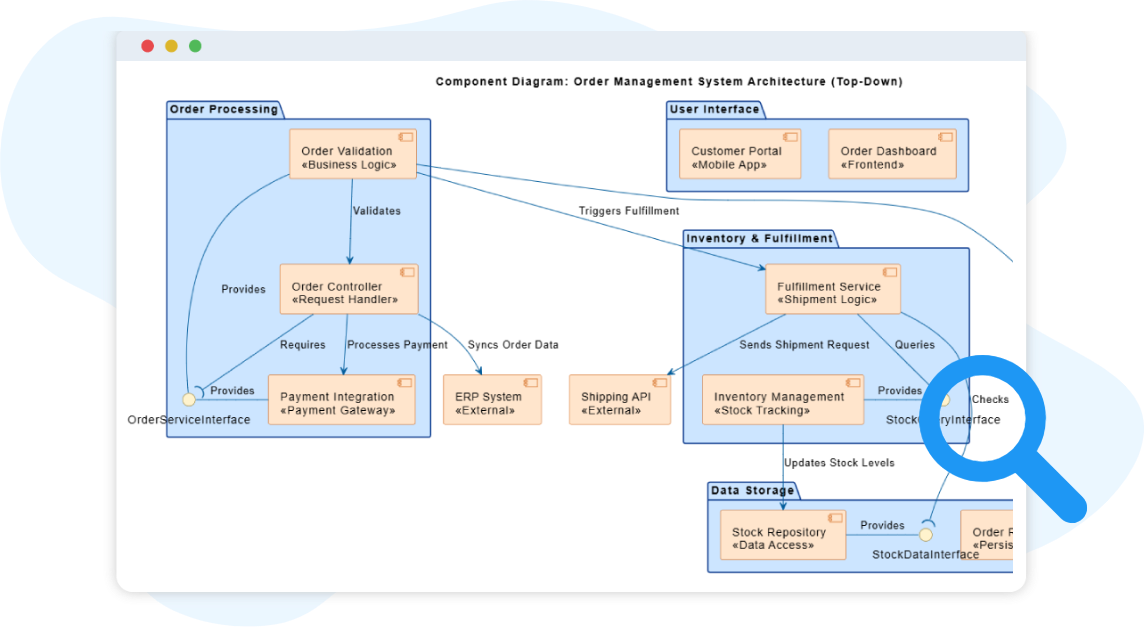
Structural Diagrams: Modeling the ‘What’ of Systems
Structural diagrams define the static architecture of a system, representing classes, components, and their relationships.
Diagram Type Primary Use Case AI Enhancement
Class Diagram Models classes, attributes, methods, and inheritance hierarchies. AI can generate class hierarchies, detect missing associations, and suggest best practices (e.g., encapsulation, dependency inversion).
Object Diagram Shows concrete instances of classes and their relationships at a specific point in time. AI generates realistic object instances with valid links, helping visualize runtime scenarios.
Component Diagram Represents modular software components (e.g., frontend, backend, API) and their interfaces. AI automatically identifies component boundaries and interface requirements from textual descriptions.
Deployment Diagram Depicts how software is deployed across hardware nodes (servers, devices). AI generates deployment scenarios based on business logic (e.g., microservices vs. monoliths).
Package Diagram
| Organizes elements into logical groups (e.g., by module or layer). | AI suggests optimal package structure based on code cohesion and coupling. |
Behavioral Diagrams: Capturing the ‘How’ of System Dynamics
Behavioral diagrams model interactions, workflows, and state transitions, offering a deep understanding of system dynamics.
| Diagram Type | Primary Use Case | AI Enhancement |
|---|---|---|
| Use Case Diagram | Defines user interactions and functional requirements from a business perspective. | AI identifies actors, use cases, and relationships (include, extend, generalization), and suggests missing scenarios. |
| Sequence Diagram | Details message exchanges between objects over time, with lifelines and message sequences. | AI generates accurate message flows, adds alt-fragments for error paths, and ensures correct message ordering. |
| Activity Diagram | Models workflows, business processes, or algorithms with decisions, forks, and swimlanes. | AI converts narrative process descriptions into structured diagrams with conditional logic and parallelism. |
| State Machine Diagram | Represents the lifecycle of an object, e.g., order status, user login state. | AI maps state transitions to trigger events (e.g., ‘payment received’ → ‘Paid’), and validates guard conditions. |
| Communication Diagram | Focuses on object interactions through links, distinct from time-based sequences. | AI generates link-based models that emphasize structure over timing, ideal for internal component interaction. |
Each diagram type is supported in full within the Visual Paradigm editor, with rich editing tools for relationships, constraints, and annotations. The AI-enhanced features go beyond simple generation—they offer suggestions, corrections, and compliance checks, ensuring diagrams meet UML best practices and enterprise standards.
Advanced AI Capabilities
Visual Paradigm’s AI engine is not a black box. It operates on a foundation of domain-specific knowledge, trained on real-world software patterns and common modeling mistakes. The AI performs:
- Context-aware generation: Interprets the intent behind prompts, e.g., ‘a sequence for user login’ leads to a structured flow with success/failure branches.
- Model validation: Flags inconsistent relationships or invalid transitions (e.g., a class with no operations).
- Consistency enforcement: Ensures naming conventions, visibility, and encapsulation rules are followed.
- Standard compliance: Adheres strictly to UML 2.0and OMG specifications.
Moreover, the AI chatbot enables real-time assistance during design sessions, supporting developers in refining models through iterative prompts and clarifications. Teams can ask questions like ‘Why is this dependency invalid?’ or ‘What would happen if I remove this state?’ and receive intelligent responses grounded in UML principles.
Strategic Implications for Modern Development Teams
The integration of AI into UML modeling is not simply a technological upgrade—it’s a transformation in how teams validate, communicate, and deliver software.
Organizations leveraging Visual Paradigm’s AI UML toolsreport:
- Up to 90% reduction in initial diagram creation time (from days to minutes)
- 50% decrease in modeling errors due to automated validation and pattern recognition
- Improved cross-functional alignment as non-technical stakeholders can contribute to design via natural language
- Accelerated development cycles by reducing time spent on upfront modeling and enabling faster iteration
For consulting firms, this translates into lower labor costs and faster project delivery. In internal R&D, it enables more experimentation and innovation without the overhead of modeling.
As software systems grow in complexity—driven by microservices, event-driven architectures, and AI integration—UML remains a vital tool for clarity. But its value depends on accessibility. Visual Paradigm’s AI ensures that UML is no longer the domain of a few experts—it becomes a shared language accessible to all team members, regardless of background.
Conclusion: The Future of UML in the AI Era
The future of software design lies in the seamless fusion of human insight and machine intelligence. Visual Paradigm’s UML AI capabilities exemplify this convergence—transforming complex modeling tasks into intuitive, scalable processes.
By automating the labor-intensive aspects of UML creation, teams can focus on what truly matters: understanding user needs, defining system behavior, and building systems that are resilient, observable, and maintainable.
As enterprises continue to adopt agile, DevOps, and AI-first approaches, the ability to quickly generate, refine, and share accurate system models will become a core differentiator. Visual Paradigm, with its deep UML support and intelligent AI features, is positioned as the leading platform to meet this demand—delivering clarity, speed, and consistency in software architecture.
Visual Paradigm’s AI resources
-
AI-Powered Visual Modeling and Design Solutions by Visual Paradigm: This portal allows users to explore cutting-edge AI-driven tools for visual modeling, diagramming, and software design to enable faster development workflows. It acts as a central hub for various intelligent modeling applications.
-
AI Chatbot Feature – Intelligent Assistance for Visual Paradigm Users: This feature leverages AI-powered chatbot functionality to provide instant guidance and automate repetitive tasks within the modeling environment. It is designed to enhance user productivity by interpreting natural language instructions.
-
Visual Paradigm Chat – AI-Powered Interactive Design Assistant: This interactive AI chat interface assists users in generating diagrams, writing code, and solving complex design challenges in real time. It supports multiple languages and allows for conversational diagram creation.
-
AI Textual Analysis – Transform Text into Visual Models Automatically: This tool utilizes AI to analyze unstructured text documents and automatically generate structured diagrams such as UML, BPMN, and ERD. It streamlines documentation by identifying key entities and relationships directly from written requirements.
-
AI-Assisted UML Class Diagram Generator – Visual Paradigm: An interactive, step-by-step tool that helps users create UML class diagrams using AI-powered suggestions and validation. It also supports PlantUML export and design analysis for software engineers.
-
Visual Paradigm AI Diagram Generation Guide: This is a comprehensive, step-by-step guide for utilizing AI-powered tools to generate various diagram types quickly and accurately. It provides practical instructions for analysts and architects to integrate AI into their modeling workflows.
-
C4-PlantUML Studio | AI-Powered C4 Diagram Generator: This purpose-built tool transforms natural language prompts into correct, layered C4 diagrams for software architecture visualization. It supports all four core levels—Context, Container, Component, and Code.
-
AI-Powered MVC System Architecture Generator by Visual Paradigm: This feature leverages AI to automatically generate clean and scalable MVC architectures with minimal manual effort. It helps developers visualize the Model-View-Controller layers of their systems instantly.
-
AI-Powered Use Case Diagram Refinement Tool – Smart Diagram Enhancement: Users can leverage this tool to automatically refine and optimize use case diagrams for better clarity and completeness. It identifies missing actors and suggests improvements to existing models.
-
AI-Powered ArchiMate Viewpoints Generator in Visual Paradigm: This release features an AI-driven generator that automates the creation of professional enterprise architecture views. It is specifically designed to support the ArchiMate 3.2 standard for aligning business goals with IT infrastructure.
Related posts:
 OpenDocs for Beginners: Your All-in-One Visual Knowledge Base (Beyond Just AI Text Generation)
 Visual Paradigm Community FREE Edition: Your Complete Guide to UML Modeling with AI-Powered Enhancement
 🎨 Send Your Visual Paradigm Online Creations Directly to OpenDocs
 Mastering UML Modeling: A Practitioner’s Review of Visual Paradigm’s Comprehensive Guide