

Modern enterprise architecture is no longer a siloed discipline confined to technical diagrams and formal specifications. Today’s most effective architecture practices are fundamentally about alignment—between strategic business objectives and the technical capabilities required to deliver value.
VP AI: How Visual Paradigm AI Enables Intelligent Business-Technical Alignment
Visual Paradigm’s AI-powered modeling platform represents a paradigm shift in how architects and business analysts collaborate. Rather than relying on manual translation between business strategy and technical implementation, the platform acts as an intelligent partner that understands context, maintains traceability, and generates actionable models directly from natural language inputs.
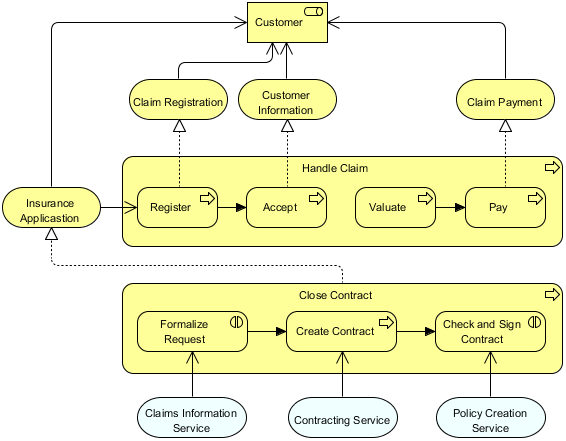

At its core, the AI leverages the ArchiMate framework—a standards-based modeling language explicitly designed to map business goals to technical solutions across organizational layers. This framework enables the creation of multi-layered views that span the Business, Application, and Technology domains, ensuring that every change in the technical stack is contextualized within the broader business mission.
1. Natural Language to Architecture: From Vision to Diagram
Imagine a CIO stating: “We want to improve our customer experience by migrating to a cloud-based, service-oriented platform.” Traditional tools would require weeks of documentation, stakeholder interviews, and manual construction of models. With Visual Paradigm AI, this high-level business intent is immediately transformed into a structured, layered ArchiMate model.
The AI parses the input, identifies key stakeholders, business goals, and desired outcomes, and then generates a complete three-layer model—
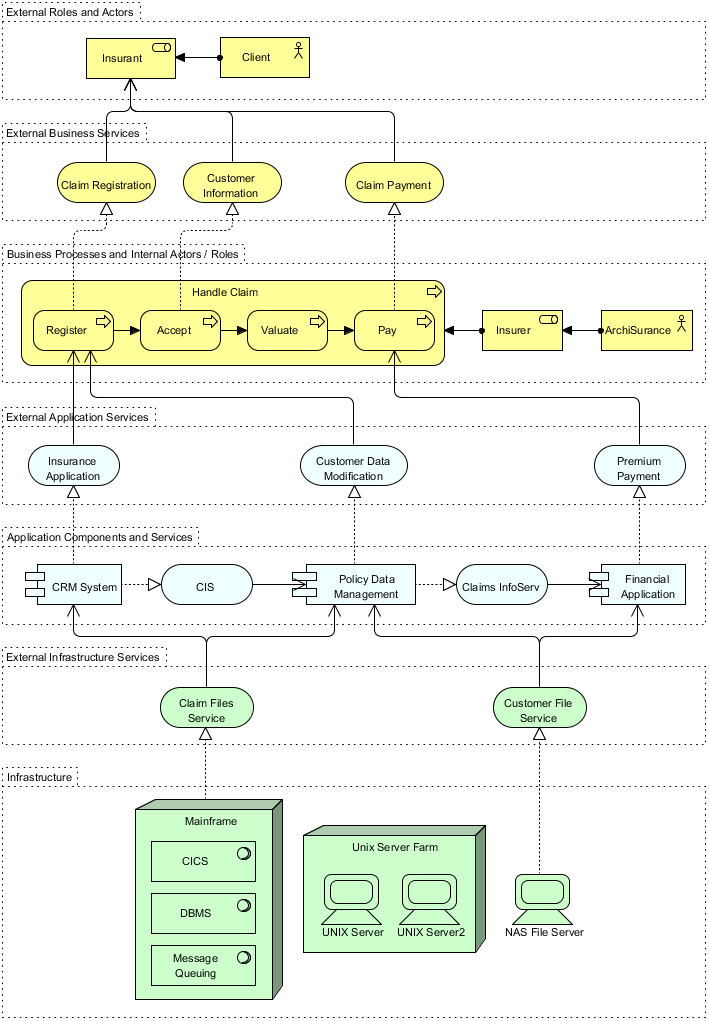
- Business Layer: Identifies customer journeys, key performance indicators, and strategic goals.
- Application Layer: Maps services such as user portals, order management, or AI-driven recommendations.
- Technology Layer: Specifies cloud services, APIs, microservices, and infrastructure components.
This process is not arbitrary—it’s grounded in ArchiMate 3.2 semantics and best practices, ensuring fidelity to the language of enterprise modeling.
2. Intent-Aware Contextual Mapping
Unlike generic AI tools that generate models without regard to context, Visual Paradigm’s AI is trained on industry standards such as ArchiMate, TOGAF, and the Business Motivation Model (BMM). This training enables it to interpret new requirements not in isolation, but within the existing architecture.
For instance, if a product team requests adding a real-time analytics service, the AI does not simply create a new component. Instead, it:
- Locates relevant business goals (e.g., “improve decision-making through data visibility”),
- Identifies existing data flows and process dependencies,
- Ensures the new service is named consistently (e.g., “Real-Time Analytics Engine”),
- Establishes proper relationships in the model (e.g., “supports”, “depends on”, “realizes”),
- Ensures alignment with existing business initiatives and KPIs.
This contextual awareness prevents modeling errors, maintains architectural integrity, and ensures that every technical change supports a defined business objective.
3. Strategic to Functional Translation
Effective enterprise architecture must bridge the gap between abstract strategy and concrete implementation. Visual Paradigm’s AI supports this through automated translation of strategic frameworks into actionable, traceable models:
Business Motivation Model (BMM) to ArchiMate
The BMM defines business drivers, goals, and motivations. The AI takes these elements and converts them into a formal ArchiMate Goal Realization Viewpoint, showing how strategic objectives are decomposed into measurable requirements and realized through specific technologies and processes.
Business Processes to User Stories
AI can map high-level business processes—such as “Order Fulfillment”—to granular user stories, such as “As a customer, I want to track my order status in real time.” These stories then serve as the foundation for technical requirements, bridging the gap between process design and development teams.
SWOT to Actionable TOWS Strategies
Teams often conductSWOT (Strengths, Weaknesses, Opportunities, Threats) analyses to identify strategic directions. The AI interprets these findings and generates TOWS (a strategic response framework)—actionable initiatives such as:
- Opportunity: Implement an AI-driven fraud detection tool to reduce losses.
- Threat: Migrate legacy systems to reduce risk of obsolescence.
- Strength: Leverage existing customer data to improve personalization.
These outcomes are not just suggestions—they are structured, traceable, and ready for integration into the enterprise architecture backlog.
4. Automated Gap Analysis for Objective-Driven Planning
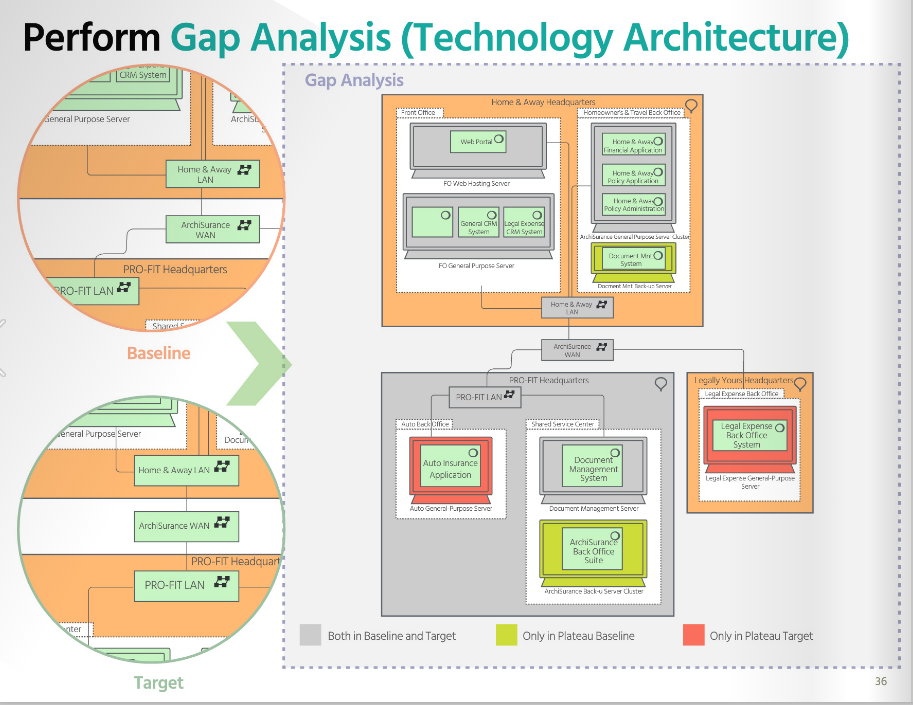
A critical challenge in enterprise transformation is identifying the exact changes needed to achieve a business goal. Visual Paradigm’s AI-powered Gap Analysis Tool performs a systematic comparison between the current state (baseline) and the desired state (target).
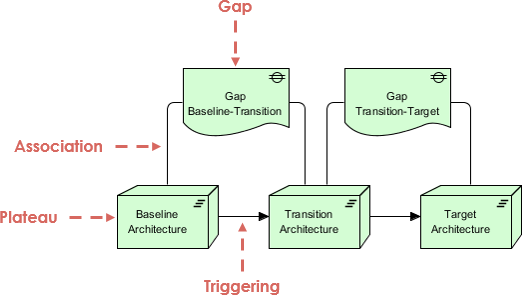
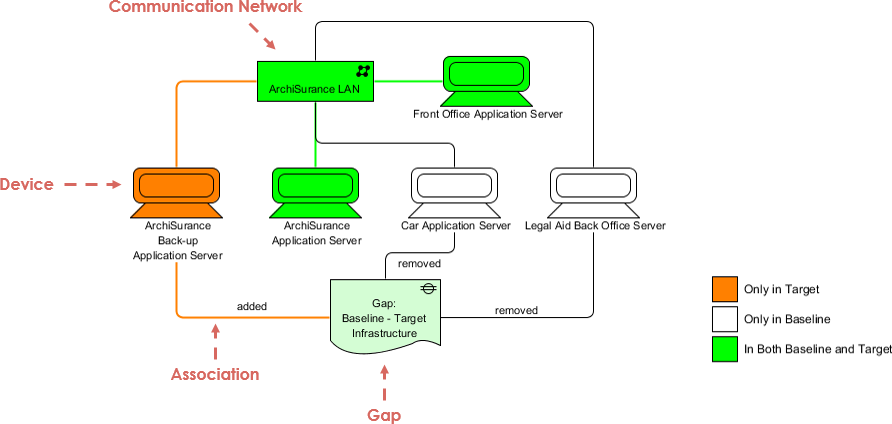
For example, if a company aims to “achieve 99.9% system availability,” the AI analyzes:
- Existing infrastructure components,
- Service dependencies,
- Current failure tolerance levels,
- Performance metrics,
Based on this analysis, the tool outputs a comprehensive list of gaps—such as missing failover mechanisms, unmonitored APIs, or inadequate redundancy—along with a prioritized action plan for resolution. This allows architects to focus on what truly matters: delivering measurable business outcomes.
VP Tools & Resources: Why Visual Paradigm is the Leading Platform for AI-Enhanced Enterprise Architecture
While numerous AI tools exist, they often fail to deliver meaningful architectural outcomes. The true value lies in contextual depth, compliance with standards, and integration with real-world workflows.
Visual Paradigm stands apart because it is built from the ground up as an enterprise architecture platform that incorporates AI not as a gimmick, but as a core enabler of:
- Modeling Consistency: Enforces standards across layers and domains.
- Traceability: Maintains a complete audit trail from business goals to technical implementation.
- Collaboration: Enables cross-functional teams (business, IT, product) to work in unison with shared models.
Its suite of industry-recognized tools—ArchiMate, BMM, TOGAF, and service-oriented modeling—provides a robust foundation upon which AI can operate with precision and intent.
Unlike generic tools that generate generic diagrams, Visual Paradigm’s AI understands the semantics of enterprise models and produces outputs that are not only visually accurate but also semantically correct, aligned with governance policies, and ready for stakeholder review.
VP Features: A Detailed Breakdown of Key AI-Integrated Capabilities
1. AI-Powered ArchiMate Generation
With natural language input, users can describe strategic initiatives (e.g., “We need to digitize our supply chain to reduce lead times”), and the AI generates a complete ArchiMate model with:
- Business goals and drivers,
- Application services responding to those goals,
- Technology components enabling service delivery,
- Explicit relationships (e.g., “designed to support”, “realizes”).
The resulting model is not just a diagram—it is a living architecture document that supports traceability, change management, and stakeholder communication.
2. Context-Aware Model Evolution
When a business requirement changes (e.g., shifting from cloud migration to hybrid cloud), the AI evaluates the impact on the existing model. It:
- Identifies dependencies that may be affected,
- Proposes updates to the business and technology layers,
- Ensures naming and relationship consistency,
- Generates a change log for audit and approval.
This prevents the common pitfalls of model drift and misalignment that plague traditional change processes.
3. Strategic Framework Translation Engine
Visual Paradigm integrates popular strategic frameworks into its modeling engine:
| Framework | AI Capability | Outcome |
|---|---|---|
| Business Motivation Model (BMM) | Converts business drivers and goals into ArchiMate Goal Realization Views | Clear path from motivation to implementation |
| SWOT Analysis | Generates TOWS strategies from identified factors | Turns analysis into actionable initiatives |
| Business Process Modeling | Maps processes to user stories and requirements | Enables cross-functional team alignment |
4. Intelligent Gap Analysis and Action Planning
The platform includes a built-in Gap Analysis Tool that:
- Compares the current state (baseline) with a defined target state,
- Identifies discrepancies in capabilities, services, or performance,
- Generates a ranked list of required changes with root cause and impact,
- Provides a step-by-step execution plan with ownership and timelines.
This feature is particularly valuable during digital transformation projects, where clarity about what’s missing and what needs to change is essential for project success.
Conclusion: The Future of Enterprise Architecture Is Intelligent, Connected, and Actionable
Visual Paradigm’s AI does not replace human expertise—it amplifies it. By automating the translation between business vision and technical implementation, the platform enables organizations to:
- Reduce time-to-market for new initiatives,
- Improve decision-making through data-rich, traceable models,
- Ensure alignment across all stakeholders—including executives, product managers, and developers—through common modeling language.
In an era of rapid digital transformation, where agility and clarity are paramount, the ability to map business goals directly to technical solutions is not a luxury—it is a necessity. Visual Paradigm, with its AI-driven, standards-compliant, and context-aware architecture capabilities, is poised to become the central nervous system of modern enterprise strategy and execution.
Articles and guides regarding AI-powered ArchiMate modeling and enterprise architecture within the Visual Paradigm ecosystem:
-
Comprehensive Tutorial: Using ArchiMate with TOGAF ADM and AI: This tutorial explores how the AI Diagram Generator and chatbot facilitate enterprise architecture modeling by keeping complex systems aligned through contextual instruction interpreting.
-
AI ArchiMate Diagram Generator: This resource details how to use AI-powered automation to generate standard-compliant ArchiMate diagrams for various modeling projects.
-
AI-Powered ArchiMate Viewpoint Generation for Enterprise Architects: A look at how AI allows architects to produce specialized viewpoints in seconds, drastically accelerating the enterprise modeling lifecycle.
-
Introducing AI-Powered ArchiMate Viewpoints Generator in Visual Paradigm: This release announcement focuses on an AI-driven tool that automates the creation of enterprise architecture views, enhancing efficiency and accuracy.
-
AI-Powered ArchiMate Modeling Guide | Visual Paradigm Enterprise: A comprehensive guide explaining how the AI generator uses Natural Language Processing (NLP) to produce standard ArchiMate 3 diagrams.
-
Guide to Visual Paradigm AI ArchiMate Generator | Enterprise Architecture: This technical resource discusses support for ArchiMate 3.1 vocabulary and notation while maintaining traceability among views.
-
Visual Paradigm AI Platform: A Comprehensive ArchiMate Guide: An analysis of how the platform’s domain-specific intelligence and persistent visual structures outperform generic LLMs for architectural tasks.
-
How to Use AI for ArchiMate Modeling in TOGAF ADM | Visual Paradigm Guide: This guide explains the use of NLP to convert text inputs into diagrams that support all official viewpoints required by the ADM cycle.
-
How to Use ArchiMate to Visualize Information Flows with AI: This article highlights how the AI modeling assistant understands ArchiMate-specific concepts like information flows and business-technology alignment.
-
ArchiMate Explained: A Guide to AI-Powered Enterprise Architecture: An introductory guide showing how an AI assistant acts as a transformative partner to help organizations design their future architecture with speed and clarity.
Related posts:
 OpenDocs for Beginners: Your All-in-One Visual Knowledge Base (Beyond Just AI Text Generation)
 Visual Paradigm Community FREE Edition: Your Complete Guide to UML Modeling with AI-Powered Enhancement
 🎨 Send Your Visual Paradigm Online Creations Directly to OpenDocs
 Mastering UML Modeling: A Practitioner’s Review of Visual Paradigm’s Comprehensive Guide