
In the high-stakes world of startup financing, the Business Model Canvas (BMC) serves as more than just a planning tool. It is the foundational document that tells the story of how a company creates, delivers, and captures value. For venture capitalists, this single-page overview often acts as the first filter in the due diligence process. While financial projections and traction matter, the logic embedded within the nine building blocks reveals the viability and scalability of the venture.
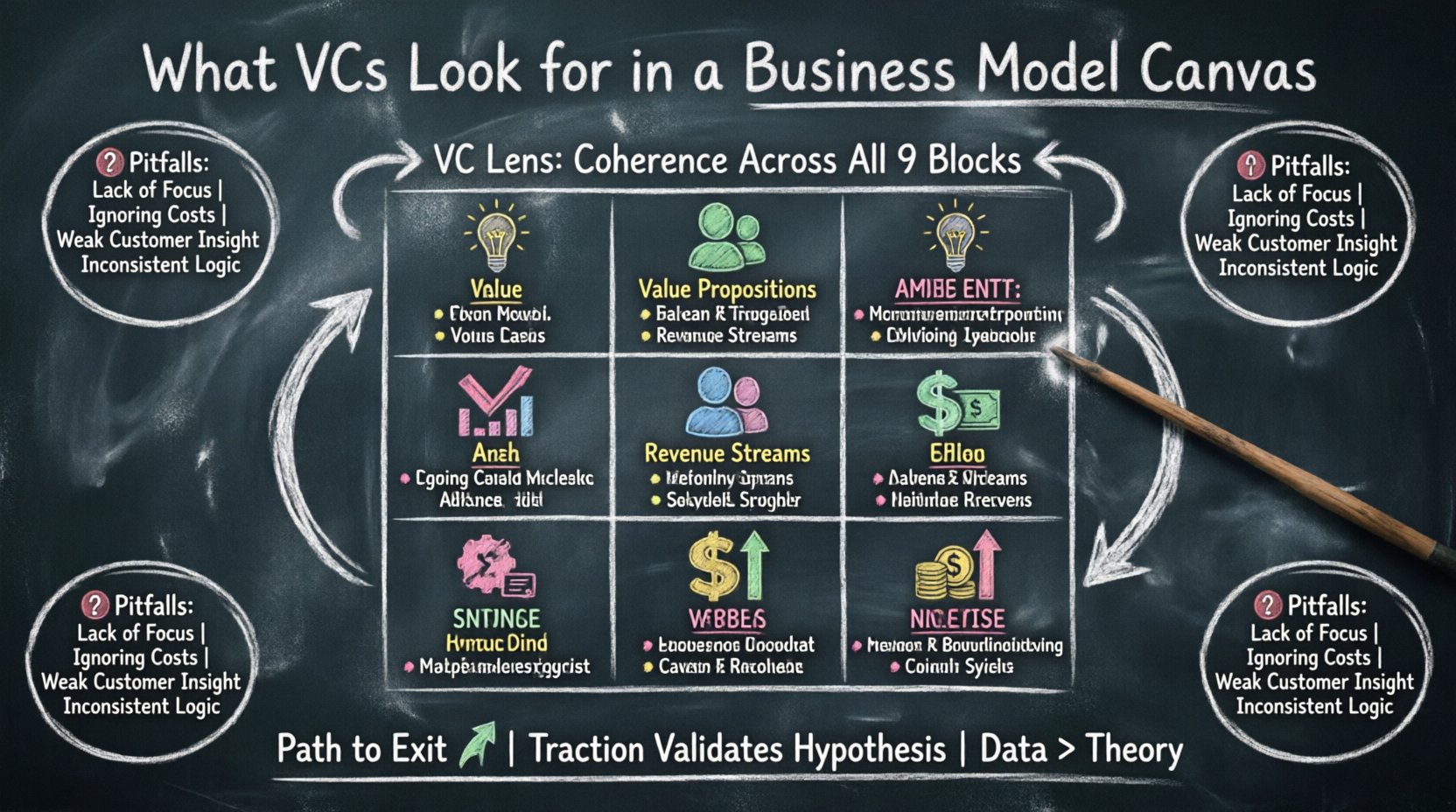
Investors do not simply look for a filled-out canvas; they look for coherence. They want to see that every element supports the others. A strong value proposition must be backed by key resources and activities. Customer segments must align with channels and relationships. When these pieces fit together, the risk profile of the investment decreases. This guide breaks down exactly what seasoned investors scrutinize in each section of the canvas.
1. Value Propositions: The Core of the Deal 💡
The value proposition is the heart of the canvas. It answers the fundamental question: why should a customer choose this product over a competitor? Venture capitalists look for clarity here. Vague statements about “innovation” or “improving efficiency” are insufficient.
- Problem-Solution Fit: Is there a genuine pain point? Investors want evidence that the problem is acute and that the solution addresses it directly.
- Differentiation: What makes this unique? Is it a proprietary technology, a unique business arrangement, or a specific market insight? Investors need to see a moat.
- Measurable Impact: Can the benefit be quantified? Saving time, reducing cost, or increasing revenue are concrete metrics that investors prefer over subjective improvements.
When evaluating this section, VCs ask if the value is compelling enough to drive adoption without heavy marketing spend. If the value proposition requires extensive education of the market, the customer acquisition cost may become prohibitive.
2. Customer Segments: Who Are You Serving? 👥
A business cannot serve everyone. Venture capitalists analyze the specificity of the customer segments. Broad targets like “small businesses” or “millennials” often signal a lack of strategic focus.
| Segment Type | VC Perspective | Example |
|---|---|---|
| Niche | High confidence, scalable if adjacent | HR tech for remote-first startups |
| Mass Market | High risk, requires massive CAC | General social networking app |
| B2B Enterprise | High contract value, long sales cycles | Supply chain security for banks |
| Long Tail | Low individual value, high volume needed | Freemium mobile utility |
Investors look for a beachhead market strategy. They want to know how the company will penetrate a specific segment before expanding. A clear definition of the ideal customer profile helps validate the go-to-market strategy.
3. Revenue Streams: How Money Flows 💰
This is arguably the most scrutinized section. Investors are looking for sustainable unit economics. They want to understand the pricing model and how it scales.
- Pricing Strategy: Is it subscription-based, transactional, licensing, or freemium? Recurring revenue models are generally preferred for stability and valuation multiples.
- Revenue Quality: Is the revenue from one-off projects or retained contracts? Retention is key to long-term growth.
- Scalability: Does selling more units increase the cost of goods sold proportionally? Investors prefer models where marginal costs decrease as volume increases.
VCs also examine the diversity of revenue streams. Relying on a single customer or a single product line introduces significant risk. A diversified portfolio of offerings within the business model suggests resilience.
4. Cost Structure: Efficiency and Burn 🔥
Revenue is vanity, but profit is sanity. The cost structure section reveals how efficiently the company operates. Investors analyze the ratio of fixed costs to variable costs.
- Fixed vs. Variable: High fixed costs can lead to operational leverage once the break-even point is reached. High variable costs can erode margins as sales grow.
- Key Cost Drivers: What are the biggest expenses? Is it talent, infrastructure, or marketing? Investors want to see that these costs are aligned with growth.
- Optimization: Are there opportunities to reduce costs without compromising quality? Efficiency is a sign of strong management.
A lean cost structure indicates that the founders understand the importance of runway. Investors appreciate businesses that can grow without burning through cash too quickly.
5. Key Activities and Resources: The Engine 🏗️
This section details what the company must do and what it must own to deliver the value proposition. Investors look for alignment between activities and the value proposition.
- Operational Focus: Is the company focused on production, problem-solving, or platform management? The activities must match the business type.
- Intellectual Property: Are there patents, proprietary algorithms, or exclusive data? These are assets that protect the business model from competition.
- Human Capital: Does the team possess the specific skills needed? Technical founders are often valued higher in deep tech ventures.
VCs assess whether the key activities are scalable. If the business relies heavily on manual labor or custom services, scaling becomes difficult. Automation and standardization are preferred indicators of growth potential.
6. Channels: How Value Reaches Customers 📢
Channels are the touchpoints where the company interacts with customers. Investors evaluate the efficiency and reach of these channels.
- Direct vs. Indirect: Does the company sell directly or through partners? Direct sales allow for better control and data, while partners offer speed and reach.
- Integration: Are the channels integrated with the rest of the model? A strong channel strategy supports the customer relationship and revenue streams.
- Customer Acquisition Cost (CAC): What does it cost to reach a customer through these channels? Lower CAC relative to customer lifetime value is a strong signal.
Investors look for a channel strategy that can be replicated. If the initial success relies on a specific founder’s network, that is not scalable. A systematic approach to channel management is preferred.
7. Customer Relationships: Retention and Growth 🤝
Acquiring a customer is expensive; keeping one is profitable. This section defines how the company interacts with customers to drive retention.
- Retention Mechanisms: Are there loyalty programs, support structures, or community building? High retention rates reduce churn and increase lifetime value.
- Automation: Can relationships be maintained without constant human intervention? Automated onboarding and support are signs of a mature model.
- Feedback Loops: How does the company learn from customers? Continuous improvement based on user feedback is vital for product-market fit.
VCs analyze the customer lifecycle. A model that encourages repeat purchases or upsells is more valuable than one that requires constant acquisition.
8. Key Partners: The Ecosystem 🌐
No business exists in a vacuum. Key partners include suppliers, alliances, and joint ventures. Investors look for strategic advantages gained through partnerships.
- Non-Competitive Synergies: Do partners complement the business without competing? Strategic alliances can expand market reach.
- Supply Chain Stability: Are the supply chains secure? Disruptions in key partnerships can halt operations.
- Validation: Do reputable partners endorse the business? Association with established entities can reduce perceived risk.
Investors also consider the dependency risk. If the business relies entirely on one partner, that is a significant vulnerability. Diversified partnerships suggest a robust ecosystem.
9. Risk Assessment and Assumptions ⚠️
While not a formal block in the original canvas, savvy investors look for evidence that the founders understand the risks. This often appears in the margins or discussions surrounding the model.
- Market Risks: Is the market growing or shrinking? Regulatory changes can impact the entire model.
- Technology Risks: Is the technology proven or experimental? Unproven tech increases the chance of failure.
- Execution Risks: Can the team execute the plan? A great model means little without the ability to deliver.
Founders who acknowledge risks and have mitigation strategies earn more trust. Hiding potential pitfalls is a red flag for experienced investors.
Visualizing the Path to Exit 🚀
Ultimately, venture capital is an exit-driven game. Investors want to know how the business model leads to a liquidity event, whether through an acquisition or an IPO. The canvas should imply a trajectory toward scale.
- Acquisition Potential: Is the technology or customer base attractive to larger players? Strategic buyers often look for specific capabilities.
- Market Valuation: Does the revenue model support a high multiple? High-margin, recurring revenue models typically command higher valuations.
- Growth Trajectory: Can the company grow to a significant size? Investors need a path to a billion-dollar opportunity.
The Business Model Canvas is a living document. It should evolve as the company learns from the market. However, the initial version must demonstrate a clear, logical path to value creation and capture.
Common Pitfalls in the Canvas 🛑
Even experienced founders make mistakes when mapping their business model. Understanding these common pitfalls can help avoid rejection during due diligence.
- Lack of Focus: Trying to solve too many problems at once dilutes the value proposition.
- Ignoring Costs: Focusing only on revenue while ignoring the cost structure leads to unsustainable growth.
- Weak Customer Understanding: Assuming the market wants the product without evidence leads to poor product-market fit.
- Inconsistent Logic: If the channels do not match the customer segments, the model is flawed.
The Role of Traction and Data 📊
A canvas is a hypothesis until proven by data. Venture capitalists value traction that validates the assumptions in the canvas. Metrics such as monthly recurring revenue, churn rate, and user growth provide the evidence needed to back up the model.
Data bridges the gap between theory and reality. A well-structured canvas with strong data points is more compelling than a perfect canvas with no traction. Investors want to see that the company is testing its assumptions and iterating based on results.
Final Thoughts on Model Viability ✅
The Business Model Canvas is a powerful tool for both founders and investors. It forces clarity and exposes gaps in logic. For venture capitalists, it is a diagnostic tool to assess the health of a potential investment. By understanding what goes into each block, founders can better position their ventures for funding.
Success in this space requires more than just a great idea. It requires a coherent system where every part supports the whole. When the value proposition, customer segments, revenue streams, and cost structures align, the business model becomes a vehicle for significant value creation. This alignment is what investors seek above all else.
Focusing on these core elements ensures that the business is built on a foundation of logic and scalability. As the market evolves, the canvas must adapt, but the fundamental principles of value creation remain constant.