Securing funding is rarely about having the perfect idea. It is about demonstrating that your idea solves a real problem in a way that is sustainable and scalable. Investors do not fund dreams; they fund evidence. Before you walk into a meeting with venture capitalists or angel investors, you must have validated the core assumptions of your business model. Without this groundwork, you are asking for money based on hope rather than data.
This guide walks you through the process of validating your business model using the Business Model Canvas framework. We will explore how to identify risks, design experiments, and gather the hard evidence needed to convince stakeholders that your venture is ready for growth. This is not about speed; it is about certainty.
Why Validation Matters in Early Stages 🎯
Most startups fail because they build something nobody wants. This is known as market risk. By validating assumptions early, you reduce the likelihood of this failure. Validation is the process of testing a hypothesis to see if it holds true in the real world. In the context of a pitch deck, validation answers the question: “Have you done the work to prove this works?”
When you present validated data, you shift the conversation from “Can you do this?” to “How fast can you scale?” Investors appreciate founders who understand their own risks and have already taken steps to mitigate them.
Understanding the Business Model Canvas Components 🧩
The Business Model Canvas is a strategic management template for developing new or documenting existing business models. It visualizes the logic of how an organization creates, delivers, and captures value. To validate effectively, you must understand each block.
- Key Partners: Who helps you deliver the value?
- Key Activities: What things must you do to operate?
- Key Resources: What assets do you need?
- Value Proposition: What problem are you solving?
- Customer Relationships: How do you interact with users?
- Channels: How do you reach your customers?
- Customer Segments: Who are you serving?
- Cost Structure: What are the major costs?
- Revenue Streams: How do you make money?
Each block contains assumptions. Some are benign, but others are existential threats. Your validation effort should focus on the riskiest assumptions first.
Identifying the Riskiest Assumptions ⚠️
Not all assumptions require the same level of scrutiny. You need to distinguish between knowns and unknowns. The riskiest assumptions are those where you have the least evidence and the highest potential cost if they prove wrong.
Ask yourself the following questions to identify high-risk areas:
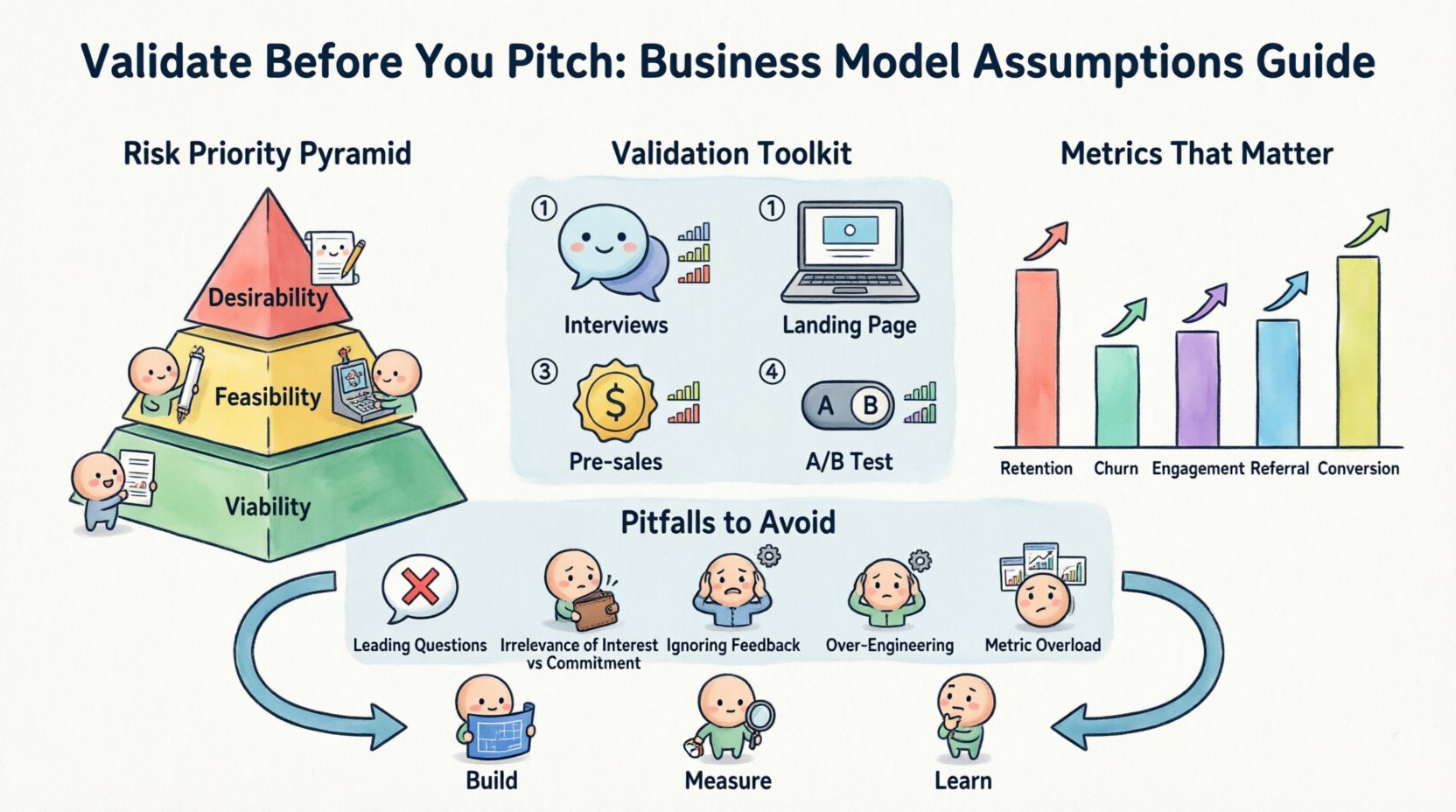
- Desirability: Do customers actually want this? (Value Prop & Customer Segments)
- Feasibility: Can you build this with available resources? (Key Activities & Resources)
- Viability: Will this make money? (Revenue Streams & Cost Structure)
- Survivability: Can you sustain operations long enough to grow? (Cost Structure)
If you cannot answer these questions with data, you have a risk that needs testing. Prioritize testing desirability before worrying about scalability. If people do not want the product, it does not matter how efficient your backend is.
Validation Methodologies and Experiments 🧪
Validation is not a single event; it is a series of experiments. Different blocks of your business model require different types of tests. Below is a breakdown of common techniques used to gather evidence.
1. Customer Discovery Interviews
This is the foundation of validation. You talk to potential customers to understand their pain points. The goal is not to sell your product, but to learn about their current behavior and frustrations.
- Ask open-ended questions: Avoid leading questions.
Focus on past behavior:
“Tell me about the last time you encountered this problem” is better than “Would you use this?”
Look for emotional reactions:
Strong emotions indicate high pain points.
2. Landing Page Tests
Create a simple page describing your value proposition and a call to action. Drive traffic to it to measure interest.
- Metrics to track: Click-through rates, sign-up rates, time on page.
- Limitation: This measures interest, not willingness to pay.
3. Pre-Sales and Deposits
The only validation that matters is money. Ask customers to pay before the product is fully built.
- Concierge MVP: Manually deliver the service to prove value.
- Wizard of Oz: Make it look automated but handle the backend manually.
4. A/B Testing
Test different versions of your value proposition or pricing to see what resonates.
| Method | Best For | Cost | Speed | Signal Strength |
|---|---|---|---|---|
| Interviews | Understanding problems | Low | Fast | Weak (Verbal) |
| Landing Pages | Measuring interest | Low | Fast | Moderate (Behavioral) |
| Pre-Sales | Proving willingness to pay | Medium | Medium | Strong (Financial) |
| Pilot Programs | Proving utility | High | Slow | Very Strong (Usage) |
Validating Specific Business Model Canvas Blocks 🔍
Once you have chosen your methods, apply them to specific parts of your canvas. Here is how to validate the critical components.
Validating Customer Segments
Do not try to serve everyone. A vague target audience is a red flag for investors.
- Define the segment: Be specific about demographics and psychographics.
- Confirm access: Can you actually reach them through your chosen channels?
- Size the market: Is the segment large enough to support growth?
Validating Value Proposition
Your value proposition must address a real pain point.
- Problem-Solution Fit: Ensure the solution directly addresses the problem identified.
- Comparison: How does your solution compare to existing alternatives?
- Switching Costs: Why would someone switch from what they are currently using?
Validating Revenue Streams
How the business makes money is often the biggest uncertainty.
- Pricing Model: Test subscription vs. one-time vs. freemium.
- Customer Lifetime Value (LTV): Estimate how much a customer is worth over time.
- Acquisition Cost (CAC): Estimate how much it costs to get a customer.
- Unit Economics: Ensure LTV is significantly higher than CAC.
Validating Channels
Channels are the touchpoints where customers interact with the company.
- Reach: How many people can you access?
- Relevance: Do customers use this channel for similar products?
- Cost: Is the channel affordable for your budget?
- Conversion: What percentage of visitors become customers?
Validating Cost Structure
Investors need to know you understand your burn rate.
- Fixed vs. Variable: Distinguish between costs that stay the same and those that grow with sales.
- Key Drivers: Identify which activities drive the most cost.
- Break-even Point: Calculate when revenue will cover costs.
| Canvas Block | Key Validation Question | Recommended Experiment |
|---|---|---|
| Value Proposition | Is this problem painful enough? | Customer Interviews |
| Customer Segments | Who specifically needs this? | Persona Validation |
| Revenue Streams | Will they pay for this? | Pre-sales / Surveys |
| Channels | Can we reach them efficiently? | Ad Testing |
| Cost Structure | Are our costs sustainable? | Vendor Quotes |
Metrics That Matter for Validation 📊
Data drives decisions. When validating, focus on metrics that indicate traction and engagement, not vanity metrics.
- Retention Rate: Are customers coming back?
- Churn Rate: How many are leaving?
- Engagement: How often do they use the product?
- Referral Rate: Are they telling others?
- Conversion Rate: Are visitors becoming users?
Avoid focusing on total downloads or page views if they do not correlate with revenue or retention. A small, engaged user base is more valuable than a large, inactive one.
Common Pitfalls in the Validation Process ⚠️
Even with a solid plan, founders often stumble. Be aware of these common mistakes.
1. Asking Leading Questions
If you ask, “Do you like this feature?”, you bias the answer. Instead, ask, “How do you currently solve this?”
2. Confusing Interest with Commitment
Saying “I would buy that” is cheap. Asking for a deposit or a signed letter of intent is expensive. Trust the latter.
3. Ignoring Negative Feedback
If a test fails, do not ignore it. A failed experiment is still valuable data. It tells you where to pivot.
4. Over-Engineering the Product
Building a full product before validating the core assumption wastes time and money. Build the smallest version possible to test the risk.
5. Chasing Too Many Metrics
Focus on one or two key metrics that indicate health. Too much data leads to analysis paralysis.
Preparing the Pitch Deck Based on Validation 📝
Once you have gathered your data, integrate it into your pitch deck. Investors want to see the journey from hypothesis to evidence.
- The Problem Slide: Cite the data gathered during customer interviews.
- The Solution Slide: Show the MVP or prototype that addresses the problem.
- The Market Slide: Use validated market size data, not just top-down estimates.
- The Traction Slide: Display retention, revenue, and user growth charts.
- The Team Slide: Highlight experience relevant to the risks you have mitigated.
Be transparent about what you do not know. Acknowledge remaining risks and outline how you plan to address them. This shows humility and strategic thinking.
The Iterative Nature of Validation 🔄
Validation is not a one-time checkbox. It is an ongoing process. As you grow, your assumptions will change. New competitors will emerge, and customer needs will shift. You must remain agile.
Regularly revisit your Business Model Canvas. Update your assumptions based on new data. This continuous loop of building, measuring, and learning is the core of a resilient business.
When you pitch to investors, show them this loop. Demonstrate that you are not just a visionary, but a learner who adapts to reality. This builds trust and confidence in your leadership.
Summary of Best Practices ✅
To wrap up, here are the essential takeaways for validating your business model before seeking capital.
- Start with the riskiest assumptions: Test viability before scalability.
- Use a mix of methods: Combine interviews with financial tests.
- Focus on behavior over words: Money speaks louder than feedback.
- Document everything: Keep records of your experiments and results.
- Be honest: Admit what you do not know and plan to find out.
- Iterate: Treat your business model as a living document.
By rigorously validating your assumptions, you transform your startup from a gamble into a calculated investment. You reduce the uncertainty for yourself and the investors. This preparation is the difference between a rejected pitch and a funded venture.