
Strategy is rarely a one-time event. It is a continuous cycle of assessment, adaptation, and execution. Yet, many organizations treat the SWOT analysis as a static document—a relic filed away after a quarterly planning session. When you find yourself staring at a four-quadrant grid that offers no new insights, you are facing a common strategic challenge: stale data.
A stale SWOT analysis does not merely lack information; it lacks relevance. It reflects a market reality that no longer exists or a self-perception that ignores current operational friction. This guide provides a technical framework for diagnosing and resolving these strategic blockages. We will move beyond the basics of what a SWOT is and focus on the mechanics of keeping it functional, accurate, and actionable.
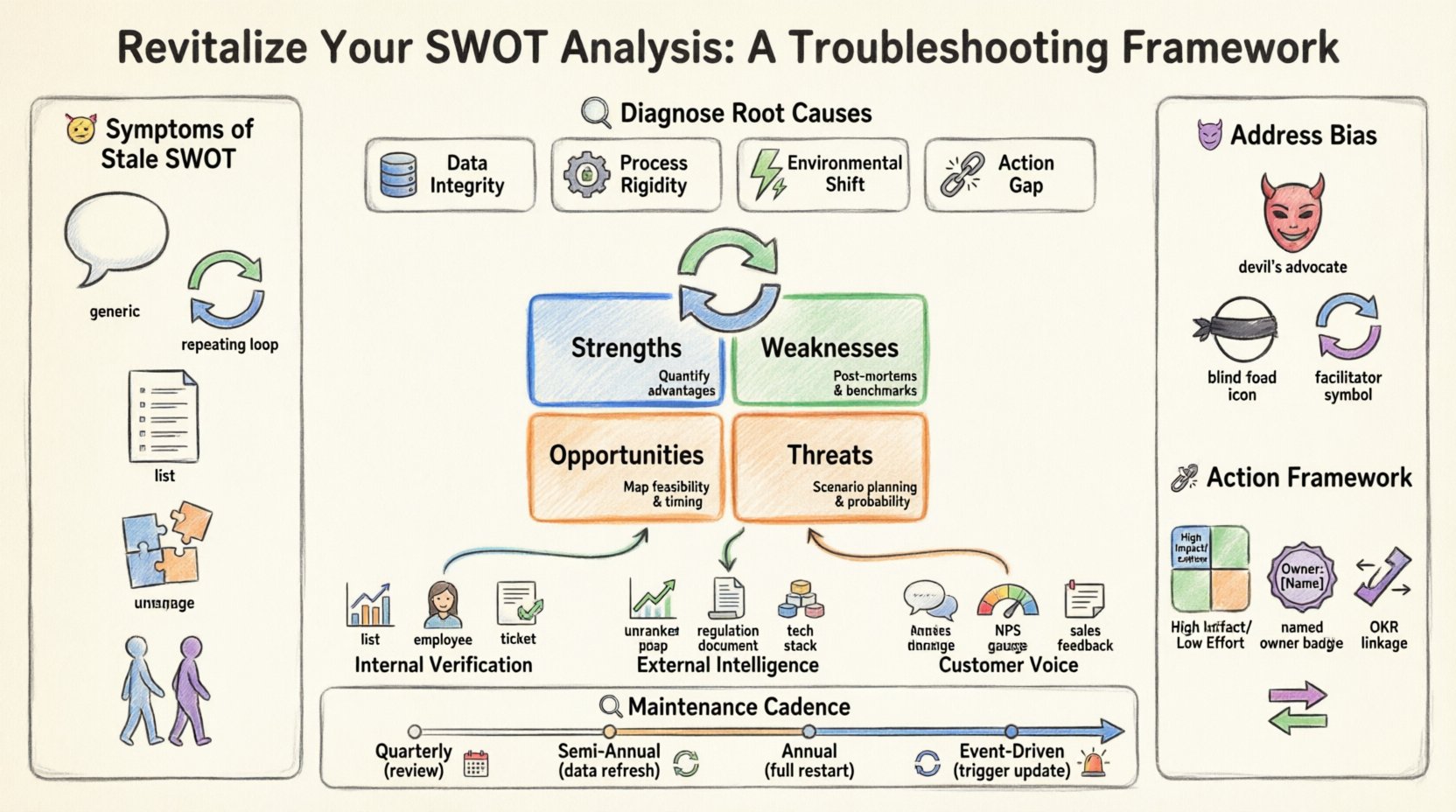
🧐 Recognizing the Symptoms of a Stale SWOT
Before you can fix the analysis, you must identify that it has degraded. A fresh SWOT analysis generates debate, highlights tensions, and points toward specific resource allocations. A stale one generates agreement without conviction, or worse, silence. Look for these specific indicators:
- Generic Statements: Items like “strong leadership” or “high market demand” appear without supporting metrics.
- Repetition: The same points appear year after year without context regarding why they persist.
- Lack of Priority: All items seem equally important, making it impossible to rank strategic initiatives.
- Disconnected from Operations: The output does not translate into departmental goals or KPIs.
- Executive Disengagement: Leadership teams find the session unproductive and avoid revisiting it.
When these symptoms appear, the document is not a tool; it is a barrier. It consumes time without delivering value. The goal is to restore the SWOT as a diagnostic instrument rather than a compliance artifact.
🔍 Diagnosing the Root Cause
Staleness rarely happens by accident. It is usually the result of process decay, data stagnation, or cognitive bias. Below is a diagnostic table to help you pinpoint where the breakdown occurred.
| Category | Indicators | Impact on Strategy |
|---|---|---|
| Data Integrity | Old market reports, unverified internal metrics, lack of customer feedback loops. | Decisions are based on assumptions rather than evidence. |
| Process Rigidity | Same facilitator, same participants, same format every time. | Groupthink dominates; new perspectives are excluded. |
| Environmental Shift | Competitors have pivoted, regulations changed, technology disrupted. | Internal strengths are irrelevant to new external threats. |
| Action Gap | No clear ownership assigned to SWOT items. | Insights remain theoretical; no operational change occurs. |
Understanding which category your organization falls into dictates the remediation strategy. If the issue is data, you need better intelligence. If the issue is process, you need better facilitation.
🔄 Refreshing the Data Sources
A SWOT analysis is only as robust as the inputs feeding it. When the analysis feels hollow, the first step is to audit the information sources. Relying on memory or outdated reports guarantees a stale output.
1. Internal Data Verification
Many organizations overestimate their strengths and underestimate their weaknesses due to internal bias. To correct this:
- Review Financial Performance: Are “strong cash flow” claims supported by the last three quarters’ P&L?
- Analyze Employee Turnover: High turnover in specific departments signals a structural weakness, not a strength.
- Customer Support Tickets: Frequent complaints regarding a feature indicate a product weakness masked by marketing claims.
- Project Failure Rates: If projects consistently miss deadlines, “efficient operations” is a false strength.
2. External Market Intelligence
Opportunities and threats are external factors. They require active scanning, not passive observation. Ensure your data collection includes:
- Competitor Pricing Strategies: Have they moved into your margin zone?
- Regulatory Changes: New laws may create immediate threats or open new opportunities.
- Supply Chain Volatility: Reliance on a single vendor is a significant vulnerability.
- Technology Adoption Rates: Is your tech stack becoming obsolete compared to industry standards?
3. Customer Voice
Internal assumptions often diverge from customer reality. You must validate your SWOT against the market.
- Churn Analysis: Why are customers leaving?
- NPS Scores: What drives detractors versus promoters?
- Sales Feedback: What objections do sales teams face daily?
- Feature Requests: What capabilities are customers explicitly asking for?
🧩 Deep Dive into the Four Quadrants
Once data is refreshed, the specific quadrants often require targeted troubleshooting. Each section has unique pitfalls that lead to staleness.
Strengths: Moving from Vague to Specific
A common error is listing “good culture” or “experienced team” as strengths. These are traits, not strategic assets. To fix this:
- Quantify the advantage. “Experienced team” becomes “Team has 50 combined years of industry experience, reducing onboarding time by 40%.”
- Identify causal links. Does the experience actually lead to higher revenue or lower error rates?
- Check for sustainability. Is this strength defensible against competitors?
Weaknesses: Confronting the Uncomfortable
Weaknesses are often hidden or ignored because they are embarrassing. A stale SWOT often treats weaknesses as “areas for improvement” rather than hard constraints.
- Conduct a Post-Mortem: Review failed projects to identify systemic weaknesses.
- External Audit: Invite an independent party to review your operations.
- Benchmarking: Compare your speed, cost, and quality against industry leaders.
- Resource Constraints: Be honest about budget or talent gaps.
Opportunities: Spotting the Real Potential
Opportunities often drift into wishful thinking. “Expand into new markets” is not an opportunity without a path. To ground this section:
- Map the Path: What specific steps are required to capture this opportunity?
- Assess Feasibility: Do we have the resources to execute this now?
- Timing: Is this the right moment, or are we entering too early or too late?
- Competitor Action: Are others already pursuing this, and if so, how?
Threats: Anticipating Risk
Threats are often listed as generic risks like “economic downturn.” You need specific exposure analysis.
- Scenario Planning: What happens if this specific threat materializes?
- Probability Assessment: Rank threats by likelihood and impact.
- Dependency Mapping: Which parts of the business are most exposed?
- Contingency Readiness: Do you have a plan B if this threat hits?
🧠 Addressing Human Bias and Facilitation
Even with perfect data, human psychology can render a SWOT analysis stale. Cognitive biases filter information before it even reaches the whiteboard.
1. Confirmation Bias
Teams often seek information that confirms their existing beliefs. If leadership believes the market is growing, they will ignore signals of saturation.
- Assign a Devil’s Advocate: Designate a team member to challenge every positive point.
- Blind Analysis: Remove names from the data review process to reduce attachment to specific outcomes.
- Red Team Exercises: Have a group attempt to prove the current strategy wrong before planning.
2. Status Quo Bias
It is easier to maintain the current state than to change it. This leads to SWOT items that justify current operations rather than questioning them.
- Ask “Why Now?”: Why is this still a priority? Why is that still a problem?
- Zero-Based Review: Treat every strategy item as if it is being proposed for the first time today.
- External Perspective: Bring in consultants or industry peers to challenge internal norms.
3. Facilitation Dynamics
If the same person leads the strategy session every year, the dynamic remains the same. Facilitation style dictates output quality.
- Rotate Facilitators: Change the person who guides the conversation.
- Change the Format: Move from a large group presentation to breakout groups or silent writing exercises.
- Limit Attendance: Fewer, more diverse voices often yield better results than large, homogenous groups.
- Set Time Limits: Rushed sessions often default to safe, generic answers. Allow space for deep thought.
🚀 From Analysis to Actionable Output
The ultimate failure of a SWOT analysis is not that it is stale, but that it is not used. A fresh analysis that sits in a folder is just as useless as an old one. The troubleshooting process must end with a clear mechanism for execution.
1. Prioritization Matrix
Not all SWOT items are equal. You must filter them through a prioritization lens.
- Impact vs. Effort: Plot items on a matrix to identify quick wins versus strategic bets.
- Strategic Alignment: Does this item support the core mission?
- Resource Availability: Can we actually do this given current constraints?
2. Assign Ownership
Every item that moves to the action plan must have a single owner. Ambiguity kills execution.
- Named Individuals: Avoid department names. Use specific people.
- Clear Deadlines: Set dates for when the insight should be validated or the action completed.
- Success Metrics: Define what success looks like for each action item.
3. Integration with OKRs
Link the SWOT directly to your Objectives and Key Results. This ensures the analysis drives daily work.
- Map SWOT to OKRs: Which Objective supports a Strength? Which Key Result mitigates a Threat?
- Review Cadence: Check progress on SWOT-derived actions during monthly business reviews.
- Feedback Loops: If an action fails, update the SWOT immediately.
📅 Maintenance and Cadence
To prevent staleness, you need a schedule. A strategy session is not a destination; it is a maintenance cycle.
| Frequency | Focus Area | Action |
|---|---|---|
| Quarterly | Review Progress | Check action items from the last SWOT. Update status. |
| Semi-Annual | Data Refresh | Update market data and internal metrics. |
| Annual | Full Restart | Conduct a full SWOT refresh with new participants. |
| Event-Driven | Triggered Updates | Revisit immediately after major market shifts or M&A. |
💡 Conclusion on Strategic Agility
The value of a SWOT analysis lies in its ability to force clarity in a complex environment. When it feels stale, it is a signal that your strategic processes need repair. By auditing your data sources, challenging cognitive biases, and enforcing strict actionability, you can transform a static document into a living strategic asset.
Strategy is not about having the perfect answer today. It is about having the right questions for tomorrow. A fresh SWOT analysis ensures you are asking those questions based on reality, not history. Keep the data flowing, keep the facilitation dynamic, and keep the focus on execution. This approach maintains the integrity of your strategic planning and ensures your organization remains resilient in the face of change.