
Building a robust database begins long before the first line of code is written. It starts with understanding the fundamental logic that drives an organization. When business stakeholders describe how a system should work, they speak in terms of processes, policies, and exceptions. The technical team, however, must translate these narratives into rigid structures that prevent errors before they happen. This translation process is the core of data modeling. It involves converting vague business expectations into precise Entity Relationship Diagram (ERD) constraints. Without this precision, data integrity suffers, leading to corruption, reporting errors, and costly system failures later in the lifecycle.
The goal is not merely to create a diagram that looks correct. The goal is to create a blueprint that enforces truth. When business rules are mapped accurately to database constraints, the system becomes self-governing. It stops accepting invalid data at the source. This article explores the methodology for bridging the gap between human requirements and machine-enforced logic. We will examine the types of rules, how they map to cardinality and attributes, and the common pitfalls that occur during this translation.
Understanding the Source Material: Business Rules 📜
Before constructing an ERD, one must dissect the requirements. Business rules are specific, actionable, and testable statements that define or constrain some aspect of the business. They are the immutable laws of the data domain. If a rule is violated, the business process cannot proceed. In the context of data modeling, these rules fall into several distinct categories.
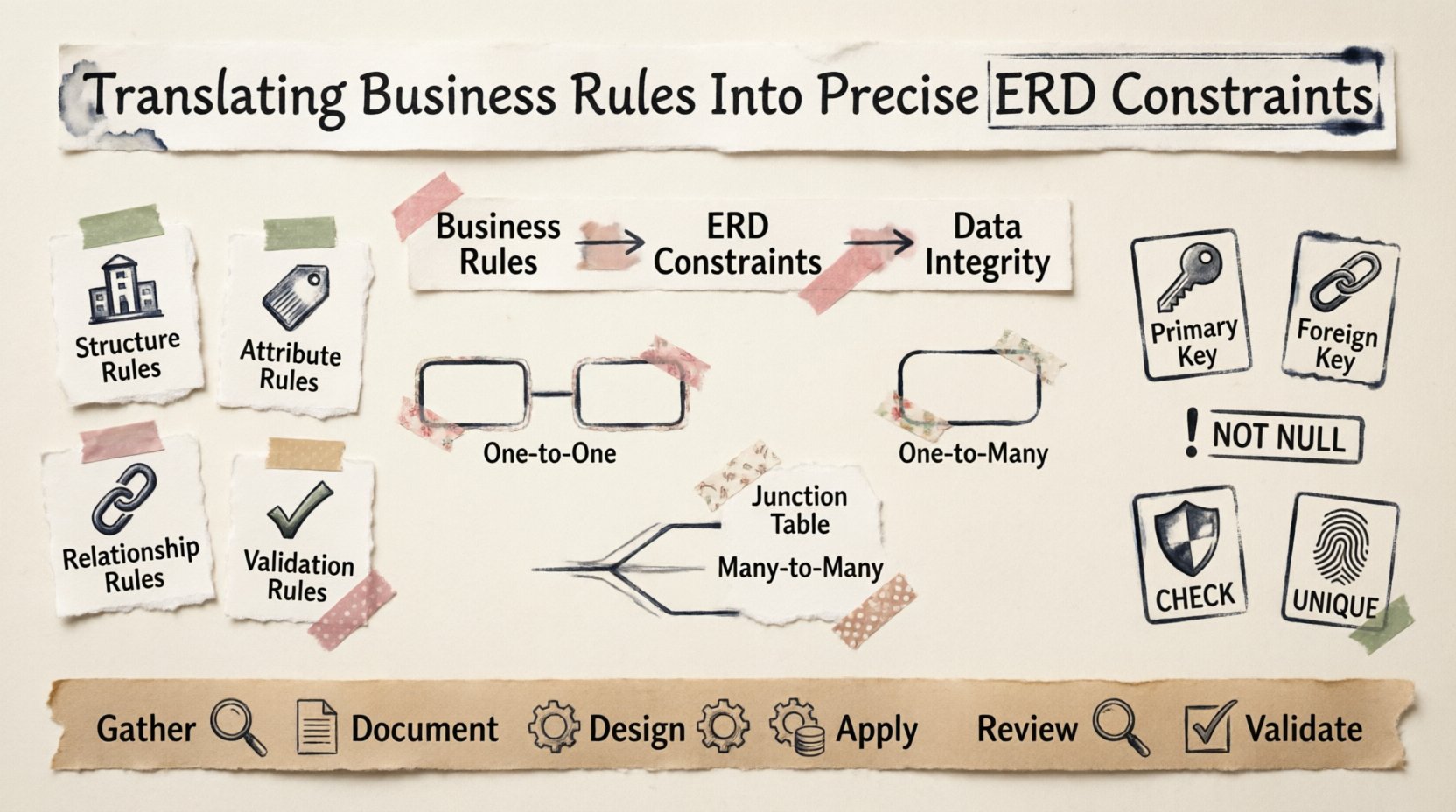
- Structure Rules: These define what entities exist and how they relate. For example, “A Customer must have at least one Address.”
- Attribute Rules: These constrain specific data points. For example, “The Order Date must be before the Ship Date.”
- Relationship Rules: These define the cardinality and participation. For example, “A Product can exist without an Order, but an Order must contain at least one Product.”
- Validation Rules: These ensure data format and range. For example, “Age must be a positive integer between 0 and 120.”
Each of these categories requires a different approach when designing the schema. Failing to identify them early leads to a model that requires constant post-entry validation, which is inefficient and prone to human error.
The Foundation: Entities and Attributes 🏗️
An Entity Relationship Diagram represents the world in terms of objects (Entities) and their properties (Attributes). However, a simple list of attributes is not enough. The constraints attached to these attributes determine the quality of the data stored within them.
Identifying Primary Keys
Every business entity needs a unique identifier. In the real world, this might be a Social Security Number, a Passport ID, or a generated UUID. In the ERD, this translates to the Primary Key constraint. The business rule here is uniqueness.
- Business Rule: “No two employees can share the same Employee ID.”
- ERD Constraint: The ID attribute is marked as Primary Key, enforcing uniqueness at the database level.
- Why it matters: Without this constraint, duplicate records can appear, causing confusion in payroll, inventory, or customer service.
Handling Nullability and Optionality
One of the most frequent translation errors involves mandatory versus optional fields. This distinction is critical for data quality. If a business rule states that a field is required, the database schema must reflect that through NOT NULL constraints.
- Business Rule: “Every Invoice must have a Customer assigned.”
- ERD Constraint: The CustomerID foreign key column cannot be NULL.
- Business Rule: “A User profile can exist without a profile picture.”
- ERD Constraint: The ProfilePictureURL column allows NULL values.
Allowing NULLs where data is required creates a dangerous loophole. It allows the system to store incomplete records, which breaks downstream reporting and application logic. Conversely, marking fields as NOT NULL where they are optional causes unnecessary errors during data entry.
Mapping Relationships to Cardinality 📊
The most complex aspect of ERD design is the relationship between entities. Business rules often dictate how many instances of one entity can link to another. This is known as cardinality. Translating this into an ERD requires precise notation.
One-to-One Relationships
This is rare in general systems but common in specific scenarios. It implies that one record in Table A links to exactly one record in Table B.
- Example: An Employee can only hold one Driver’s License, and a License is issued to only one Employee.
- Implementation: The foreign key in the Employee table points to the License table, with a unique constraint on that foreign key.
One-to-Many Relationships
This is the most common structure. One parent entity relates to multiple child entities.
- Example: A Department contains many Employees, but an Employee belongs to only one Department.
- Implementation: The Employee table holds a foreign key referencing the Department table. The Department table does not reference the Employee table.
- Business Rule Translation: “An Employee cannot be deleted if they are currently assigned to a Department.”
- Constraint: This requires a Referential Integrity rule, often called a “Keep Parent” or “Restrict Delete” rule.
Many-to-Many Relationships
When multiple records in Table A relate to multiple records in Table B, a direct link is impossible in a standard relational model. This requires an associative entity (a junction table).
- Example: Students enroll in Courses. A Student takes many Courses. A Course has many Students.
- Implementation: Create a “Enrollment” entity that holds the StudentID and CourseID. This breaks the many-to-many into two one-to-many relationships.
- Business Rule Translation: “A Student cannot enroll in a Course if the Course is Full.”
- Constraint: This often requires a check constraint or a trigger on the Enrollment table to verify seat availability.
Advanced Constraints: Check and Domain Rules 🔒
Not all rules fit into keys or relationships. Some rules are about the actual values stored in the columns. These are known as check constraints or domain constraints.
Consider a rule regarding financial data. The business might state that a discount cannot exceed the total price of the item. In a standard ERD, this is often overlooked until the application layer is built. To ensure integrity, this logic should be modeled as a constraint within the data definition.
- Business Rule: “The Discount Percentage cannot be greater than 100%.”
- ERD Constraint: A check constraint on the Discount column: (Discount <= 100).
- Business Rule: “Negative quantities are not allowed in stock.”
- ERD Constraint: A check constraint on the Quantity column: (Quantity >= 0).
While application-level validation is common, relying on it exclusively is risky. If multiple applications access the same database, they must all implement the same logic. Database constraints provide a single source of truth.
Common Pitfalls in Translation ⚠️
Even experienced modelers make mistakes when converting business language into technical schemas. Awareness of these common traps helps maintain accuracy.
- Ambiguity in “Must”: Business stakeholders often use “should” or “usually” when they mean “must.” The modeler must clarify if a rule is a hard constraint or a guideline. Hard constraints belong in the schema; guidelines belong in the application logic.
- Ignoring Temporal Data: Many rules involve time. “An order is valid only for 24 hours.” This requires date-time constraints and potentially expiration logic that standard ERDs do not always capture visually.
- Over-Normalization: Trying to enforce every business rule at the database level can make the schema rigid and slow. Normalization is essential for integrity, but over-normalization can break performance. Balance is key.
- Assuming Implicit Rules: Just because a field exists does not mean its rules are defined. For example, if a “Status” field exists, does it have a defined list of allowed values? This should be an enumerated constraint or a lookup table.
A Practical Workflow for Constraint Mapping 📝
To ensure no rule is missed, follow a structured workflow. This process moves from abstract requirements to concrete schema definitions.
- Gather Requirements: Interview stakeholders. Ask “What prevents this action?” and “What data is required to proceed?”
- Document Rules: List every business rule found. Group them by Entity.
- Design the Schema: Draft the initial ERD with entities and basic relationships.
- Apply Constraints: Go through the rule list one by one. Assign Primary Keys, Foreign Keys, Not Null, and Check constraints.
- Review for Gaps: Look for entities that have no constraints defined. Ask if they are truly optional.
- Validate with Stakeholders: Show the diagram back to the business. Ask, “Does this model reflect your rules?”
Comparison of Rule Types and ERD Implementations 📋
The following table summarizes how different business rule types translate into technical constraints.
| Business Rule Type | Example Requirement | ERD Implementation | Constraint Type |
|---|---|---|---|
| Uniqueness | Email addresses must be unique across users. | Unique Index on Email column | Unique Constraint |
| Existence | Every Order must belong to a Customer. | Foreign Key from Order to Customer | Referential Integrity |
| Range | Temperature readings must be between -50 and 50. | Check constraint on Temperature column | Check Constraint |
| Mandatory | Product Name cannot be empty. | NOT NULL on Name column | Nullability Constraint |
| Cardinality | A Manager manages many Employees. | Foreign Key on Employee referencing Manager | One-to-Many Relationship |
| Logical Dependency | Checkout Date must be after Start Date. | Check constraint comparing Date columns | Check Constraint |
The Impact of Data Integrity on Business Operations 📈
Why does this level of detail matter? The answer lies in the cost of bad data. When business rules are not enforced at the database level, data drift occurs. Reports become inaccurate. Inventory counts go wrong. Financial audits fail. Fixing this data after it is stored is exponentially more expensive than preventing it during modeling.
Furthermore, precise constraints reduce the burden on application developers. When the database enforces the rules, the application code becomes simpler. It does not need to validate every input field manually. It can trust the schema. This leads to faster development cycles and fewer bugs in production.
Additionally, a well-constrained ERD serves as documentation. New developers can look at the diagram and understand the business logic without reading through pages of requirements documents. The schema becomes the living documentation of the business rules.
Final Considerations for Modelers 🧠
Translating business rules is not a one-time task. As the business evolves, rules change. A new regulation might require a field to be mandatory. A new process might allow a customer to have multiple phone numbers. The ERD must be versioned and updated accordingly.
Always prioritize clarity over complexity. If a constraint is too difficult to explain to a business stakeholder, it might be too complex for the system to handle efficiently. Strive for a model that is both strict enough to protect data and flexible enough to support future growth.
By treating business rules as the foundation of the data model, you ensure that the system supports the organization accurately. This alignment between logic and structure is the hallmark of professional data architecture. It turns a simple collection of tables into a reliable engine for business operations.