
Most teams treat a SWOT analysis like a grocery list. They write down strengths, weaknesses, opportunities, and threats, check a box, and move on to the next meeting. It feels productive. It looks organized. But if you ask a single person in that room, "So what?", silence often follows. 🤔
A SWOT analysis without concrete objectives is just data collection. It tells you where you are, but not where you need to go. To drive real change, you must bridge the gap between observation and action. This guide explains how to transform generic insights into measurable business objectives that actually move the needle.
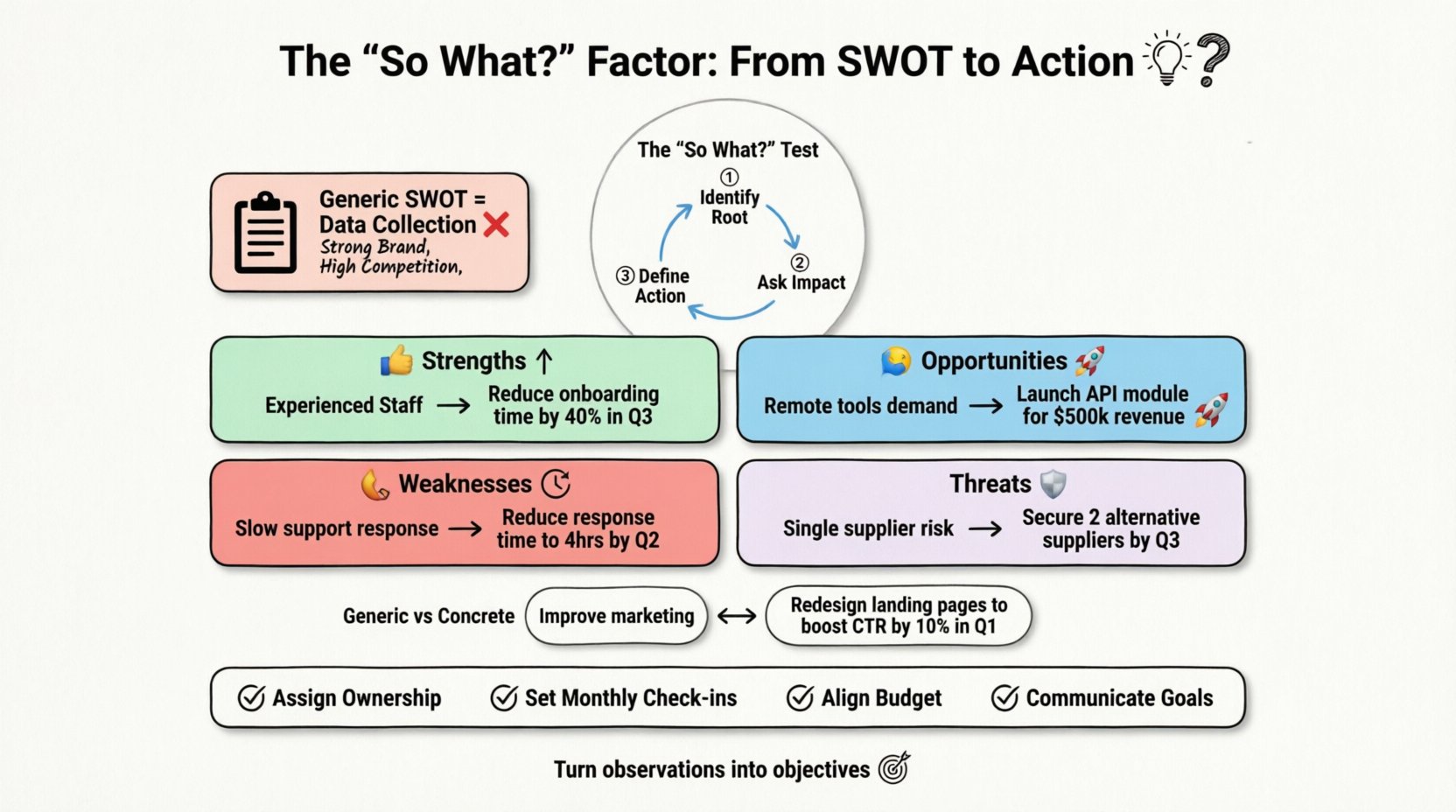
Why Generic SWOT Analysis Fails 🛑
When a strategy session ends with a whiteboard full of phrases like "Strong Brand", "High Competition", or "New Market", the analysis has hit a wall. These are observations, not strategies. They lack context and direction.
Here are the common pitfalls that prevent a SWOT from becoming a plan:
- Lack of Specificity: "Good reputation" is vague. What reputation? In which market? With which customer segment?
- Missing Timeframes: Without a deadline, an objective is just a wish.
- No Resource Allocation: Identifying a weakness doesn’t tell you who will fix it or with what budget.
- Passive Language: Phrases like "We need to improve" are too soft. Strategy requires commitment.
The core issue is that teams confuse diagnosis with treatment. A doctor doesn’t just list your symptoms and leave; they prescribe a plan. Your SWOT is the diagnosis. The business objectives are the prescription.
The "So What?" Test Framework 🧐
To convert a generic point into a business objective, you need a rigorous filter. Before writing down any item on your strategy list, run it through this three-step interrogation.
- Identify the Root: Is this fact true across the entire organization or just a perception?
- Ask the Impact: How does this specific point affect revenue, efficiency, or risk in the next 12 months?
- Define the Action: What is the specific step we must take to leverage or mitigate this?
If you cannot answer the second and third questions, the point belongs on a "Monitor" list, not a "Strategy" list. Let's break down how to apply this to each quadrant.
Transforming Strengths into Objectives 💪
Strengths are often the easiest to list and the hardest to utilize. A team might write "Experienced Staff". That is a resource, not an objective. How does that experience translate to a goal?
Instead of stopping at the asset, look for the competitive advantage it creates.
Step 1: Quantify the Strength
Avoid adjectives. Use data. "Experienced Staff" becomes "80% of senior leadership has 10+ years in the industry."
Step 2: Link to Market Value
Why does this matter to the customer? "Because our leadership is experienced, we can reduce onboarding time for enterprise clients by 40%."
Step 3: Formulate the Objective
Turn the value into a target. "Reduce enterprise client onboarding time by 40% within Q3 to increase retention."
Example Transformation:
- Generic: "We have a proprietary technology."
- So What?: "Our technology allows us to process data 3x faster than competitors."
- Objective: "Capture 15% of the high-volume processing market segment by December through targeted sales campaigns leveraging speed metrics."
Transforming Weaknesses into Objectives 📉
Weaknesses are uncomfortable to discuss, which is why they often get buried. However, they represent the highest potential for efficiency gains if addressed correctly. The goal here is not to "fix everything" but to mitigate risk.
When addressing a weakness, the objective must be specific about the outcome, not just the activity.
Step 1: Acknowledge the Gap
Be honest. "Our customer support response time is 24 hours."
Step 2: Define the Cost of Inaction
What happens if we don't fix this? "Churn rates increase by 5% for premium users."
Step 3: Set the Improvement Target
Create a measurable target. "Reduce average response time to 4 hours by end of Q2 to stabilize churn."
Example Transformation:
- Generic: "Outdated marketing materials."
- So What?: "Prospects perceive our brand as less innovative, leading to lower click-through rates on digital ads."
- Objective: "Redesign all landing pages and ad creatives by Q1 to improve click-through rates by 10%."
Transforming Opportunities into Objectives 🚀
Opportunities are external factors you can exploit. The trap here is wishful thinking. Just because a market exists doesn't mean you can capture it. You need to validate the fit.
An opportunity objective requires a go-to-market strategy component.
Step 1: Validate the Demand
Is there actual demand? "There is a growing demand for remote collaboration tools."
Step 2: Assess Capability
Do we have the ability to serve this? "Our engineering team has the capacity to build an API integration module."
Step 3: Define the Revenue Impact
Connect the opportunity to the bottom line. "Launch the API module to capture $500k in new recurring revenue."
Example Transformation:
- Generic: "Competitor is launching in a new region."
- So What?: "This creates a vacuum in the local service sector that we can fill with our logistics network."
- Objective: "Establish three distribution hubs in the region to capture 20% of the displaced market share within 12 months."
Transforming Threats into Objectives 🌩️
Threats are external risks. The instinct is to avoid them, but strategy is about managing risk exposure. An objective regarding a threat is about resilience.
Don't just say "Reduce risk." Say "Reduce risk to X level by Y date."
Step 1: Identify the Vulnerability
Where are we exposed? "We rely on a single supplier for critical components."
Step 2: Estimate the Impact
What is the worst case? "A disruption could halt production for 3 weeks."
Step 3: Set the Mitigation Goal
Create a buffer. "Secure two alternative suppliers and maintain 30-day inventory stock by Q3."
Example Transformation:
- Generic: "Regulatory changes incoming."
- So What?: "New compliance standards will increase our operational costs by 15% if not addressed early."
- Objective: "Complete full compliance audit and system upgrade by June to avoid fines and maintain margin stability."
Comparison Table: Generic vs. Concrete 📊
Use this table as a quick reference guide during your next planning session. Compare the vague statements to the actionable versions.
| SWOT Quadrant | Generic Point | Concrete Business Objective |
|---|---|---|
| Strength | Strong brand loyalty | Launch a referral program to increase customer acquisition by 25% using current loyalty data by Q2. |
| Weakness | Slow website load times | Optimize image assets and server configuration to reduce load time to under 2 seconds by end of month. |
| Opportunity | Growth in e-commerce sector | Expand online distribution channel to capture 10% of total sales volume within 18 months. |
| Threat | Price war with new entrant | Differentiate service offering to maintain 5% margin premium while increasing customer retention by 15%. |
Implementation Steps for Strategic Alignment 🛠️
Once you have transformed your points into objectives, you must ensure they are executed. A list on a page is useless. Here is the workflow to ensure these objectives drive daily work.
- Assign Ownership: Every objective must have one named owner. Ambiguity kills execution.
- Set Check-in Cadence: Review progress monthly. If an objective is not moving, pivot the strategy immediately.
- Align Resources: Ensure budget and headcount are allocated to support the objective. If you don't fund it, you don't do it.
- Communicate Up and Down: The CEO needs to know the goal, but the individual contributor needs to know how their task contributes to it.
Measuring Success: KPIs and Metrics 📏
How do you know if the transformation worked? You need Key Performance Indicators (KPIs) that directly correlate to the objectives. Avoid vanity metrics like "awareness" or "engagement" unless they directly tie to revenue or cost savings.
Recommended Metrics for Each Type:
- For Strengths: Market Share %, Customer Lifetime Value (CLV), Referral Rate.
- For Weaknesses: Error Rates, Cycle Time, Cost Per Unit, Churn Rate.
- For Opportunities: New Revenue Streams, Lead Conversion Rate, Market Penetration.
- For Threats: Risk Mitigation Score, Cost Avoidance, Compliance Pass Rate.
Common Pitfalls in the Transformation Process ⚠️
Even with a good framework, teams stumble. Here are three traps to avoid when refining your SWOT analysis.
1. Overloading the Strategy
It is tempting to write 20 objectives for each quadrant. This leads to paralysis. Focus on the top 3 to 5 objectives that have the highest impact. If everything is a priority, nothing is.
2. Confusing Tactics with Objectives
"Hire 5 sales reps" is a tactic. "Increase sales capacity to handle 50% more leads" is an objective. Tactics change based on resources; objectives remain focused on the outcome.
3. Ignoring Interdependencies
One objective might rely on another. If you plan to expand globally (Opportunity), you need to fix your currency risk management (Threat) first. Map these dependencies to avoid bottlenecks.
Maintaining Momentum Over Time 🔄
A SWOT analysis is not a one-time event. Markets shift, competitors evolve, and internal capabilities change. To keep the analysis relevant:
- Quarterly Reviews: Revisit the original points. Are they still true?
- Trigger Events: If a major competitor launches a product, trigger an immediate SWOT re-evaluation.
- Feedback Loops: Ask frontline employees if the objectives are still realistic. They see the market reality daily.
By treating the SWOT analysis as a living document rather than a static report, you ensure that your business strategy remains agile. The goal is not to produce a perfect document, but to produce a clear path forward.
Final Thoughts on Strategic Clarity 🧠
The difference between a struggling business and a thriving one often comes down to the quality of its strategic thinking. Generic lists create noise. Concrete objectives create signal.
When you apply the "So What?" factor to every point in your SWOT, you force the organization to think critically. You move from hoping for success to engineering it. This process requires discipline, honesty, and a willingness to be specific.
Start today. Take your next list of observations, and challenge them. Turn them into targets. Turn them into wins. 🏆