
In a crowded marketplace, clarity is the most valuable currency. Businesses often struggle to articulate what makes them distinct. They possess assets, skills, and market positions, yet fail to translate these into a coherent message. The Unique Value Proposition (UVP) is not merely a tagline; it is the foundational promise of value you deliver to customers. It answers the critical question: Why should a client choose you over the competition?
Strategic planning often relies on frameworks that analyze past performance. However, forward-looking differentiation requires a specific lens. The SWOT analysis is a classic tool for assessing internal and external factors. When applied correctly, it serves as a rigorous filter to extract the core elements of your UVP. This guide explores how to leverage this framework to identify your strategic edge with precision and authority.
🧩 Understanding the Core Components
Before integrating tools, we must define the mechanics of the two primary components involved here: the Unique Value Proposition and the SWOT Analysis. Misunderstanding either term leads to fragmented strategy.
🏆 The Unique Value Proposition Defined
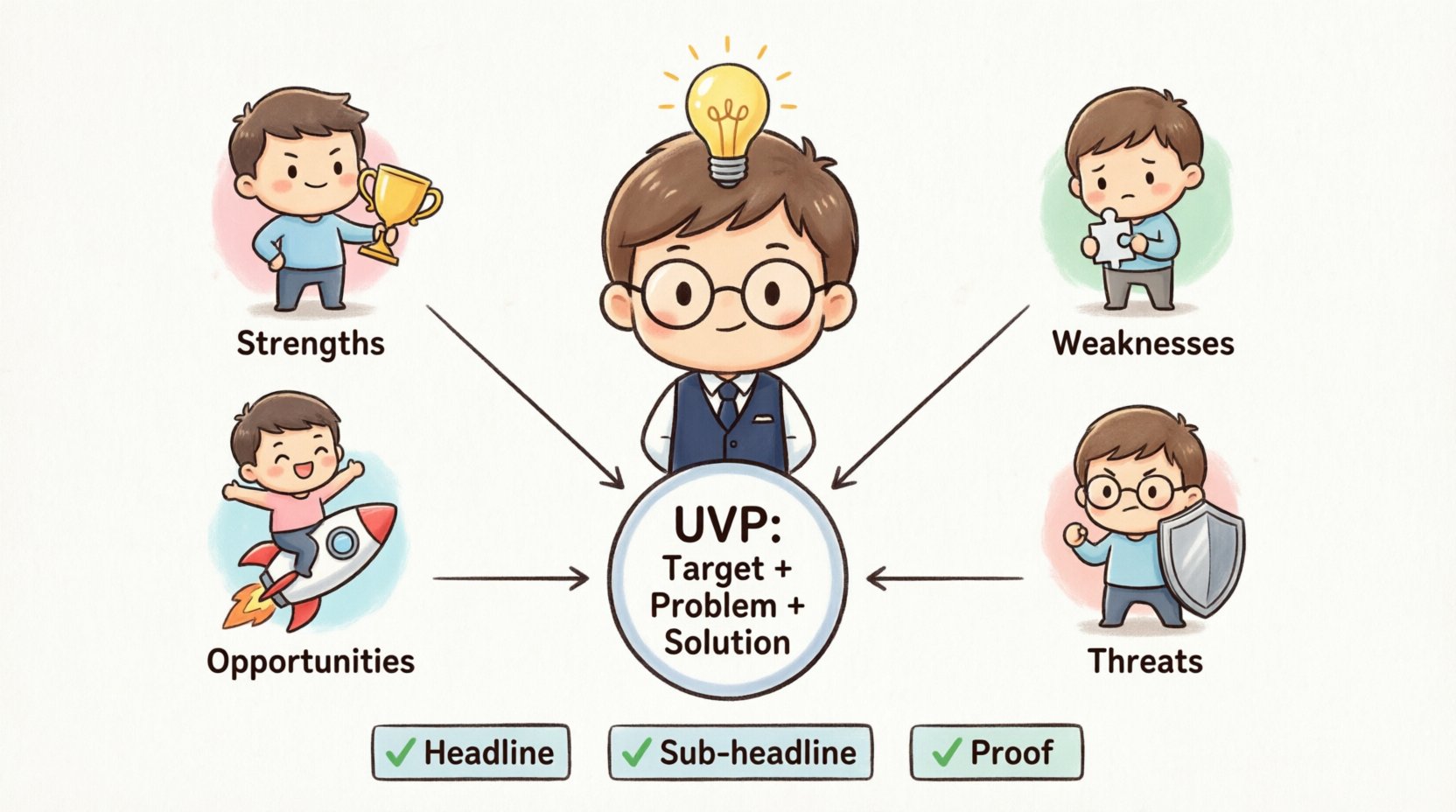
A UVP is a clear statement that describes the benefit of your offer, how you solve your customer’s needs, and what distinguishes you from the competition. It is not about what you do; it is about the outcome you create. A robust UVP contains three essential pillars:
- Target Audience: Who is the specific customer segment?
- The Problem: What specific pain point does this customer face?
- The Solution: How do you solve it better than anyone else?
Many organizations confuse a UVP with a mission statement. A mission statement explains why the company exists. A UVP explains what value the customer receives. Confusing these two dilutes marketing efforts and confuses stakeholders.
🔍 The SWOT Framework Explained
SWOT stands for Strengths, Weaknesses, Opportunities, and Threats. It is a structured method for evaluating the strategic position of an organization. Traditionally, it is used for high-level planning. However, to derive a UVP, we must treat SWOT not as a static list, but as a dynamic matrix for value extraction.
- Strengths: Internal attributes that give you an advantage over others.
- Weaknesses: Internal attributes that place you at a disadvantage relative to others.
- Opportunities: External chances to make progress or improve performance.
- Threats: External elements that could cause trouble for the business.
The intersection of these four quadrants reveals where your competitive advantage lies. By mapping internal capabilities against external market realities, you isolate the specific value that is both feasible and desirable.
🎯 The Strategic Gap: Why Standard SWOT Fails
Most businesses conduct SWOT analysis as a checkbox exercise. They list generic attributes like “good customer service” or “strong brand.” These lists rarely lead to a compelling UVP because they lack specificity. A generic strength does not translate into a unique value proposition.
To bridge this gap, the analysis must shift from listing attributes to identifying differentiators. For example, having “experienced staff” is common. Having “staff with 15 years of niche industry compliance history” is a differentiator. The standard SWOT often fails to dig deep enough into the why behind the strength.
Furthermore, standard analysis often treats Opportunities and Threats as external noise. To identify a UVP, you must view Opportunities as gaps in the market that your specific Strengths can fill. You must view Threats as areas where your Weaknesses make you vulnerable, forcing you to pivot your value delivery.
🔍 Deep Dive: Internal Analysis for Value Discovery
The internal analysis focuses on what you control. This is the bedrock of your value. Without tangible internal capabilities, external claims are hollow promises.
💪 Strengths: The Core of Value
When auditing strengths for UVP purposes, avoid vague adjectives. Ask specific questions during your assessment:
- What processes do we have that competitors cannot easily copy?
- Which proprietary technology or intellectual property do we own?
- Do we have exclusive partnerships or distribution channels?
- What specific metrics demonstrate our superior performance?
Strengths that feed directly into a UVP are those that reduce friction for the customer. If your strength is “speed of delivery,” your UVP should highlight time savings. If your strength is “data security,” your UVP should highlight risk reduction.
⚠️ Weaknesses: Identifying the Boundaries
Weaknesses are often avoided in planning, yet they are critical for UVP refinement. They define the boundaries of your promise. You cannot promise a feature you cannot deliver.
- Scope Definition: Acknowledging a weakness helps you narrow your target audience. If you lack 24/7 support, your UVP should not promise instant response times.
- Compensation: Sometimes a weakness is offset by a strength. If your product is complex (weakness in usability), your strength might be “deep functionality.” Your UVP must communicate that the complexity buys superior results.
- Trust Signals: Being honest about limitations can build credibility. A UVP that acknowledges a specific challenge and solves it uniquely is often more persuasive than one that claims perfection.
🌍 Deep Dive: External Analysis for Market Fit
Internal strengths mean nothing if the market does not value them. The external analysis connects your capabilities to customer desires and market trends.
🚀 Opportunities: The Gap in the Market
Opportunities represent unmet needs. A UVP is essentially a statement of how you capture an opportunity. To find these, look for:
- Regulatory Changes: New laws that create demand for specific compliance solutions.
- Technological Shifts: New tools that allow you to solve old problems faster.
- Competitor Withdrawal: When a major player leaves a segment, a void opens.
- Customer Behavior Changes: Shifts in how people work or consume services.
Mapping an Opportunity to a Strength is where the UVP is born. If the market is shifting towards sustainability (Opportunity) and you have a green supply chain (Strength), your UVP focuses on eco-efficiency.
⚡ Threats: Risk Management in Value
Threats are often seen as negative, but they clarify your value through contrast. If competitors are threatening to lower prices, your UVP might focus on quality rather than cost. If a new technology threatens obsolescence, your UVP might emphasize human expertise and adaptability.
Understanding threats allows you to position your value as a shield. You are not just selling a product; you are selling stability and continuity in a volatile environment.
📊 The Integration Matrix: Mapping SWOT to UVP
To move from analysis to strategy, you must visualize the connections. The following table demonstrates how to map each quadrant of the SWOT analysis directly into components of a Unique Value Proposition.
| SWOT Quadrant | Strategic Question | UVP Contribution |
|---|---|---|
| Strengths | What do we do better than anyone? | Defines the Core Benefit and Proof. |
| Weaknesses | Where are we vulnerable? | Defines the Scope and Boundaries to manage expectations. |
| Opportunities | What is the market asking for? | Defines the Problem Context and Relevance. |
| Threats | What could stop us from winning? | Defines the Risk Mitigation and Reliability. |
This matrix ensures that every claim in your UVP is backed by internal capability and external market demand. It prevents the common error of promising something the market wants but the business cannot deliver.
📝 Crafting the Proposition: The Synthesis Process
Once the data is gathered and mapped, the synthesis begins. This is where the narrative is constructed. A strong UVP statement is concise, yet dense with meaning.
🔗 The Formula
While there is no single rigid formula, the most effective structures follow a logical flow:
- Headline: The primary benefit or outcome.
- Sub-headline: How it works or for whom.
- Visual/Proof: Evidence of the claim.
When drafting, refer back to your SWOT matrix. If your Strength is “proprietary data” and your Opportunity is “market uncertainty,” your headline might focus on “predictive clarity.” Do not use industry jargon. Use the language your customers use.
🗣️ Voice and Tone
The tone of the UVP should match the authority of the analysis. If your SWOT revealed deep technical expertise, the tone should be precise and confident. If it revealed a focus on community and support, the tone should be empathetic and warm.
Avoid superlatives like “best” or “number one” unless you have concrete data to back them up. Instead, use comparative language that highlights the specific advantage identified in the Strengths quadrant. For example, “Faster than industry standards” is better than “The fastest service.”
✅ Validation: Testing Your Claim
Writing the UVP is only half the work. You must validate that it resonates with the market. Validation ensures that your internal assessment aligns with external perception.
- A/B Testing: Run variations of the UVP on landing pages. Measure conversion rates to see which messaging drives action.
- Customer Interviews: Ask prospects if your value proposition solves their problem. Listen for hesitation. If they do not understand it immediately, it needs refinement.
- Competitor Review: Monitor how competitors respond. If they copy your messaging, it confirms the value is significant.
Validation is an ongoing process. Market conditions change, and so should your SWOT analysis and your UVP. A static UVP eventually becomes a liability.
🛑 Common Pitfalls to Avoid
Even with a solid framework, errors occur. Being aware of these pitfalls helps maintain the integrity of your strategic planning.
❌ Overpromising
Do not use the UVP to sell a future that does not exist. If your SWOT analysis shows a weakness in scalability, do not promise enterprise-level reliability in your value statement. This leads to churn and reputation damage.
❌ Generic Claims
Phrases like “customer-centric” or “quality solutions” are ubiquitous. They add no value. The UVP must be specific to your operational reality. Specificity signals confidence.
❌ Ignoring the Weaknesses
Many strategists focus solely on Strengths and Opportunities. However, a UVP that ignores Weaknesses is fragile. It fails to account for the risks that could prevent delivery. Addressing Weaknesses in your strategy, even if not in the marketing copy, ensures you are prepared.
❌ Confusing Features with Benefits
A SWOT analysis often lists features as Strengths (e.g., “cloud-based platform”). The UVP must translate this into a benefit (e.g., “access your data from anywhere”). Customers buy outcomes, not features.
❓ Frequently Asked Questions
How often should I update my SWOT for UVP purposes?
Conduct a full review annually. However, significant market shifts, such as new regulations or competitor launches, should trigger an immediate re-evaluation of the Opportunities and Threats quadrants.
Can a UVP change if my target audience changes?
Yes. The UVP is tied to the customer. If you pivot your audience, you must revisit the Opportunities quadrant to understand their new needs and adjust the Strengths quadrant to show how you meet them.
Is SWOT the only tool needed for UVP?
No. SWOT provides the internal and external context. You may also need customer journey maps or persona development to fully understand the “Problem” part of the UVP. SWOT is the foundation, not the entire structure.
What if my Strengths are the same as my competitors?
Then you must look deeper. Are your processes faster? Is your culture more aligned? If the tangible assets are identical, focus on the intangible assets identified in the SWOT, such as team expertise or community trust. If nothing differentiates you, you may need to change your market positioning entirely.
🏁 Final Thoughts on Strategic Clarity
Defining your Unique Value Proposition is an exercise in honesty and strategy. It requires you to look inward at your capabilities and outward at the market with equal rigor. The SWOT analysis provides the structure for this inquiry. It forces you to confront your limitations and leverage your advantages.
By mapping internal strengths to external opportunities, you create a value proposition that is not just a marketing slogan, but a strategic reality. This clarity reduces friction in sales, aligns teams, and builds a sustainable competitive advantage. The process is methodical. The result is a clear path forward.