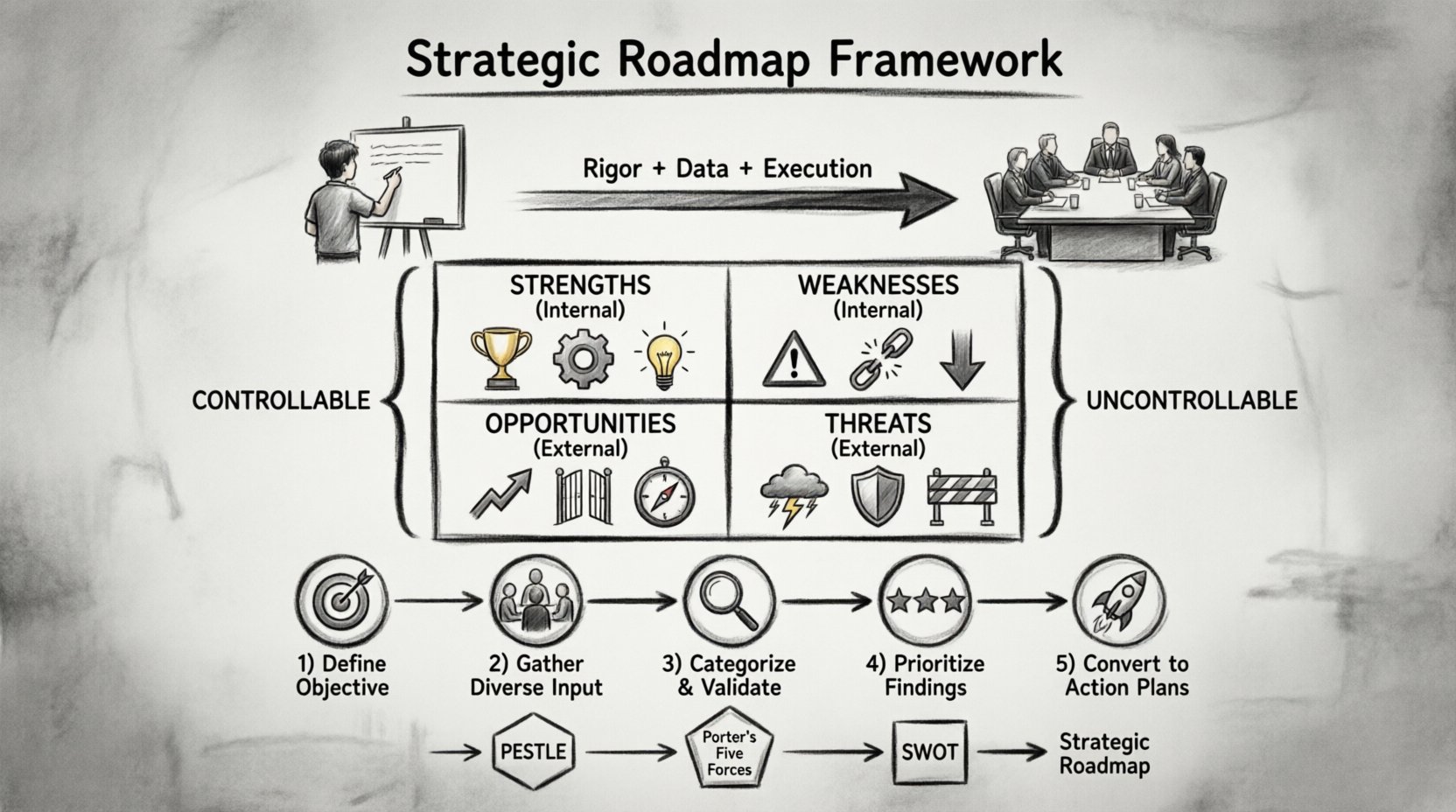
Walk into a university classroom, and you will likely see a group of students huddled around a whiteboard, mapping out Strengths, Weaknesses, Opportunities, and Threats. It is a rite of passage. It is often treated as a theoretical exercise, a box to check for a grade. But walk into a corporate boardroom, and you will find the same framework on the table, yet the stakes are exponentially higher. The difference lies not in the tool itself, but in the rigor, the data, and the execution behind it. 📊
Many business leaders dismiss SWOT analysis as outdated or too simple. They argue that market dynamics are too complex for a four-quadrant grid. However, this perspective misses the point. The SWOT analysis is not about complexity; it is about clarity. It forces an organization to confront internal realities and external pressures simultaneously. When executed correctly, it transforms from a static diagram into a dynamic strategic compass. 🧭
This guide explores the evolution of the SWOT framework. We will dissect how to move beyond the academic version to create a living document that informs high-stakes decision-making. We will look at the mechanics, the common pitfalls, and the strategic integration required to make this tool relevant in a modern business environment. 💡
Understanding the Framework: More Than Just Acronyms 🧩
At its core, a SWOT analysis is a strategic planning technique used to identify factors affecting an objective. It categorizes these factors into two dimensions: Internal (controllable) and External (uncontrollable). This dichotomy is the foundation of strategic thought. Without understanding what you can control versus what you must adapt to, strategy becomes guesswork. 🛑
The Internal Factors: Strengths and Weaknesses
These elements reside within the organization. They are the attributes of the company itself. They do not change overnight unless the organization actively decides to change them. 💪
- Strengths: These are advantages that give the organization an edge over competitors. They can be tangible, like proprietary technology or capital reserves, or intangible, like brand reputation or employee expertise. A strength is only a strength if it is better than what the competition offers.
- Weaknesses: These are limitations that place the organization at a disadvantage. This might include outdated infrastructure, lack of talent, or poor cash flow management. Acknowledging a weakness requires honesty, which is often the hardest part of the process.
The External Factors: Opportunities and Threats
These elements exist in the environment surrounding the organization. They are not created by the company, but the company must respond to them. 🌍
- Opportunities: These are external conditions that the organization can exploit to its advantage. This could be a regulatory change, a gap in the market left by a competitor, or a shift in consumer behavior. It is the “where” and “when” of growth.
- Threats: These are external conditions that could cause trouble for the organization. Examples include new legislation, economic downturns, or aggressive new entrants. A threat becomes a crisis if ignored.
The Shift: Academic Exercise vs. Strategic Asset 📉
In an academic setting, the SWOT analysis is often a snapshot. A student might list “good grades” as a strength and “lack of sleep” as a weakness. In a boardroom, the granularity must be significantly deeper. A strength cannot simply be “good marketing”; it must be “market share growth of 5% in the APAC region due to localized content strategy.” 📝
The transition from student to professional involves three key shifts:
- Data Dependency: Students often rely on intuition. Professionals rely on market research, financial reports, and customer feedback.
- Time Horizon: Student projects look at the immediate next semester. Strategic analysis looks at the next 3 to 5 years.
- Accountability: In class, a grade is the outcome. In business, the outcome is revenue, survival, or market position.
When you treat SWOT as a static document, it fails. When you treat it as a living conversation, it drives action. The boardroom version requires constant updating. It is not a one-time event; it is a recurring pulse check on the health of the strategy. ❤️
How to Conduct a Rigorous SWOT Analysis 🛠️
Creating a high-quality analysis requires a structured approach. There is no software magic that can do this thinking for you. It requires human judgment, facilitated by data. Here is a step-by-step methodology to ensure depth and accuracy.
Step 1: Define the Objective Clearly 🎯
Before drawing the grid, you must define the scope. Are you analyzing the entire company? A specific product line? A marketing campaign? A new market entry? The scope dictates the data you need. A vague objective leads to vague results.
Step 2: Gather Input from Diverse Sources 🗣️
Do not rely on a single viewpoint. To get a true picture, you need input from:
- Front-line employees: They know the operational bottlenecks best.
- Sales teams: They hear the customer complaints and desires daily.
- Finance: They understand the capital constraints and cost structures.
- External stakeholders: Customers, partners, or industry analysts.
Step 3: Categorize and Validate 🔍
List every potential factor. Then, challenge each one. Is this fact or opinion? Is this an internal weakness or an external constraint? For example, “high employee turnover” is an internal weakness. “Labor shortage in the region” is an external threat. Distinguishing these is critical for knowing who is responsible for solving the problem.
Step 4: Prioritize the Findings 📊
Not all items are equal. A SWOT list with 50 items is useless. You must rank them by impact and probability. Use a weighted scoring system if possible. Focus on the top three items in each quadrant. This forces decision-makers to confront the most critical issues first.
Step 5: Convert Analysis into Action Plans 🚀
This is where most frameworks fail. You must connect the quadrants. How can you use a Strength to capitalize on an Opportunity? (SO Strategy). How can you use a Strength to mitigate a Threat? (ST Strategy). How do you fix a Weakness to seize an Opportunity? (WO Strategy). How do you minimize a Weakness to avoid a Threat? (WT Strategy).
Common Pitfalls and How to Avoid Them ⚠️
Even with a good process, errors occur. Recognizing these traps is half the battle. Below are the most frequent mistakes made during strategic planning sessions.
| Pitfall | Description | The Fix |
|---|---|---|
| Vagueness | Listing generic items like “good leadership” or “bad market”. | Be specific. Use numbers. “High retention rate” vs “Good leadership”. |
| Confusing Internal/External | Putting market trends in the “Strengths” column. | Remember: If you can’t control it, it is external. |
| Static Mindset | Creating the document and filing it away. | Schedule quarterly reviews to update the analysis. |
| Groupthink | Everyone agrees too quickly to avoid conflict. | Assign a devil’s advocate to challenge every point. |
| Ignoring Weaknesses | Focusing only on strengths to feel good. | Make weaknesses a priority item for discussion. |
Integrating SWOT into Broader Strategy 🧩
A SWOT analysis is rarely a standalone document. It gains power when integrated with other strategic frameworks. Think of it as the foundation upon which the house is built. Without a solid foundation, the structure will not stand. 🏗️
Connection to PESTLE
While SWOT covers Opportunities and Threats broadly, a PESTLE analysis (Political, Economic, Social, Technological, Legal, Environmental) provides the deep dive into external factors. You can use PESTLE data to populate the “Opportunities” and “Threats” quadrants of your SWOT with greater precision. This ensures you are not missing regulatory shifts or technological disruptions. 📈
Connection to Porter’s Five Forces
Porter’s model analyzes industry competitiveness. The insights here feed directly into your “Threats” analysis. If the threat of new entrants is high, your “Threats” column will reflect that. If supplier power is high, your “Weaknesses” regarding cost control might be highlighted. This cross-referencing validates your assumptions. ✅
From Analysis to Roadmap
The final step is translating the grid into a timeline. If you identify a “Weakness” in digital infrastructure, does that become a project for Q1? If you see an “Opportunity” in a new market, does that become a budget line for Q2? The SWOT must drive the budget and the resource allocation. If it does not touch the budget, it is just a discussion. 💰
The Human Element in Strategic Planning 👥
There is a tendency to treat strategy as a purely logical exercise. However, people are the engine of execution. A SWOT analysis that ignores culture will fail. 🚫
- Cultural Strengths: Sometimes a “Strength” is simply a culture of innovation. This is harder to measure than revenue, but often more valuable.
- Cultural Weaknesses: A resistance to change is a massive weakness. It can prevent the organization from seizing an Opportunity even if the strategy is perfect.
- Buy-in: If the team does not believe the analysis, they will not execute the plan. Involving the team in the creation of the SWOT increases ownership and accountability.
Measuring the Impact of Your Analysis 📏
How do you know if your SWOT analysis was actually useful? You measure it by the decisions it informed. Look for the following indicators over the next fiscal year:
- Resource Reallocation: Did you move money or people away from the “Weakness” areas to “Strength” areas?
- Risk Mitigation: Did you anticipate a Threat before it became a crisis?
- Goal Achievement: Did the actions taken based on the “Opportunities” quadrant result in the projected growth?
If the answer is yes, the analysis was effective. If the answer is no, the analysis was likely disconnected from reality. This feedback loop is essential for continuous improvement. 🔄
Conclusion: The Value of Discipline 💪
The journey from a student project to a boardroom decision is defined by discipline. The SWOT analysis is a simple tool, but simplicity is often mistaken for lack of depth. The value lies in the rigor of the inquiry and the courage to face the truth of the organization’s position.
When you stop treating it as a checkbox and start treating it as a mirror, the results change. You stop reacting to the market and start shaping your path through it. It requires effort, honesty, and a willingness to update your thinking as the world changes. But for any organization serious about its future, it remains one of the most reliable tools for navigating uncertainty. 🌟
Start with the data. End with the action. And remember, the grid is only as good as the people filling it out. Make it count. 🎯