
Launching a new venture involves significant risk. Statistics show that a large percentage of early-stage companies fail within the first few years. This attrition often stems from a lack of market validation or an inability to articulate a sustainable business model. Entrepreneurs need a structured method to assess their concept before committing resources. The SWOT analysis offers a proven framework for this assessment. It allows founders to examine internal capabilities and external market conditions simultaneously. This guide details how to apply this tool specifically for startup validation and pitch preparation.
What is a SWOT Analysis? 🧐
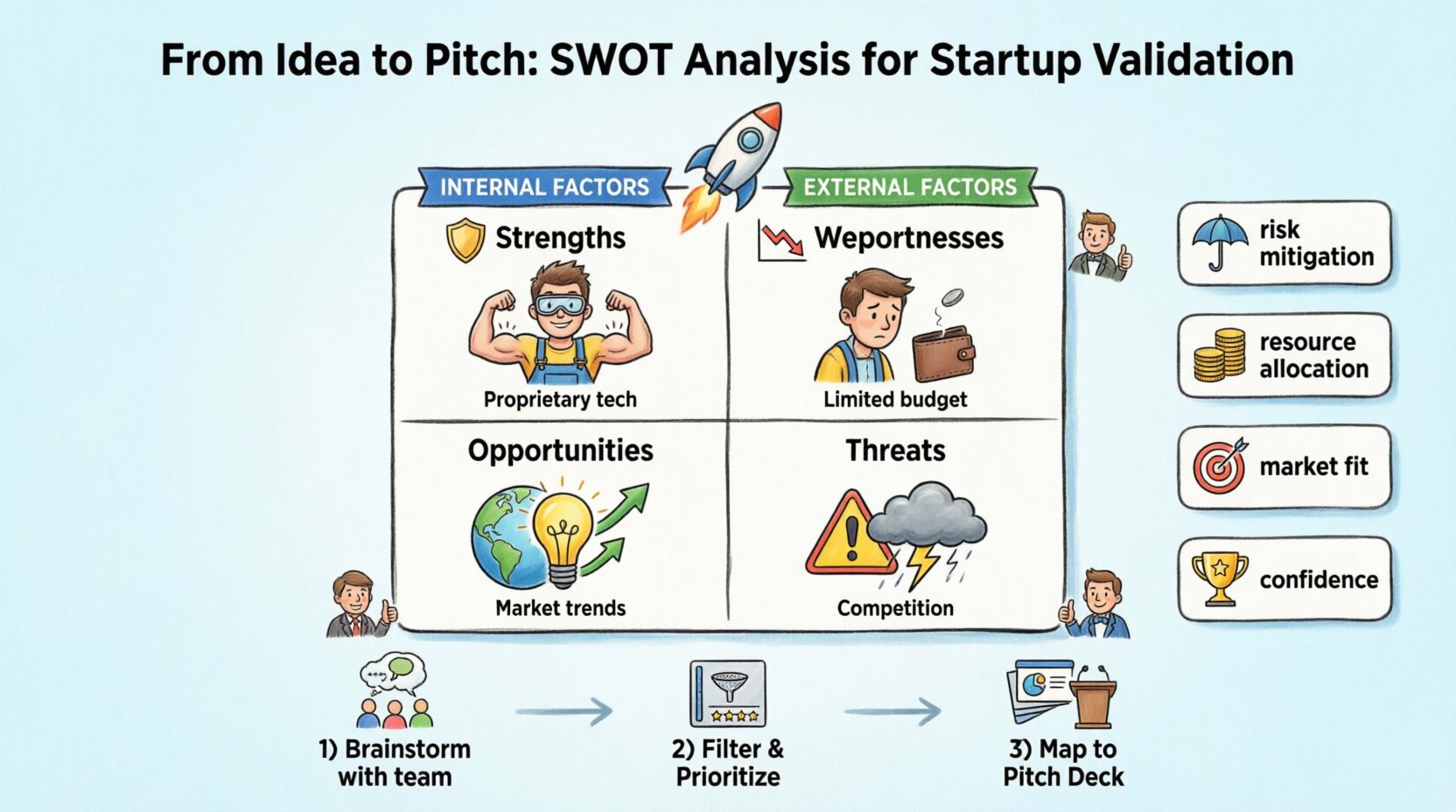
A SWOT analysis is a strategic planning technique used to identify key factors that influence a project or business. The acronym stands for Strengths, Weaknesses, Opportunities, and Threats. While originally designed for corporate strategy, it is equally powerful for early-stage founders. It forces a clear distinction between what you control and what lies outside your influence. This distinction is crucial when preparing to approach investors or partners.
The process involves listing relevant factors in four distinct categories:
- Strengths: Internal attributes that give you an advantage.
- Weaknesses: Internal limitations that may hinder progress.
- Opportunities: External conditions you can exploit for growth.
- Threats: External challenges that could cause trouble.
By mapping these elements, you create a snapshot of your current position. This snapshot acts as a foundation for your pitch deck. Investors do not just want to hear about the vision; they want to see that you understand the landscape. A well-executed SWOT analysis demonstrates this understanding.
Why This Tool Matters for Early-Stage Ventures 📊
Startups operate under conditions of extreme uncertainty. Unlike established corporations, you lack historical data. This makes traditional forecasting difficult. The SWOT framework provides structure in an unstructured environment. It helps you identify blind spots before they become critical failures. It also serves as a communication tool for your co-founders and team.
Key benefits include:
- Risk Mitigation: Identifying threats early allows you to build contingency plans.
- Resource Allocation: Knowing your weaknesses helps you decide where to hire or invest.
- Market Fit: Analyzing opportunities clarifies where the customer demand actually lies.
- Confidence: A documented analysis provides evidence for your claims during fundraising.
Without this clarity, founders often fall in love with their solution rather than the problem they are solving. The SWOT analysis brings a level of objectivity to the conversation. It shifts the focus from hope to strategy.
Breaking Down the Four Quadrants 🔍
Understanding the specific nature of each quadrant is essential for accurate analysis. Each section requires a different mindset and type of inquiry.
Strengths: Internal Advantages 🛡️
Strengths are internal factors. They are things your team possesses that competitors do not. These can be tangible or intangible. When listing strengths, be specific. Avoid vague terms like “good team.” Instead, describe specific expertise.
- Proprietary technology or intellectual property.
- Unique access to a specific distribution channel.
- Founders with deep domain experience or industry connections.
- Low burn rate compared to industry standards.
- A loyal early user base or waiting list.
Identifying strengths helps you answer the question: “Why us?” This is the core of your value proposition. It is the leverage you use in negotiations.
Weaknesses: Internal Limitations 📉
Weaknesses are also internal. They are areas where you lack resources or capabilities. Acknowledging these does not indicate failure; it indicates realism. Investors appreciate founders who know where they are vulnerable.
- Limited brand recognition or marketing budget.
- Gaps in the team, such as missing technical or sales roles.
- Dependence on a single supplier or partner.
- Technical debt or a non-scalable architecture.
- Restricted cash flow or funding runway.
Listing weaknesses allows you to create action items. If you lack sales experience, you can plan to hire a sales lead. If you lack cash, you must plan for a leaner runway.
Opportunities: External Possibilities 🌍
Opportunities are external. They are trends or changes in the market that your company can capitalize on. These are not under your control, but you can position yourself to take advantage of them.
- Emerging technologies that reduce your costs.
- Regulatory changes that favor your solution.
- Competitors exiting the market or failing to innovate.
- Shifts in consumer behavior or preferences.
- Partnership possibilities with larger established firms.
Opportunities drive the growth narrative. They show investors that the market is moving in your direction. They justify the timing of your launch.
Threats: External Challenges ⚠️
Threats are external risks. They are factors outside your control that could negatively impact your business. Ignoring threats is a common mistake. You must assess the severity of these risks.
- Established competitors with more resources.
- Economic downturns reducing customer spending.
- Changes in data privacy laws.
- Supply chain disruptions.
- Technology shifts making your solution obsolete.
Addressing threats in your pitch shows you have a risk management strategy. It proves you are not naive about the market environment.
Executing the Analysis Step-by-Step 🛠️
Conducting a SWOT analysis requires time and focus. It is not a one-minute exercise. Follow a disciplined process to ensure quality results.
- Assemble the Right Team: Include co-founders and key advisors. Diverse perspectives prevent groupthink.
- Gather Data: Do not rely on intuition alone. Collect market research, customer feedback, and financial projections.
- Set a Time Limit: Dedicate a specific session, such as two hours, to brainstorming.
- Brainstorm Each Quadrant: Write down every point you can think of. Do not judge them yet.
- Filter and Prioritize: Review the list. Remove duplicates. Select the top three items for each quadrant.
- Develop Strategies: Connect the dots. How do you use strengths to seize opportunities? How do you use strengths to avoid threats?
- Document Findings: Save the results in a shared document for future reference.
This process should be iterative. As you gather more customer data, revisit the analysis. The market changes, and your understanding of it should evolve.
Mapping Findings to Your Pitch Deck 📊
The output of a SWOT analysis is not just an internal document. It informs your external communication. You can integrate these insights directly into your presentation for investors.
- The Problem Slide: Use the Threats and Weaknesses sections to highlight the pain points in the current market.
- The Solution Slide: Highlight your Strengths as the differentiators that solve the problem.
- The Market Slide: Use Opportunities to demonstrate market size and growth potential.
- The Risk Slide: Address Threats honestly. Explain your mitigation strategy.
Transparency regarding risks builds trust. If you hide threats, investors will find them anyway. By addressing them proactively, you show control over the narrative.
Internal vs. External Factors Table 📋
To ensure clarity during the analysis, use the following framework to categorize your findings. This table helps distinguish between what you can fix and what you must adapt to.
| Category | Type | Focus Question | Example |
|---|---|---|---|
| Strengths | Internal | What do we do better than anyone else? | Founders have 10 years in logistics. |
| Weaknesses | Internal | Where are we lacking resources? | Limited marketing budget. |
| Opportunities | External | What market trends can we use? | New trade regulations favoring local suppliers. |
| Threats | External | What could stop us from succeeding? | A major competitor launching a free tier. |
This visual aid keeps the brainstorming session on track. It prevents confusion between internal capabilities and external market conditions.
Common Mistakes in Startup Assessment 🚫
Even with a solid framework, errors occur. Being aware of common pitfalls helps you avoid them.
- Being Too Vague: “Good technology” is not a strength. “Patent pending for battery efficiency” is.
- Confusing Strengths with Opportunities: A strong team is an internal strength. A hiring boom is an external opportunity.
- Ignoring Weaknesses: Listing only positives creates a biased view. Investors can smell dishonesty.
- Static Analysis: Treating the SWOT as a one-time document. The market is dynamic.
- Lack of Evidence: Claims must be backed by data. Do not guess.
Accuracy is more important than volume. A list of ten accurate points is better than fifty vague ones.
Illustrative Scenarios 🏪
Consider how this applies to different business models. The application changes based on the industry.
SaaS Startup Example
- Strength: Proprietary algorithm reducing processing time.
- Weakness: High customer acquisition cost.
- Opportunity: Competitor’s recent security breach driving demand for secure alternatives.
- Threat: Open source alternatives reducing pricing power.
E-Commerce Brand Example
- Strength: Direct relationships with manufacturers.
- Weakness: Lack of brand awareness compared to giants.
- Opportunity: Rising consumer demand for sustainable packaging.
- Threat: Fluctuating shipping costs due to fuel prices.
In both cases, the analysis highlights specific strategic needs. The SaaS company needs to focus on security marketing. The E-commerce brand needs to secure supply chain stability.
Frequently Asked Questions ❓
Founders often have specific questions when applying this tool.
How often should I update the SWOT?
Update it quarterly or whenever a major milestone is reached. Market conditions change rapidly. An analysis from six months ago may no longer be relevant.
Can I do this alone?
You can, but it is less effective. A solo analysis often suffers from bias. Involve at least one other person to challenge your assumptions.
Does this replace market research?
No. It synthesizes research. You need data to fill out the quadrants accurately. The SWOT organizes the data, but it does not generate it.
How do I present this to investors?
You generally do not show the full grid. You extract the insights. Show them the strategic implications. For example, “We identified a threat in competitor X, so we built feature Y to counter it.”
What if the list is too long?
Consolidate. Group similar items together. Focus on the top three most critical points per category. Less is more for presentation purposes.
Is this useful for pre-seed stages?
Yes. Even with limited data, the framework helps clarify your thinking. It prevents you from ignoring obvious risks before they happen.
Can it help with hiring?
Absolutely. If “Weakness” is “No technical expertise,” the hiring plan is clear. If “Opportunity” is “New market,” the sales plan adjusts accordingly.
What is the main takeaway?
The goal is not perfection. The goal is awareness. Knowing where you stand allows you to navigate the path forward with intention rather than luck.
Final Thoughts on Strategic Validation 🎯
Validation is a continuous process. It is not a single event that happens before launch. Using a SWOT analysis provides a baseline for that process. It grounds your ambition in reality. It helps you build a business that can withstand external shocks. It ensures that when you pitch, you speak with authority. This authority comes from preparation. It comes from knowing your numbers, your market, and your team.
Start with the data. Organize it with the framework. Act on the insights. This cycle leads to sustainable growth. It moves you from an idea to a validated venture ready for the next stage of funding.