
Business strategy is not an art of intuition. It is a discipline of evidence. In the high-stakes environment of business school case competitions, the difference between a passing grade and top honors often lies in the depth of your analysis. Too many students approach the SWOT framework as a simple checklist. They fill boxes with generic statements like “strong brand” or “market growth” without backing them up. This approach leads to shallow insights and weak recommendations.
To succeed, you must treat SWOT analysis as a rigorous diagnostic tool. It requires a shift from guessing to verifying. This guide outlines how to construct a robust SWOT analysis specifically tailored for MBA case studies. We will explore the mechanics of the framework, the evidence required for each quadrant, and how to translate findings into actionable strategic moves.
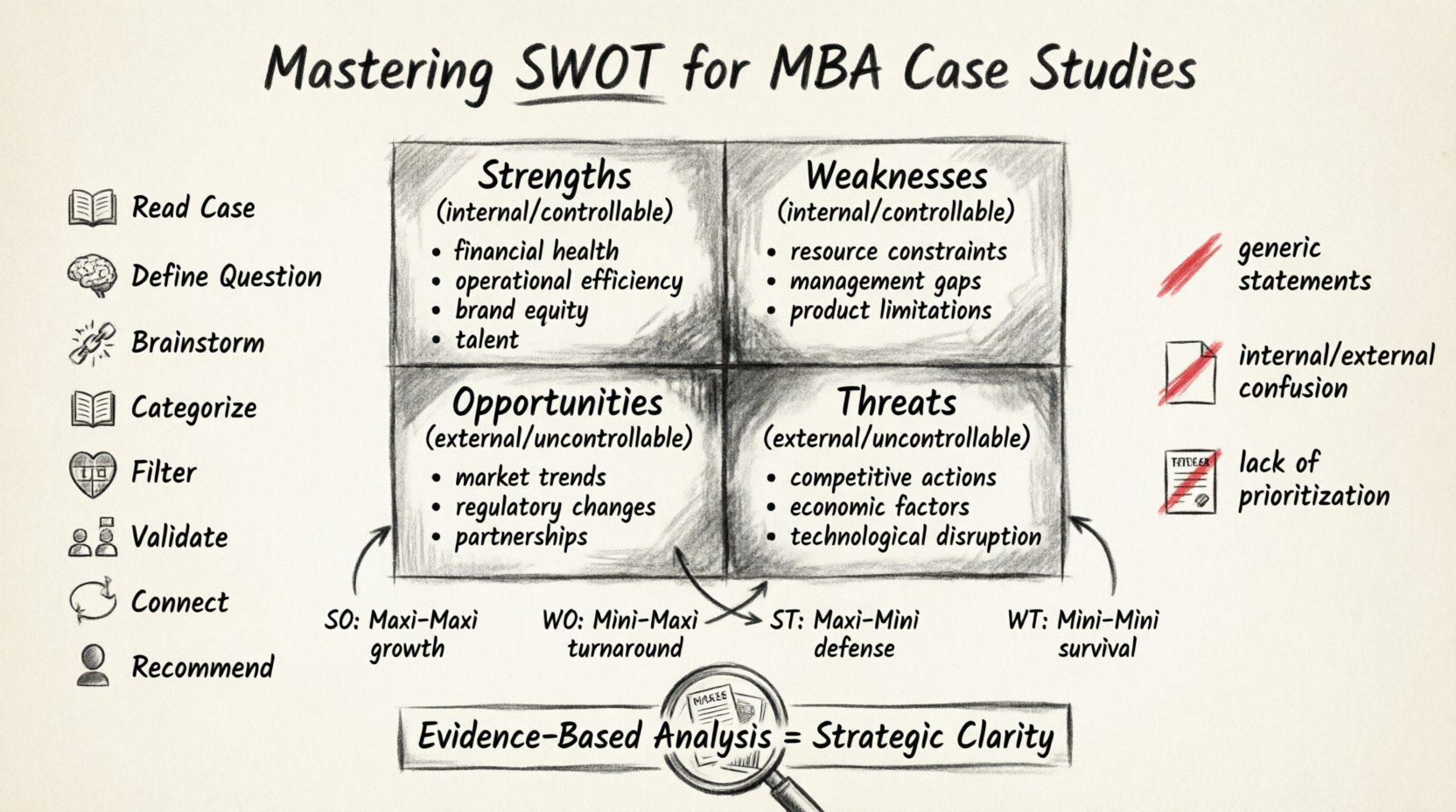
🧩 The Anatomy of a Case Study SWOT
A standard SWOT matrix divides factors into four categories: Strengths, Weaknesses, Opportunities, and Threats. However, in an academic context, the definition of these categories must be precise. Vague definitions lead to vague conclusions.
- Strengths are internal attributes that give the organization an advantage over others. These are assets under your direct control.
- Weaknesses are internal attributes that place the organization at a disadvantage relative to others. These are areas requiring improvement.
- Opportunities are external chances to make greater profits. These are trends in the environment you can exploit.
- Threats are external elements in the environment that could cause trouble for the business. These are risks outside your control.
The critical distinction lies in the source of the factor. Is it internal or external? Can the company control it? If you mix these, your analysis loses structural integrity.
🏗️ Deep Dive: Internal Factors (Strengths & Weaknesses)
Internal analysis requires a look at the organization’s resources and capabilities. In a case study, you do not have access to the CEO’s private notes, so you must rely on available data points. Here is how to categorize internal factors with authority.
1. Identifying Strengths
Strengths are not just “what the company does well.” They are specific competitive advantages. When evaluating strengths, look for:
- Financial Health: High profit margins, strong cash flow, or low debt ratios compared to industry peers.
- Operational Efficiency: Proprietary technology, streamlined supply chains, or unique distribution networks.
- Brand Equity: Customer loyalty, high recognition, or premium pricing power.
- Talent: A specialized workforce, strong leadership team, or culture of innovation.
- Intellectual Property: Patents, trademarks, or exclusive licenses.
Example: Instead of writing “Good product,” write “Product holds 40% market share due to patented technology.” Specificity builds credibility.
2. Identifying Weaknesses
Weaknesses are often the hardest to identify because admitting them feels counterintuitive. However, a case study demands honesty. Weaknesses are gaps in resources or capabilities that hinder performance.
- Resource Constraints: Limited capital, outdated infrastructure, or lack of R&D budget.
- Management Gaps: Poor leadership structure, high employee turnover, or lack of experience in key markets.
- Product Limitations: Narrow product line, low quality perception, or lack of innovation.
- Market Position: Low brand awareness, poor distribution reach, or high customer churn.
Do not list weaknesses that are actually opportunities. For example, “expanding into new markets” is an opportunity, not a weakness. A weakness would be “current inability to distribute in new markets due to logistics failures.”
🌍 Deep Dive: External Factors (Opportunities & Threats)
External factors exist in the macroeconomic, industry, or competitive environment. The company cannot control these, but it can respond to them. This section requires an understanding of the broader business landscape.
3. Identifying Opportunities
Opportunities are favorable conditions in the external environment. They represent potential for growth or improvement. Look for:
- Market Trends: Shifts in consumer behavior, demographic changes, or emerging technologies.
- Regulatory Changes: New laws that favor the industry or remove barriers to entry.
- Competitor Failures: Rivals exiting the market or suffering from scandals.
- Partnerships: Potential alliances, mergers, or acquisition targets.
- Geographic Expansion: Untapped regions with growing demand.
Key Question: Can the company leverage its existing strengths to capture this opportunity? If the answer is no, it is not a viable strategic opportunity.
4. Identifying Threats
Threats are obstacles to success. They are often external forces that could erode the company’s market position. Consider:
- Competitive Actions: New entrants, price wars, or aggressive marketing by rivals.
- Economic Factors: Recession, inflation, or currency fluctuation.
- Technological Disruption: Innovations that render current products obsolete.
- Regulatory Risks: Stricter compliance requirements or trade tariffs.
- Supplier Power: Dependence on a single vendor or rising input costs.
📊 Structuring the Analysis: A Practical Table
To ensure clarity in your presentation, organize your findings into a structured format. A table helps the reader quickly grasp the critical issues. Below is a template for structuring your case study findings.
| Category | Factor Description | Evidence from Case | Strategic Impact |
|---|---|---|---|
| Strength | Strong R&D pipeline | Case states 20% of revenue invested in innovation | Enables premium pricing and market leadership |
| Weakness | Outdated distribution network | Case mentions 15% delayed shipments in Q3 | Limits expansion into rural markets |
| Opportunity | Emerging demand in Asia | Market report shows 10% growth rate | Revenue diversification potential |
| Threat | New competitor entry | Announcement of startup funding round | Price pressure on core products |
Notice how the “Evidence” column anchors the analysis in the case facts. This prevents the analysis from becoming theoretical.
🕵️♂️ Gathering Intelligence: Data Sources
In a real-world scenario, you would pull data from financial statements, industry reports, and customer surveys. In a case study, your data is limited to the provided text. You must scrutinize every detail.
- Financial Statements: Look at balance sheets and income statements for liquidity, solvency, and profitability ratios.
- Operational Data: Check production volumes, inventory levels, and capacity utilization.
- Customer Feedback: Review testimonials, complaint logs, or survey results provided in the case.
- Competitor Intel: Analyze competitor press releases, market share data, and strategic moves.
- Industry Reports: Use provided macroeconomic data to understand trends.
If data is missing, acknowledge the gap. Do not invent facts. State that the analysis is based on available information and note where further research would be required.
🚀 From Analysis to Action: The TOWS Matrix
Many students stop at the SWOT matrix. This is a critical error. The matrix is diagnostic; it does not prescribe action. To move from analysis to strategy, you must connect the quadrants. This is often done using a TOWS matrix (or SO, WO, ST, WT strategies).
1. SO Strategies (Maxi-Maxi)
Use strengths to maximize opportunities. This is the growth strategy. Example: Use strong cash reserves (Strength) to acquire a competitor in a growing market (Opportunity).
2. WO Strategies (Mini-Maxi)
Overcome weaknesses by taking advantage of opportunities. This is the turnaround strategy. Example: Fix outdated IT systems (Weakness) to capitalize on a digital shift (Opportunity).
3. ST Strategies (Maxi-Mini)
Use strengths to avoid threats. This is the defense strategy. Example: Leverage brand loyalty (Strength) to withstand a price war (Threat).
4. WT Strategies (Mini-Mini)
Minimize weaknesses to avoid threats. This is the survival strategy. Example: Cut costs (Weakness) to survive a recession (Threat).
By mapping these connections, you demonstrate that your recommendations are logically derived from the analysis, not just random suggestions.
❌ Common Student Errors to Avoid
Even experienced candidates make mistakes when applying this framework. Review this list to ensure your work avoids common pitfalls.
- Generic Statements: Avoid “good management” or “high quality.” Be specific about why management is good or what makes the quality high.
- Confusing Internal and External: Do not list “new technology” as a Strength. Technology is external; having a proprietary tech stack is the Strength.
- Ignoring the Context: A strength in one industry may be a weakness in another. Ensure your analysis fits the specific industry dynamics of the case.
- Lack of Prioritization: Not all factors are equal. Identify the top 3-5 factors that matter most to the strategic decision at hand.
- Disconnected Recommendations: If your recommendation does not address a Strength, Weakness, Opportunity, or Threat, it is irrelevant.
🗣️ Presenting the Findings
The final step is communication. In an MBA setting, you must present your analysis clearly to stakeholders or a panel. Structure your presentation to tell a story.
- Start with the Problem: Define the core strategic issue the company faces.
- Present the Evidence: Show the SWOT analysis as the foundation of your argument.
- Connect the Dots: Explain how the TOWS strategies address the problem.
- Quantify the Impact: Where possible, estimate the financial or operational impact of your recommendations.
- Address Risks: Acknowledge potential downsides to your proposed strategy.
Clarity and logic are your primary tools. Avoid jargon where plain English suffices. Your audience wants to understand the business logic, not be impressed by complex terminology.
🔍 Building the Argument: A Step-by-Step Workflow
To ensure consistency, follow this workflow when tackling a new case study.
- Read the Case Thoroughly: Highlight all numerical data, dates, and names of competitors.
- Define the Strategic Question: What decision needs to be made? (e.g., Enter market X? Launch product Y?)
- Brainstorm Factors: List all potential internal and external factors without filtering initially.
- Categorize: Sort the list into S, W, O, T quadrants.
- Filter: Remove factors that are irrelevant to the strategic question.
- Validate: Check each factor against the evidence in the text.
- Connect: Develop SO, WO, ST, and WT strategies.
- Recommend: Choose the best strategy and outline the implementation plan.
📝 Final Thoughts on Strategic Rigor
Success in MBA case studies relies on the ability to synthesize complex information into a clear path forward. The SWOT analysis is the backbone of this synthesis. It forces you to look at the organization from multiple angles. It prevents you from focusing solely on problems or solely on aspirations.
When you stop guessing and start analyzing, you shift from being a passive participant to an active strategist. You move from asking “What should we do?” to saying “Based on the data, we must do this.” This shift in mindset is what defines top-tier performance in business strategy.
Remember, a framework is only as good as the data that fills it. Dedicate time to finding the evidence. Challenge your assumptions. And ensure that every recommendation ties back to the analysis. This discipline will serve you well beyond the classroom and into your professional career.