
Every startup begins with an idea, but few ideas survive without a structured plan. The difference between a concept that fades and a business that scales often lies in strategic clarity. One of the most enduring frameworks for this clarity is the SWOT analysis. While often taught in business schools, its true value emerges when applied to the chaotic reality of early-stage ventures. This guide moves beyond abstract definitions to explore how to leverage Strengths, Weaknesses, Opportunities, and Threats to drive tangible financial outcomes.
Too many founders treat strategic planning as a one-time checkbox exercise. They fill out a template, store the document, and move to product development. However, profit comes from decisions made based on accurate data about your position in the market. By treating SWOT as a living document, startups can align their resources with market realities, mitigate risks before they become fatal, and capitalize on gaps competitors have left open.
Understanding the Framework Beyond the Acronym 🧠
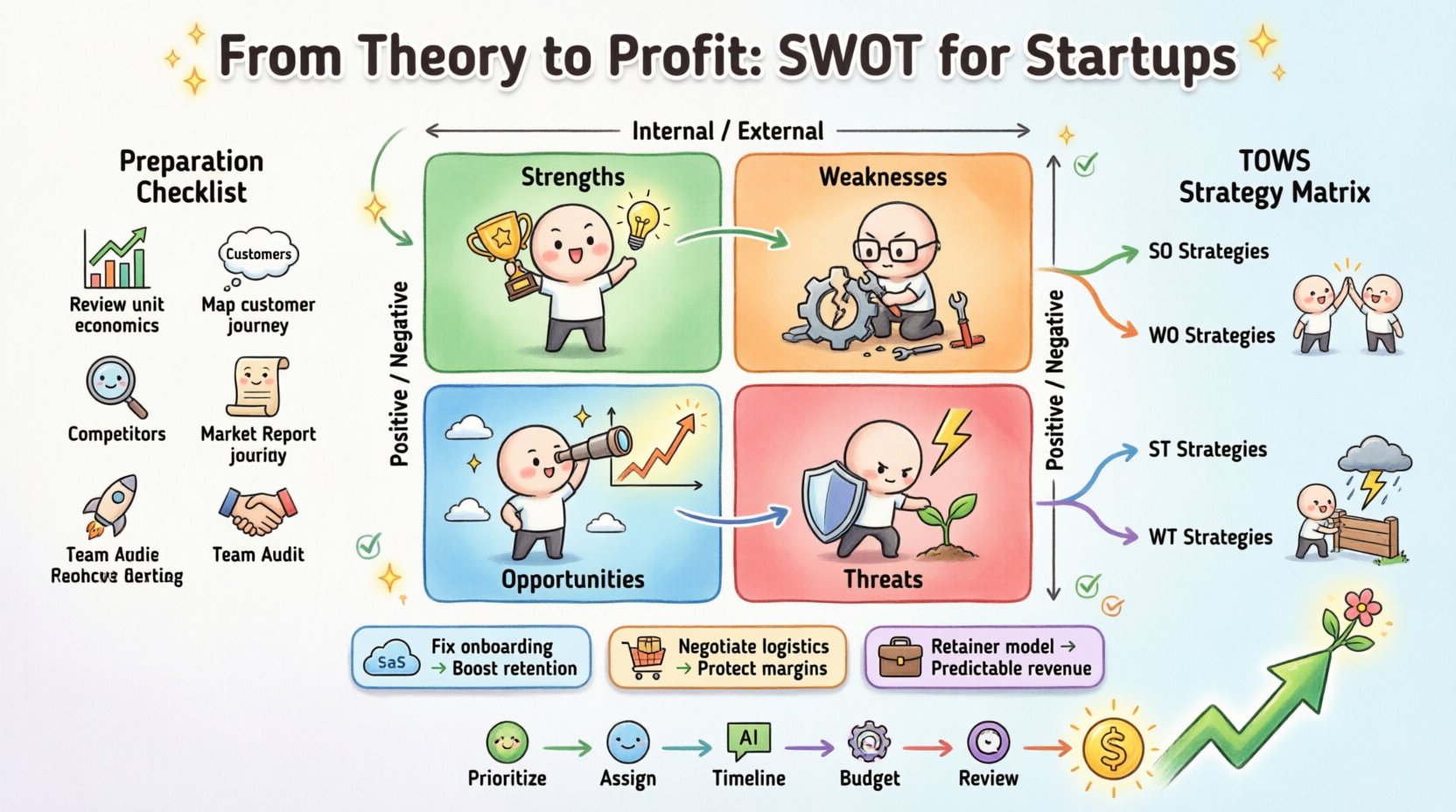
SWOT stands for Strengths, Weaknesses, Opportunities, and Threats. While the letters are simple, the underlying logic requires a disciplined approach to categorization. The framework divides factors into two dimensions: Internal vs. External, and Positive vs. Negative.
- Internal Factors: These are elements within your control. You can change your team, your technology, or your processes.
- External Factors: These exist outside your organization. Market trends, competitor actions, and regulatory changes fall here.
- Positive Factors: Assets or conditions that help you succeed.
- Negative Factors: Obstacles or risks that hinder progress.
Confusion often arises when mixing these dimensions. For example, a strong brand is an internal strength. A sudden shift in consumer preference is an external opportunity or threat depending on your alignment. Clear categorization ensures that the resulting strategy is actionable rather than theoretical.
The Four Pillars of Strategic Assessment
To conduct a meaningful analysis, each pillar requires specific scrutiny. Vague statements like “we are good at marketing” do not provide enough detail to form a strategy. Specificity is the key to converting analysis into profit.
| Category | Focus | Key Questions |
|---|---|---|
| Strengths (Internal + Positive) | What you do better than anyone else | What unique resources do we own? Who is our target audience? |
| Weaknesses (Internal + Negative) | Where you lack resources or capability | What processes are slowing us down? Where do we lose budget? |
| Opportunities (External + Positive) | Market conditions you can exploit | What trends are growing? Are there gaps in competitor offerings? |
| Threats (External + Negative) | External risks that could cause harm | Who is entering our market? What regulations are changing? |
Preparation: Gathering Data Before the Workshop 📊
A SWOT session without data is merely a brainstorming session. To ensure the output is useful for profit generation, you must gather evidence before gathering the team. Relying on assumptions leads to blind spots that can drain capital.
Here is a checklist for the preparation phase:
- Financial Records: Review burn rates, profit margins, and cash flow statements. Identify where money is leaking.
- Customer Feedback: Compile support tickets, survey results, and churn reasons. This highlights product weaknesses and satisfaction strengths.
- Competitor Analysis: Look at competitor pricing, feature sets, and marketing messages. Identify where they are vulnerable.
- Market Research: Analyze industry reports for growth sectors or emerging technologies.
- Internal Audits: Assess team skills, technology stack, and operational workflows.
This data collection phase ensures that every point made during the analysis has a basis in reality. It prevents the analysis from becoming a wish list or a complaint session.
Conducting the Analysis: Step-by-Step Process 🛠️
Once the data is ready, the team convenes to build the matrix. The goal is not just to list items but to find connections between them. A strength might solve a weakness. An opportunity might mitigate a threat. These connections are where strategy lives.
Step 1: Define the Scope
SWOT is most effective when focused. A company-wide analysis can be too broad. A startup might focus on a specific product launch, a new market entry, or a fiscal year plan. Narrowing the scope ensures the insights are relevant to the immediate decisions being made.
Step 2: Populate the Quadrants
Assign specific team members to focus on different quadrants to avoid groupthink. For example, the engineering lead might focus on technical strengths and weaknesses, while the sales lead focuses on market opportunities and threats. This brings diverse perspectives to the table.
- Brainstorming: List every factor identified in the preparation phase.
- Categorization: Place each item into the correct quadrant based on the definitions above.
- Verification: Ask, “Is this actually within our control?” If not, move it to External.
- Refinement: Remove duplicates and vague items. Keep only the critical factors.
Step 3: Cross-Analysis (The TOWS Matrix)
This is the most critical step often skipped. Do not stop at the four boxes. You must cross-reference them to generate strategies.
- SO Strategies: Use Strengths to maximize Opportunities. (e.g., Use a proprietary technology to capture a growing market segment.)
- WO Strategies: Use Opportunities to overcome Weaknesses. (e.g., Partner with a larger firm to gain market access while fixing distribution issues.)
- ST Strategies: Use Strengths to minimize Threats. (e.g., Use cash reserves to withstand a price war from a competitor.)
- WT Strategies: Minimize Weaknesses and avoid Threats. (e.g., Cut a loss-making product line to reduce cash burn in a recession.)
Real Startup Scenarios: Applying the Framework 💼
Theory is useful, but application is where value is created. Below are three distinct scenarios showing how different types of startups utilize this framework to reach profitability.
Scenario 1: The SaaS Startup Scaling Up
A software-as-a-service company has achieved product-market fit but struggles with churn. They conduct a SWOT analysis to stabilize revenue.
- Strengths: High user engagement, low customer acquisition cost (CAC), robust API.
- Weaknesses: Limited customer support team, complex onboarding process.
- Opportunities: Enterprise tier expansion, integration with popular tools.
- Threats: New entrants with better pricing, economic downturn reducing tech spend.
Actionable Insight: The company realizes their Weakness (complex onboarding) is causing churn, which negates their Strength (low CAC). They decide to invest in product development to simplify the user journey (WO Strategy) rather than spending more on ads. This directly improves profitability by increasing retention.
Scenario 2: The E-Commerce Brand Launching a New Line
An online retailer wants to expand into a new product category. They need to assess risk before investing inventory capital.
- Strengths: Loyal customer base, strong social media presence.
- Weaknesses: Limited supply chain experience, high reliance on third-party logistics.
- Opportunities: Seasonal demand spike, competitor out of stock.
- Threats: Rising shipping costs, supply chain disruptions.
Actionable Insight: The Weakness (logistics reliance) conflicts with the Threat (shipping costs). The ST Strategy involves negotiating long-term contracts with logistics partners using their Strength (loyal customer base) as leverage for volume discounts. This protects margins during the expansion.
Scenario 3: The Service-Based Agency
A digital marketing agency faces declining growth and needs to pivot to maintain revenue.
- Strengths: Skilled team, strong portfolio, high client retention.
- Weaknesses: Revenue model relies on billable hours, limited digital products.
- Opportunities: Shift to retainer models, demand for AI-driven analytics.
- Threats: Automation tools reducing need for manual services, freelance competition.
Actionable Insight: The agency identifies that their Weakness (billable hours) is a Threat (automation). They pivot to a WO Strategy by packaging their services into fixed-price retainers that include automated reporting tools. This increases revenue predictability and reduces the impact of automation on their billable hours.
Turning Insights into Action Plans 📝
Once the SWOT analysis is complete and cross-referenced, the output must be converted into a roadmap. A document that sits on a shelf does not generate profit. The following steps ensure the analysis drives execution.
| Step | Activity | Outcome |
|---|---|---|
| 1. Prioritize | Rank items by impact and feasibility | A focused list of high-value tasks |
| 2. Assign Ownership | Designate a leader for each action item | Clear accountability and responsibility |
| 3. Set Timelines | Define start and end dates for initiatives | Milestones for tracking progress |
| 4. Allocate Budget | Ensure funds are available for execution | Financial support for strategic moves |
| 5. Review Cadence | Schedule regular check-ins on the plan | Continuous alignment and adjustment |
Prioritization Criteria
Not all items in the SWOT matrix are equally important. Use the following criteria to decide what to tackle first:
- Impact: How much will this move the needle on revenue or efficiency?
- Urgency: Does this need to be addressed immediately to prevent loss?
- Cost: Is the investment required proportional to the potential return?
- Effort: Can this be achieved with current resources, or does it require hiring?
By ranking items, the startup avoids “analysis paralysis”. It focuses energy on the few moves that matter most.
Common Pitfalls to Avoid ⚠️
Even with a solid framework, execution can go wrong. Understanding common mistakes helps protect the integrity of the analysis.
- Confusing Means with Ends: Listing “hire a CMO” as a Strength is incorrect. A CMO is a resource to achieve a result. The Strength is “access to experienced leadership”.
- Ignoring Negative Data: Teams often gloss over Weaknesses to maintain morale. Hiding flaws prevents them from being fixed. Honest assessment is required.
- Static Analysis: Treating the document as a one-time event. Market conditions change. The SWOT must be reviewed quarterly or when major shifts occur.
- Lack of Specificity: “Better customer service” is not a strength. “24/7 support with 2-hour response time” is a measurable strength.
- Disconnect from Strategy: Creating the matrix but not updating the business plan. The SWOT must inform the budget and hiring plans.
Integrating SWOT with Financial Projections 💰
The ultimate goal is profit. Therefore, the SWOT analysis must link directly to financial models. When a weakness is identified, such as high customer acquisition costs, the financial model should reflect the cost to fix it. When an opportunity is found, such as a new market, the revenue forecast should be adjusted.
This integration ensures that strategic decisions are grounded in economic reality. For instance, if a Threat involves rising costs, the financial model must show how margins will be protected. If a Strength involves a unique technology, the model should show how this allows for premium pricing.
By connecting qualitative insights to quantitative data, the startup creates a feedback loop. Performance data validates the SWOT, and the SWOT guides future performance data collection.
Sustaining the Strategic Mindset 🔄
Strategic thinking is a habit, not a task. To maintain the benefits of this framework, the organization must embed the process into its culture.
- Regular Reviews: Make SWOT a standard agenda item for quarterly business reviews.
- Transparent Communication: Share relevant parts of the analysis with the wider team. Everyone needs to understand the competitive landscape.
- Adaptability: Be willing to change course if the external environment shifts significantly.
- Continuous Learning: Use the data collected to refine future analyses. The process gets better with each iteration.
When a startup operates with this level of strategic awareness, it reduces the likelihood of reactive decision-making. Instead of chasing trends, the company shapes its path based on a deep understanding of its own capabilities and the market environment.
Summary of Strategic Integration 📌
The path from theory to profit requires discipline. A SWOT analysis is not a magic wand, but it is a powerful map. It helps leaders see where they stand, where they want to go, and what obstacles lie in the way. By rigorously gathering data, categorizing factors accurately, and cross-referencing insights into actionable strategies, startups can navigate uncertainty with confidence.
The difference between a struggling venture and a profitable one often comes down to how well the internal team understands its own limitations and how well it anticipates external shifts. This framework provides the structure to find that understanding. When applied consistently, it transforms raw data into a competitive advantage that drives sustainable growth.
Start today. Gather your data. Map your position. And begin turning insights into income.