In the complex landscape of modern business, the ability to execute core functions with precision is often the differentiator between success and stagnation. The Business Model Canvas provides a structured framework for understanding how an organization creates, delivers, and captures value. Within this framework, Key Activities stand out as the critical actions required to make the business model work. These activities form the backbone of operations, directly influencing cost structures and value propositions.
However, having a list of activities is not enough. The challenge lies in optimizing these actions to ensure resources are not wasted, time is utilized effectively, and quality remains high. Streamlining these processes involves a systematic approach to analysis, elimination of redundancy, and continuous improvement. This guide explores how to identify, evaluate, and refine the key activities that drive your business forward, ensuring operational efficiency without compromising value.
Understanding Key Activities in the Business Model Canvas 🧩
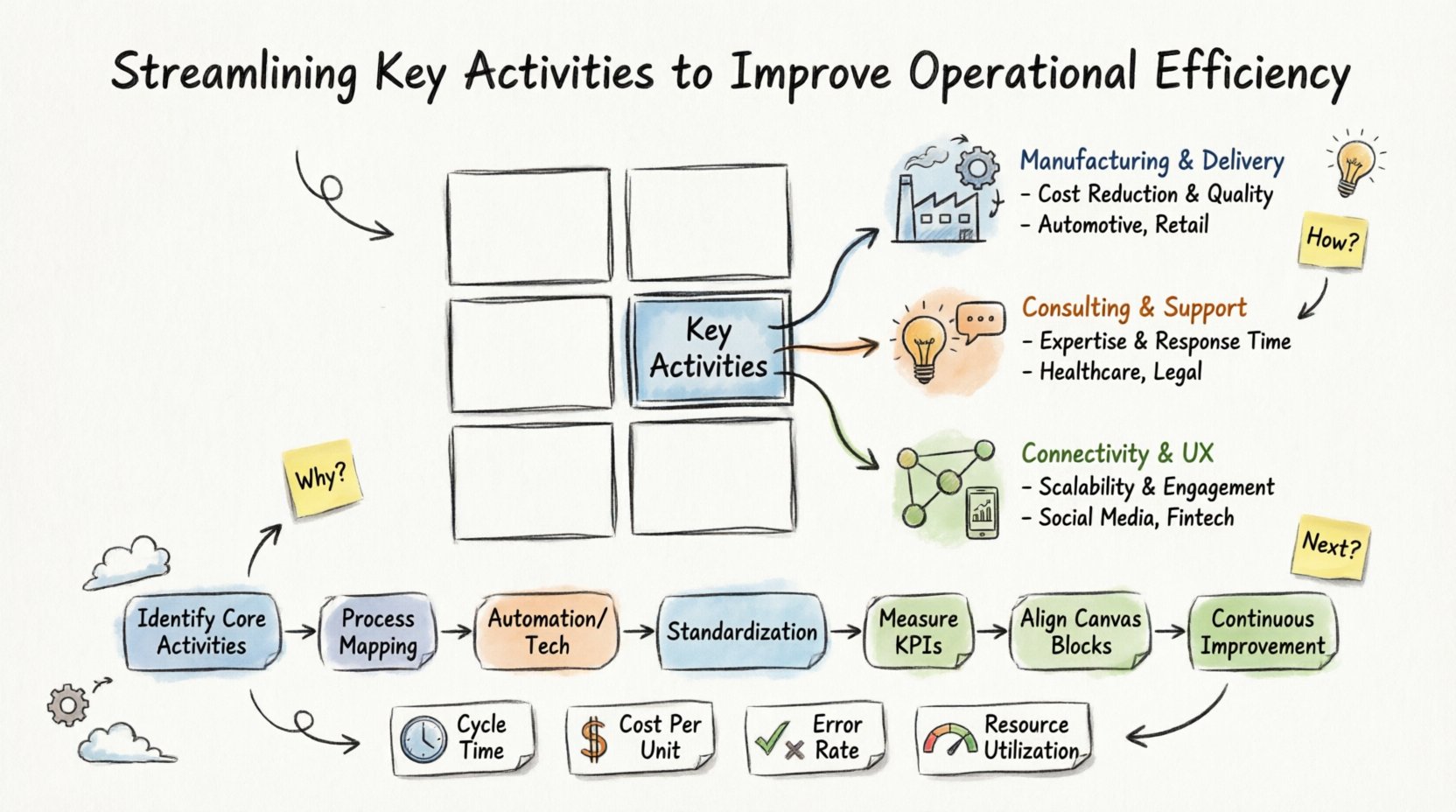
Before optimizing, one must define what constitutes a Key Activity. In the Business Model Canvas, these are the most important actions a company must take to operate successfully. They vary significantly depending on the business type and its value proposition. Generally, Key Activities fall into three main categories:
- Production: Designing, making, and delivering a product in substantial quantities and/or of superior quality. This is common in manufacturing, software development, and retail.
- Problem Solving: Finding new solutions to individual customer problems or providing consulting services. This applies to hospitals, law firms, and management consultancies.
- Platform/Network: Maintaining and improving a platform or network. This is typical for companies that facilitate exchanges between third parties, such as social media platforms, payment processors, and marketplaces.
Each category requires a distinct approach to efficiency. A production-heavy business focuses on supply chain logistics and quality control. A problem-solving entity prioritizes knowledge management and employee expertise. A platform business concentrates on user experience, security, and scalability. Recognizing which category your business falls into is the first step toward streamlining.
Identifying Your Core Key Activities 🔍
Many organizations struggle with scope creep, where non-essential tasks dilute focus. To improve operational efficiency, you must clearly delineate what is essential. The process of identification involves mapping the value chain and scrutinizing every step of the operation.
Follow these steps to pinpoint your core Key Activities:
- Analyze the Value Proposition: What specific value are you delivering? If the value is speed, your logistics and delivery activities are key. If the value is customization, your design and development processes are key.
- Map the Value Chain: Break down the business into primary and support activities. Identify which steps directly contribute to the customer receiving the value. Steps that do not add value are candidates for reduction or elimination.
- Consult Stakeholders: Interview department heads and frontline employees. They often know where bottlenecks occur and which processes feel redundant.
- Review Customer Feedback: Direct feedback often highlights which activities customers care about most. If customers complain about delays, your fulfillment activities need attention.
Comparison of Activity Types
Understanding the nuance between different activity types helps in setting the right efficiency metrics.
| Activity Type | Primary Focus | Efficiency Driver | Example Sector |
|---|---|---|---|
| Production | Manufacturing & Delivery | Cost Reduction & Quality | Automotive, Retail |
| Problem Solving | Consulting & Support | Expertise & Response Time | Healthcare, Legal |
| Platform/Network | Connectivity & UX | Scalability & Engagement | Social Media, Fintech |
Strategic Approaches to Streamlining Operations 🛠️
Once activities are identified, the next phase is streamlining. This is not merely about cutting costs; it is about enhancing the flow of work to maximize output with minimal input. Several methodologies and principles can be applied to achieve this.
Process Mapping and Analysis
Visualizing the workflow is essential. Create detailed flowcharts that show every step from initiation to completion. This visual aid reveals:
- Bottlenecks: Where does work pile up?
- Redundancies: Are there duplicate approval steps?
- Handoffs: How many people touch the task before it is finished?
By identifying these friction points, you can restructure the process to create a smoother path. Removing unnecessary approval layers or consolidating tasks can significantly reduce cycle time.
Automation and Technology Integration
While human judgment is irreplaceable in many areas, repetitive tasks are prime candidates for automation. The goal is to shift human effort from transactional work to strategic work.
- Data Entry: Automate the movement of data between systems to prevent errors and save time.
- Reporting: Use automated reporting tools to generate performance dashboards without manual compilation.
- Scheduling: Implement systems that handle appointment booking or resource allocation automatically.
It is important to note that automation requires careful planning. Introducing technology without a clear process can amplify inefficiencies. Always optimize the manual process first, then apply technology to support it.
Outsourcing vs. In-House Management
Not every Key Activity needs to be performed internally. Focus on what the organization does best (core competencies) and consider outsourcing non-core activities.
- Focus on Core: If your value proposition is product design, manufacturing might be a distraction. Partner with a manufacturer to handle production.
- Cost Efficiency: External partners may achieve economies of scale that you cannot match in-house.
- Flexibility: Outsourcing allows you to scale operations up or down based on demand without the burden of fixed staffing costs.
Standardization and Best Practices
Consistency leads to predictability. Develop standard operating procedures (SOPs) for recurring activities. This ensures that every team member performs tasks in the same optimal way.
- Reduce Variability: Standardization minimizes errors caused by individual differences in execution.
- Easier Training: New employees can onboard faster when processes are documented and clear.
- Quality Control: It is easier to monitor quality when the expected output is clearly defined.
Measuring Operational Efficiency 📊
You cannot improve what you do not measure. Establishing Key Performance Indicators (KPIs) specific to your Key Activities allows you to track progress and identify areas for further optimization. These metrics should be quantifiable and directly linked to business goals.
Essential Efficiency Metrics
| Metric | Definition | Why It Matters |
|---|---|---|
| Cycle Time | Time taken to complete one unit of work | Indicates speed and responsiveness to customers. |
| Cost Per Unit | Total cost divided by number of units produced | Measures financial efficiency of production. |
| Error Rate | Percentage of tasks completed incorrectly | Reflects quality and reliability of processes. |
| Resource Utilization | Percentage of time resources are productively used | Highlights underused or overworked assets. |
Regularly review these metrics. If cycle time increases, investigate whether new bottlenecks have formed. If error rates rise, consider if standardization is being followed. Data-driven decisions prevent guesswork and ensure that efficiency gains are real and sustainable.
Aligning Activities with Other Canvas Blocks 🔗
The Business Model Canvas is an interconnected system. Changes to Key Activities have ripple effects on other building blocks. It is crucial to ensure alignment across the entire model.
Key Resources
Your Key Activities require specific resources. If you streamline an activity, you might reduce the need for certain resources. Conversely, a new activity might require new talent or equipment. Ensure your resource allocation matches your optimized activity list.
Value Propositions
Do not streamline activities to the point where the value proposition suffers. For example, reducing customer service staffing might save money but could degrade the customer experience, weakening your value proposition. Efficiency should support the value, not replace it.
Customer Relationships
How you interact with customers is often a Key Activity. Streamlining this area should aim to make interactions smoother, not colder. Use data to personalize interactions while automating the administrative side of communication.
Revenue Streams
Efficiency improvements often lead to lower costs, which can improve margins. Alternatively, faster delivery can justify premium pricing. Ensure that the financial benefits of streamlining are realized in the revenue model.
Navigating Common Implementation Challenges ⚠️
Even with a solid plan, implementing changes to Key Activities faces hurdles. Awareness of these challenges helps in preparing mitigation strategies.
- Resistance to Change: Employees may fear that efficiency measures lead to job losses. Communicate clearly that the goal is to remove friction, not people. Involve the team in the design of new processes.
- Scope Creep: During optimization, it is easy to expand the project beyond the original scope. Stick to the defined Key Activities to prevent burnout and budget overruns.
- Over-Optimization: Pushing for maximum efficiency can sometimes lead to fragility. Ensure there is enough redundancy to handle unexpected spikes in demand.
- Measurement Lag: Efficiency gains may not show up immediately in financial reports. Be patient and track leading indicators, not just lagging financial results.
Sustaining Long-Term Efficiency 🔄
Streamlining is not a one-time project; it is a continuous discipline. Markets change, customer expectations evolve, and technology advances. To maintain operational efficiency:
- Conduct Regular Audits: Schedule periodic reviews of your Key Activities. Ask if they are still relevant to the current value proposition.
- Encourage Feedback Loops: Create channels for employees to suggest improvements. Those doing the work often see inefficiencies first.
- Stay Agile: Be prepared to pivot activities if the business model shifts. Flexibility is a form of efficiency in a volatile environment.
- Invest in Training: Ensure your team has the skills needed for the optimized processes. Continuous learning prevents skill gaps.
By treating operational efficiency as an ongoing journey rather than a destination, organizations can build resilience and adaptability. The Business Model Canvas serves as a living document, and the Key Activities within it must evolve to support the company’s growth. Through careful analysis, strategic implementation, and consistent measurement, businesses can achieve a level of operational excellence that drives sustainable success.
Focus on the work that matters most. Remove the noise. Optimize the flow. This disciplined approach to managing Key Activities ensures that your organization remains competitive, responsive, and capable of delivering value consistently.