In the fast-paced world of digital media, achieving streamlined content approval can be fraught with challenges. Frequent revisions and unclear decision points often cause bottlenecks in the workflow. Many teams find themselves entangled in parallel review paths that lead to excessive rework and unclear outcomes. However, utilizing AI for generating Activity Diagrams offers solutions to these pitfalls by clearly visualizing processes and decision points, enhancing team collaboration and productivity.
Activity Diagram Overview
Activity diagrams are a vital tool in Business Process Modeling (BPM). They illustrate workflows and processes in a clear, visual format. Each activity is represented by a node, connected by arrows that signify the flow of the process. These diagrams not only help in visualizing tasks but also clarify decision points that stakeholders must navigate during content approval.
In a typical content creation cycle, an activity diagram can pin down the sequential steps—from content creation to approval, and finally publishing—making it easier for teams to follow the necessary actions. As a result, roles and responsibilities become clearer, fostering accountability and reducing errors. Adopting AI tools like Visual Paradigm for generating these diagrams makes this entire process efficient and error-free, empowering teams to focus on delivering high-quality content without the usual headaches associated with manual diagram creation.
The Streamlining Content Approval & Publishing Cycle Scenario

In a prominent digital media company that publishes news and videos, the content approval cycle often involves multiple stakeholders: writers, editors, graphic designers, and compliance teams. The challenge arises when numerous reviews take place simultaneously, often leading to confusion over who is responsible for what. With traditional methods, the team frequently encountered **rework loops**, where changes made by one team member did not reflect effectively across the board.
Faced with the need for a solution, the company turned to Visual Paradigm’s AI diagram generation feature. The goal was straightforward: to eliminate bottlenecks by visually mapping out the entire approval process. Using AI-driven technology, they generated an activity diagram that clearly outlined each step and decision point in the cycle. Consequently, they could streamline communication and increase engagement, reducing the average time taken to approve and publish articles significantly.
AI’s Role in Pitfall-Free Activity Diagrams
- Efficiency: AI generates diagrams quickly, reducing the lag time associated with manual diagrams.
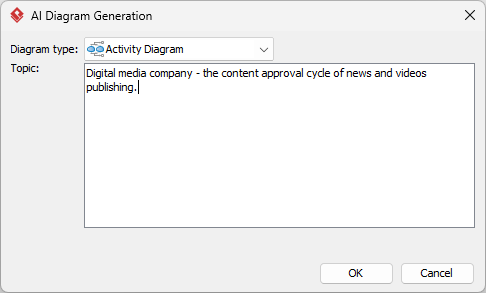
Generated diagram: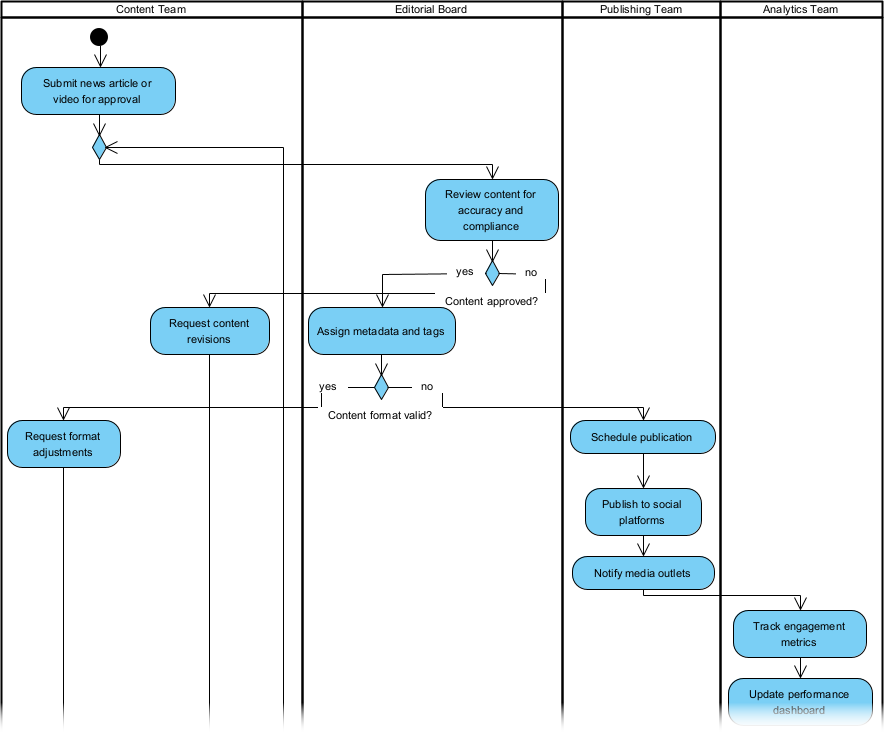
- Clarity: Clearly defined steps and decision points prevent confusion among team members.
- Consistency: Automated generation ensures uniformity in notation and representation.
- Customization: Easily modifiable diagrams adapt to changing workflows.
- Collaboration: Teams can collaborate in real-time, fostering synergy.
By integrating AI-generated activity diagrams in their workflow, the company ensured that every stakeholder was aligned in the content approval process. This led to a reduction in miscommunication and a marked increase in accuracy during the approval cycle.
How to Generate Without Common Errors
- Identify the key steps in your content approval cycle.
- Use Visual Paradigm’s AI diagram generation to create an initial draft of your activity diagram.
- Double-check for missing tasks or decision points.
- Ensure all team roles are represented accurately.
- Share the diagram with stakeholders for feedback and adjustments.
- Finalize the diagram and incorporate it into your workflow.
Refine & Enhance
Basic Corrections
Make sure to regularly revisit your activity diagram for any required updates, especially after significant process changes. Basic corrections might include adding or removing activities, clarifying notes, or refining decision pathways based on stakeholder feedback.
Advanced Avoidance
Advanced enhancements involve utilizing feedback loops within the activity diagram itself. By integrating user feedback at each stage of the approval cycle, teams can identify recurring issues that lead to delays. For instance, if revisions repeatedly arise from a specific department, addressing the root cause can lead to more efficient future processes. Using Visual Paradigm’s AI features, these diagrams can also model various scenarios to prepare for different outcomes and optimize workflows accordingly.
Pitfalls the AI Helps You Dodge
- Notation inconsistency that leads to misinterpretations.
- Overlooking relationships that connect various tasks.
- Scalability issues that arise from evolving processes.
By leveraging AI to create activity diagrams, the media company was able to avoid these common pitfalls. Each diagram was consistent and clear, relationships among different tasks were accurately depicted, and scalability issues were mitigated as the process was continuously refined.
Results & Takeaways
- The average approval time for content decreased by 30%.
- Stakeholder satisfaction improved due to clearer expectations.
- Less rework meant more time for creative tasks, enhancing overall productivity.
- The team embraced a culture of continuous process improvement.
Conclusion
Using AI to generate activity diagrams enables digital media companies to streamline their content approval processes effectively. By minimizing common pitfalls, such as unclear pathways and notation inconsistencies, teams can improve their overall efficiency and focus on delivering quality content. Embrace Visual Paradigm‘s AI capabilities to revolutionize your workflow.