
Strategy is rarely about guessing. It is about clarity, structure, and honest assessment. Yet, when teams sit down to discuss the future of their organization, the conversation often drifts into vague aspirations rather than grounded reality. This is where the SWOT analysis comes in. It is a staple of business planning, but like any tool, its value depends entirely on how it is wielded.
Many leaders struggle with this framework. They treat it as a box-checking exercise or a brainstorming session with no clear output. To cut through the noise, we are turning to a strategy veteran. With decades of experience guiding complex organizations through transformation and growth, this expert has seen every variation of the SWOT model. The goal here is not to simply define the acronym, but to understand the mechanics of making it work for you.
In this guide, we address the difficult questions that often stall progress. We explore how to gather accurate data, how to distinguish between internal and external factors, and how to ensure the output translates into actual movement. No fluff, just actionable insight.
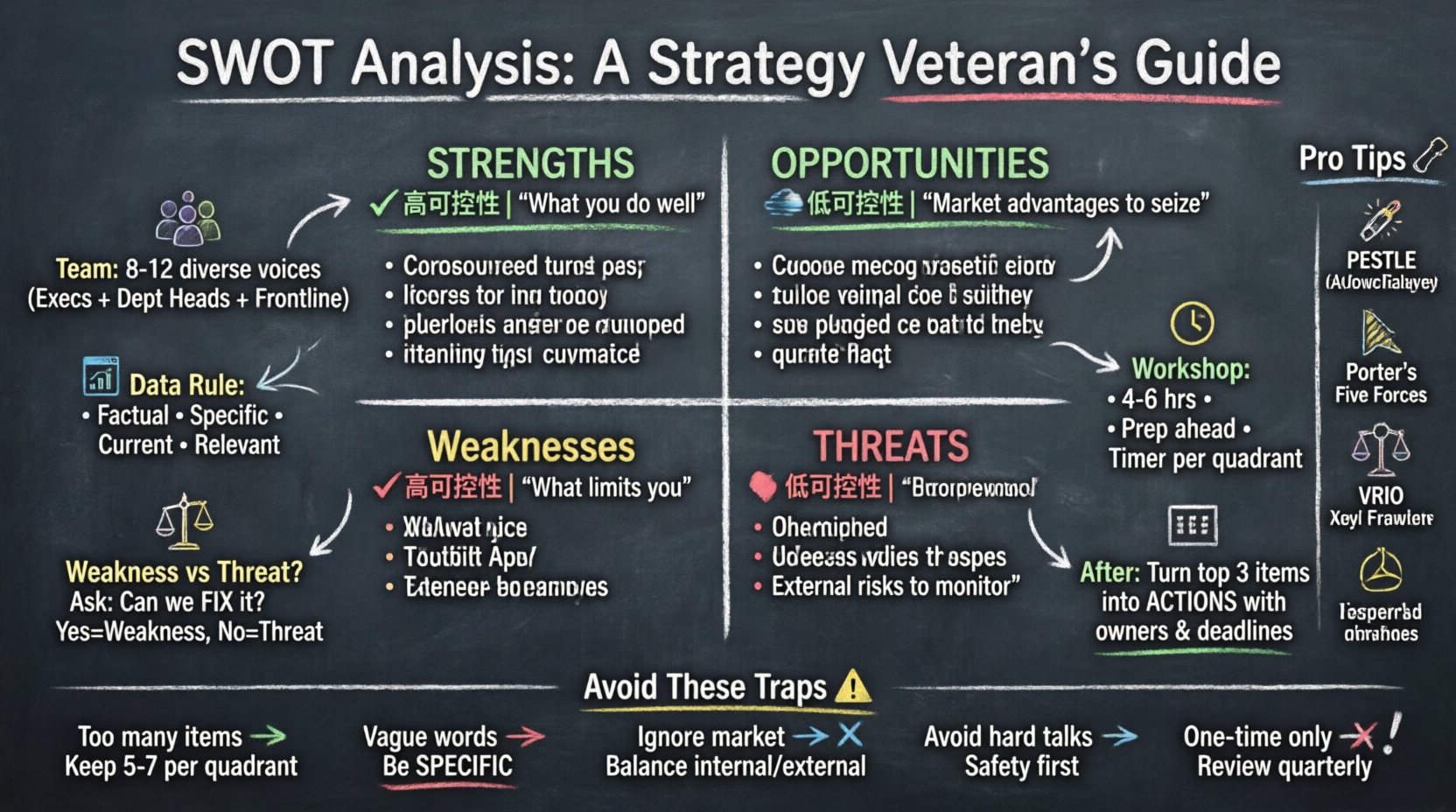
Understanding the Core Components 🔍
Before diving into the questions, it is vital to align on the definitions. The SWOT framework breaks down into four distinct quadrants. Each quadrant serves a specific purpose in the strategic diagnostic process.
- Strengths: These are internal attributes that give your organization an advantage. They are things you do well or resources you control.
- Weaknesses: These are internal limitations that place you at a disadvantage. They are areas where you lack resources or capabilities.
- Opportunities: These are external conditions that you could exploit to your benefit. They exist in the market, the regulatory environment, or the competitive landscape.
- Threats: These are external challenges that could cause trouble for your business. They are outside your direct control.
The critical error many make is confusing what belongs where. A weak brand is a weakness, not a threat. A competitor launching a new product is a threat, not an opportunity (unless you can leverage it). Getting this distinction right is the first step in a rigorous analysis.
The Q&A Session with a Strategy Veteran 🗣️
We have compiled the most pressing questions regarding the execution of a SWOT analysis. These points address the friction points that occur during workshops and planning cycles.
1. Who Should Participate in the Session? 👥
One of the most common debates in strategic planning is the composition of the team. Some leaders believe it should be limited to the C-suite to ensure confidentiality. Others argue for a broad cross-section of the organization to capture ground-level reality.
The veteran approach suggests a hybrid model. You need a mix of perspectives to avoid blind spots. Consider the following structure:
- Executive Leadership: They provide the high-level vision and context regarding long-term goals.
- Department Heads: They understand the specific capabilities and bottlenecks of their functional areas.
- Frontline Representatives: They often see customer feedback and operational inefficiencies that leadership misses.
- External Advisors: Occasionally, bringing in a neutral third party can help challenge assumptions and prevent groupthink.
If the group is too large, the session becomes chaotic. If it is too small, the analysis lacks depth. A team of 8 to 12 people is often the sweet spot for a focused workshop. Ensure that the participants have the authority to make decisions or the influence to drive them forward. A session with people who cannot act on the findings is a waste of time.
2. How Do We Ensure Data Integrity? 📊
Strategy built on intuition is often a gamble. Strategy built on data is a calculated risk. The danger with SWOT analysis is that it can easily become a list of opinions. Everyone has a different view of the company’s strengths. Some say “innovation” is a strength; others say “cost efficiency” is the real driver.
To combat this, you must demand evidence. When a team member claims a strength, ask for proof. Is it a metric? A customer testimonial? A market share number? When they identify a weakness, ask for the impact. Does it affect revenue? Does it slow down delivery?
Consider the following checklist before finalizing the list:
- Is it factual? Can we verify this claim?
- Is it specific? “Good customer service” is vague. “95% response time under 2 hours” is specific.
- Is it current? A strength from five years ago may no longer exist if the market has shifted.
- Is it relevant? Does this factor actually impact the strategic goal we are trying to achieve?
By grounding the discussion in verifiable facts, you move the conversation from a personality contest to a strategic assessment.
3. What Is the Difference Between a Weakness and a Threat? ⚖️
This is the most frequent point of confusion. The distinction lies entirely in control.
- Weakness: You can fix this. It is internal. For example, outdated technology or a skills gap in the marketing team.
- Threat: You cannot fix this directly. It is external. For example, a new regulation or a competitor entering your market.
Confusing the two leads to bad strategy. If you treat a threat as a weakness, you might waste resources trying to “fix” something you cannot change. If you treat a weakness as a threat, you might ignore an internal problem that you could solve easily.
Use the following table to help categorize items correctly during your workshop:
| Factor | Origin | Control Level | Example |
|---|---|---|---|
| Strength | Internal | High | Proprietary patent |
| Weakness | Internal | High | High employee turnover |
| Opportunity | External | Low | New emerging market |
| Threat | External | Low | Supply chain disruption |
4. How Long Should the Process Take? ⏱️
There is no one-size-fits-all answer, but time pressure often yields better results than endless deliberation. A SWOT analysis that drags on for weeks loses its momentum. Participants lose focus, and the urgency of the strategic challenge fades.
For a standard business unit, a dedicated workshop of 4 to 6 hours is usually sufficient. This allows enough time to brainstorm, debate, and categorize without burning out the team. If you are analyzing a complex, multi-national entity, you might break this into multiple sessions over a week.
Key timing tips:
- Preparation is key: Send out pre-reading materials so participants arrive with ideas already formed.
- Set a timer: Allocate specific time slots for each quadrant to prevent one area from dominating the conversation.
- Review immediately: Do not leave the room without summarizing the key takeaways while the discussion is fresh.
5. What Happens After the Analysis? 🏁
This is where most strategies fail. The SWOT matrix is a diagnostic tool, not a strategy itself. Finding a strength does not automatically tell you what to do with it. Identifying a threat does not solve the problem.
The output must be a set of actions. This involves connecting the quadrants to create strategies. You can pair Strengths with Opportunities (S-O strategies) to grow. You can pair Strengths with Threats (S-T strategies) to defend. You can use Weaknesses to avoid Opportunities (W-O strategies) or mitigate Threats (W-T strategies).
Without this step, the document sits in a folder and gathers dust. The strategy veteran recommends converting the top three items from each quadrant into specific action items with owners and deadlines. This transforms the analysis from a theoretical exercise into an operational roadmap.
Common Pitfalls to Avoid ⚠️
Even with a solid process, teams fall into traps. Being aware of these pitfalls helps you navigate around them.
- Too Many Items: A SWOT list with 50 items is useless. It dilutes focus. Aim for 5 to 7 items per quadrant. If you have more, group them or prioritize ruthlessly.
- Generic Statements: “High quality” is not a strength. “Zero defects in production for the last 12 months” is. Specificity drives clarity.
- Ignoring the Environment: Focusing only on internal factors ignores the reality of the market. A strong product in a dying market is still a problem. Ensure the Opportunities and Threats sections are robust.
- Conflict Avoidance: Some topics are uncomfortable. Addressing a weakness might mean admitting a past failure. Encourage psychological safety so honest discussion can happen.
- Static Thinking: The market changes. A SWOT done today may be obsolete in six months. Treat it as a living document that requires regular review.
Turning Insights into Action 🚀
Once you have the list, the real work begins. You need to translate the findings into strategic initiatives. Here is a practical framework for moving from analysis to execution.
Step 1: Prioritize
Not all factors are equal. Some strengths are foundational, while others are nice to have. Rank your items based on impact and urgency. Use a scoring system if necessary. This ensures you are focusing resources on the most critical areas.
Step 2: Match and Cross-Reference
Look for connections between the quadrants. For instance, if you have a Strength in “Agile Development” and an Opportunity in “Rapid Market Expansion,” how do you use the former to seize the latter? If you have a Threat in “Rising Costs” and a Weakness in “Low Margins,” how do you address that vulnerability?
Step 3: Assign Ownership
Every strategic initiative needs an owner. Do not assign tasks to “the team.” Assign them to specific individuals who have the authority and resources to get the job done. Accountability drives execution.
Step 4: Set Metrics
How will you know if you are succeeding? Define key performance indicators (KPIs) for each action item. This allows you to track progress and make adjustments if the strategy is not yielding results.
Integrating with Other Strategic Tools 🛠️
While SWOT is powerful, it is not the only tool in the kit. It works best when integrated with other frameworks to provide a more complete picture.
- PESTLE Analysis: This helps flesh out the Opportunities and Threats. It looks at Political, Economic, Social, Technological, Legal, and Environmental factors. This adds depth to the external analysis.
- Porter’s Five Forces: This provides a deeper dive into the competitive landscape. It helps refine the Threats and Opportunities sections by looking at supplier power, buyer power, and competitive rivalry.
- VRIO Framework: This helps validate Strengths. It asks if a resource is Valuable, Rare, Inimitable, and Organized. This ensures your strengths are sustainable competitive advantages.
Using these tools together creates a robust strategic foundation. SWOT acts as the summary or synthesis of the data gathered from these more detailed analyses.
The Veteran’s Final Thoughts on Consistency 🔄
Consistency is the backbone of effective strategy. A one-off analysis is rarely enough. The business environment is dynamic. Regulations change, technologies evolve, and customer preferences shift.
Establish a rhythm for your strategic reviews. Some organizations do a deep dive annually. Others do a lighter touch quarterly. The key is to keep the conversation alive. Do not let the document become a relic.
Remember that the goal is not perfection. The goal is progress. A SWOT analysis that is 80% accurate but leads to 100% of the necessary decisions is better than a perfect analysis that leads to no action. Keep the process agile. Be willing to update the factors as new information becomes available.
Summary of Key Takeaways 📝
- Internal vs. External: Control is the deciding factor. Internal is Strength/Weakness. External is Opportunity/Threat.
- Data over Opinion: Require evidence for every claim made during the session.
- Actionable Output: The analysis must lead to specific initiatives with owners and deadlines.
- Frequency: Treat SWOT as a living document, not a one-time event.
- Breadth of Input: Include diverse voices to capture a full picture of the organization.
By following these principles, you move beyond the basics of the framework. You create a tool that drives real strategic value. The veteran perspective remains clear: the tool is simple, but the application requires discipline, honesty, and a commitment to action.