Business growth is the lifeblood of any organization. However, rapid expansion without a foundation of stability often leads to structural failure. Many leaders rush to hire new talent or open new markets without pausing to assess their current capacity. This oversight creates a dangerous gap between ambition and operational reality. To bridge this divide, a rigorous diagnostic process is required. The SWOT analysis serves as a cornerstone for this evaluation.
A Strategic Audit using SWOT (Strengths, Weaknesses, Opportunities, Threats) allows leadership teams to view the organization with clarity. It moves beyond gut feeling and into data-driven decision-making. By examining internal capabilities alongside external market conditions, you can determine if the company is truly ready for the next phase of growth. This guide outlines how to conduct this audit effectively, ensuring that hiring and scaling efforts are supported by a healthy organizational structure.
🛑 Why Rushing Growth Leads to Failure
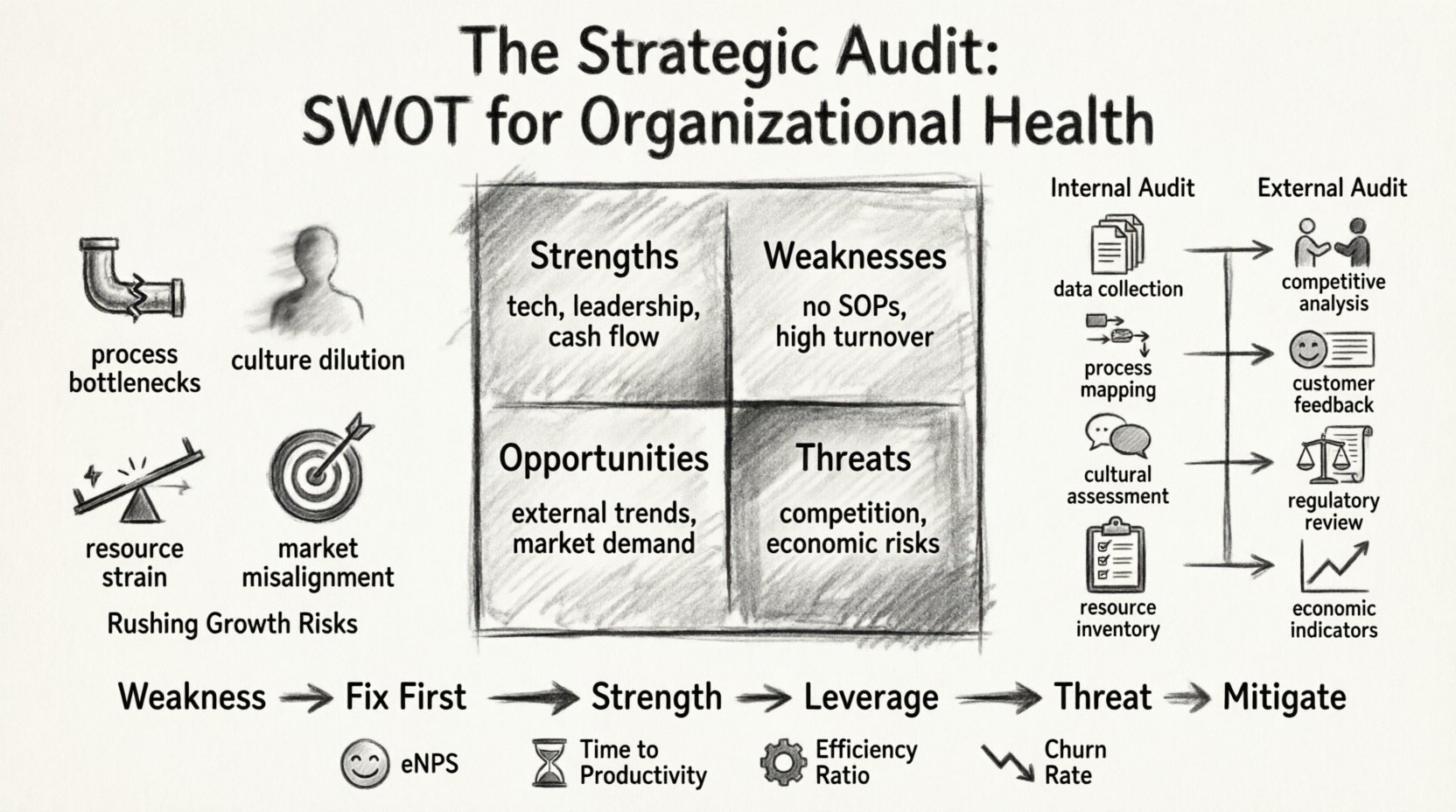
Scaling a business is not merely about adding more people or revenue. It is about maintaining efficiency, culture, and quality while increasing volume. When an organization hires aggressively without addressing underlying inefficiencies, those inefficiencies simply scale up, becoming larger and more expensive to fix. Consider the following common scenarios:
- Process Bottlenecks: Adding staff to a broken workflow does not fix the workflow. It creates more chaos.
- Culture Dilution: Rapid onboarding can erode core values if there is no system in place to integrate new team members.
- Resource Strain: New roles often require new tools, budgets, and management attention, which may not be available.
- Market Misalignment: Hiring for a market need that does not exist leads to wasted capital and morale issues.
Conducting a strategic audit mitigates these risks. It forces the leadership team to pause and answer critical questions before committing resources. This pause is not a delay; it is an investment in sustainable success.
🔍 The SWOT Framework Explained
The SWOT matrix is a classic tool, but its application in a scaling context requires nuance. It is not enough to list generic attributes. Each element must be contextualized against the specific goal of hiring or expansion.
1. Strengths (Internal)
These are the assets your organization currently controls. In a growth context, strengths answer the question: “What allows us to execute faster than our competitors?”
- Proprietary technology or intellectual property.
- A highly engaged, experienced leadership team.
- Strong cash flow and financial reserves.
- Deep relationships with key clients or partners.
- Efficient operational processes that require low maintenance.
2. Weaknesses (Internal)
Weaknesses are internal limitations that hinder performance. Before scaling, these must be addressed or managed. If a weakness is critical, scaling will exacerbate it.
- Lack of documented Standard Operating Procedures (SOPs).
- High employee turnover in key departments.
- Outdated technology stack that cannot handle more data.
- Dependence on a single founder or key individual.
- Insufficient capital reserves to cover a 6-month runway.
3. Opportunities (External)
These are favorable conditions in the market that the organization can exploit. They represent the “why now” for your expansion.
- Emerging market trends that align with your product.
- Competitors facing financial difficulties or rebranding.
- Regulatory changes that favor your business model.
- Technological advancements that reduce your cost of delivery.
- New geographic regions with unmet demand.
4. Threats (External)
External factors that could cause trouble for the business. These require mitigation strategies before significant investment.
- Economic downturns affecting customer spending power.
- New competitors entering the space with lower pricing.
- Supply chain disruptions increasing costs.
- Talent shortages in specific skill sets required for growth.
- Changes in compliance or data privacy laws.
📊 Diagnostic Checklist: SWOT Quadrant Mapping
To ensure a comprehensive audit, use the following checklist during your workshop sessions. This table helps categorize findings accurately.
| Category | Focus Area | Key Question to Ask | Scale Readiness Indicator |
|---|---|---|---|
| Strengths | Operational | Can we support 2x volume with current systems? | Yes / No / Partial |
| Weaknesses | Human Capital | Do we have the management bandwidth for new hires? | Yes / No / Partial |
| Opportunities | Market | Is there proven demand for the new offering? | Yes / No / Partial |
| Threats | Financial | Can we survive a 20% revenue dip during expansion? | Yes / No / Partial |
🏗️ Step-by-Step: Conducting the Internal Audit
The internal audit focuses on Strengths and Weaknesses. This requires honesty and data. Avoid assumptions. Gather information from multiple sources to get a complete picture.
Step 1: Data Collection
Start by reviewing quantitative data. Look at financial statements, productivity metrics, and customer satisfaction scores. Qualitative data is equally important. Conduct interviews with department heads to understand their pain points.
Step 2: Process Mapping
Document the current workflows. Where do bottlenecks occur? Where does information get lost? If you scale without fixing these leaks, you will lose money and time. Identify processes that are manual and prone to error.
Step 3: Cultural Assessment
Culture is often overlooked until it breaks. Assess employee engagement levels. Are people aligned with the mission? Is there a clear path for career progression? A toxic culture will amplify under stress.
Step 4: Resource Inventory
Take stock of your assets. What technology do you own? What intellectual property is protected? What is the status of your cash reserves? Ensure you have the runway to sustain growth for at least 12 months.
🌍 Navigating the External Landscape
The external audit focuses on Opportunities and Threats. This requires market research and competitive intelligence. You must look outside your office walls.
Step 1: Competitive Analysis
Identify who else is in your space. What are they doing that you are not? Are they hiring aggressively? Are they raising capital? Understanding their moves helps you anticipate market shifts.
Step 2: Customer Feedback
Talk to your clients. Are they asking for features you don’t have? Are they struggling with your current onboarding? Their feedback reveals opportunities for product-led growth.
Step 3: Regulatory Review
Check for upcoming laws or regulations. Tax changes, data privacy rules, or industry standards can impact your scaling plans. Ensure compliance is built into your expansion strategy.
Step 4: Economic Indicators
Monitor macroeconomic trends. Inflation rates, interest rates, and employment data influence customer behavior. Adjust your financial projections based on these realities.
👥 Aligning Hiring Plans with Audit Findings
Once the audit is complete, the results should directly inform your hiring strategy. Do not hire to fill a seat; hire to fill a gap identified in the SWOT analysis.
Addressing Weaknesses First
If your audit reveals a weakness in management bandwidth, do not hire more individual contributors. Hire a manager or implement better project management tools. Fixing the foundation is more important than adding to the structure.
- Gap: Lack of technical documentation.
- Action: Hire a Technical Writer before hiring more Engineers.
- Gap: Sales cycle is too long.
- Action: Hire a Sales Operations specialist to optimize the funnel before hiring more Account Executives.
Leveraging Strengths
Use your strengths to capture opportunities. If you have a strong brand, use that to attract top talent who might otherwise go to competitors.
- Strength: High client retention rate.
- Action: Hire a Customer Success Manager to turn retention into referrals.
Managing Threats
Prepare for threats before they hit. If talent shortage is a threat, build a pipeline of candidates now. If cash flow is a threat, secure a line of credit before you need it.
🚀 Scaling Infrastructure vs. Scaling Headcount
A common mistake is equating growth with headcount. Often, scaling requires infrastructure improvements before adding people. The audit helps distinguish between these two needs.
Infrastructure Needs
Before hiring, ensure the following are ready:
- IT Systems: Can your CRM handle more records? Is your email server stable?
- Finance: Are your payroll and accounting systems automated?
- Legal: Are your contracts ready for new jurisdictions or higher volumes?
- Security: Is data protection robust enough for more users?
Headcount Needs
Once infrastructure is stable, determine the roles required:
- Direct Revenue Roles: Sales and Business Development.
- Support Roles: Customer Success and Support.
- Operational Roles: HR, Finance, and Operations.
- Innovation Roles: R&D and Product Development.
Use the SWOT matrix to prioritize these roles. If a weakness is in customer support, hire support first. If an opportunity is in a new market, hire market-specific sales staff first.
🚫 Common Analysis Errors to Watch For
Even with a structured approach, bias can creep into the audit. Be vigilant against these common pitfalls.
- Overestimating Strengths: Do not assume your current success guarantees future success. Market conditions change.
- Ignoring Cultural Weaknesses: A strong product cannot save a broken culture. Be honest about interpersonal dynamics.
- Static Thinking: SWOT is not a one-time event. Revisit it quarterly as the business evolves.
- Groupthink: Ensure diverse voices are in the room. A single perspective will miss blind spots.
- Confusing Symptoms with Causes: Low morale might be a symptom of poor leadership, not low pay. Address the root cause.
📈 Measuring Impact Post-Audit
The audit is not the end of the process. It is the beginning of execution. You must track the impact of your decisions.
Key Performance Indicators (KPIs)
Define metrics that reflect organizational health, not just revenue.
- Employee Net Promoter Score (eNPS): Measures internal satisfaction.
- Time to Productivity: How fast do new hires become effective?
- Operational Efficiency Ratio: Cost to serve per unit of revenue.
- Churn Rate: Are customers staying as you scale?
Feedback Loops
Establish regular check-ins with leadership to review SWOT findings. If a threat materializes, adjust the plan. If a strength becomes less relevant, pivot.
🔎 Final Considerations for Sustainable Growth
A strategic audit using SWOT is a tool for clarity. It does not guarantee success, but it significantly increases the odds. It forces you to confront reality rather than fantasy. When you hire or scale based on this analysis, you build a business that can withstand pressure.
Remember that organizational health is dynamic. It requires constant monitoring. Treat the SWOT analysis as a living document. Update it as you make decisions. This discipline separates companies that grow sustainably from those that grow and collapse.
Start your audit today. Gather your team. Be honest. The path to scaling is paved with preparation, not just ambition.