
In the competitive landscape of modern commerce, the alignment between what a business provides and what a customer desperately needs is the defining factor of success. Many organizations struggle not because their product is flawed, but because their understanding of the customer’s friction points is superficial. This guide explores the mechanics of identifying core customer pain points and constructing targeted value offers within the framework of the Business Model Canvas. The objective is clarity, precision, and sustainable fit.
The Foundation: The Business Model Canvas Context 🏗️
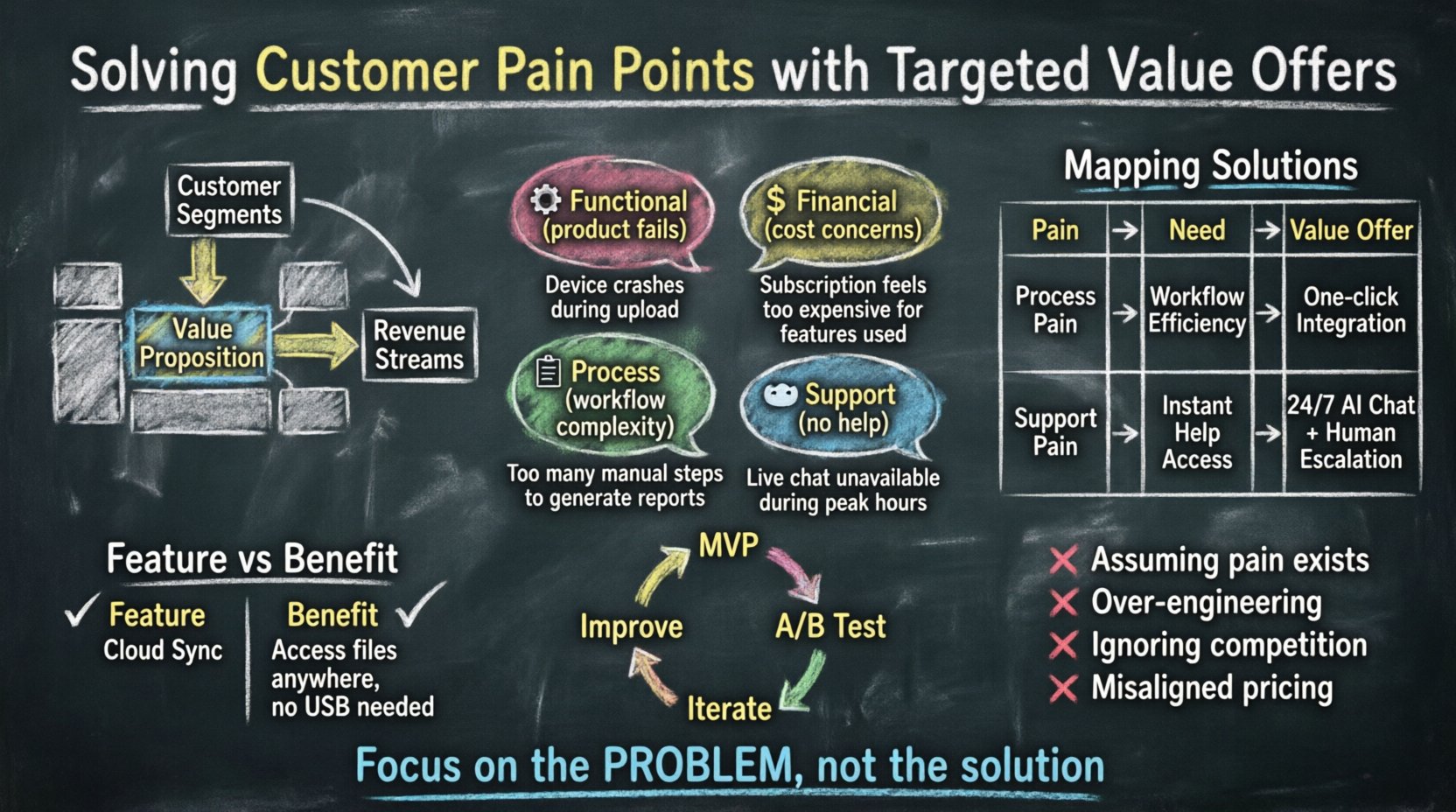
The Business Model Canvas serves as a strategic management template for developing new or documenting existing business models. It is a visual chart with elements describing a firm’s or product’s value proposition, infrastructure, customers, and finances. Within this structure, the Value Proposition block sits centrally, bridging the gap between customer segments and the revenue streams they generate.
However, a value proposition is not merely a list of features. It is a promise of value to be delivered. To make this promise credible, it must directly address the specific problems a customer faces. Without this connection, resources are wasted on development and marketing efforts that do not resonate. The canvas acts as a diagnostic tool, revealing where the disconnect lies between the organization’s output and the market’s input.
- Value Proposition: The bundle of products and services that create value for a specific customer segment.
- Customer Segments: The different groups of people or organizations an enterprise aims to reach and serve.
- Customer Relationships: The types of relationships a company establishes with specific customer segments.
When these elements are misaligned, the business model becomes fragile. A robust model requires that every element of the Value Proposition is a direct response to a verified pain point. This process moves beyond intuition and relies on structured analysis.
Deconstructing Customer Pain Points 🔍
To solve a problem, one must first define it accurately. Customer pain points are obstacles that prevent customers from reaching their goals. These obstacles can be functional, financial, process-oriented, or social. Understanding the category of the pain point is crucial for designing an effective solution.
1. Functional Pain Points ⚙️
These occur when a product or service does not work as expected. The customer has a task they need to complete, and the current solution fails to facilitate that task efficiently. This is the most common type of friction in software and hardware sectors.
- Example: A project management tool crashes when exporting large data sets.
- Impact: Loss of time, frustration, and potential data loss.
- Requirement: Reliability and performance stability.
2. Financial Pain Points 💰
These relate to the cost of acquiring or using a solution. Customers may perceive a solution as too expensive, or they may fear hidden costs that will arise later. Financial friction is often about perceived value versus price.
- Example: High upfront implementation costs that strain the budget.
- Impact: Budget cuts, delay in adoption, or switching to cheaper alternatives.
- Requirement: Transparent pricing and clear ROI.
3. Process Pain Points 📋
These involve the complexity of integrating a solution into existing workflows. If a new tool requires extensive training or disrupts established routines, it creates resistance regardless of its technical merit.
- Example: A new CRM requires manual data entry that duplicates existing records.
- Impact: Low adoption rates and employee frustration.
- Requirement: Ease of integration and intuitive user experience.
4. Support Pain Points 🤝
These arise when customers feel abandoned or unsupported after a purchase. Lack of timely assistance or poor documentation can turn a minor issue into a major crisis.
- Example: No clear path to contact technical support.
- Impact: Erosion of trust and negative word-of-mouth.
- Requirement: Accessible and knowledgeable support channels.
Mapping Solutions to Friction 🧩
Once pain points are identified, the next step is to map them against potential value offers. This mapping ensures that every feature or service offered has a specific purpose in alleviating a specific burden. A generic value offer attempts to solve everything and often solves nothing effectively. Targeted offers are focused and precise.
The following table illustrates how specific pain categories translate into tangible value offers within the canvas framework.
| Pain Point Category | Customer Need | Targeted Value Offer |
|---|---|---|
| Functional | System reliability | 99.9% uptime guarantee with automated backups |
| Financial | Cost reduction | Pay-per-use pricing model to control budget |
| Process | Workflow efficiency | One-click integration with existing platforms |
| Social | Professional recognition | Certification badges for using the tool |
| Support | Quick resolution | 24/7 dedicated account manager |
Notice that each value offer addresses the root cause of the friction. For instance, a process pain point regarding integration is solved not by a faster computer, but by an API connector. This specificity builds trust.
Designing the Value Offer 🔨
Creating the value offer involves more than just listing solutions. It requires articulating the benefit clearly. Customers do not buy features; they buy outcomes. The language used in the value proposition must reflect the customer’s perspective, not the company’s internal jargon.
Clarity Over Cleverness
Ambiguity creates friction. If a customer reads the value proposition and has to ask, “What does this mean for me?”, the offer has failed. The statement must be direct. Use active verbs and concrete nouns. Avoid vague adjectives like “best” or “innovative” unless they are backed by specific data.
Feature vs. Benefit
- Feature: The system has a 10GB storage limit.
- Benefit: Store three years of project data without worrying about capacity.
The feature describes the product. The benefit describes the solution to the pain. The value offer should focus heavily on the benefit.
Quantifiable Metrics
Numbers build credibility. Instead of saying “saves time”, say “reduces processing time by 40%”. Instead of “low cost”, say “50% less than industry average”. Quantifiable metrics allow the customer to calculate the value themselves, reducing the risk perception.
Integration Within the Canvas 🔄
The Value Proposition does not exist in isolation. It influences and is influenced by other blocks in the Business Model Canvas. A targeted value offer requires specific resources, channels, and customer relationships to function.
Key Resources and Activities
If the value offer relies on speed, the Key Activities must include rapid deployment protocols. If the value offer relies on security, the Key Resources must include certified security teams. There must be a direct line of sight between the promise made to the customer and the internal capabilities required to deliver it.
Channels and Relationships
The channel through which the value is delivered must match the pain point. If the pain point is related to technical complexity, the channel should include onboarding support. If the pain point is about cost, the channel might need to offer self-service options to reduce service costs.
Consider the feedback loop. The canvas is dynamic. As customers interact with the value offer, new pain points may emerge. The model must allow for iteration. Regularly review the Customer Segments block to ensure the segments identified at the start still match the current market reality.
Testing and Refinement 🧪
Assumptions about pain points are rarely 100% accurate until tested. Validation is the process of proving that the pain exists and that the value offer effectively solves it. This phase is critical before scaling operations.
MVP and Prototyping
Creating a Minimum Viable Product allows you to test the value proposition with real users. This does not mean a half-finished product, but rather a version that delivers the core value promise. Feedback from this stage is more valuable than any amount of market research.
- A/B Testing: Test different value propositions to see which resonates more.
- Customer Interviews: Ask open-ended questions about their current struggles.
- Analytics: Monitor how users interact with the solution.
Iterative Improvement
Refinement is continuous. As the solution is used, the context of the pain point may change. What was a critical pain point last year might be a minor inconvenience today due to market shifts. The value offer must evolve to maintain relevance. This requires a culture that values feedback over ego.
Common Strategic Errors 🚫
Even with a solid framework, organizations often stumble when trying to align value with pain. Recognizing these pitfalls can prevent wasted effort and resources.
1. Assuming the Pain Exists
Organizations often assume they know what customers want without verifying it. This leads to building solutions for problems that do not exist or are not important enough to solve. Always validate the pain before designing the solution.
2. Over-Engineering the Solution
Adding features to make the product “better” often adds complexity and creates new pain points. Simplicity is often the highest form of value. Strip away anything that does not directly address the core friction.
3. Ignoring the Competition
Competitors may already be addressing the pain point. Understanding the competitive landscape helps identify gaps. If competitors solve the functional pain, perhaps the opportunity lies in solving the support pain better.
4. Misaligning Pricing
The value offer is often tied to the pricing model. If the value is high but the price is prohibitive, the offer fails. Ensure the pricing structure matches the value perception. Sometimes a lower price with a narrower scope is better than a high price with a broad scope.
Continuous Evaluation and Growth 📈
The work of solving pain points does not end at launch. Market conditions change, and so do customer needs. A static business model is a dying business model. Regular audits of the Value Proposition against the Customer Segments are necessary.
Set up key performance indicators that measure the effectiveness of the value offer. These might include customer retention rates, net promoter scores, or reduction in support tickets. These metrics provide objective data on whether the pain points are being resolved.
Feedback Loops
Establish formal mechanisms for collecting feedback. This could be post-purchase surveys, user testing sessions, or community forums. The goal is to keep the pulse on the customer experience. When a pain point is reported, it should be treated as an opportunity to refine the value offer.
Adapting to Change
External factors such as economic shifts or new regulations can alter pain points. For example, a change in data privacy laws might create a new functional pain point regarding compliance. The business model must be flexible enough to pivot the value proposition to address these new realities.
Final Considerations 🏁
Building a business model centered on solving core customer pain points requires discipline and empathy. It demands that the organization looks outward rather than inward. It requires listening to the customer, analyzing the data, and being willing to change the product to fit the need.
The Business Model Canvas provides the structure, but the insight comes from the work done to understand the human behind the transaction. When the value offer is perfectly targeted, the friction disappears. The transaction becomes smooth, the relationship becomes strong, and the business achieves sustainable growth.
Focus on the problem, not the solution. Let the problem dictate the features. This approach ensures that every resource invested contributes to alleviating a genuine burden. That is the essence of value creation.