


Entering a new market is rarely a matter of luck. It requires a calculated approach to identifying the right individuals who will validate your concept before the broader audience arrives. Early adopters are not just customers; they are co-creators who provide the critical feedback needed to refine your offering. When viewed through the lens of the Business Model Canvas, this segmentation process becomes a strategic exercise rather than a marketing guess.
This guide explores how to identify, engage, and leverage early adopters to secure initial traction. We will examine the psychological profiles, the alignment with business model blocks, and the operational frameworks required to sustain momentum without relying on broad-scale advertising.
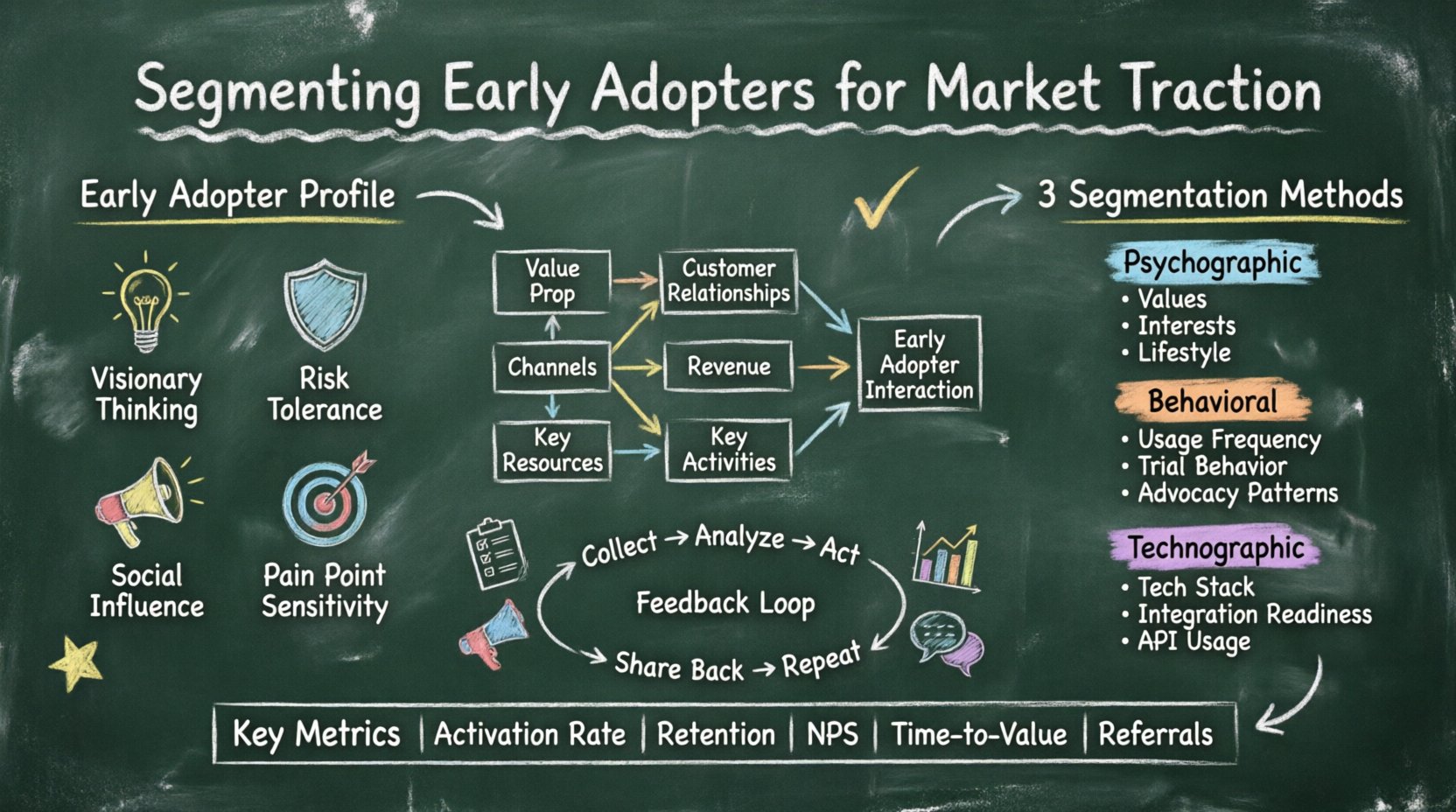
Understanding the Early Adopter Profile 🧐
Early adopters differ significantly from the early majority or the late majority. They are driven by different motivations and tolerate different levels of friction. Understanding these distinctions is the foundation of successful segmentation.
Key Psychological Traits
To build a reliable segment, you must look beyond basic demographics. The following characteristics define the individuals most likely to engage with a new value proposition:
- Visionary Thinking: They see potential in a product before its utility is fully proven. They imagine a future where this solution is standard.
- Risk Tolerance: They are comfortable with imperfections. They understand that a new solution requires iteration and are willing to report bugs or suggest changes.
- Social Influence: They often serve as opinion leaders within their niche. Their endorsement carries weight with peers.
- Pain Point Sensitivity: They suffer from the specific problem you are solving more acutely than the average user. The cost of not having your solution is high for them.
Behavioral Indicators
Psychology is internal; behavior is observable. Look for these signals when analyzing potential segments:
- Active Problem Solving: They have already tried to solve the issue using workarounds or competitors.
- Information Seeking: They actively research solutions and compare options before making a decision.
- Community Engagement: They participate in forums, groups, or networks relevant to the industry.
- Speed of Adoption: They are the first to try new technologies or methodologies in their workflow.
Aligning Segmentation with the Business Model Canvas 📊
The Business Model Canvas provides a structured way to map how early adopters interact with your venture. It is not enough to find these users; you must ensure your model supports their specific needs. This alignment reduces churn and increases the quality of feedback.
Mapping Customer Segments to Canvas Blocks
Below is a breakdown of how early adopters influence specific blocks of the canvas during the initial phase.
| Business Model Block | Early Adopter Interaction | Strategic Goal |
|---|---|---|
| Value Proposition | Testing the core hypothesis. | Validate if the problem is real and the solution is viable. |
| Customer Relationships | Direct, high-touch communication. | Build loyalty and establish a feedback loop. |
| Channels | Personal outreach or niche communities. | Minimize acquisition cost while maximizing relevance. |
| Revenue Streams | Willingness to pay for access or beta status. | Confirm willingness to pay before scaling pricing. |
| Key Resources | Feedback data and testimonials. | Gather assets needed for broader marketing later. |
| Key Activities | Participation in beta testing. | Iterate product features based on real usage. |
The Value Proposition Fit
For early adopters, the value proposition must be clear and immediate. They do not have the patience for vague promises. Your communication must articulate exactly how the solution alleviates their specific pain.
- Problem/Solution Fit: Ensure the core function works reliably. Early adopters will forgive minor UI issues but not broken core functionality.
- Time Savings: Many early adopters are motivated by efficiency. Show them how the solution saves time compared to their current workarounds.
- Status Gain: Being the first to use a new tool can confer status. Highlight exclusivity or the “pioneer” aspect of using your solution.
Segmentation Methodologies for Traction 🎯
Once the profile is understood, you need a method to isolate these users from the general market. Relying on broad categories often dilutes your message. Precision is key.
1. Psychographic Segmentation
This approach categorizes users based on their values, interests, and lifestyles. It is often more effective than demographics for early-stage products.
- Lifestyle Alignment: Do they value innovation over stability? Do they prefer open-source cultures or proprietary systems?
- Values: Are they motivated by cost reduction, quality improvement, or social impact?
- Personality: Are they analytical or intuitive? Do they prefer data-driven decisions or gut feelings?
2. Behavioral Segmentation
This focuses on how users interact with the problem space. It looks at actions rather than attributes.
- Purchase Behavior: Have they bought similar tools in the past? What was their decision timeline?
- Usage Patterns: Do they use the current solution daily, weekly, or monthly?
- Loyalty Status: Are they loyal to competitors, or are they currently shopping for a switch?
- Benefits Sought: Are they looking for speed, reliability, or ease of use?
3. Technographic Segmentation
If your solution is technical, the technology stack they currently use is a strong indicator of readiness.
- Platform Compatibility: Are they already on the infrastructure required to support your solution?
- Innovation Rate: Do they adopt new software versions quickly, or do they stick to legacy systems?
- Integration Needs: How critical is it that your solution connects with their existing tools?
Building the Feedback Loop 🔁
The primary asset early adopters provide is data. This data drives the iteration of your product. Without a structured feedback loop, you risk building features that do not matter to the broader market.
Structuring the Interaction
Establish clear protocols for how feedback is collected and processed. Ad-hoc conversations lead to inconsistent data.
- Regular Check-ins: Schedule recurring calls or meetings with your initial segment. Consistency builds trust.
- Surveys and Questionnaires: Use structured questions to gather quantitative data on satisfaction and feature priority.
- Usage Analytics: Monitor how they use the product. Look for drop-off points or features that are ignored.
- Community Channels: Create a dedicated space for them to discuss issues among themselves. Peer-to-peer support often reveals usage patterns you missed.
Closing the Loop
Feedback is wasted if it is not acknowledged. You must demonstrate that user input leads to tangible changes.
- Transparency: Share your roadmap. Let users know what is being built and why.
- Credit: Acknowledge contributors. When a feature is released, mention who suggested it.
- Speed: Act on critical feedback quickly. This proves you value their time and input.
Communication Strategies for Early Segments 📣
How you speak to early adopters differs from how you speak to mass markets. The tone should be collaborative, not transactional.
Tone and Language
Avoid corporate jargon. Speak directly to the problem they face.
- Direct and Honest: Admit limitations. Early adopters respect transparency over polished marketing speak.
- Technical Depth: If your audience is technical, do not oversimplify. They appreciate understanding how the solution works.
- Educational Content: Provide guides, tutorials, and best practices. Help them succeed with your product.
Channel Selection
Where you find them dictates where you communicate. Do not use channels that are too broad.
- Direct Email: Personalized outreach works best for initial contact.
- Niche Forums: Participate in communities where the problem is discussed, not where you advertise.
- Events and Conferences: Attend industry-specific gatherings to meet users face-to-face.
- LinkedIn: Use professional networking to identify and connect with key decision-makers in your target sector.
Risks and Mitigation in Early Traction ⚠️
Focusing too heavily on early adopters can create blind spots. You must be aware of the risks associated with this strategy.
Common Pitfalls
- Over-customization: Building features solely for the first few users can make the product unusable for the mass market. Keep the core value proposition intact.
- Dependency: Relying on a single early adopter for revenue or validation creates fragility. Diversify your initial segment.
- Feedback Bias: Early adopters are more forgiving than average users. Do not assume your product is ready for everyone just because it works for them.
- Price Sensitivity: Early adopters may accept a higher price for access. Do not set your long-term pricing based solely on their willingness to pay.
Mitigation Strategies
Protect your long-term viability while nurturing the early stage.
- Maintain a Vision: Ensure every feature request aligns with the long-term product vision, not just the immediate needs of the pilot group.
- Set Expectations: Clearly define the scope of the beta or early access period. Let them know the product is still evolving.
- Monitor Churn: Track if early adopters stay engaged. High churn in this group indicates a fundamental mismatch in the value proposition.
- Plan for Scaling: Design your infrastructure and support processes to handle growth, not just the current user base.
Measuring Success Beyond Revenue 💰
In the initial phase, revenue is a lagging indicator. Leading indicators provide a clearer picture of traction.
Key Metrics to Track
- Activation Rate: What percentage of early adopters complete the core action that delivers value?
- Retention Rate: Do they return after the first week? The first month?
- Net Promoter Score (NPS): How likely are they to recommend your solution to a peer?
- Time to Value: How long does it take for them to experience the core benefit?
- Referral Rate: Are they bringing in other users without your direct intervention?
The Transition to the Early Majority 🔄
The goal of segmenting early adopters is to reach the point where they can bridge the gap to the early majority. This transition requires a shift in focus.
Signs of Readiness
- Product Stability: The core solution is reliable enough for users who cannot tolerate bugs.
- Support Infrastructure: You have processes in place to handle a larger volume of inquiries.
- Marketing Messages: You have refined your messaging to appeal to risk-averse users.
- Case Studies: You have testimonials and data from early adopters that prove success.
Strategic Shifts
As you move forward, the strategy must evolve.
- Reduce Touch: Move from high-touch, personal relationships to scalable self-service models.
- Broaden Channels: Expand from niche forums to broader marketing channels.
- Standardize: Create standard onboarding flows rather than custom implementations.
- Focus on Efficiency: Optimize for cost per acquisition as the volume of leads increases.
Sustaining Momentum Over Time 🔋
Initial traction is a milestone, not a destination. Sustaining growth requires continuous attention to the segment you initially targeted.
- Continuous Innovation: The market changes. Continue to adapt your solution to remain relevant.
- Community Management: Keep your early adopters engaged even after the beta phase ends.
- Data-Driven Decisions: Use the data gathered from your segment to inform future development cycles.
- Customer Success: Invest in helping users achieve their goals with your product, not just selling to them.
Final Thoughts on Market Entry 🌍
Segmenting early adopters is the most critical step in validating a business model. It transforms abstract ideas into concrete data. By aligning this segmentation with the Business Model Canvas, you ensure that every part of your organization is designed to serve these specific users.
Success does not come from shouting to the widest audience. It comes from understanding the few who matter most at the start. Focus on their needs, respect their time, and build a solution that genuinely improves their situation. The broader market will follow once the foundation is solid.